
Evaluating spot uv vs drip-off varnish is an essential engineering consideration for packaging converters aiming to create striking tactile and visual contrast on folding cartons, cosmetic boxes, and luxury marketing collateral. While both finishing techniques produce juxtaposed gloss and matte textures on a printed sheet, their chemical crosslinking mechanisms, press configurations, and operational cost curves differ substantially. Understanding the precise pressroom dynamics of spot uv vs drip-off varnish allows commercial print buyers and packaging designers to balance aesthetic impact against high-volume unit economics.
Historically, achieving high-gloss accents required offline screen printing or dedicated rotary spot UV coating units. Although offline screen UV delivers a thick, tactile coating film, it introduces secondary press passes, manual registration errors, and extended lead times. In contrast, modern multi-unit offset presses equipped with inline coating towers allow converters to apply either inline spot UV via photopolymer plates or drip-off varnish systems through standard printing units and anilox coaters in a single pass. Selecting the right coating technology requires examining film thickness, curing kinetics, substrate interaction, and mechanical durability.
Coating Mechanics: Spot UV vs Drip-Off Varnish
Comparison of chemical reaction, press architecture, and surface topography
Targeted Gloss Deposition
Selective varnish transfer via photopolymer plate or screen mesh directly to designated artwork areas.
- Gloss Level: 85–95+ GU (Glass-like mirror finish)
- Film Thickness: 4–12 µm (Flexo/Coater) or 15–35 µm (Screen)
- Border Definition: Knife-edge sharp boundaries
Repellent Chemical Interaction
Standard offset plate applies primer; overall flood UV coater beads up over primer zones.
- Texture Effect: Orange-peel / sand fine grain structure
- Registration: Exact sheetfed offset register (0.05 mm)
- Tooling: Zero photopolymer plate tooling costs
Inline Single-Pass Throughput
Press speed and setup efficiency comparison across commercial volume tiers.
- Spot UV: Separate coater makeready and plate mounting
- Drip-Off: Standard CTP offset plate in final printing unit
- Speed: 15,000–18,000 sheets/hour continuous run
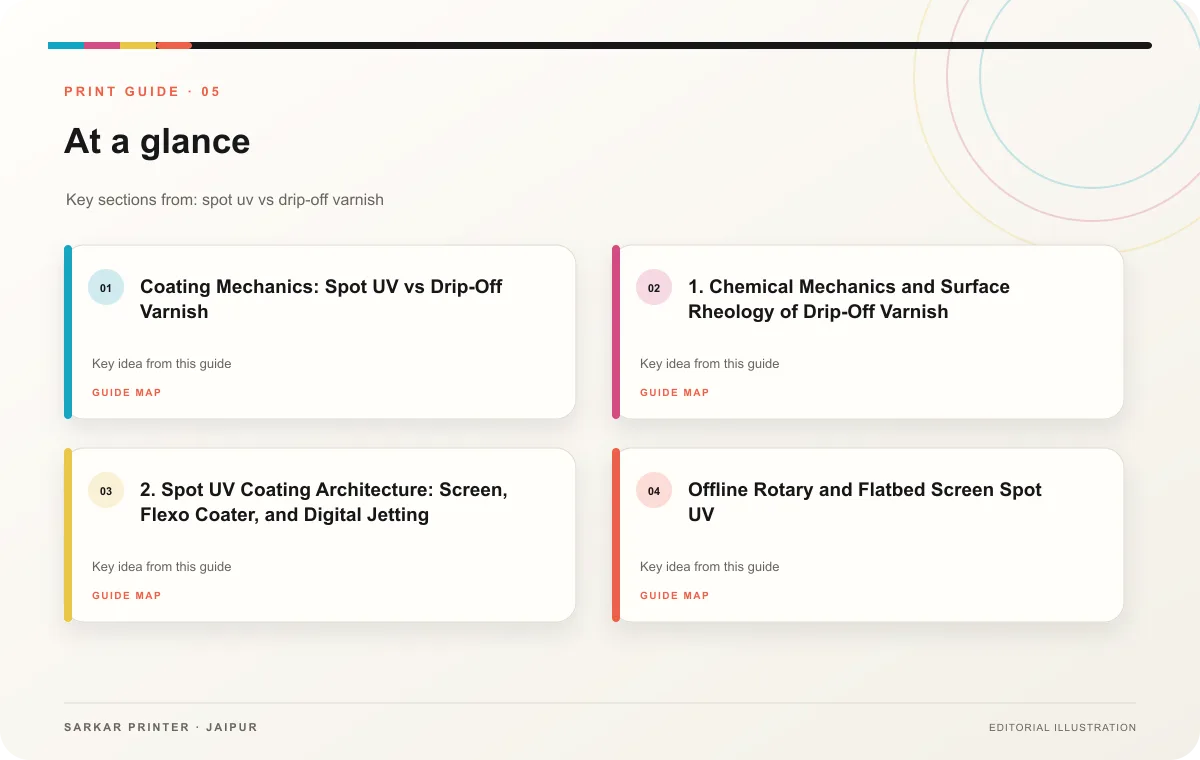
1. Chemical Mechanics and Surface Rheology of Drip-Off Varnish
The drip-off (also known as strike-through or twin-effect) varnishing process is fundamentally an antagonistic chemical reaction between two distinct coatings applied in rapid succession on an offset press:
In the final standard printing unit of an offset press (Unit 5 or Unit 6), an ordinary CTP aluminum printing plate applies a formulated oil-based matte drip-off primer. Crucially, this primer is applied only to the areas intended to display a matte or textured finish—such as backgrounds, body copy fields, or subtle patterns. The high-gloss focal points (logos, product imagery, key headlines) receive zero primer.
Immediately downstream, without intermediate drying, the sheet enters the dedicated coating tower equipped with a smooth chambered doctor blade and ceramic anilox roller. The coater floods the entire sheet with a high-reactivity, low-viscosity UV-curable gloss coating. When this wet UV varnish contacts the freshly printed oil-based primer, interfacial surface tension differences cause the UV varnish to repel and bead up. In physics, this phenomenon resembles water beading on a freshly waxed automotive hood.
In the primed areas, the beading creates microscopic peaks and valleys that scatter incident light, yielding a fine-grained, tactile orange-peel or sand-textured matte finish. Conversely, in the unprimed open areas, the UV gloss varnish flows out completely flat onto the paperboard, forming a mirror-smooth, high-gloss surface. The sheet then passes immediately under high-intensity mercury vapor or LED-UV curing lamps, freezing the physical topography permanently in fractions of a second.
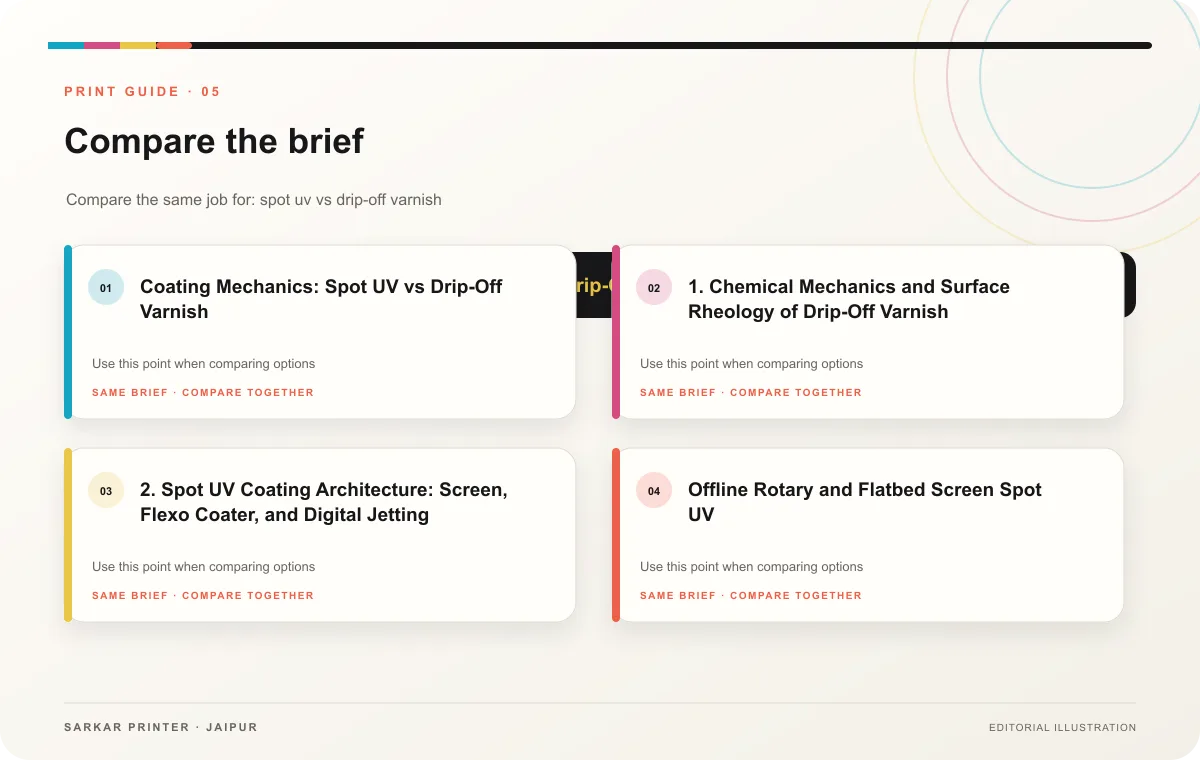
2. Spot UV Coating Architecture: Screen, Flexo Coater, and Digital Jetting
When analyzing spot uv vs drip-off varnish , the physical film weight and edge acuity of spot UV remain distinct advantages for specific luxury packaging designs:
Offline Rotary and Flatbed Screen Spot UV
Screen printing forces high-viscosity UV varnish through woven polyester or stainless steel mesh stencils. Because the mesh openings can transfer substantial fluid volumes, screen spot UV deposits dry film thicknesses ranging from 15 to 35 microns (or up to 70+ microns in high-build dimensional varnishing). This generous film build creates a tangible 3D embossed sensation and intense specular gloss exceeding 95 Gloss Units (GU). However, rotary screen units run at slower speeds (typically 3,000–5,000 sheets per hour) and require dedicated screen preparation.
Inline Flexographic Coating Towers
On modern commercial packaging presses, spot UV is applied inline using a flexographic photopolymer coating plate mounted on the coater cylinder. While film build is thinner (typically 4 to 8 microns), production speeds match the full press output (up to 18,000 sheets per hour). The boundary between coated and uncoated areas is sharp, but because the varnish is applied directly to bare or sealed paperboard without chemical beading, the surrounding non-UV areas remain standard paperboard matte rather than structured textured matte.
3. Comparative Technical Performance Matrix
Engineering Decision Framework: Coating Technology Selection
- Design Intent & Volume Requirements: Intricate Text, Fine Line Art & Micro-Patterns: Limitation: Photopolymer plates stretch and exhibit dot gain under pressure.
- Solution: Drip-off varnish utilizing 2400 DPI CTP aluminum plates for zero registration drift.
- Extreme Gloss Contrast & Mirror Reflections: Limitation: Drip-off gloss areas occasionally experience slight primer drag if duct settings drift.
- Solution: Inline or screen Spot UV directly over unprinted or matte-laminated surfaces.
- High-Volume Industrial Packaging (> 20,000 Cartons): Solution: Drip-off varnish for single-pass efficiency, eliminating offline bottlenecks.

4. Pressroom Quality Control and Troubleshooting
- Primer-to-Coating Ratio: Primer film thickness must reach at least 1.2 g/m² to ensure the repellent reaction triggers reliably. Viscosity of UV gloss coating must remain strictly within 35 to 50 seconds (DIN 4 cup at 20°C).
- Cross-Hatch Adhesion Testing (ASTM D3359): Press operators perform cross-hatch tape adhesion tests across scores to verify that UV varnishes do not flake during high-speed folding and gluing.
- Low-Migration Formulations: For food and cosmetic packaging, certified low-migration photoinitiators compliant with EuPIA and Swiss Ordinance are mandatory.

5. Strategic Takeaways for Commercial Print Procurement
- Specify Drip-Off Varnish: For intricate full-coverage geometric patterns, fine reverse-out typographic text, and large commercial packaging runs where single-pass speed and minimal plate tooling costs maximize ROI.
- Specify Spot UV: For standalone luxury hero packaging where maximum gloss impact (95+ GU) or 3D raised tactile embossing is required to differentiate premium cosmetics, perfumes, and consumer electronics at retail.
TALK TO OUR PRESS EXPERTS
Planning high-volume brochures, mono cartons, or custom rigid boxes? Get factory-direct offset quotes with precision Pantone color matching.