
In high-volume commercial packaging and commercial print manufacturing, color fidelity is the ultimate baseline of brand trust. Whether you are producing rigid luxury boxes for cosmetics or folding cartons for retail shelves, brand owners demand exact color matching across various substrates, printing presses, and global manufacturing plants. Mastering Delta E ($\Delta E$) standards and spectrophotometric control ensures that every press run hits certified tolerances.
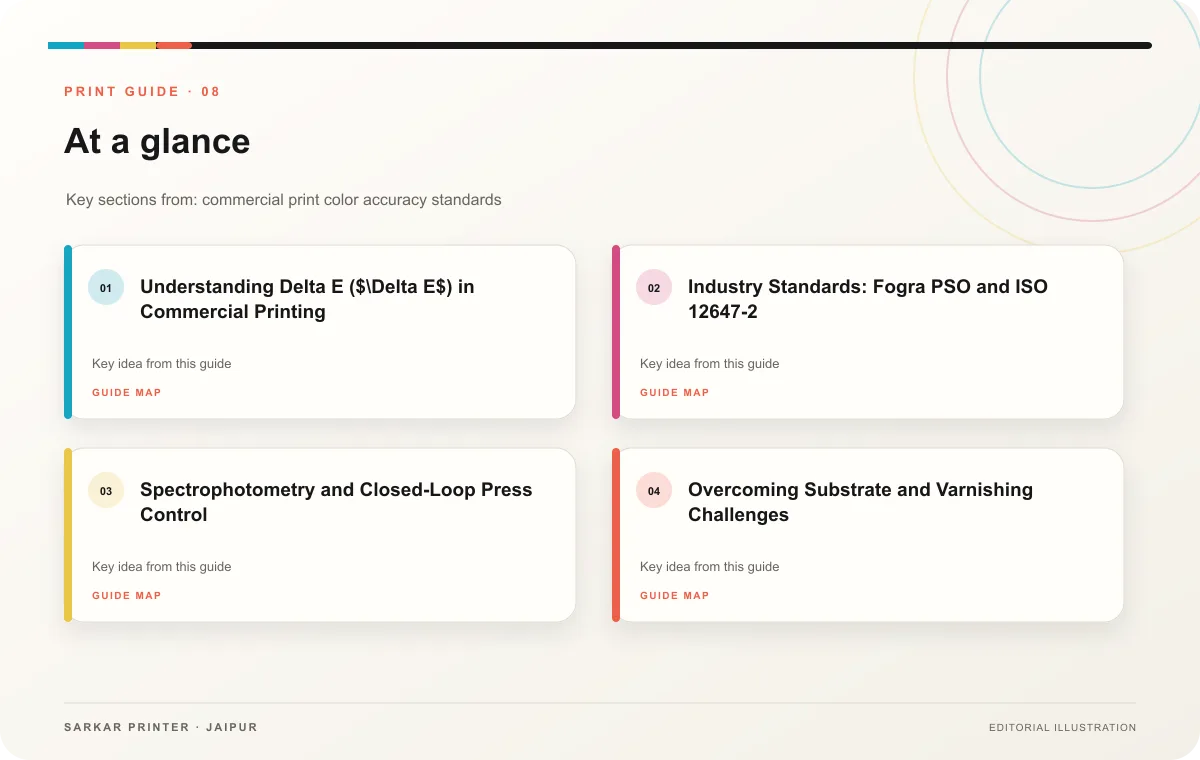
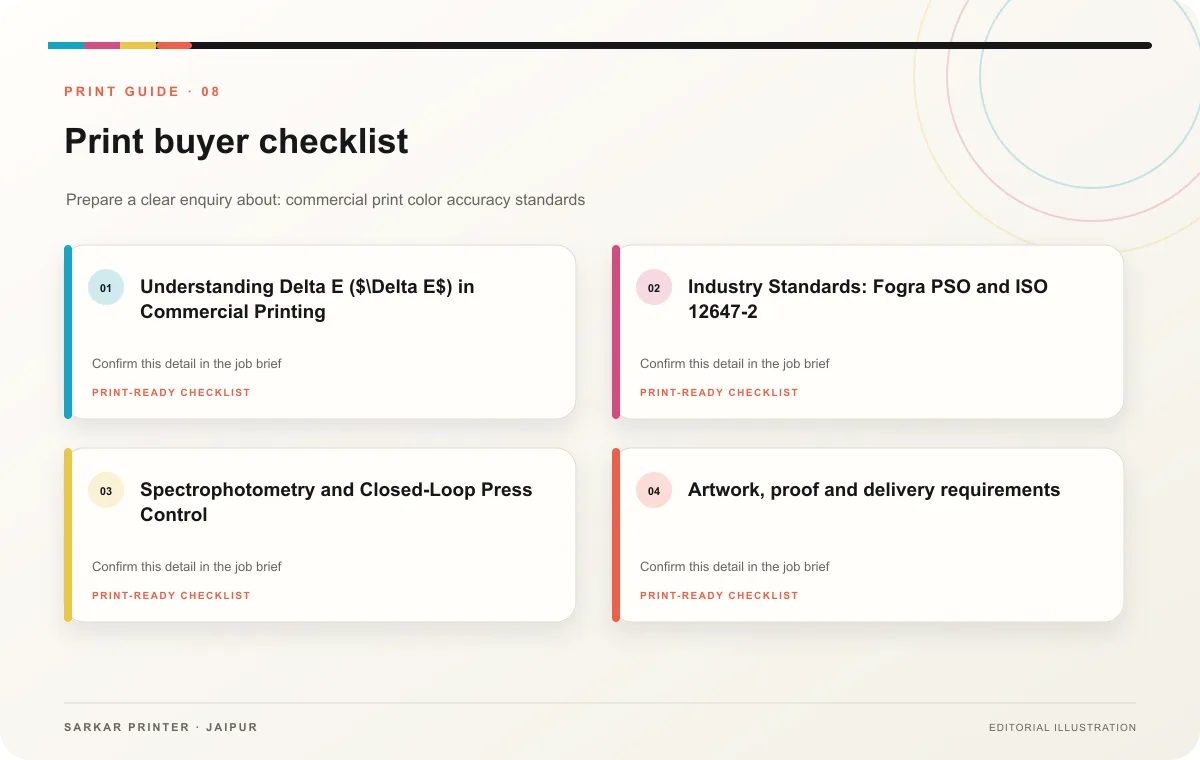
Understanding Delta E ($\Delta E$) in Commercial Printing
Delta E is the single metric that quantifies the difference between two colors. Derived from the CIELAB color space, $\Delta E$ calculates the distance between a reference color (the approved brand standard or digital proof) and the sample color measured off the press sheet using a spectrophotometer.
- $\Delta E$ 1.0: Imperceptible to the human eye; achievable under strict laboratory or controlled packaging proofing conditions.
- 1.0 – 2.0: Excellent commercial match; acceptable for high-end cosmetics, luxury rigid boxes, and premium pharmaceutical packaging.
- 2.0 – 3.0: Standard commercial tolerance; acceptable for general commercial print, brochures, and standard folding cartons.
- 3.0: Noticeable color shift; generally rejected by strict quality assurance protocols and brand guardians.
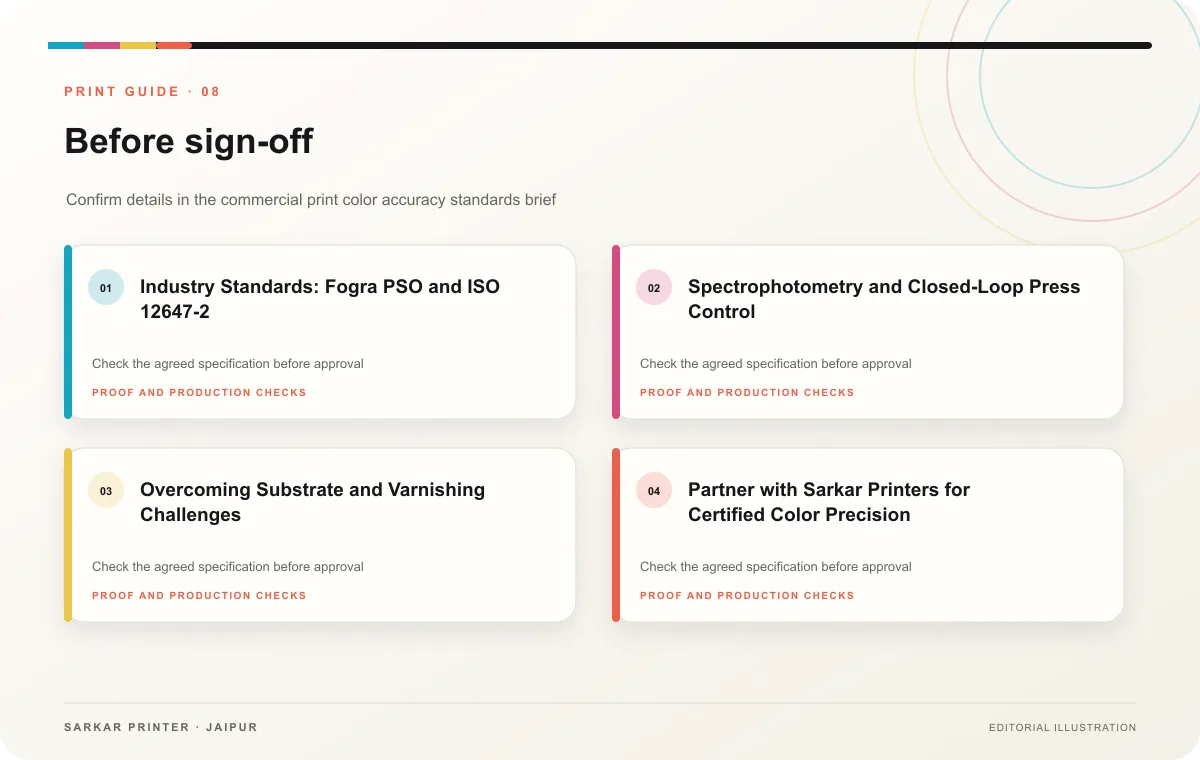
Industry Standards: Fogra PSO and ISO 12647-2
For a job enquiry, share the artwork status, quantity, material, finish and target date with Sarkar Printer. Ask the team to confirm the available production route, any applicable process records and the delivery schedule in the written quotation.
By enforcing Fogra PSO guidelines, prepress workflows compensate for dot gain before plates are exposed on our Heidelberg presses, eliminating costly press-side adjustments and ensuring repeatable color fidelity across repeat orders.
Spectrophotometry and Closed-Loop Press Control
Modern commercial printing cannot rely on visual approval under standard D50 lighting alone. Inline and offline spectrophotometers play a pivotal role in maintaining color stability:
- Prepress Profiling: ICC profiles are generated for specific combinations of paper stock (e.g., art paper, SBS board, kraft) and offset ink sets to predict dot gain and trapping behavior.
- Press-Side Makeready: Press operators scan color bars (measuring CMYK solid patches, slur, and doubling) to verify that initial sheets fall within ISO tolerances.
- Closed-Loop Feedback: Advanced presses feature closed-loop spectrophotometric systems that automatically adjust ink fountain keys across the sheet in real-time, correcting drift before $\Delta E$ exceeds acceptable thresholds.
Overcoming Substrate and Varnishing Challenges
Color perception shifts dramatically depending on post-press finishing. Applying an aqueous coating, UV lamination, or hot foil stamping alters the light absorption and reflection of the ink film. Prepress color management must account for post-press optical changes:
For instance, gloss lamination deepens dark tones and enhances contrast, while matte lamination mutes highlights and compresses the dynamic range. Measuring Delta E after finishing ensures that the final packaged product matches the digital proof approved by the client.
Questions to Ask About Colour Control
For a job enquiry, share the artwork status, quantity, material, finish and target date with Sarkar Printer. Ask the team to confirm the available production route, any applicable process records and the delivery schedule in the written quotation.
For a job enquiry, share the artwork status, quantity, material, finish and target date with Sarkar Printer. Ask the team to confirm the available production route, any applicable process records and the delivery schedule in the written quotation.