
Maintaining rigorous commercial print color accuracy is vital for enterprise brand identity. Furthermore, it protects consumer trust across high-speed packaging runs. According to global lithographic benchmarks in ISO 12647-2 process control standards , measuring color numerically eliminates visual subjectivity. Consequently, modern offset print facilities rely on spectrophotometers and Delta E (ΔE) calculations to maintain tight color fidelity across millions of packaging impressions.
For corporate brand owners and pharmaceutical manufacturers across Rajasthan, color deviation compromises brand integrity. When packaging shades shift noticeably across retail shelves, consumers suspect counterfeit products. Therefore, understanding color measurement science allows print procurement managers to establish enforceable contractual tolerances. In addition, it reduces reject rates during press production.
Whether you produce cosmetics folding cartons, FMCG labels, or corporate catalogs, scientific color management delivers predictable manufacturing. When evaluating lithographic production runs, this practical commercial print color accuracy manual ensures standardized quality control. Furthermore, it eliminates costly pressroom disputes.
Color Science & Quality Control Architecture
- 1. Colorimetry Measurement Mechanics CIE L*a*b* 3D Color Space: Luminance (L*), Green-Red (a*), Blue-Yellow (b*).
- Spectrophotometer Optics: 45°/0° directional geometry vs spherical diffuse geometry.
- Standard Illuminants: D50 (5000K daylight) and 2° standard colorimetric observer.
- 2. Delta E (ΔE) Mathematical Formulas Legacy ΔE*ab (1976): Euclidean distance in CIELAB color space.
- Modern ΔE2000 (CIEDE2000): Ellipsoidal weighting correcting human eye non-uniformity.
- Commercial Tolerance Thresholds: Pass/fail limits for spot brand colors and process CMYK.
- 3. Pressroom Process Calibration G7 Calibration: Neutral Print Density Curves (NPDC) for gray balance matching.
- Interplay with our paper GSM selection guide and base stock whiteness.
- Impact of inline sealers from our paper coating technology guide on dry-back shifts.
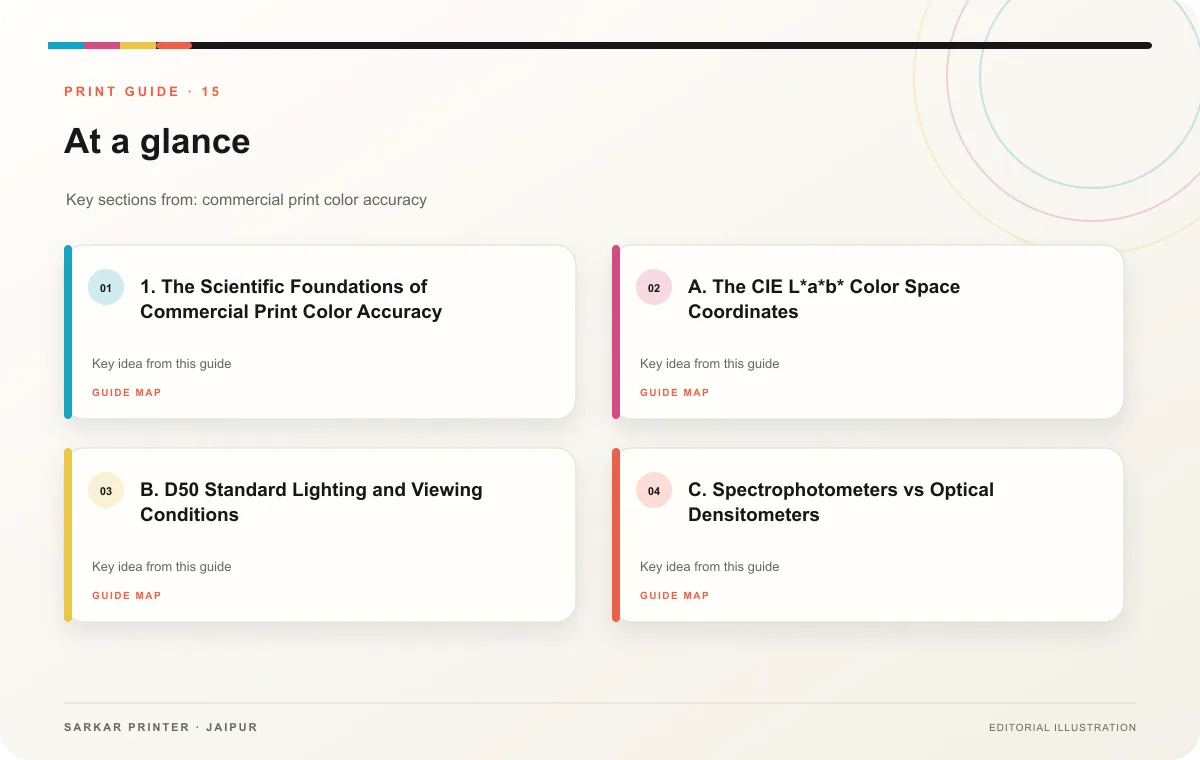
1. The Scientific Foundations of Commercial Print Color Accuracy
Unlike human vision which suffers from optical fatigue and ambient lighting variations, industrial colorimetry measures spectral reflectance. Specifically, three core parameters define mathematical color verification:
A. The CIE L*a*b* Color Space Coordinates
In 1976, the International Commission on Illumination established the CIELAB color model. This model plots colors across a three-dimensional coordinate sphere. The L* axis defines lightness from absolute black (0) to diffuse white (100). Meanwhile, the a* axis represents color vectors along the green-to-magenta axis. Similarly, the b* axis tracks values from blue to yellow. As a result, every measurable print color possesses an unambiguous numerical address.
B. D50 Standard Lighting and Viewing Conditions
Visual color perception shifts dramatically when viewed under varying light sources. Consequently, the graphic arts industry standardizes inspection environments under ISO 3664 viewing booths. Standard D50 illuminant simulates natural daylight with a 5000 Kelvin color temperature. Therefore, evaluating press proofs under mismatched office fluorescent lighting invalidates color comparison.
C. Spectrophotometers vs Optical Densitometers
Traditional densitometers measure only ink film thickness through color filters. In contrast, modern spectrophotometers capture spectral reflectance curves across the visible wavelength spectrum (400 to 700 nanometers). Consequently, spectrophotometers calculate absolute colorimetric coordinates. As a result, press operators can match custom Pantone spot inks and delicate brand pastels accurately.
Delta E (ΔE00) Commercial Tolerance Thresholds
Quantifying perceptible color differences between target proofs and press production
Imperceptible Difference
Inaudible color shift to the naked eye. Exceeds standard commercial requirements; typical of luxury brand master proofs.
Standard Commercial Target
Perceptible only through side-by-side trained inspection. The gold standard for retail folding carton production.
Acceptable Production Drift
Standard tolerance across long manufacturing runs. Imperceptible when products are displayed independently on store shelves.
2. Understanding Delta E (ΔE): Evolution from 1976 to CIEDE2000
Delta E (written as ΔE) measures the mathematical distance between two color samples in color space. A ΔE score of zero represents identical color matches. However, early calculation formulas struggled with visual inconsistencies.
In 1976, the original CIE76 formula used simple Euclidean distance. Unfortunately, human eyes perceive color shifts unevenly. Specifically, human vision detects subtle shifts in neutral grays much faster than in saturated yellows. Consequently, a CIE76 ΔE of 2.0 produced inconsistent visual differences across the color spectrum.
To solve this, the CIE developed the CIEDE2000 (ΔE00) mathematical standard. This advanced equation incorporates specialized weighting factors for lightness, chroma, and hue. In addition, it accounts for color space rotation in blue regions. Today, certifying commercial print color accuracy under ΔE00 guarantees that numerical values correlate directly with human visual perception.
3. Technical Specification Matrix: Color Tolerances by Print Application
To assist packaging buyers and quality assurance teams, the following matrix outlines standard industrial color tolerances:
*Note: Measurements reflect dry ink films. Ink dry-back typically introduces a 0.5 to 1.0 ΔE shift during solvent and oil vehicle absorption.
4. Pressroom Variables Influencing Color Shift
Achieving consistent color accuracy on an industrial offset press requires balancing mechanical and physical variables across continuous production:
A. Substrate Whiteness and Optical Brighteners (OBAs)
In offset lithography, printing inks are semi-transparent pigments. Consequently, the underlying paper color directly modifies the final reflected shade. Substrates formulated with Optical Brightening Agents (OBAs) reflect ultraviolet light as visible blue glow. Therefore, prepress profiles must utilize M1 spectrophotometer measurement conditions to account for substrate fluorescence.
B. Ink Dry-Back and Emulsification Balance
Fresh wet ink films appear significantly glossier and more saturated than fully cured ink. As liquid ink vehicles sink into paper pores, ink density drops. Consequently, color shifts by 0.5 to 1.2 ΔE during drying. Press engineers compensate for dry-back by calibrating wet press targets slightly above final dry specifications. Reviewing the mechanical principles of what is offset printing helps print buyers understand how ink-water balance controls dot gain.
C. Dot Gain (Tonal Value Increase)
Mechanical pressure between the offset blanket cylinder and the paper surface squeezes ink outward. Consequently, a 50% halftone dot on the printing plate expands to 65% or 70% on the final printed sheet. Managing dot gain through Computer-to-Plate (CTP) calibration curves ensures balanced color reproduction without dark, muddy midtones.
Furthermore, evaluating project volume within our comprehensive offset printing cost in Jaipur analysis demonstrates how computerized closed-loop ink control minimizes make-ready paper waste while maintaining tight Delta E tolerances.
5. Five Procurement Best Practices for Managing Color Quality
To eliminate color disputes and guarantee production fidelity, enterprise procurement officers should adopt standard verification procedures:
- Supply Digital Color Targets (CxF Files): Provide color standards as Color Exchange Format (CxF/X-4) digital files rather than physical ink swatches. Digital spectral data never fades or degrades over time.
- Contractually Mandate CIEDE2000 Tolerances: Specify exact ΔE00 threshold numbers in purchase orders (e.g., maximum ΔE00 2.0 for brand logos, ΔE00 3.0 for background solids).
- Require Certified Hardcopy Contract Proofs: Ensure pressroom contract proofs carry Fogra or IDEAlliance certified color control wedges with verified pass certificates.
- Incorporate Color Bars on All Packaging Dielines: When engineering carton layouts using precision folding carton dieline design , allocate margin space for pressroom color bars.
- Inspect Under Calibrated D50 Lighting: Avoid examining packaging under store or office lighting. Always verify production samples inside calibrated 5000K viewing booths.
6. Summary: Delivering Scientific Commercial Print Color Accuracy
Ultimately, consistent brand color across consumer packaging is not a matter of luck or pressman intuition. Instead, it is an exact scientific discipline grounded in spectrophotometry, statistical process control, and rigorous mathematical standards.
By enforcing clear Delta E tolerances and adhering to this comprehensive commercial print color accuracy guide, brand founders and packaging procurement teams guarantee that every retail carton matches corporate brand standards across every manufacturing batch.
TALK TO OUR PRESS EXPERTS
Planning high-volume brochures, mono cartons, or custom rigid boxes? Get factory-direct offset quotes with precision Pantone color matching.