
Implementing cmyk extended gamut printing (often termed Extended Color Gamut or ECG 7-color printing) has emerged as a transformative operational breakthrough for commercial packaging converters. By augmenting standard four-color process inks (Cyan, Magenta, Yellow, Black) with Orange, Green, and Violet (OGV), pressrooms expand the reachable Pantone spot color spectrum to over 90% without requiring custom ink formulations. According to the Fogra Research Institute for Media Technologies (Fogra 55 / ISO 12647-2) characterization data, 7-color fixed-palette printing slashes wash-up downtime and ink waste while ensuring Delta E 2.0 repeatability across complex folding carton gang runs.
Historically, commercial packaging production required dedicating specific printing units to premixed spot inks for brand-critical colors. On an 8-color offset or flexo press, running a packaging job with multiple customer SKUs meant extensive makeready shutdowns: draining ink ducts, washing roller trains, swapping anilox rollers, and re-calibrating ink keys. With modern cmyk extended gamut printing , the press maintains a standardized fixed palette of seven inks permanently loaded in the stations. Jobs featuring entirely different brand palettes are sequenced back-to-back without press wash-ups, fundamentally transforming packaging unit economics.
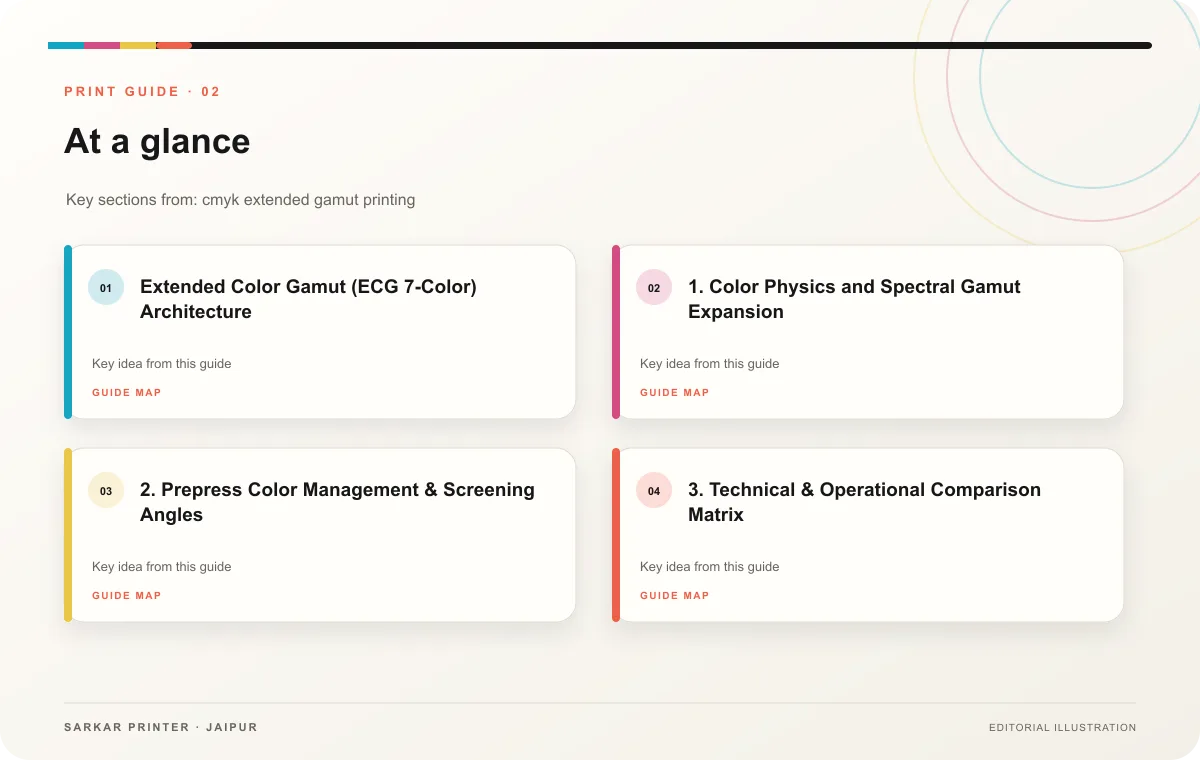
Extended Color Gamut (ECG 7-Color) Architecture
Spectral volume comparison between CMYK, CMYK+OGV, and Spot Ink manufacturing
Traditional 4-Color Process
Covers only 55%–65% of the Pantone Formula Guide solid colors.
- Color Gaps: Saturated oranges, vibrant greens, deep reflex blues
- Registration: Standard rosette screen geometry
- Limitation: Muddy tertiary color blends
Fixed Palette Extended Gamut
Covers 90%–95% of solid Pantone library with zero press ink wash-ups.
- Screen Angles: Specialized FM stochastic or offset rosette separation
- Fogra 55: a published characterization dataset whose fit depends on process and substrate
- Makeready Gain: 40%–60% reduction in job changeover time
Physical ink blending for 100% exact spectral pigment matching.
- Advantage: Uniform solid color under all lighting
- Disadvantage: Expensive leftover ink stock, duct wash-ups
- Ganging: Incompatible with combining multiple SKU jobs
1. Color Physics and Spectral Gamut Expansion
In standard subtractive color synthesis (CMYK), mixing cyan and yellow produces green; mixing magenta and yellow yields orange; mixing cyan and magenta generates violet. However, secondary color synthesis suffers from physical pigment absorption flaws. Real-world yellow, magenta, and cyan pigments contain spectral impurities. When two pigments combine, unwanted light absorption reduces chroma, shifting pure saturated colors toward dark, desaturated neutrals.
By adding pure mono-pigment Orange, Green, and Violet inks, cmyk extended gamut printing directly populates the outer perimeter of the CIELAB color space. The gamut volume increases by more than 50% compared to standard ISO 12647-2 (FOGRA39/51). Spot colors such as Pantone 021 Orange, Reflex Blue, and Green 347—previously impossible to simulate in CMYK—are accurately reproduced with Delta E 1.5 color differences undetectable to human eyes.
2. Prepress Color Management & Screening Angles
Successfully printing with seven process colors requires sophisticated prepress color management software (such as Esko Equinox, GMG OpenColor, or CGS ORIS). The primary technical hurdle is moiré interference. In standard 4-color offset, angles are separated by 30° (e.g., C: 15°, M: 75°, Y: 0°, K: 45°). Adding three more colors into a 90° quadrant mathematically ensures screen clash unless specialized separation strategies are implemented:
- Color Pair Replacement: In modern ECG color engines, opposite colors rarely print in the same pixel coordinate. For instance, Orange and Cyan or Green and Magenta do not overprint directly. The RIP engine assigns identical screen angles to non-competing pairs (e.g., sharing the same angle between Cyan and Orange).
- Stochastic (FM) Screening: Using Frequency Modulated screening completely removes directional screen angles, eliminating moiré patterns and allowing microscopic photographic reproduction.
3. Technical & Operational Comparison Matrix
Manufacturing Decision Mindmap: Extended Gamut Adoption
- Production Profile & Optimization Strategy: High-Mix, Variable SKU Packaging (FMCG, Food, Cosmetics): Challenge: Frequent job changeovers consume 40% of pressroom productive hours.
- Solution: Adopt ECG 7-color to gang 5–10 brand SKUs on a single master sheet with zero wash-ups.
- Strict Monolithic Corporate Branding (e.g., Coca-Cola Red, Tiffany Blue): Challenge: Minor register or dot gain variation shifts critical corporate brand equity.
- Solution: Maintain dedicated pure spot ink unit for global hero brand colors.
4. Pressroom Calibration & Quality Standards
- Spectrophotometric Curve Verification: Press calibration must adhere to Fogra 55 characterization datasets using X-Rite eXact or inline spectrophotometers, maintaining TVI (Tone Value Increase) within ± 2% across all 7 channels.
- Ink Trapping and Wet-on-Wet Splitting: Because seven ink films superimpose, tack values must be strictly sequenced in descending order (K > C > M > Y > O > G > V) to prevent back-trap picking on press blankets.
5. Strategic Takeaways for Packaging Converters
- Embrace ECG for Gang Printing: Extended gamut printing delivers massive profitability gains by combining disparate brand SKUs onto unified production sheets without washing down ink units.
- Maintain Spot Inks Where Legally or Optically Mandated: Specialized metallic foils, fluorescent taggants, and singular corporate hero hues remain best served by spot inks.
TALK TO OUR PRESS EXPERTS
Planning high-volume brochures, mono cartons, or custom rigid boxes? Get factory-direct offset quotes with precision Pantone color matching.