Make the product range easy to compare
A useful print project begins with a clear job. A catalogue helps a reader compare a range. Packaging introduces and protects a product. A brochure explains a company or offer. Stationery…

JAIPUR BASE · SERVING BARMERPRINTING PRESS IN BARMER
Need a printing press in Barmer? Sarkar Printer is based in Jaipur and coordinates print enquiries for businesses in Barmer. Share the format, quantity, artwork and delivery needs so we can discuss a practical production plan.
ONE CLEAR ROUTE
MAKE THE BRIEF CLEARFROM FIRST FILE TO FINAL PRINT
For Barmer, enquiries are planned from our Jaipur base. We confirm the print specification and dispatch scope against your job.
A useful print project begins with a clear job. A catalogue helps a reader compare a range. Packaging introduces and protects a product. A brochure explains a company or offer. Stationery…
Rajasthan’s Economic Review 2023–24 identifies Kasheedakari embroidery and block-printed items in the district-wise One District One Product table for Barmer. For a craft or artisan…
A consistent stationery set supports everyday communication as well as product selling. Tell us which pieces you need—such as a letterhead, visiting card or notepad—and whether they share a…
GOOD TO KNOWJAIPUR · BARMER
Every job is planned from the Jaipur base; delivery scope and timing are confirmed against the brief.
LOCAL PRINT PLANNINGCOMMERCIAL PRINT
Sarkar Printer · Jaipur · Serving Barmer
Plan commercial print around the product, audience and way it will be used. Sarkar Printer is based in Jaipur and serves businesses in Barmer from Jaipur. Share your format, quantity, artwork and delivery needs to discuss a practical specification.
Start with a product name, rough quantity, sample or print-ready file.
A useful print project begins with a clear job. A catalogue helps a reader compare a range. Packaging introduces and protects a product. A brochure explains a company or offer. Stationery keeps routine communication recognisable. The right format depends on what your customer needs to understand and what your team needs to use after printing.
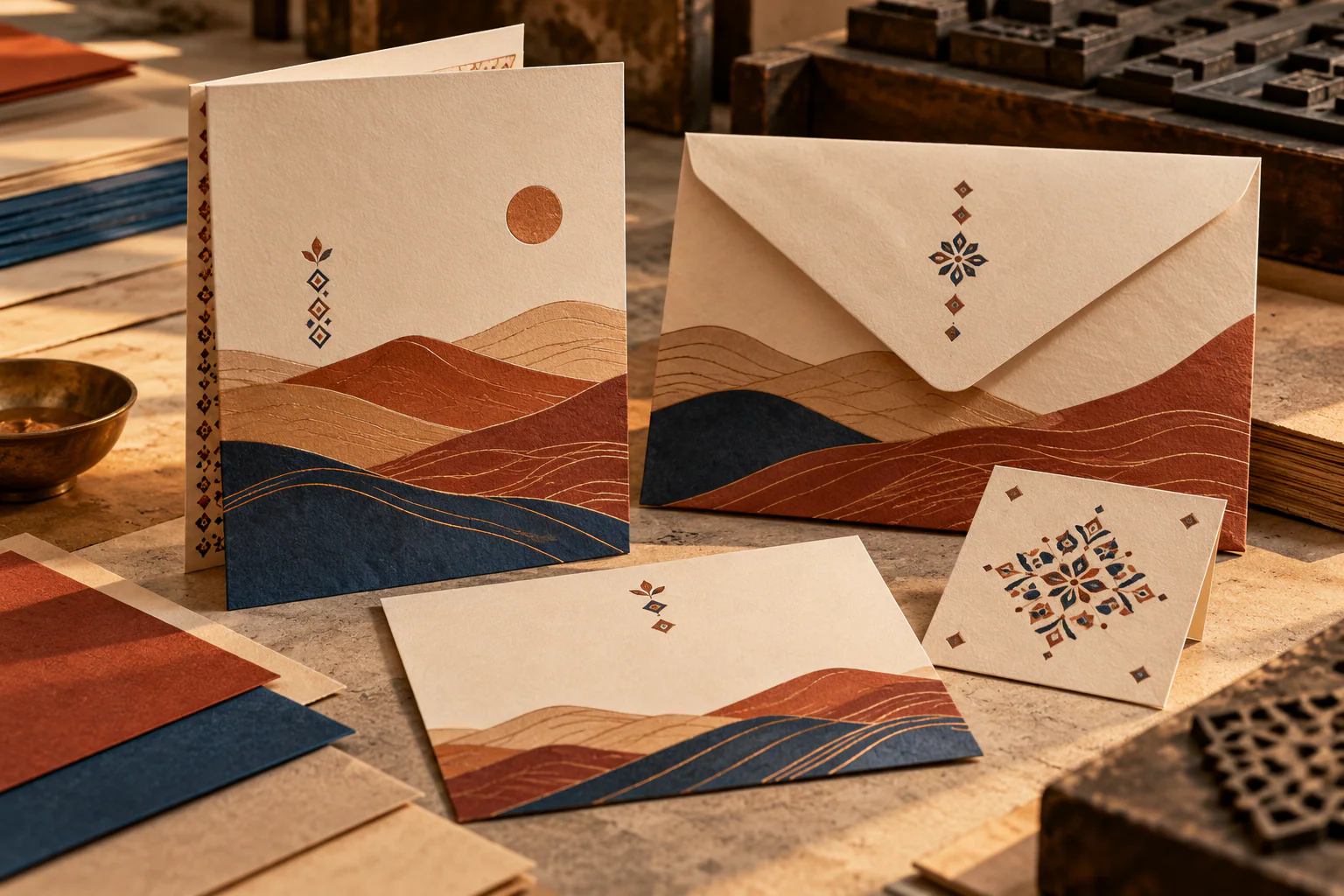
Rajasthan’s Economic Review 2023–24 identifies Kasheedakari embroidery and block-printed items in the district-wise One District One Product table for Barmer. For a craft or artisan product, print can help explain the story behind a piece without crowding the object itself. Consider a concise maker or collection card, a product catalogue with clear variant names, a care or handling insert supplied by the brand, and packaging that protects the item while presenting it. If a design includes hand-made variation, avoid implying every piece is identical; use captions that describe the range honestly. Photographs, material notes and dimensions should be checked against the actual products. A proof is especially useful when fine artwork, metallic-looking colours or detailed illustrations must remain legible. This is a practical design angle based on a public state report, not a claim about specific local clients or current demand.
This guide is for businesses researching a printing press in barmer . It brings practical print-planning steps together with a local product context from a public state report. It does not claim a Sarkar Printer branch, local customer list, standard district price or guaranteed delivery time in Barmer. Enquiries are coordinated from Jaipur, with the scope and dispatch plan confirmed for each job.
For a team in Barmer, the order of decisions matters: define the audience and information first, select format next, and approve a production specification only after the content is ready.
A catalogue or brochure should answer a buyer’s first questions without asking them to decode the layout. For a business in Barmer, begin with the product families, audience and decision the document supports. A craft story works best when it is specific and concise: name the technique or collection only when the business can verify it, credit makers only with permission, and explain the product’s distinguishing details in plain language. Let the photograph and object remain the focus. Share the approximate page count, finished size, image status and whether the print is handed over, mailed or used in a meeting. Our catalogue and prospectus format page shows a related service reference.
Packaging has to fit the product, not just the artwork. Share its dimensions, approximate weight, how it is packed and how it will be carried, displayed or stored. If products vary by hand, describe that variation clearly rather than promising identical details across pieces. A catalogue can use a shared layout for the range while giving each item its own name, image and dimensions. Check that the print file does not crop important detail or obscure an illustration. If you have a dieline, label the approved version; if not, say so before artwork is prepared. Mockups help compare appearance, but the final dimensions and construction still need confirmation. Explore related examples on our printed boxes and paper carry bags pages.
A consistent stationery set supports everyday communication as well as product selling. Tell us which pieces you need—such as a letterhead, visiting card or notepad—and whether they share a logo, address, colour system or contact details. For gift-oriented packaging, consider how the item will be presented, protected and carried. Share actual product dimensions, wrapping or insert requirements and artwork files. A render or mockup helps discuss appearance but final construction and production details must be agreed from the real specification. If several pieces are ordered together, provide one approved brand file and point out the fields that vary. This helps keep the set coordinated while leaving room for each piece to do its own job. See our business stationery reference .
Flyers, posters, booklets, menus and other campaign pieces are judged at different distances and in different settings. Specify where the piece will be seen, how long it will be used, and whether the date or offer changes between versions. For a craft exhibition or collection presentation, use one display piece to invite attention and a separate take-away card or brochure for the product details. Verify maker names, technique descriptions, dimensions and image permissions before print; keep small illustration details visible in the proof. Keep the call to action, contact route and any QR destination current. A proof gives the team a chance to check the copy, crop, layout and important details before print. For process context, visit the digital printing page .
For a craft or handmade collection, give the object space and let the printed story explain what a photograph cannot. Use verified names for techniques and materials, concise descriptions, clear dimensions and a contact route for the next step. If individual pieces vary, say so accurately; a catalogue can show a family of work without suggesting every item is identical.
Choose images that show both the overall form and the details that matter to a buyer. Captions should identify the correct piece or variant, and a proof should be checked for crops that hide fine work. If a maker, artisan group or place is named, confirm the wording and obtain any permissions the business needs before publishing it in print.
For a collection card or gift insert, keep the message short and useful. Decide whether it should describe care, the collection, the maker or how to enquire; trying to do all four at equal length can make the card hard to scan. Match any packaging insert to the actual item and its presentation.
Build one reliable source for product names, descriptions, contact details and visual assets. When copy changes, mark the updated version and list the pages or pieces affected. If multiple print formats are involved, decide which information belongs everywhere and which belongs only on a product sheet. This avoids an attractive layout carrying outdated details.
From first note to delivery planning
You can begin before every design decision is final. The purpose of the first review is to clarify the brief, identify open details and agree what should be quoted.
Tell us what you want to print, who will use it, the approximate quantity and the intended destination in Barmer. A sketch, reference image or previous sample is enough to start. If your brief connects with Kasheedakari embroidery and block-printed items, say whether you need a product catalogue, packaging, a sales handout or another format.
Share the size, number of pages or panels, artwork status, paper preference and finishing reference. List what is confirmed and what is undecided; there is no need to guess. If the job includes technical, product or compliance information, name the person who will verify it.
The right route depends on format, quantity, material, schedule and artwork. Explain whether this is a one-time job or a repeat requirement, and what matters most: consistency, finish, short-run flexibility or an organised product range. The team can discuss the route against the actual brief.
Check that the quotation reflects the agreed quantity, dimensions, stock, finishing, artwork responsibilities, delivery destination and validity period. Ask about any line that is unclear. Production and dispatch arrangements for Barmer are discussed and confirmed before approval.
Have the responsible reviewer check names, numbers, spelling, dimensions, images, colour references and any claim or regulated wording. A visual proof is a review step, not an automatic guarantee that source information is correct. Confirm the final version in writing.
Once the job is approved, confirm packaging, dispatch method, destination details and the schedule with the team. Sarkar Printer is based in Jaipur and serves Barmer from Jaipur; no local branch or fixed delivery time is implied by this page.
Use a clear file name and version number. Confirm page size, page order and the number of panels or pages. Inspect the export at full size for missing images, clipped text, incorrect contact details or old product descriptions. If your designer has supplied a print-ready PDF, use the export settings they recommend and ask about bleed, crop marks, colour profile or font handling instead of guessing.
For product catalogues and brochures for Barmer, ask a knowledgeable reviewer to compare the copy with the latest product records. Check codes, quantities, units, measurements and spelling. For packaging, verify the dieline version, folds, glue areas and which panel carries each element. For campaign material, check dates, QR destinations, offers and contact routes.
A proof is a chance to identify problems before production, but it cannot validate source information the printer did not create. Assign one person to collect corrections, send a single consolidated response and clearly state which version is approved. Keep the approved file and quotation together so a repeat order starts from the same reference.
If a detail is unknown, mark it “to be confirmed.” That separates real requirements from assumptions and helps the team discuss the next decision clearly.
Offset and digital printing are not interchangeable labels for “large” and “small” jobs. The appropriate process depends on the quantity, substrate, artwork, finishing, schedule and consistency requirements. Send the relevant details and ask for a recommendation against the actual project. For more context, see the offset printing and digital printing pages.
Sarkar Printer is based in Jaipur and serves Barmer from Jaipur. This page is not a claim of a local branch. You can send the brief remotely, and delivery arrangements to your destination are confirmed with the quotation.
Share the product, approximate quantity, final size, pages or panels, stock or finish preference, artwork status, destination and target date. If the work relates to Kasheedakari embroidery and block-printed items, attach an approved reference or a source sheet for any technical details.
A catalogue can be discussed when you share the product range, intended readers, page count, image status and how it will be distributed. A subject-matter reviewer should verify specifications and product descriptions before the final artwork is approved.
You can begin with the format, purpose, references and rough specifications. The team can clarify what is needed for a print-ready file and whether design or prepress support is available for your specific job. Confirm the scope before production.
There is no single process for every job. Quantity, format, stock, artwork, schedule and repeat requirements affect the decision. Share those details and discuss options for your exact brief rather than relying on a general rule.
Timing depends on the approved specification, artwork readiness, production schedule and dispatch arrangement. Share your required date early, then confirm the production and delivery timeline with the team before approving the job.
Tell us the format, approximate quantity, what the piece needs to communicate and what is already ready. If your work connects with Kasheedakari embroidery and block-printed items, attach a current product list or approved reference so the first discussion can stay specific. You can still enquire if sizes, finishing or artwork are undecided—just mark those items as open questions.
Sarkar Printer is based in Jaipur and serves Barmer from Jaipur. Before an order proceeds, confirm the final specification, quotation, production schedule and delivery arrangement for your destination. No local office, fixed rate or guaranteed turnaround is implied.
BEFORE YOU STARTCOMMON QUESTIONS
Clear answers make it easier to approve artwork, choose a finish and plan production.
Sarkar Printer is based in Jaipur. Enquiries for this city are coordinated from Jaipur, and the production and dispatch plan is confirmed for each job.
Share the item, finished size, quantity, paper or material preference, artwork status and the date you need the order.
Send the file you have. The team can review the supplied artwork and explain any specifications to settle before production.
SARKAR PRINTER · JAIPURLET’S TALK ABOUT THE JOB
Share your product, quantity and timeline. We’ll use the brief to discuss the next practical step.