
Navigating raw material choices with a structured paper gsm selection guide empowers packaging developers, marketing agencies, and B2B procurement managers to balance material structural integrity with cost efficiency. According to the international ISO 536 paper grammage determination standards , specifying the correct mass per unit area prevents mechanical press feeding jams and structural carton failures. Consequently, understanding how paperboard thickness, fiber stiffness, and grammage interact guarantees superior tactile brand luxury and structural resilience.
For corporate purchasing teams across Rajasthan, paperboard represents over 55% of total commercial print manufacturing expenditures. In high-speed manufacturing environments, an incorrect substrate selection causes press ink bleed-through, paper curl, or carton bulging during transit. Therefore, standardizing raw substrate parameters before locking production files eliminates costly press downtime and product damage.
Whether you are producing corporate brochures, folding gift cartons, or pharmaceutical inserts, selecting the appropriate basis weight is paramount. When planning your production schedule, mastering this practical paper gsm selection guide ensures reliable press performance and immaculate structural presentation.
Substrate Architecture & Decision Mind Map
- 1. Commercial Substrate Classification Lightweight Text Papers (70 to 130 GSM): Catalogs, inserts, and direct mailers.
- Mid-Weight Cover Stocks (170 to 250 GSM): Presentation folders, brochures, and book covers.
- Heavyweight Packaging Boards (280 to 450 GSM): Retail cartons, rigid packaging, and mailers.
- 2. Critical Physical Performance Metrics Grammage (GSM) vs. Caliper (Caliper thickness measured in microns / points).
- Grain direction alignment across crease and fold geometries.
- Bursting strength, tear resistance, and Taber stiffness factors.
- 3. Industrial Manufacturing Economics Balancing sheet yield with freight weight and mailing thresholds.
- Post-press coating receptivity (UV gloss, matte aqueous, and foil stamping).
- High-speed sheetfed feeder speeds and drying rack capacities.
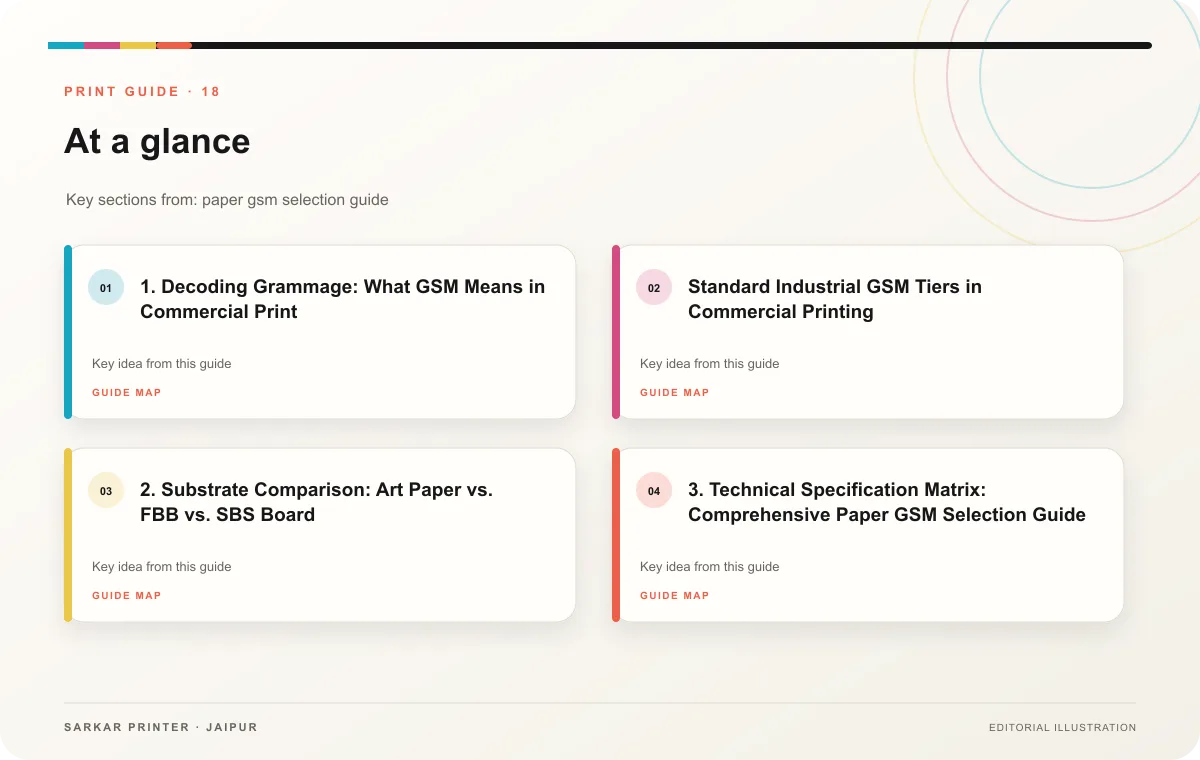
1. Decoding Grammage: What GSM Means in Commercial Print
In international manufacturing terminology, GSM stands for "Grams per Square Meter." Specifically, it defines the metric mass of one square meter of paper stock cut under controlled atmospheric conditions. Consequently, a sheet rated at 300 GSM weighs exactly 300 grams per square meter of surface area.
However, procurement officers must recognize that GSM measures weight rather than total thickness. For example, two different paperboards sharing an identical 300 GSM rating can exhibit significantly divergent physical thickness and rigidity. This divergence occurs because fibrous bulk and manufacturing density vary across different wood pulp treatments.
Therefore, laboratory testing under TAPPI T 410 standard test methods evaluates both basis weight and bulk volume. When evaluating substrates, measuring caliper thickness alongside mass prevents unexpected structural rigidity failures during post-press die-cutting.
Standard Industrial GSM Tiers in Commercial Printing
Comparative functional classification for commercial marketing and packaging production
Uncoated bond, maplitho, and lightweight gloss art papers. Ideal for publication text pages and commercial flyers.
Heavy art paper and premium matte card stock. Perfect for corporate brochures, annual reports, and catalog covers.
Virgin fiber FBB and SBS boards. Engineered for pharmaceutical cartons, cosmetic boxes, and luxury retail packaging.
2. Substrate Comparison: Art Paper vs. FBB vs. SBS Board
Selecting the right stock requires matching fiber composition to operational demands. Furthermore, commercial printers categorize raw paper stocks into distinct manufacturing grades based on pulp purity and coating layers.
First, Coated Art Paper (Gloss and Matte) features a kaolin clay coating on both surfaces. As a result, it provides exceptional ink holdout, sharp halftone dot reproduction, and vibrant color density. Consequently, art paper ranging between 130 and 170 GSM represents the industry standard for high-volume catalogs and marketing leaflets.
Second, Folding Box Board (FBB) features multi-layer mechanical pulp sandwiched between bleached chemical pulp plies. Because the mechanical core provides elevated bulk and high bending stiffness, FBB delivers exceptional rigidity at lower basis weights. In addition, its smooth coated top liner supports premium hot foil stamping and spot UV varnishes.
Third, Solid Bleached Sulfate (SBS) board consists entirely of pure bleached virgin chemical pulp. Thus, SBS offers superior internal tear strength, ultra-white brightness, and uncompromised purity. Major pharmaceutical, luxury perfumery, and confectionary manufacturers specify SBS board between 300 and 380 GSM for critical packaging lines.
In addition, when evaluating bulk manufacturing runs, reviewing your calculated offset printing cost in Jaipur ensures you select an economical board caliper without paying for unnecessary substrate weight.
3. Technical Specification Matrix: Comprehensive Paper GSM Selection Guide
To assist structural packaging engineers and print estimators, the following matrix outlines standard commercial benchmarks used in industrial offset manufacturing:
*Note: Technical caliper tolerances adhere to international paper mill standards (±5% nominal thickness variation). Moisture content and relative humidity directly impact finished caliper dimensions.

4. Critical Structural Factors Beyond Basis Weight
While specifying GSM establishes weight, physical carton performance depends on three vital mechanical variables. Specifically, ignoring these engineering factors leads to structural defects during post-press conversion:
A. Caliper Thickness vs. Grammage Density
Caliper measures the physical thickness of a single paper sheet, expressed in microns (1/1000th of a millimeter) or points (1/1000th of an inch). Because different pulp fibers possess varying specific volume, low-density boards offer higher caliper per gram than high-density papers. Consequently, a high-bulk 280 GSM paperboard can deliver equal compression resistance as a standard 320 GSM board while reducing raw tonnage costs.
B. Grain Direction Alignment
During papermaking, wood pulp fibers align parallel to the motion of the paper machine wire. This creates two distinct physical axes: Grain Direction (Machine Direction, MD) and Cross Direction (CD). Papers bend and fold easily parallel to the grain, whereas bending across the grain encounters strong structural resistance.
Therefore, carton packaging dielines must be laid out so that primary vertical score lines run parallel to paper grain. If creases run across the grain on heavy 300+ GSM boards, fibers snap violently, producing unsightly cracked edges. Understanding what is offset printing press sheet orientation requires helps prepress operators align sheet layouts correctly.
C. Creasing and Post-Press Finishing Durability
Heavyweight paperboards exceeding 200 GSM require precision mechanical score creasing before folding. Furthermore, applying thermal matte or gloss lamination film provides structural reinforcement across the folded hinge. For premium consumer packaging, laminating high-GSM boards prevents surface scuffing and enables sophisticated anti counterfeit packaging printing techniques such as micro-embossed holographic foils.
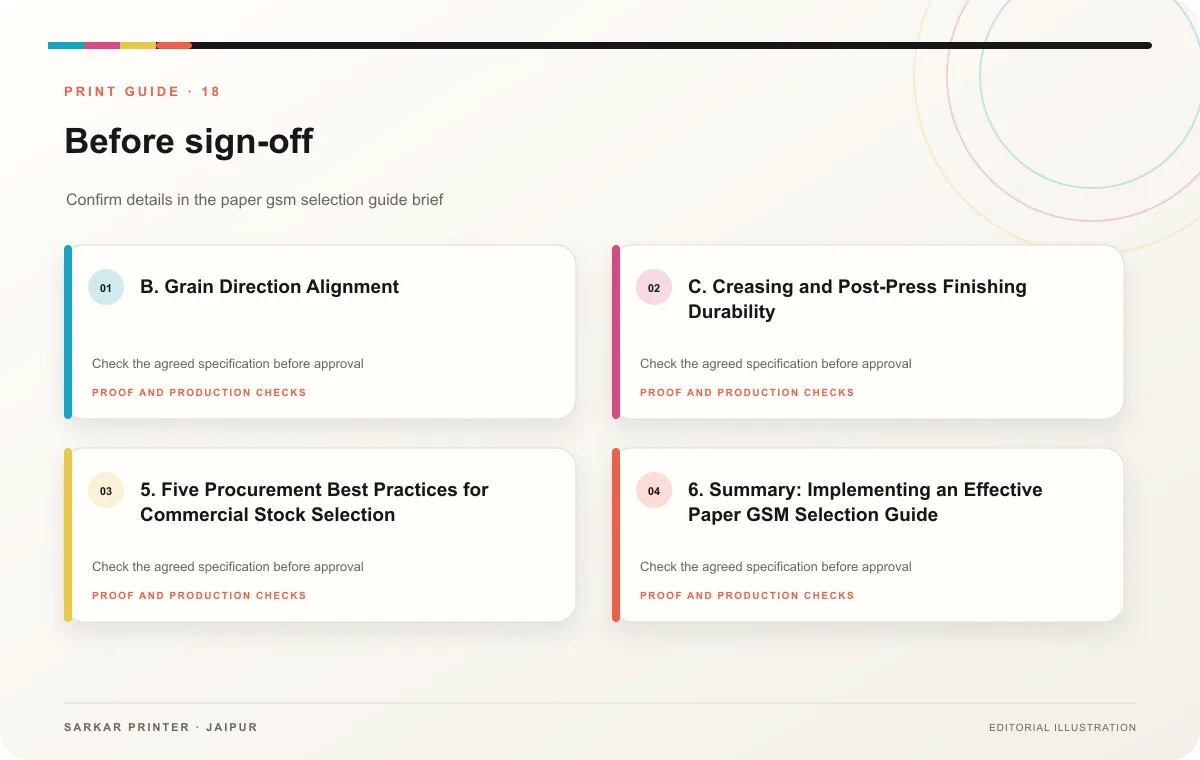
5. Five Procurement Best Practices for Commercial Stock Selection
To optimize budget allocations without compromising packaging integrity, enterprise buyers should enforce standard procurement protocols. Specifically, applying these five evaluation principles ensures predictable production quality:
- Demand Physical Draw-Down Samples and Dummies: Request an unprinted, die-cut mock carton dummy produced on the exact specified board stock. Testing the structural dummy with actual product weight verifies wall stiffness before committing to bulk manufacturing runs.
- Factor Packaging Transit and Stacking Loads: Calculate warehouse pallet stacking weight during substrate specification. Because corrugated outer cartons share compression loads with inner folding boxes, higher GSM boards reduce warehouse crush damage.
- Evaluate Automatic Machine Cartoning Speeds: If your filling lines utilize automated high-speed carton erectors, specify paperboards with certified stiffness ratings. Board that is too flexible causes suction cup feeding failures, halting automated packaging lines.
- Verify Ink Coverage and Drying Absorption: High-density saturated ink graphics on uncoated stocks require longer oxidative drying cycles. Conversely, coated boards allow quick ink setting and crisp visual reproduction under high press speeds.
- Standardize Mill-Certified Stock Brands: Sourcing consistent, branded paperboards from certified paper mills eliminates batch-to-batch color shifts and surface roughness variations.
6. Summary: Implementing an Effective Paper GSM Selection Guide
Ultimately, selecting the correct paperboard and text stock requires balancing aesthetic luxury, tactile stiffness, and production economics. By deploying a systematic paper gsm selection guide across every production brief, procurement directors and packaging designers protect corporate brand prestige while maximizing return on investment.
Commercial print manufacturing is fundamentally a discipline of precision engineering. When project stakeholders carefully evaluate grammage, caliper, grain direction, and post-press finishing requirements upfront, finished marketing collateral and retail packaging perform reliably from press delivery through retail checkout.
TALK TO OUR PRESS EXPERTS
Planning high-volume brochures, mono cartons, or custom rigid boxes? Get factory-direct offset quotes with precision Pantone color matching.