
Transitioning to certified eco-friendly inks commercial printing formulations is now a mandatory operational priority for corporate procurement directors and sustainable packaging designers. According to environmental standards established by the ISO 14001 environmental management systems , substituting traditional petroleum-based solvents with renewable bio-derived vehicles drastically reduces Volatile Organic Compound (VOC) emissions. Consequently, mastering the chemical dynamics of soy-based vegetable inks, LED-UV curable formulations, and water-based flexographic systems guarantees compliant environmental ESG reporting without compromising color vibrancy.
For industrial brand owners across Rajasthan, packaging sustainability has transitioned from a niche marketing tactic into an enforceable procurement mandate. When global consumer goods brands audit print supply chains, high-VOC solvent emissions trigger immediate supplier disqualifications. Therefore, standardizing green pressroom chemistries before running high-volume lithographic production safeguards regulatory compliance and corporate reputation.
Whether producing corporate catalogs, organic cosmetic cartons, or export-grade food packaging, sustainable ink performance is critical. When establishing press parameters, this practical eco-friendly inks commercial printing guide ensures flawless ink transfer. Furthermore, it elevates sustainable brand equity.
Sustainable Ink Chemistry & Process Mind Map
- 1. Vegetable & Bio-Based Formulations Soybean Oil Vehicles: Natural triglyceride oils replacing crude mineral distillates.
- Linseed and Vegetable Esters: Fast-setting renewable plant resins.
- Ultra-Low VOC Emissions: Emissions below 2% compared to 25%+ in conventional solvents.
- 2. Energy-Curable LED-UV Chemistry 100% Solid Photopolymer Systems: Zero solvents, zero atmospheric VOC evaporation.
- Instant Cold LED Polymerization: 385–395nm wavelength curing requiring 70% less energy.
- Synergy with our verified paper coating technology guide standards.
- 3. De-Inking & Circular Pulp Recovery INGEDE Method 11 Compliance: Efficient ink detachment during paper recycling.
- Preventing fiber discoloration and sludge toxicity in paper repulping mills.
- Integration with our paper GSM selection guide benchmarks.
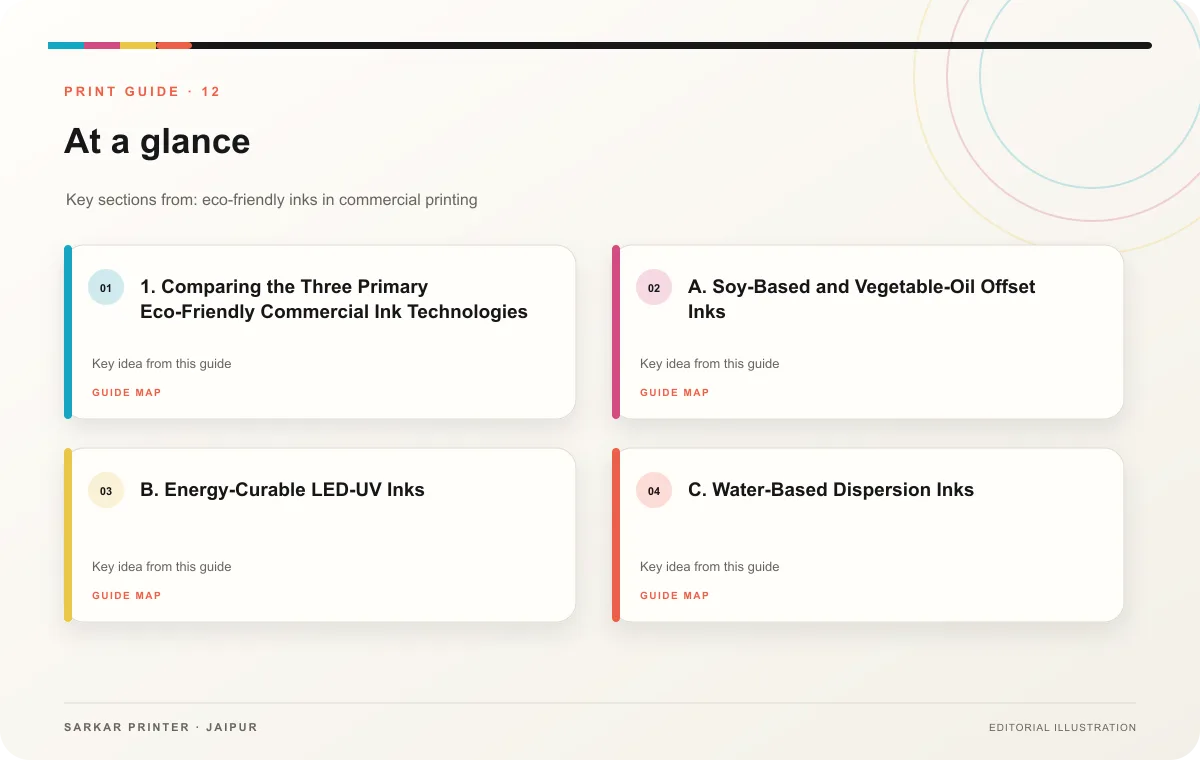
1. Comparing the Three Primary Eco-Friendly Commercial Ink Technologies
Modern commercial offset manufacturing utilizes three primary sustainable ink systems. Specifically, each chemical formulation offers distinct drying mechanisms and operational strengths:
A. Soy-Based and Vegetable-Oil Offset Inks
Soy-based inks replace petroleum-derived mineral oils with refined soybean oil and linseed plant resins. Because vegetable oils possess lower viscosity and natural wetting properties, soy inks distribute smoothly across press rollers. As a result, ink transfer efficiency improves while pigment consumption drops by up to 15%.
Furthermore, VOC emissions depend on the complete ink formulation and drying process; check the supplier’s technical data and applicable requirements. However, because vegetable oils dry through air oxidation and paper capillary absorption, sheets require 4 to 8 hours of curing before post-press die-cutting. Therefore, scheduling press runs requires careful workflow planning.
B. Energy-Curable LED-UV Inks
LED-UV inks represent 100% solid chemical systems containing liquid monomers, oligomers, and photoinitiators. Rather than relying on solvents that evaporate into the atmosphere, LED-UV inks cure instantly under narrow-band ultraviolet light diodes. Consequently, VOC emissions are mathematically zero.
Moreover, instant polymerization eliminates the need for spray anti-setoff powders in the press delivery pile. In addition, cured ink films provide outstanding chemical resistance and surface hardness. When paired with high-precision commercial print color accuracy standards, LED-UV inks maintain tight Delta E tolerances across non-porous synthetic substrates.
C. Water-Based Dispersion Inks
Water-based inks utilize water as the primary solvent carrier for organic pigments and acrylic resins. Widely deployed in flexographic corrugated packaging and food-contact packaging, water-based formulations eliminate heavy metals and toxic amines. Consequently, cartons comply with strict food safety migration thresholds.
Comparative Ecological & Mechanical Footprint
Comparing industrial attributes across green ink systems in modern sheetfed offset production
Renewable Raw Materials
Derived from agriculture. Superior de-inkability during recycling and rich dot reproduction on uncoated stocks.
Zero VOC & Instant Dry
Instant cold curing with 70% lower electrical power. Eliminates spray powder and accelerates post-press converting.
Low chemical migration thresholds. Formulated specifically for secondary food cartons and corrugated shippers.
2. Recyclability and the De-Inking Imperative
Sustainability extends beyond the print shop floor into the circular recycling stream. Specifically, when paper waste arrives at repulping mills, printed ink must detach cleanly from cellulose fibers during alkaline flotation de-inking.
Traditional petroleum inks bind tenaciously to fibers, requiring harsh chemical bleach to separate. Consequently, residual ink particles darken the recycled slurry, forcing mills to downgrade pulp into low-grade egg cartons.
In contrast, soy vegetable inks dissolve smoothly during standard hydrapulping. Laboratory tests under INGEDE Method 11 de-inking standards confirm that bio-based vegetable inks yield significantly whiter recycled paper pulp. Therefore, specifying vegetable inks ensures printed packaging participates fully in circular recycling loops.
3. Technical Specification Matrix: Eco-Friendly Inks in Commercial Printing
To assist procurement managers in specifying green pressroom chemistry, the following matrix compares industrial performance metrics:
*Note: Bio-renewable percentage measured in accordance with ASTM D6866 carbon isotope radiocarbon dating standards.
4. Operational Factors When Converting to Sustainable Inks
Transitioning pressrooms to eco-friendly inks commercial printing requires balancing mechanical roller settings and press chemistry:
A. Press Wash Chemistry and Low-VOC Blanket Washes
Using green inks while cleaning press rollers with toxic hydrocarbons defeats sustainability goals. Therefore, modern factories utilize vegetable-ester roller washes and flash-point solvents exceeding 100°C. Consequently, press cleaning releases zero dangerous fumes into factory air.
B. Substrate Whiteness and Rub Resistance
Because vegetable oils dry through fiber penetration, porous uncoated stocks absorb ink readily. To prevent scuffing during transit, printers apply inline water-based aqueous coatings over soy ink films. In addition, checking how paper selection influences overall offset printing cost in Jaipur ensures you optimize board grades without paying for unnecessary substrate weight.
C. Pressroom Energy Footprint and Carbon Accounting
Traditional mercury-vapor UV curing lamps generate immense heat and ozone, requiring high exhaust ventilation. In contrast, solid-state LED-UV lamps consume 70% less electricity and generate zero ozone. Furthermore, understanding the mechanics of what is offset printing helps print buyers appreciate how modern green press lines lower overall carbon footprints.
5. Five Procurement Best Practices for Sustainable Print Sourcing
To ensure genuine environmental compliance and avoid corporate greenwashing, enterprise procurement teams should enforce standard verification checks:
- Mandate Certified Soy Ink Trademarks: Require printer verification under the American Soybean Association SoySeal standards. This certifies minimum 20% soy oil content.
- Specify Mineral-Oil Free Inks for Food Packaging: Ensure food cartons are printed with MOAH/MOSH-free inks to prevent hydrocarbon migration into edible goods.
- Require Low-VOC Press Audit Certificates: Request air quality monitoring reports confirming factory VOC emissions comply with local industrial pollution limits.
- Pair Green Inks with FSC-Certified Substrates: Match sustainable inks with Forest Stewardship Council certified boards to guarantee an ethical raw material chain of custody.
- Verify Heavy-Metal Free Organic Pigments: Demand compliance with RoHS and EN 71-3 safety regulations, confirming inks contain zero toxic lead or cadmium pigments.
6. Summary: Driving Value with Eco-Friendly Inks in Commercial Printing
Ultimately, adopting sustainable press chemistry is both an ecological imperative and a competitive commercial advantage. By deploying advanced eco-friendly inks commercial printing technology, brand owners meet strict ESG sustainability benchmarks while enjoying brilliant color saturation and crisp halftone reproduction.
When renewable vegetable oils, zero-VOC LED-UV curing, and certified recyclable substrates unite, commercial print manufacturing demonstrates that high-volume production can thrive in harmony with environmental stewardship.
TALK TO OUR PRESS EXPERTS
Planning high-volume brochures, mono cartons, or custom rigid boxes? Get factory-direct offset quotes with precision Pantone color matching.