
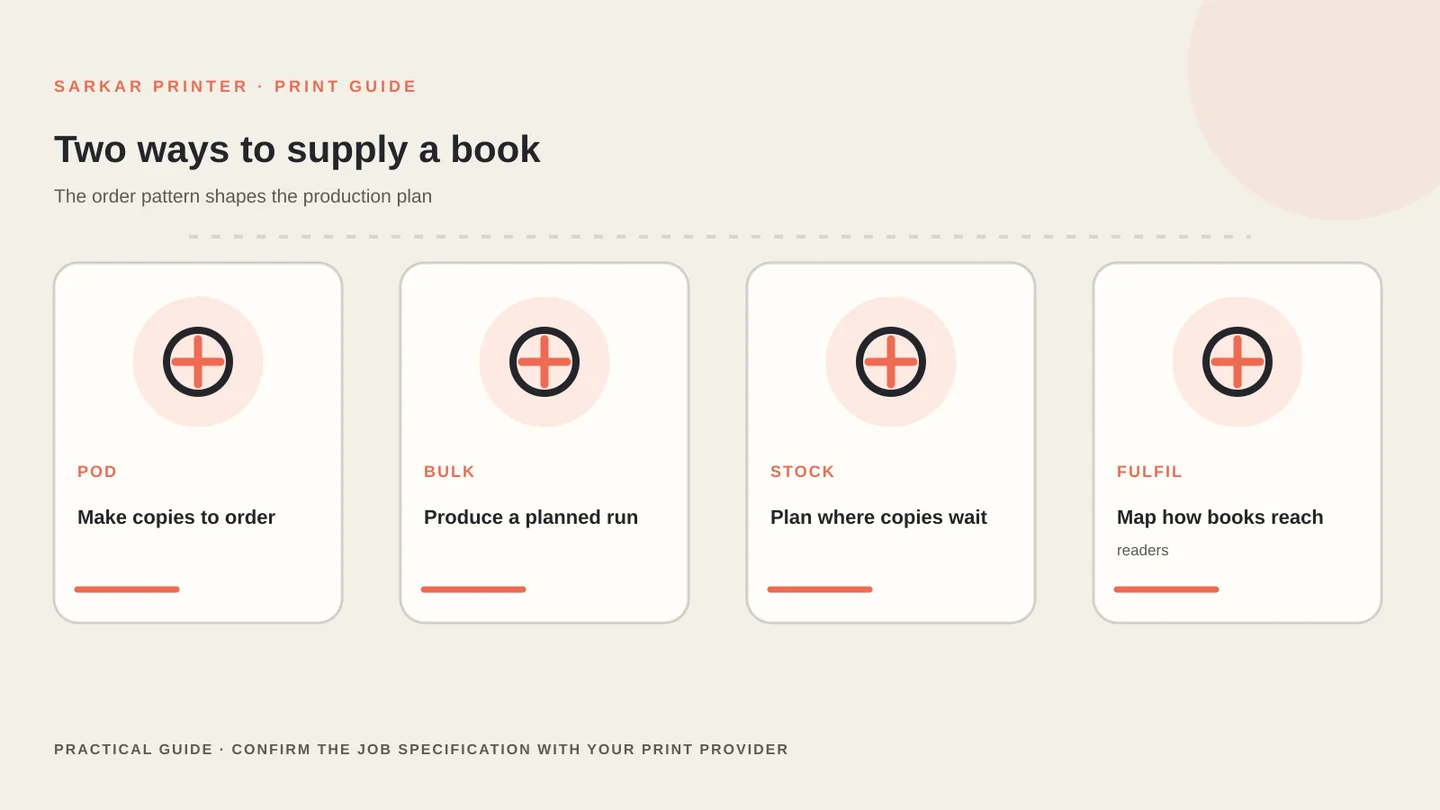
Print on demand means a copy is produced after an order or request reaches the fulfilment workflow. A publishing platform stores the approved title files and prints copies when demand appears. The model can reduce the need to hold a large finished inventory, but the provider’s file rules, available formats and delivery terms matter.
What print on demand means for a book
Bulk printing produces a planned quantity in a scheduled run. A publisher decides how many copies to make, approves the production specification and manages storage or distribution after manufacture. The approach gives the publisher a planned stock of copies, while asking for a demand estimate and a plan for unsold inventory.
Neither model fits every title. Consider how copies will be sold, whether you need them together for an event, how often content changes, which binding and paper you want, and how the supplier handles fulfilment. Start with our book printing planning guide.
Compare the cost structure without guessing a break-even point
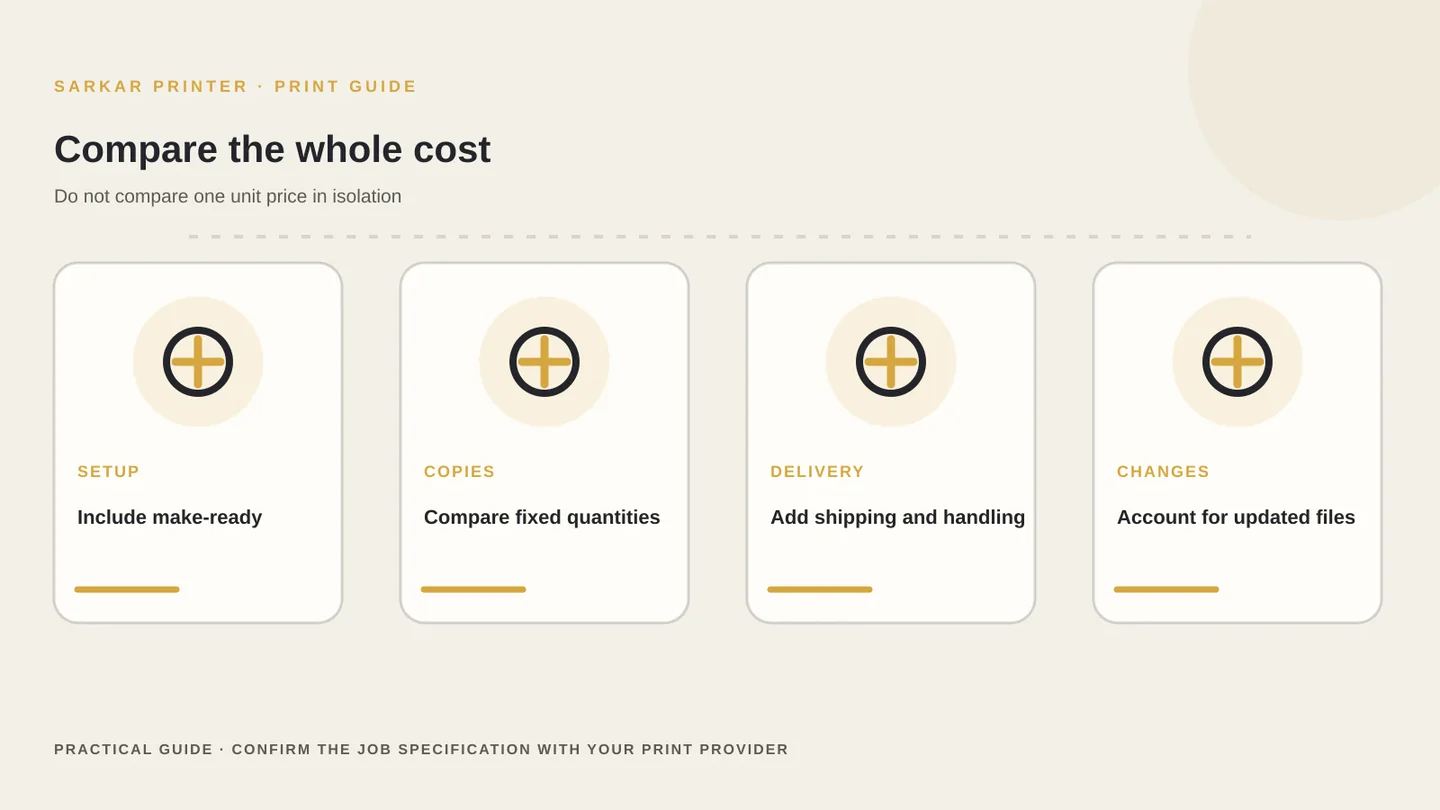
Print on demand can avoid a large upfront stock order, but the per-copy price, shipping, marketplace fees and fulfilment terms depend on the provider. A single copy may use a different production route from a larger run. Request a current quote and check whether it includes production, packing, delivery and any platform charge.
Bulk printing includes setup and make-ready work. A larger run may spread some fixed production costs across more copies, but the outcome depends on page count, size, paper, colour coverage, binding, finishing, waste allowance and delivery. Ask for two or three quantities using the same specification so the comparison stays fair.
Build the decision around the whole order, not one unit-cost figure. Add stock handling, storage, pick-and-pack, reprints, delivery to multiple locations and likely manuscript changes. IngramSpark describes its own print-on-demand model for independent publishers; use each provider’s published terms for your own calculation.
Plan for demand, revisions and availability
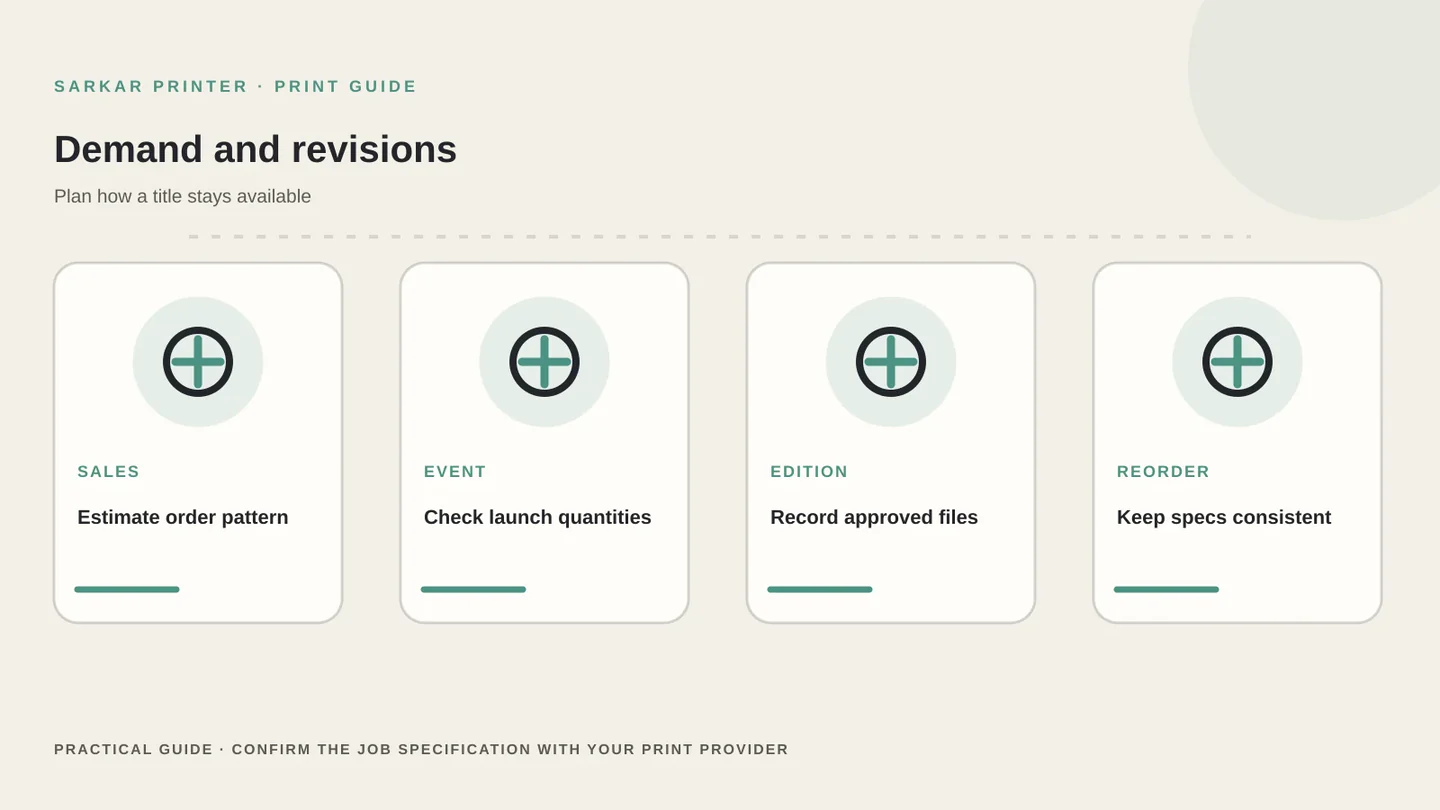
POD can suit titles with uncertain demand, a long selling life or orders arriving one at a time. A publisher can keep a title available through a participating platform without storing a large run. Check the provider’s edition-update process, available formats, shipping coverage and final delivery window.
A bulk run may work better when a publisher needs copies together for a launch, school term, conference or retail distribution plan. It can also support a paper, binding or finishing combination that a POD catalogue may not offer. Confirm production capacity and delivery timing before announcing an event date.
Some publishers combine the approaches: they make an initial batch for known demand and use another fulfilment route for occasional replenishment. That plan only works when both routes can keep trim size, cover, paper appearance and binding consistent enough. Keep one approved master file and record each edition.
Prepare a fair comparison before choosing
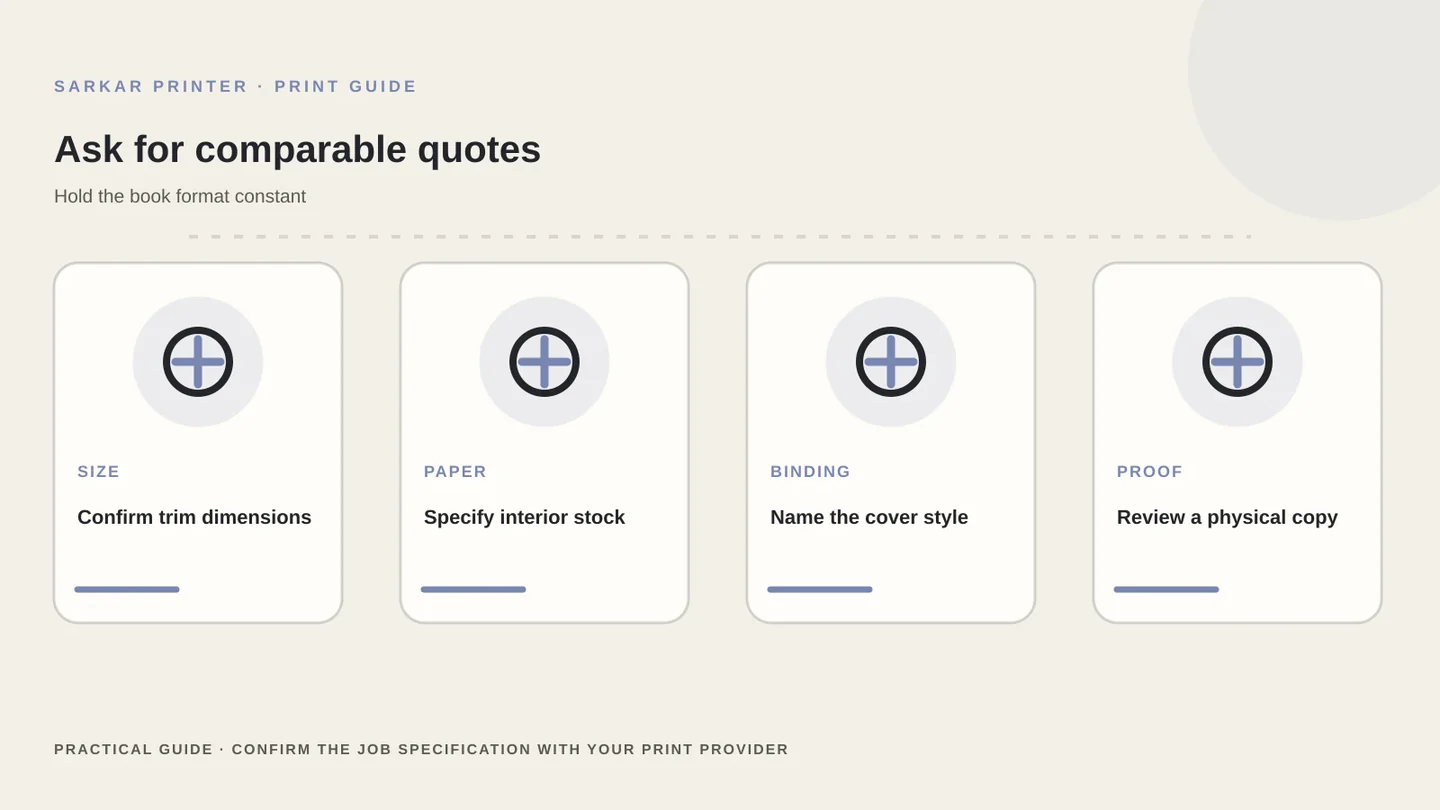
Give every provider the same page count, finished size, interior colour, paper, cover format, binding and delivery destination. Ask how each workflow handles proof approval, changes after sign-off, reprints and damaged copies. A quote that omits delivery or finishing does not describe the same product as a complete estimate.
Approve a physical proof when paper, colour, binding or cover finish matters. Check page sequence, margins, spine width, cover wrap, text size and images that cross a spread. Use our types of printing guide to frame the production conversation, then record the selected edition and date.
If you need an event batch, classroom set or repeatable publisher run, share the finished book specification with Sarkar Printer’s team. The right comparison starts with a clear brief, not a promise that one print model always costs less.
Print on demand and bulk printing compared
Features and terms vary between providers. Confirm the current service, specification and price before choosing a production plan.
| Decision | Print on demand | Bulk printing |
|---|---|---|
| Production timing | A copy is made after an order or request | A planned quantity is produced together |
| Inventory | Can reduce publisher-held finished stock | Requires a plan for storage or distribution |
| Cost comparison | Check per-copy price, fulfilment and platform terms | Compare setup, quantity, finishing and delivery |
| Revisions | Check how updated files replace an edition | Plan whether a change needs a new production run |
| Best first question | How will orders be printed and fulfilled? | How many copies do we need and where will they go? |
CONTINUE THE PRINT PLAN
Make the next print decision with a clear brief.
Start with your finished book specification and a realistic demand plan. Explore book and booklet printing, offset printing, or ask for a production conversation.
Frequently asked questions
Is print on demand the same as digital printing?
Print on demand describes when copies are produced in response to demand. A provider may use a digital process, but the fulfilment model and printing technology describe different parts of the service.
Is bulk printing always cheaper per book?
Not always. Compare the same format and include setup, quantity, paper, binding, finishing, delivery, storage and unsold stock before drawing a conclusion.
When should a publisher consider print on demand?
Consider it when orders arrive irregularly, demand is uncertain or holding stock is difficult. Verify the provider’s formats, file rules, delivery coverage and update process.
Can a publisher use both print on demand and bulk printing?
Yes. Some publishers plan a batch for known demand and a separate route for occasional copies. Confirm that both routes can maintain the edition’s specifications.