
Learn how paper grain affects folds, page opening and finishing, and what to confirm with your printer before a brochure or book run. Evaluate surface curing, adhesion, and gloss reflectance aligned with Fogra graphic technology specifications and sustainable substrate handling under FSC chain-of-custody guidelines.
What paper grain direction means
Paper grain describes the predominant direction in which fibres align as the sheet is made. Stock can be long-grain or short-grain relative to its sheet dimensions. The supplier’s packaging or stock specification may identify the direction; do not infer it from the visible face alone.
Grain matters because paper bends, folds and responds to moisture differently along and across the fibre direction. The practical effect depends on grade, coating, thickness, humidity and finishing steps.
Check grain against the fold
Folding parallel to the grain often produces a cleaner fold than folding across it, while a fold against the grain can show more resistance or cracking on some stocks. This is a useful starting principle, not a substitute for a material-specific test.
For a brochure or carton, compare the planned fold with the sheet grain and talk through printing, coating, scoring and folding. A sample made from the intended stock gives a better answer than a general rule.
| Print use | Grain question | Useful confirmation |
|---|---|---|
| Folded brochure | Does grain run parallel to the main fold? | Ask about sheet orientation and review a folded sample. |
| Book or booklet | How will grain run relative to the spine? | Confirm imposition, page opening and cover stock. |
| Folding carton | How does grain relate to scores and opening? | Review the dieline and test a sample through finishing. |
| Unspecified paper | Can the direction be identified on this stock? | Ask the supplier or printer; do not guess from dimensions. |
Plan grain direction for books and multi-page pieces
For a bound item, discuss how the pages should open and how the grain will run relative to the spine. The right choice depends on page size, sheet orientation, imposition and available stock. A printer can confirm the production layout before a long run.
If the item uses a different cover stock, heavy coating or unusual format, review the cover separately. A good dummy can reveal pages that resist opening, a cover that curls or a fold that does not sit as expected.
Put grain direction into the print brief
Record the finished size, fold or binding, stock name and any grain preference in the brief. Ask the printer to confirm available sheet orientation and whether scoring or a sample is recommended. This makes the requirement visible before prepress and imposition.
When comparing quotes, compare the same stock and finishing scope. If a supplier proposes a different sheet orientation or paper grade, ask how it affects the fold and finished piece instead of comparing the quoted GSM alone.
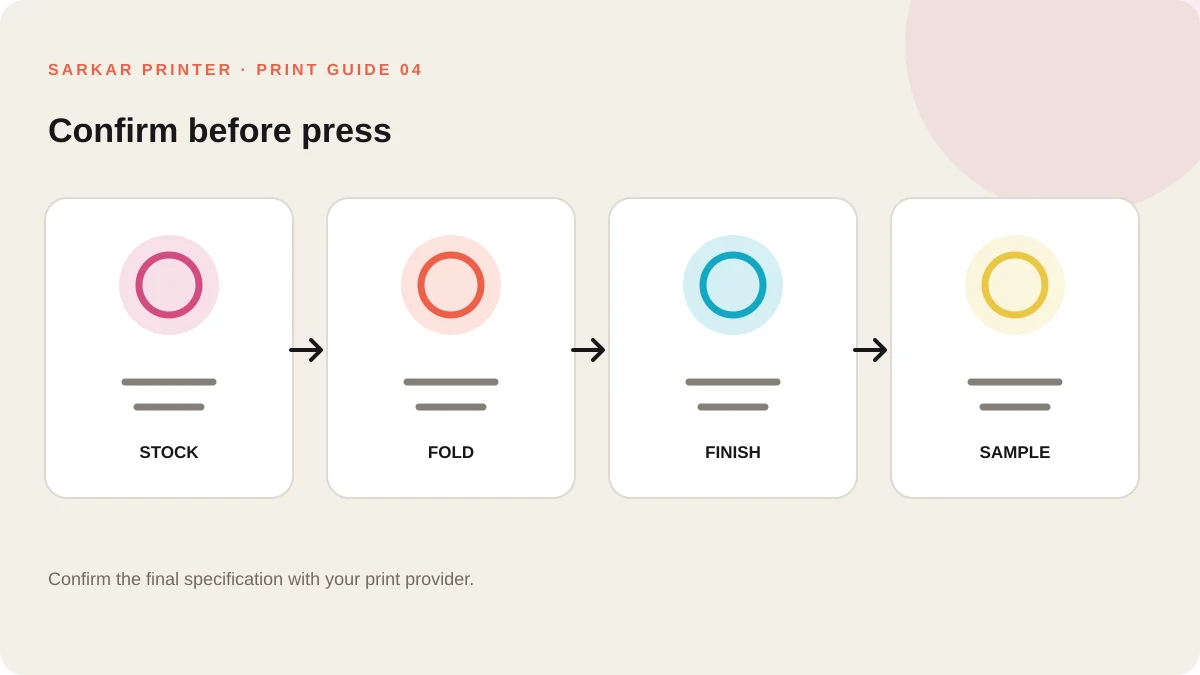
Print brief checklist
- Name the exact stock, not only a GSM range.
- Describe the fold, score, binding or carton structure.
- Ask the printer to confirm grain against the production layout.
- Approve a sample when the fold or opening is critical.
For product-specific options, see Book and booklet printing or send the team a print enquiry.
Frequently asked questions
Why does paper grain matter in printing?
Grain can affect how paper folds, bends and opens. The result depends on the stock and finishing process, so confirm direction for the actual job.
Should a brochure fold with the grain?
Folding parallel to the grain is often a useful starting point for a cleaner crease, but stock, coating and construction can change the result.
How can I find paper grain direction?
Check the supplier’s label or specification and ask the printer. A fold comparison can indicate direction, but it is not a calibrated measurement.
Does every book need grain parallel to the spine?
Many book workflows consider grain relative to the spine, but the final choice depends on sheet, format, imposition and stock. Ask the printer to confirm.