
Take a close look at a high-end luxury cosmetic carton, a glossy magazine cover, or a clean corporate catalog. You will notice sharp, edge-to-edge text, rich color depth, and completely uniform ink laydown. That level of industrial precision comes down to one question print buyers ask: what is offset printing?
Despite decades of digital advancements, commercial manufacturing still relies heavily on this classic lithographic method. Because when brands require volume, consistent spot colors, and low unit economics, nothing beats an industrial offset press.
Here is your complete guide to understanding how offset lithography works, where it outperforms digital alternatives, and how to decide if it fits your next bulk run.
What is Offset Printing? The Core Principle
At its heart, offset printing is an indirect planographic technique. Rather than stamping ink straight from a plate onto paper, the press first offsets the image onto a rubber cylinder, which then rolls it onto your chosen substrate.
The underlying process runs on a basic chemistry rule: oil and water do not mix.
Unlike relief methods that rely on raised letterforms or gravure that carves physical grooves, an offset plate is completely smooth. Digital imaging systems treat the image areas on an aluminum plate with an oleophilic (oil-attracting) coating.
Meanwhile, non-image sections receive a hydrophilic (water-attracting) wash called fountain solution. Because the ink is oil-based, it adheres strictly to the graphic areas while sliding off the damp non-image space. That is why lines stay razor-sharp across thousands of impressions.
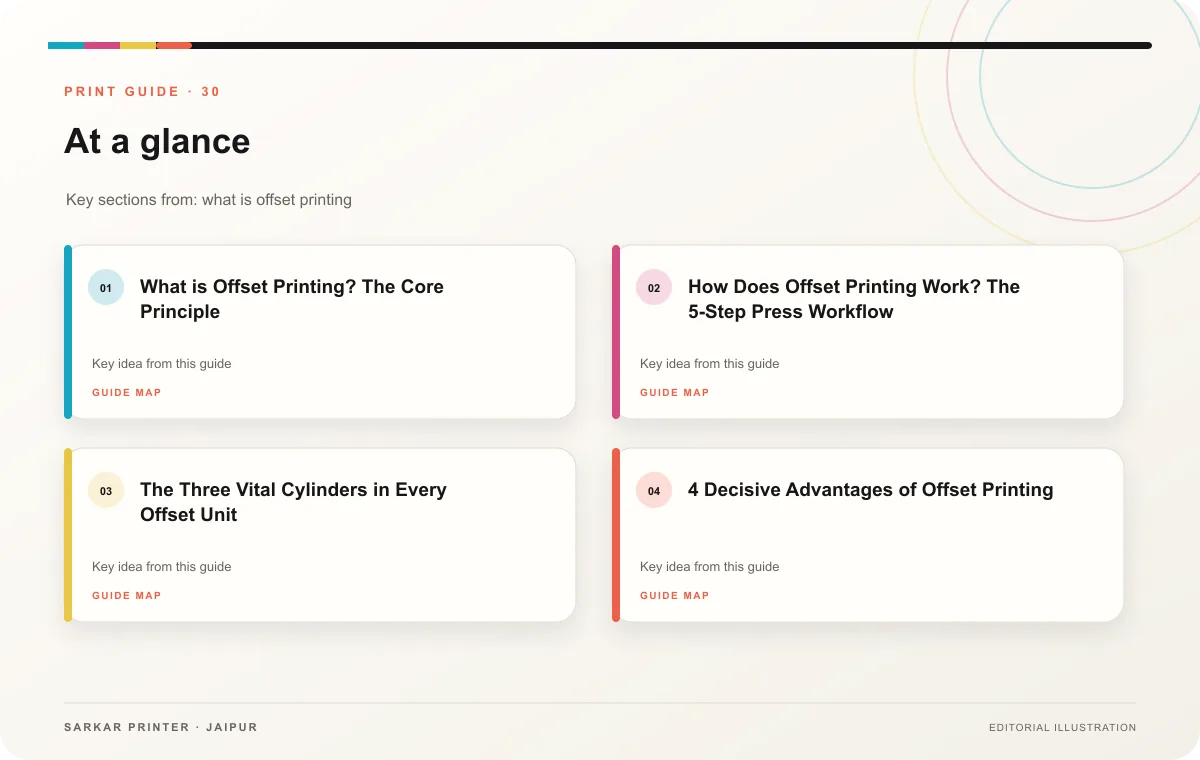
How Does Offset Printing Work? The 5-Step Press Workflow
Producing a large-scale commercial run follows a tightly controlled mechanical workflow from prepress to post-press finishing.
- Prepress and CTP Etching: Designers separate artwork files into four primary process colors (Cyan, Magenta, Yellow, Black) or designated Pantone Matching System (PMS) channels. A Computer-to-Plate (CTP) laser then burns each separation onto individual aluminum plates.
- Press operators mount each plate onto its dedicated printing unit. They fine-tune mechanical registration pins down to fractions of a millimeter to ensure clean color alignment.
- Dampening and Inking: As cylinders spin, water dampening rollers wet the plate, followed immediately by inking rollers that deposit oil-based ink onto the receptive graphics.
- Blanket Transfer: The plate transfers its wet reverse image onto an elastic rubber blanket cylinder. This blanket flexes against the surface grain of paper or board, transferring a clean right-reading impression.
- Drying and Finishing: High-speed presses dry ink using infrared heat, anti-setoff powder, or instant ultraviolet (UV) curing units before passing sheets to bindery lines for slitting, folding, and packaging.
The Three Vital Cylinders in Every Offset Unit
Each color station on an industrial press functions using three synchronized rotating drums:
- The Plate Cylinder: Holds the imaged aluminum plate securely and feeds directly against dampening and ink trains.
- The Blanket Cylinder: Wrapped in a high-density synthetic rubber blanket. Because paper has microscopic peaks and valleys, the resilient rubber cushions the impact, preventing ink mottling.
- The Impression Cylinder: A heavy steel roller running counter to the blanket. It applies calibrated tonnage, pressing sheet stock against the rubber blanket to guarantee full ink transfer.
4 Decisive Advantages of Offset Printing
For growing enterprises and procurement managers, offset delivers specific operational benefits:
- Unmatched Economies of Scale: You pay a fixed setup fee for plate creation and press make-ready. But after that threshold, the incremental price of paper and ink drops rapidly. That is why your per-unit cost falls steeply at 2,000, 5,000, or 50,000 units.
- True Pantone (PMS) Color Fidelity: While 4-color process printing blends dots to approximate shades, offset allows pre-mixed spot inks. If your corporate brand guidelines demand an exact Pantone shade, offset delivers it accurately on every run.
- Broad Substrate Range: Because the rubber blanket is pliable, you are not limited to standard coated paper. You can print cleanly on rough handmade stock, heavy cardstock, corrugated board, and non-porous plastics.
- Uniform Ink Solids: Offset eliminates digital streaking, banding, and toner cracking along heavy fold lines.
Limitations to Consider Before You Order
Offset is built for scale, which introduces two clear trade-offs:
- High Minimum Setup Costs: Creating separate physical plates and tuning color balances requires press time, test paper, and skilled labor. Small orders under 500 units become economically inefficient.
- Static Graphics (No Variable Data): Every sheet coming off the blanket matches the metal plate exactly. If you need dynamic addresses, sequential serial numbers, or variable barcodes, you will need hybrid offline numbering or inline digital equipment.
Offset Printing vs. Digital Printing: Quick Comparison
When evaluating production paths, review these comparative specifications:
Common Commercial Applications
- Packaging & Cartons: Rigid mono cartons, pharmaceutical inserts, and folding boxboards.
- Corporate Marketing: Wire-bound and saddle-stitched catalogs, annual reports, pocket folders, and high-volume brochures.
- Business Stationery: Exact-match brand stationery, secure billing documents, and multi-part accounting ledgers.
- Publishing: Softcover and casebound books, long-run academic texts, and magazines.
Frequently Asked Questions
What is the typical turnaround time for an offset run?
Turnaround depends on proof approval, press availability, quantity, stock and finishing. Confirm the production and delivery dates in the written quotation.
Can offset presses handle custom coatings?
Yes. Modern presses frequently feature inline coating towers to apply flood gloss, matte aqueous finishes, soft-touch coatings, or spot UV varnishes directly after the ink units.
How should I prepare my design files for offset printing?
Submit vector-based PDFs with all fonts converted to outlines. Ensure full-color assets are converted from RGB to CMYK, raster imagery sits at 300 DPI, and your document includes a standard 3mm (1/8") bleed margin.
Plan an Offset Print Run
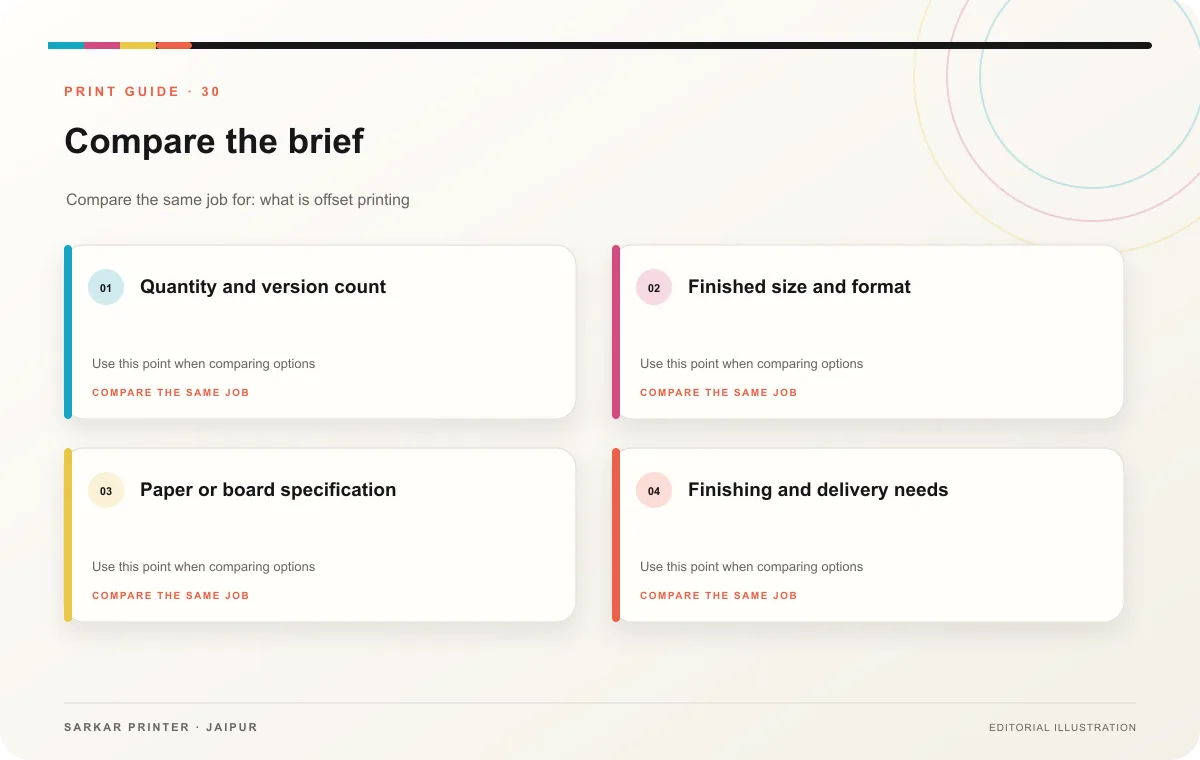
For a job enquiry, share the artwork status, quantity, material, finish and target date with Sarkar Printer. Ask the team to confirm the available production route, any applicable process records and the delivery schedule in the written quotation.
Whether you need strict Pantone matching for corporate collateral or large-volume mono cartons, our team manages your print run from digital prepress to final bindery. Reach out to our team today to review your project specs and request an enterprise quote.
TALK TO OUR PRESS EXPERTS
Planning high-volume brochures, mono cartons, or custom rigid boxes? Get factory-direct offset quotes with precision Pantone color matching.