
Looking for the right answers in our offset printing FAQ's? When you hold a luxury rigid box, a crisp annual report, or a vibrant product catalogue, achieving that pinpoint sharpness comes down to high-precision commercial lithography.
Yet, for business founders, production coordinators, and agency managers, navigating press options can feel daunting. That is why compiling these practical offset printing FAQ's cuts through the technical jargon to give you transparent, actionable insights for your brand collateral.
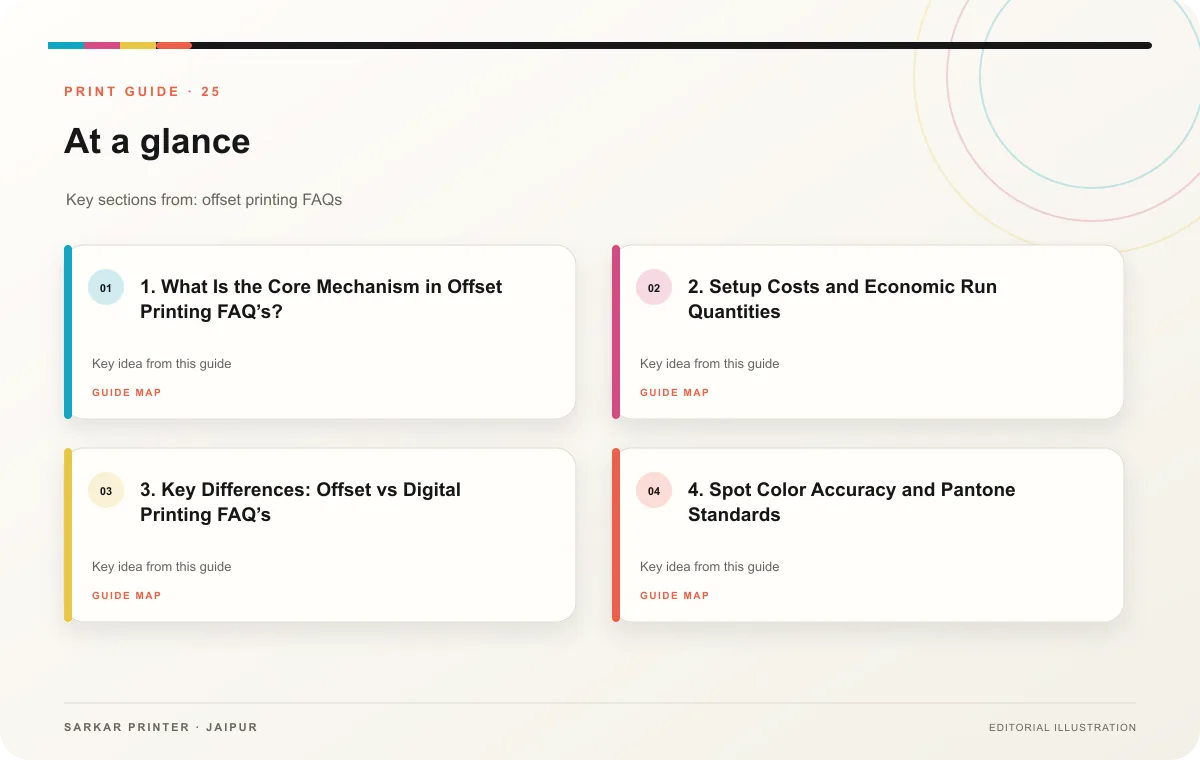
1. What Is the Core Mechanism in Offset Printing FAQs?
The defining characteristic of offset lithography is indirect ink transfer. Instead of applying ink straight from an image carrier to the sheet, the image transfers across three distinct mechanical cylinders.
First, custom aluminum plates receive water and oil-based ink. Because water repels the oil ink, only the designated artwork areas hold the color. Next, the plate cylinder transfers (or "offsets") this inked image onto an intermediate rubber blanket cylinder.
Finally, the rubber blanket rolls the impression directly onto your paper stock. Because rubber conforms flexibly to paper surfaces, this method yields sharp text, unbroken solid tones, and distortion-free graphics on every sheet.
2. Setup Costs and Economic Run Quantities
A recurring question across most offset printing FAQ's concerns setup pricing. Conventional lithography requires dedicated aluminum plates, manual ink-duct calibration, and make-ready test sheets for every individual job.
Because these upfront fixed costs occur before a single finished sheet exits the delivery pile, small runs below 500 units carry a relatively high cost per unit. However, once those press cylinders start rolling at 10,000 to 15,000 impressions per hour, the marginal cost drops dramatically.
That is why orders exceeding 1,000 units achieve remarkable economic efficiency. The higher your total volume, the lower your per-piece expense, making bulk print procurement exceptionally cost-effective.
3. Key Differences: Offset vs Digital Printing FAQs
Understanding whether to choose digital engines or heavy-duty press lines hinges on order volume, lead times, and customization requirements.
Digital printing operates like an industrial office printer, depositing toner or liquid ink directly onto sheets without mechanical plates. It delivers fast turnaround times that depend on provider, workload and finishing and excels at variable data, such as personalized addresses or unique numbering.
In contrast, offset printing locks the artwork onto rigid plates. It requires longer setup preparation, but it provides unmatched color consistency, broader substrate flexibility, and far superior unit economics for commercial runs.
4. Spot Color Accuracy and Pantone Standards
For enterprise brands, maintaining exact color identity across corporate collateral is non-negotiable. Standard four-color process printing (CMYK) simulates colors using microscopic dot patterns, which can shift slightly across long runs.
Offset machinery bypasses this risk by supporting custom-mixed inks formulated to the Pantone Matching System (PMS) . Press operators mix exact pigment recipes before feeding the ink fountain, guaranteeing absolute shade accuracy on every run.
Furthermore, leading commercial facilities align press parameters with the rigorous ISO 12647-2 standards certified by the Fogra Research Institute . This closed-loop process control ensures consistent optical density from the first sheet to the fifty-thousandth sheet.
5. Substrate Flexibility: Paperboard and Heavy Cardstock
A critical operational advantage revealed in comprehensive offset printing FAQ's is substrate adaptability. While digital production engines often struggle with rough textures or heavy calibers, offset presses handle diverse media with ease.
Standard offset equipment feeds delicate 60 GSM Bible paper up to rigid 400 GSM folding box board (FBB). Whether you specify high-gloss coated stock for photo journals, matte velvet art paper for lookbooks, or raw uncoated kraft for natural packaging, the ink adheres smoothly.
Because the flexible rubber blanket accommodates surface peaks and valleys, your prints avoid the mottled patches frequently seen on textured linen or embossed papers.
6. Why Product Packaging Relies on Offset Methods
Product packaging serves as the initial tactile touchpoint between your brand and your end consumer. A flimsy carton or a misaligned color bar damages brand authority immediately upon unboxing.
Offset lithography remains the primary production standard for mono cartons, outer shipping sleeves, and retail display trays. It delivers uniform solid ink coverage and pairs smoothly with inline post-press enhancements.
After laying down ink, sheets can pass straight into UV curing tunnels, aqueous coating modules, foil-stamping presses, and high-speed die-cutters. This mechanical integration turns raw paperboard into durable, luxury packaging ready for retail shelves.
7. Proofing Protocols: Protecting Quality Before Mass Runs
The final safeguard in any professional printing workflow is pre-flight verification. Once physical plates are burned and bolted onto cylinders, changing artwork requires manufacturing fresh plates and re-calibrating fountains.
That is why reliable press operators provide calibrated digital contract proofs or physical press proofs before mass output begins. Reviewing an accurate hard-copy proof allows your design team to check spelling, verify fold lines, and confirm image cropping under controlled lighting.
Catching layout oversights during the proofing phase prevents expensive material reprints and guarantees that your delivered shipment matches your design intent.
Strategic Comparison: Production Capabilities at a Glance
Essential Offset Printing FAQs for Regional Brands
Choosing between production paths comes down to balancing campaign budgets, project deadlines, and quality standards. If your project involves fast prototyping, short test runs, or personalized recipient data, digital print serves your needs well.
However, when launching major brand campaigns, multi-page corporate catalogues, or commercial packaging, offset production remains the clear winner for quality and cost efficiency.
For a job enquiry, share the artwork status, quantity, material, finish and target date with Sarkar Printer. Ask the team to confirm the available production route, any applicable process records and the delivery schedule in the written quotation.
Review our custom manufacturing capabilities or contact our prepress specialists today to review your project specifications and receive an accurate commercial quotation.
TALK TO OUR PRESS EXPERTS
Planning high-volume brochures, mono cartons, or custom rigid boxes? Get factory-direct offset quotes with precision Pantone color matching.