
Discovering the latest offset printing trends is essential for commercial print buyers, procurement managers, and brand directors navigating high-volume production.
The days of sluggish, labor-intensive press rooms are rapidly giving way to connected, data-driven manufacturing floors. As market expectations tilt toward faster delivery windows, sustainable substrates, and tighter budgets, traditional lithography continues to evolve.
Here is your comprehensive breakdown of the major shifts redefining commercial lithography and how they directly affect your bottom line.
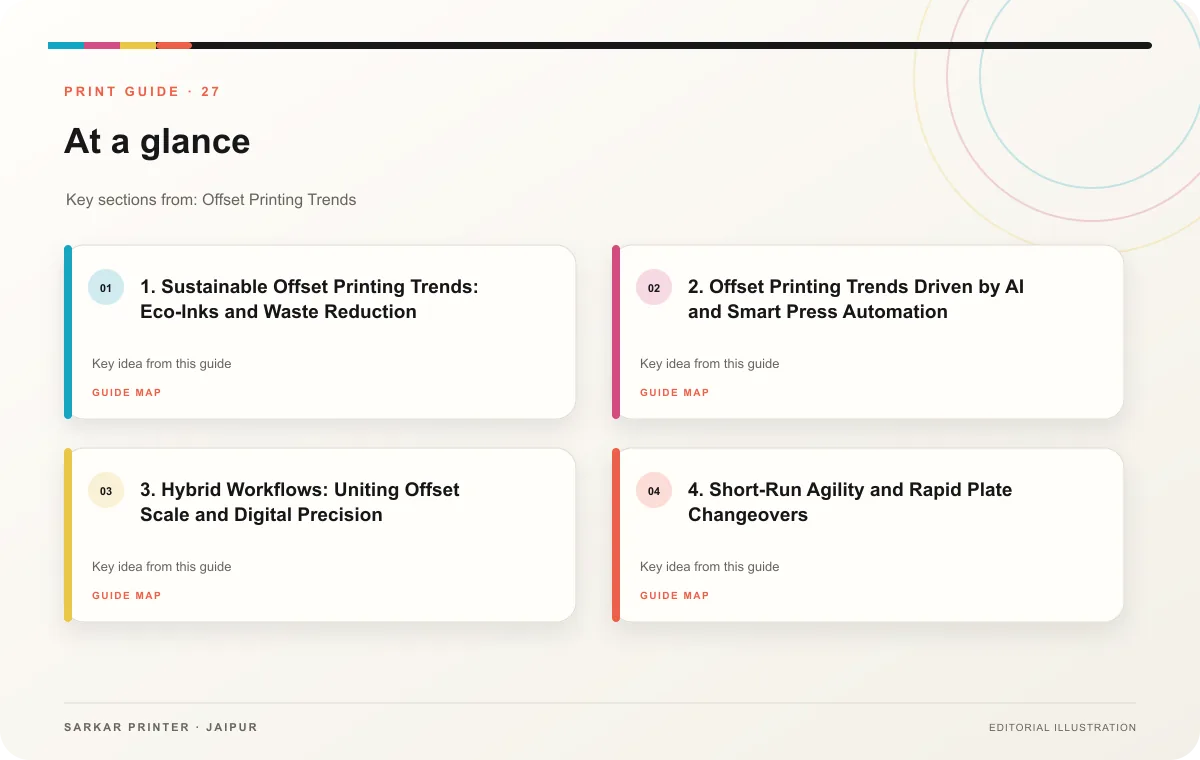
1. Sustainable Offset Printing Trends: Eco-Inks and Waste Reduction
When analyzing prominent offset printing trends, environmental sustainability leads commercial procurement requirements.
Corporate brands must actively minimize their carbon footprints. Historically, commercial pressrooms depended on petroleum-based inks and toxic solvents. In response, modern production facilities have shifted toward renewable, eco-friendly formulations.
Today, standard production runs rely on vegetable- and soy-based inks, which significantly curtail volatile organic compound (VOC) emissions. Furthermore, the expansion of waterless lithography and chemistry-free Computer-to-Plate (CTP) systems helps high-volume facilities eliminate contaminated wastewater entirely.
That is why aligning with these sustainable practices is now a mandatory baseline for securing institutional contracts.
2. Offset Printing Trends Driven by AI and Smart Press Automation
Artificial intelligence is driving some of the most impactful operational offset printing trends across modern facilities.
Press consoles have transitioned from manual mechanical stations into intelligent, software-driven command centers. Modern sheetfed presses utilize real-time optical sensors and AI algorithms that continuously monitor ink densities and registration alignment during production runs.
One of the most cost-effective innovations is "push-to-stop" technology . These automated platforms allow high-speed presses to queue, change over, and launch sequential jobs with minimal manual operator intervention.
Because make-ready calibration is handled digitally, start-up paper waste drops from thousands of test sheets to just a few hundred, directly lowering per-unit production costs.
3. Hybrid Workflows: Uniting Offset Scale and Digital Precision
The traditional boundary separating lithography from digital production is disappearing, generating highly practical hybrid workflows.
Enterprise campaigns often require the low unit cost of long-run lithography alongside the personalized touch of digital printing. To achieve this, pressrooms increasingly run static backgrounds, packaging shells, or catalog bodies on heavy offset presses first.
Once the bulk run finishes, the sheets pass through high-speed inkjet heads to print variable elements. This enables marketers to add localized dealer addresses, unique promotional QR codes, or personalized customer names across tens of thousands of identical sheets.
So, by merging these technologies, businesses capture bulk manufacturing rates while running targeted direct-mail and retail campaigns.
4. Short-Run Agility and Rapid Plate Changeovers
Historically, lithographic presses were considered practical only for orders exceeding 10,000 units. However, current market conditions have forced machinery to adapt to leaner supply chains.
Retailers and corporate buyers now avoid excess warehouse stock, favoring smaller, more frequent replenishment cycles. Press manufacturers have responded with fully automatic plate-loading mechanisms that swap all printing plates simultaneously in under five minutes.
Because make-ready turnaround times have fallen so drastically, lithography now competes aggressively against digital alternatives on mid-sized orders between 1,000 and 3,000 sheets. That means procurement managers no longer need to sacrifice sharp offset line quality just to keep order quantities manageable.
5. Structural Packaging and Smart Interactive Finishes
The packaging sector remains a primary engine driving advanced commercial print technologies.
Standard plain cartons no longer satisfy modern consumer expectations. Today's brands require premium folding boxboards, rigid micro-flute packaging, and multi-sensory unboxing experiences.
Presses now execute high-end tactile enhancements inline during the primary print run, including:
- Spot UV varnishes and tactile drip-off textural contrasts.
- Soft-touch matte coatings and scratch-resistant barrier layers.
- Precision hot foil stamping and structural 3D micro-embossing.
Additionally, manufacturers are incorporating scannable near-field communication (NFC) chips and dynamic serialized QR codes onto pharmaceutical and luxury packaging. This bridges the physical box with digital authentication, supply chain tracking, and interactive customer portals.
6. Robotic Assistance and Workforce Streamlining
Behind the factory doors, commercial printing is managing a major demographic transition.
As a generation of veteran press operators approaches retirement, manufacturers face a deficit of specialized pressroom technicians. Equipment builders have met this challenge by developing self-calibrating machinery equipped with intuitive touchscreen interfaces.
Modern press consoles operate much like enterprise software applications, automating ink zone presets and mechanical cylinder timing. Automated closed-loop dampening systems eliminate operator guesswork, preventing color drift and scumming.
Because automation handles mechanical micro-adjustments, high-volume facilities maintain uninterrupted around-the-clock schedules with zero compromise in sheet consistency.
7. Color Management: Offset Printing Trends in Quality Control
For multinational organizations, brand color consistency is non-negotiable.
Slight variations in corporate hues dilute brand recognition across retail shelves. Consequently, real-time spectrophotometric scanning has become an industry standard.
High-speed cameras built directly into the press delivery path scan every passing sheet at line speed, measuring microscopic color patches and comparing them to target digital proofs. If color density wanders by even a fraction of a Delta-E unit, the press automatically adjusts the corresponding ink keys.
This guarantees that pre-mixed spot shades and CMYK builds match your approved proofs from the first signature to the final bundle.
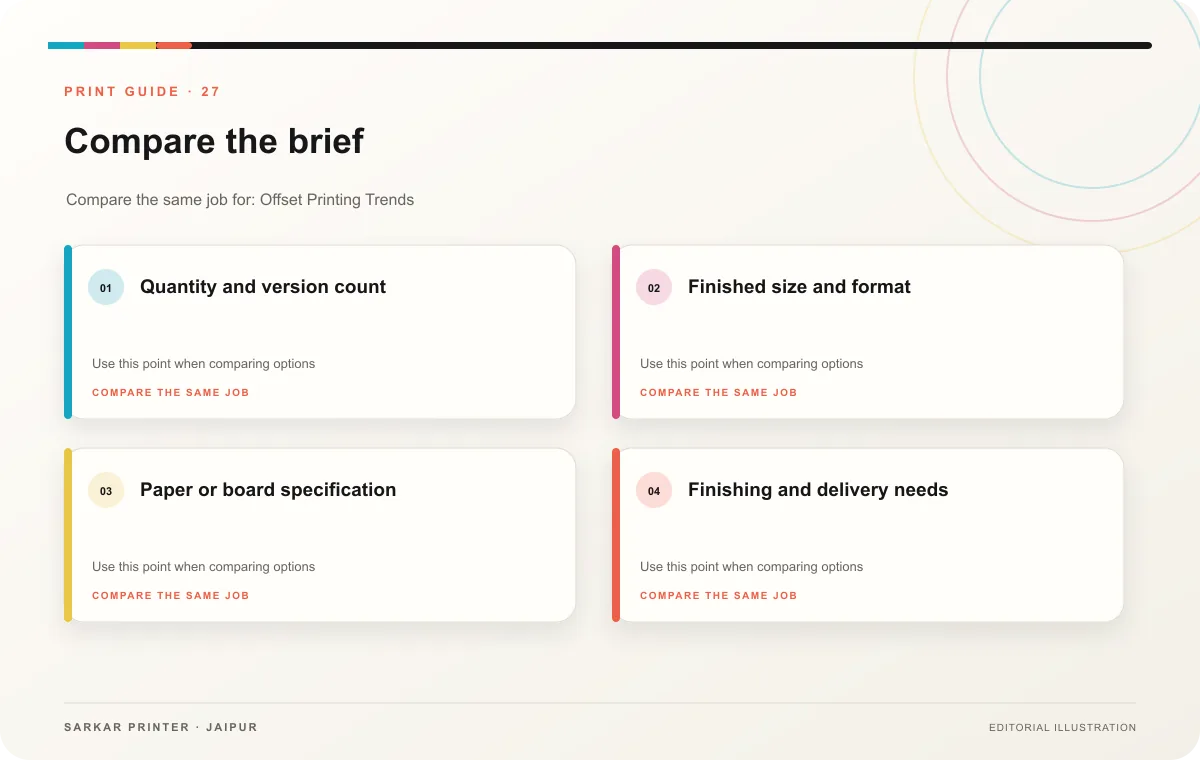
Summary: How Modern Offset Lithography Compares
Plan Your Commercial Print Brief
For a job enquiry, share the artwork status, quantity, material, finish and target date with Sarkar Printer. Ask the team to confirm the available production route, any applicable process records and the delivery schedule in the written quotation.
Whether you require high-volume retail folding cartons, commercial marketing catalogs, corporate brochures, or precision accounting ledgers, our team manages production to exact tolerances. Contact Sarkar Printer today to review your project specifications and secure an enterprise quote.
TALK TO OUR PRESS EXPERTS
Planning high-volume brochures, mono cartons, or custom rigid boxes? Get factory-direct offset quotes with precision Pantone color matching.