
Understanding the industrial rigid box manufacturing process is essential for luxury brand managers and packaging engineers. According to international packaging benchmarks from the European Carton Makers Association (ECMA) , rigid setup boxes offer superior mechanical crush resistance compared to standard folding cartons. Consequently, mastering greyboard grooving, corner staying, and automated wrap lamination ensures structural perfection for high-end consumer goods.
For corporate purchasing teams across Rajasthan, luxury rigid boxes represent the gold standard for premium packaging. Whether housing luxury confectionery, fine jewelry, or flagship consumer electronics, rigid setup boxes protect high-value goods during transport. Therefore, standardizing raw substrate parameters before locking production dies eliminates costly assembly failures.
Unlike folding cartons that ship flat, rigid boxes remain permanently formed. When planning your production schedule, mastering this comprehensive rigid box manufacturing process guide guarantees reliable pressroom execution. Furthermore, it elevates unboxing luxury.
Rigid Box Engineering & Manufacturing Mind Map
- 1. Core Structural Board Preparation High-Density Greyboard Selection (1.5mm to 3.0mm thickness).
- V-Grooving and U-Grooving for razor-sharp 90-degree outer corners.
- Rotary die-cutting and precision 4-corner scoring.
- 2. Tray Formation & Corner Staying Heat-sealable kraft or polymer tape applied to all 4 erect corners.
- Quad-stayer automated alignment ensuring squareness and perimeter strength.
- Tolerances aligned with our verified folding carton dieline design rules.
- 3. Outer Wrap Printing & Automated Gluing Offset printed Litho wrap (130 to 170 GSM coated art paper).
- Post-press embellishments: Hot foil stamping, matte lamination, and spot UV.
- Full animal-protein or PVA adhesive coating and tight mechanical turn-in.
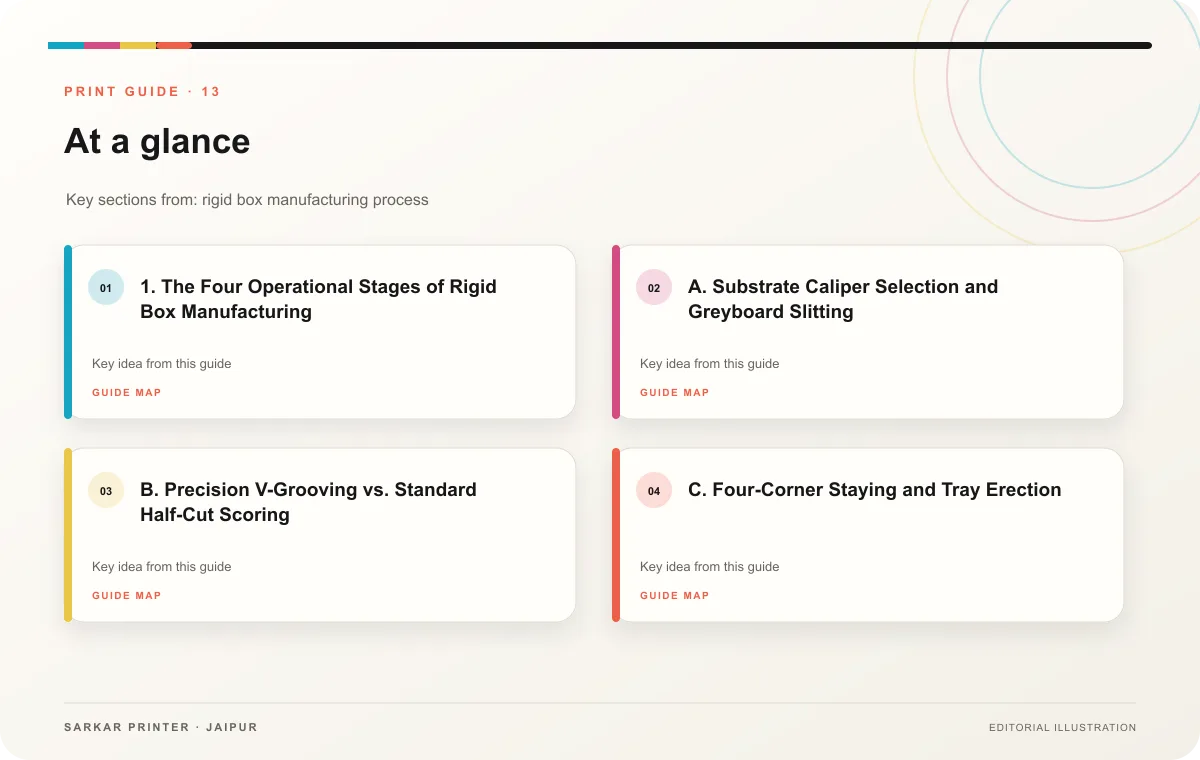
1. The Four Operational Stages of Rigid Box Manufacturing
In modern packaging factories, manufacturing a two-piece or hinged rigid box involves distinct operational steps. Specifically, four primary production stages define the workflow:
A. Substrate Caliper Selection and Greyboard Slitting
The structural backbone of any setup box is high-density chipboard or unbleached greyboard. Specifically, board caliper ranges between 1,000 microns (1.0 mm) and 3,000 microns (3.0 mm). High-speed rotary slitting machines cut master board sheets into precise rectangular blanks. Consequently, consistent caliper prevents warping during glue application.
Furthermore, board density directly dictates compression strength. Therefore, checking raw material specifications against our paper gsm selection guide ensures you choose the appropriate basis weight for your product load.
B. Precision V-Grooving vs. Standard Half-Cut Scoring
Traditional setup boxes use simple half-cut die scores to bend board edges. However, half-cut scoring leaves a rounded, blunt corner radius. In contrast, luxury packaging lines utilize automated V-grooving machinery. Specifically, carbide blades carve a 90-degree triangular channel halfway through the greyboard core.
Consequently, when the board folds upward, the outer corner forms a razor-sharp, crisp 90-degree right angle. As a result, the finished box exhibits the crisp geometric silhouette demanded by prestige electronics and perfume brands.
C. Four-Corner Staying and Tray Erection
Once the grooved flat blank is cut, an automated quad-staying machine erects the four vertical walls. Specifically, heat-activated thermal tape or reinforced kraft tape seals each corner under pneumatic pressure. Consequently, the stayed tray gains rigid three-dimensional stability.
Moreover, modern automated quad-stayers process up to 40 boxes per minute. In addition, tight alignment tolerances prevent corner skewing. Therefore, the lid fits smoothly over the base without jamming.
D. Outer Wrap Printing, Gluing, and Automated Wrapping
The rigid tray itself remains unprinted and grey. Therefore, aesthetic branding relies on an outer printed paper wrap, known as the litho wrap. Specifically, 130 to 157 GSM art paper is printed on multi-unit offset presses.
Next, specialized roller coaters apply a uniform thin layer of hot gelatin adhesive (animal glue) to the reverse side of the wrap. The stayed tray is placed onto the glued wrap with optical camera registration. Finally, automated wrapping arms wrap the paper around the base, folding 15mm turn-ins neatly inside.
Key Engineering Stages in Rigid Box Assembly
Step-by-step mechanical progression from raw greyboard to luxury retail packaging
V-Groove Architecture
90° or 120° precision blade cuts through 80% board caliper. Creates razor-sharp outer corner profiles.
Corner Tape Reinforcement
Thermal tape applied to all 4 corners simultaneously under pressure. Locks dimensional squareness.
Printed art paper glued with hot animal protein adhesive. Automated turn-in brushes tuck paper cleanly inside.
2. Common Styles: Lift-Off Lid vs. Book-Style Magnetic Closure
Rigid boxes accommodate diverse functional opening styles. Specifically, two structural designs dominate corporate packaging briefs:
A. Two-Piece Telescoping Box (Lift-Off Lid)
The two-piece setup box consists of an independent lid tray fitting over a matching base tray. Specifically, lid depth can be full-telescoping (covering the entire base) or partial-telescoping. Furthermore, precision tolerances create an audible air-cushion resistance during opening. Consequently, this slow-release sensation heightens luxury unboxing.
B. Book-Style Rigid Box with Magnetic Snap Closure
Book-style rigid boxes feature a single three-panel hinged outer case enclosing an interior three-sided tray. Furthermore, high-power neodymium magnets are embedded into the front lip and greyboard walls before wrapping. As a result, the lid closes with a satisfying, tactile click. In addition, pairing book-style structures with custom luxury packaging finishing techniques delivers unmatched brand prestige.
3. Technical Specification Matrix: Rigid Box Engineering Parameters
To assist packaging developers in finalizing technical drawings, the following engineering matrix outlines commercial setup box specifications:
*Note: Board caliper selection depends on finished box dimensions. Boxes exceeding 300mm length require at least 2.0mm greyboard to avoid center wall flexing.
4. Critical Engineering Considerations in Assembly
Achieving defect-free results in the rigid box manufacturing process requires strict factory climate controls. Specifically, three mechanical factors must be tightly managed:
A. Board Warping and Relative Humidity Control
Greyboard is hygroscopic, expanding and contracting with ambient humidity shifts. When water-based wet glue is applied, paper fibers absorb moisture rapidly. If the opposite side dries slower, tension forces cause board bowing. Therefore, advanced packaging facilities maintain controlled 50% relative humidity. Furthermore, using hot animal glue with low moisture content prevents warping.
B. Clearance Allowances Between Lid and Base
In lift-off telescoping boxes, the lid must slide over the base effortlessly. If dimensions are too tight, friction creates vacuum lock. Conversely, excessive clearance causes lid wobbling. Packaging engineers allocate an internal clearance offset of 2.0mm to 3.0mm in width and length. This compensates for paperboard thickness and folded wrap turn-ins.
C. Color Consistency and Surface Coatings
Because the outer paper wrap is printed separately before mounting, maintaining color fidelity across production batches is paramount. Utilizing strict commercial print color accuracy standards ensures brand hues match corporate guidelines across both lid and base. In addition, applying protective matte coatings prevents scuffing during automated wrapping.
Furthermore, evaluating project volume within our verified offset printing cost in Jaipur framework allows procurement teams to balance custom V-grooved luxury with bulk production economics.
5. Five Procurement Best Practices for Rigid Box Orders
To avoid production delays and ensure structural perfection, enterprise procurement officers should follow standard production protocols:
- Demand a Fully Wrapped White Structural Sample: Before approving tooling dies, request a physical blank mock-up. Testing actual product fit verifies wall stiffness and lid friction.
- Specify V-Grooving for Sharp Geometry: For luxury cosmetics and electronics, mandate V-grooving over die-cutting. This guarantees crisp, premium 90-degree corners.
- Verify Turn-In Dimensions on Inner Walls: Ensure outer paper wraps tuck at least 15mm inside the box rim. Consequently, you avoid exposed greyboard edges.
- Mandate Low-Odor, Non-Warping Adhesives: Specify fast-setting animal protein or hot-melt glues to prevent chemical odors inside gift packaging.
- Audit Pallet Stacking and Transit Packaging: Because rigid boxes cannot ship flat, specify sturdy corrugated outer cartons with internal dividers to prevent crush damage during freight.
6. Summary: Mastering the Rigid Box Manufacturing Process
Ultimately, high-end rigid packaging represents the intersection of structural engineering and fine print craftsmanship. By understanding each phase of the rigid box manufacturing process , packaging designers and procurement leaders ensure flawless protection and unforgettable brand presentation.
When greyboard caliper, precision V-grooving, and automated wrapping align seamlessly, the resulting packaging protects valuable products while reinforcing brand prestige on luxury retail shelves.
TALK TO OUR PRESS EXPERTS
Planning high-volume brochures, mono cartons, or custom rigid boxes? Get factory-direct offset quotes with precision Pantone color matching.