
Implementing rigorous pharmaceutical packaging printing standards is an absolute regulatory and operational mandate for life sciences procurement executives and packaging engineers. According to global good manufacturing practice benchmarks published under ISO 15378 primary packaging standards for medicinal products , packaging manufacturing controls directly prevent catastrophic product recalls, formulation contamination, and counterfeit diversion. Consequently, mastering high-resolution inline 2D DataMatrix serialization, low-migration ink systems, and 100% optical camera inspection guarantees flawless compliance across high-volume healthcare folding box board production.
For pharmaceutical manufacturers operating across Rajasthan and national distribution corridors, medicinal packaging permits zero margin for mechanical error. When high-speed blistering and cartoning equipment packs hundreds of units per minute, unreadable batch serialization or flawed tamper-evident seals trigger immediate production quarantines. Therefore, institutionalizing rigorous technical standardization across prepress, pressroom, and finishing facilities protects consumer health and corporate licensure.
Whether producing secondary mono cartons for oral solid dosages, clinical trial packaging, or temperature-sensitive biologics cartons, manufacturing rigor remains essential. When planning bulk production runs, this definitive pharmaceutical packaging printing standards guide delivers actionable engineering protocols. Furthermore, it ensures end-to-end regulatory compliance.
Pharmaceutical Packaging GMP Compliance Mind Map
- 1. Cleanroom Manufacturing & GMP Hygiene ISO Class 8 cleanroom converting facilities with positive air pressure differentials.
- Strict line-clearance protocols preventing mixed-batch packaging cross-contamination.
- Certified raw substrates matching our verified paper gsm selection guide .
- 2. Serialization & Regulatory Traceability 600 DPI thermal inkjet inline GS1 DataMatrix code printing with cryptographic keys.
- ISO/IEC 15415 verification guaranteeing Grade A reflectance and cell contrast.
- Integration with certified anti counterfeit packaging printing techniques .
- 3. Chemical Safety & Optical Vision Inspection Low-migration inks meeting our eco-friendly inks commercial printing benchmarks.
- 100% optical camera verification ejecting missing pharmacodes and micro-smudges.
- Crease stiffness adherence per folding carton dieline design engineering.
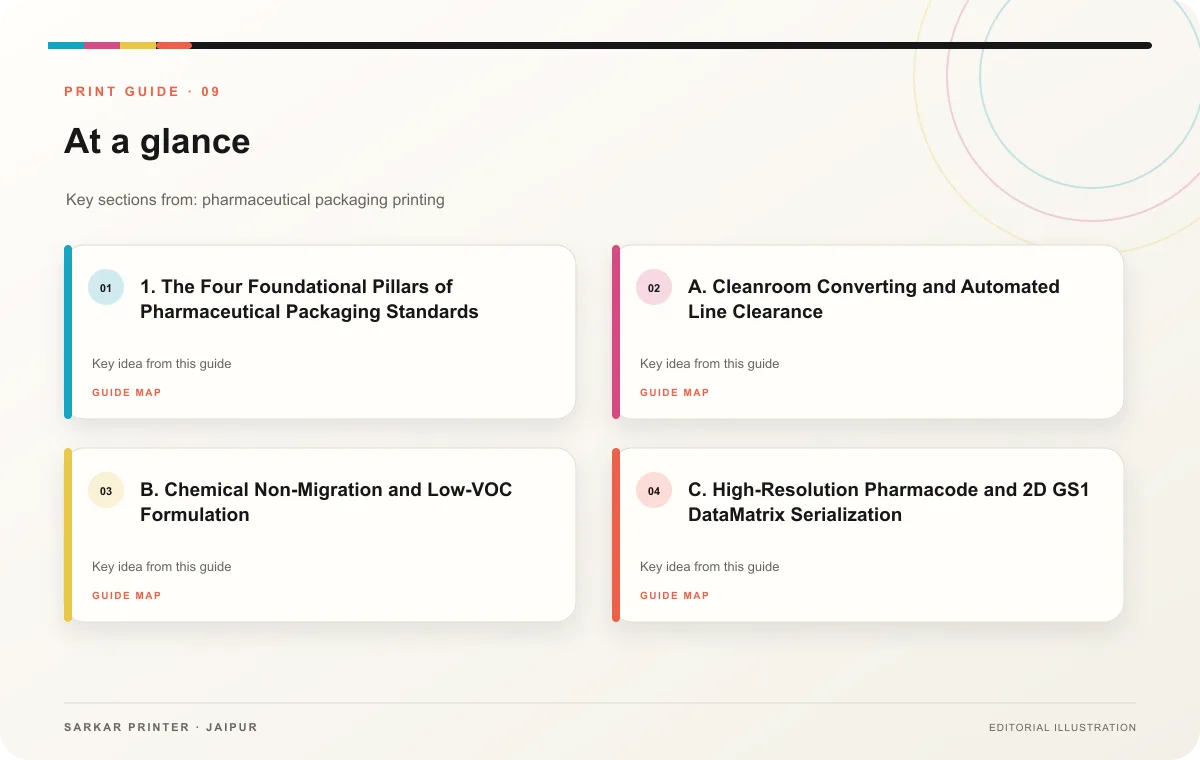
1. The Four Foundational Pillars of Pharmaceutical Packaging Standards
Unlike standard FMCG cartons, pharmaceutical packaging is legally classified as a critical component of the drug delivery system. Specifically, four industrial standards dictate Good Manufacturing Practice (GMP) compliance in healthcare packaging:
A. Cleanroom Converting and Automated Line Clearance
Pharmaceutical secondary packaging must be produced in controlled cleanroom press environments operating under ISO Class 8 standards. Positive atmospheric air pressure prevents outdoor airborne dust and insects from entering press bays. Furthermore, operators must execute documented, double-witnessed line clearances between print runs.
Every parent sheet, proof sheet, and waste scrap from a previous batch must be physically removed from the pressroom before new printing plates are mounted. Consequently, mechanical line clearance completely eliminates mixed-batch packaging, where a box for one medicine is accidentally packaged with another.
B. Chemical Non-Migration and Low-VOC Formulation
Pharmaceutical products are highly sensitive to chemical leaching and solvent odor contamination. Standard commercial offset printing inks contain petroleum distillates and aromatic hydrocarbons that can migrate through paperboard fibers. Therefore, pharmaceutical carton production mandates certified low-migration, mineral-oil-free ink chemistries.
Furthermore, overprint varnishes must utilize purified water-based acrylic polymers or low-odor electron-beam coatings. Aligning varnish selection with our authoritative paper coating technology guide guarantees that protective barriers prevent chemical migration into blister foil pockets.
C. High-Resolution Pharmacode and 2D GS1 DataMatrix Serialization
Global regulatory bodies, including the US FDA Drug Supply Chain Security Act (DSCSA) and India's Ministry of Health, mandate unique serialization on every retail medicine carton. Specifically, each unit must carry a serialized 2D GS1 DataMatrix code containing the Global Trade Item Number (GTIN), randomized serial number, batch lot, and expiration date.
Because automated packing lines scan these codes at speeds exceeding 400 cartons per minute, print quality must be flawless. Prepress systems must maintain minimum 600 DPI imaging resolution. Consequently, codes maintain razor-sharp edge contrast and zero ink dot gain.
D. Structural Tamper-Evidence and Fiber-Tear Physics
Directives under EU Falsified Medicines Directive (FMD) and global pharmacopeias mandate tamper-evident features on all prescription packaging. Rather than relying on simple stickers, structural engineers integrate precision fiber-tear perforation cuts directly into folding carton dielines.
When hospital pharmacists or consumers open the tuck flap, the paperboard structure ruptures irreversibly. Consequently, cartons cannot be resealed without leaving prominent visual evidence of tampering.
GMP Quality Checkpoints in Pharmaceutical Print Manufacturing
End-to-end verification gates safeguarding patient safety across commercial drug carton production
Digital Text Comparison
Pixel-by-pixel automated software verification comparing approved regulatory PDF proofs against CTP rip files, detecting single-character variances.
Inline Spectral Scanning
Real-time spectrophotometric monitoring holding critical brand colors within Delta E 2.0 per certified commercial color standards.
100% Optical Inspection
High-resolution camera arrays mounted on folder-gluers inspecting every individual carton, automatically ejecting defective units at full speed.
2. Barcode and Pharmacode Optical Verification Standards
Every commercial medicine package relies on optical scanning codes during secondary packaging, warehouse distribution, and retail pharmacy dispensing. A single unreadable barcode can stall automated packaging lines or lead to severe inventory quarantine.
Therefore, industrial packaging manufacturers evaluate printed codes against rigorous international standards. Two primary coding systems dominate pharmaceutical production:
Linear Pharmacodes and Color Ring Controls
Printed on carton glue flaps, miniature linear pharmacodes are scanned by photoelectric sensors on automated packaging lines. If a rogue carton from an incorrect product batch enters the magazine feeder, the sensor detects the barcode mismatch instantly and shuts down the cartoning machine.
Consequently, maintaining crisp print contrast and precise bar-width dimensions is essential. Furthermore, operators must preserve a minimum 3.0 mm unprinted quiet zone around all pharmacodes to ensure instantaneous sensor recognition.
2D DataMatrix Verification under ISO/IEC 15415
Unlike consumer QR codes, pharmaceutical 2D DataMatrix symbols must adhere to strict ISO/IEC 15415 grading parameters. Specialized barcode verification cameras inspect symbol contrast, modulation, print growth, and axial non-uniformity.
For compliant commercial distribution, every printed code must achieve an overall verification Grade A (3.5 to 4.0 score). Furthermore, pairing unit-level serialization with certified commercial print color accuracy protocols ensures consistent contrast across high-speed thermal inkjet printing stations.
3. Technical Specification Matrix: Pharmaceutical Packaging Standards
To assist procurement directors and QA auditors in drafting technical specifications, the following matrix outlines mandatory manufacturing benchmarks:
*Note: All quality control batches are accompanied by certified Certificates of Analysis (CoA) and tamper-evident packaging logs.
4. Braille Embossing Standards for Healthcare Packaging
Across Europe, North America, and emerging regulatory markets in Asia, pharmaceutical secondary cartons must incorporate standardized Braille lettering. This feature enables visually impaired patients to verify medication names and dosages safely.
Under international standard EN 15823 for packaging Braille , dot dimensions must meet strict tactile requirements:
- Target Dot Height: Braille dots must achieve a target height between 0.16 mm and 0.20 mm above the carton surface.
- Substrate Holdout: High-density Virgin Folding Box Board (FBB) or Solid Bleached Sulphate (SBS) boards are mandatory. Recycled greyboard lacks the fiber elasticity required to maintain Braille dot height under transit stacking pressure.
- Inline Tactile Inspection: Modern folder-gluers deploy laser profilometers that verify the height of every embossed dot in real time, automatically rejecting cartons with crushed or sub-standard Braille lettering.
5. Five Procurement Best Practices for Pharmaceutical Cartons
To ensure flawless production and maintain compliance with healthcare authorities, pharmaceutical procurement teams should enforce five core operational rules:
- Mandate Full Batch Line Clearance Documentation: Require certified line clearance logs verifying zero risk of rogue carton co-packaging between production runs.
- Specify Low-Migration Vegetable Chemistries: Demand non-migrating, mineral-oil-free inks and aqueous varnishes to protect sensitive pharmaceutical chemical compounds.
- Require Automated Pixel Preflight Proofing: Utilize automated digital comparison systems that compare CTP raster files against approved regulatory text down to fractional punctuation marks.
- Enforce In-Line ISO 15415 2D Code Verification: Contractually mandate that all serialized DataMatrix codes maintain verified Grade A readability on automated vision systems.
- Partner with Audited Healthcare Converting Facilities: Work exclusively with certified commercial print manufacturers such as Sarkar Printer that operate dedicated cleanroom production bays, calibrated spectrophotometric controls, and audited ISO 15378 quality management systems.
6. Summary: Delivering Safety through Pharmaceutical Packaging Printing Standards
Ultimately, pharmaceutical carton converting is an exacting science where mechanical precision directly impacts public health. By enforcing comprehensive pharmaceutical packaging printing standards across every procurement brief, life sciences brands eliminate product recalls, defeat counterfeiters, and maintain seamless automated packaging performance.
When cleanroom converting, cryptographic 2D serialization, and calibrated inline inspection operate in harmony, pharmaceutical manufacturers deliver life-saving medications with absolute packaging integrity.
TALK TO OUR PRESS EXPERTS
Planning high-volume brochures, mono cartons, or custom rigid boxes? Get factory-direct offset quotes with precision Pantone color matching.