
Offset printing vs digital printing comes down to the job, not a single “better” technology. Offset presses transfer ink through plates and are often economical for repeat, high-volume runs. Digital presses print from the file without printing plates, which can suit shorter quantities, faster revisions and variable data. The right choice depends on quantity, artwork, stock, finish and delivery plan.
For a fair comparison, give the printer the same specification for both routes: finished size, number of pages or panels, paper or board, colours, finishing, quantity and required delivery date. A low unit price is useful only if the finished product meets the brief and the total run cost fits the budget.
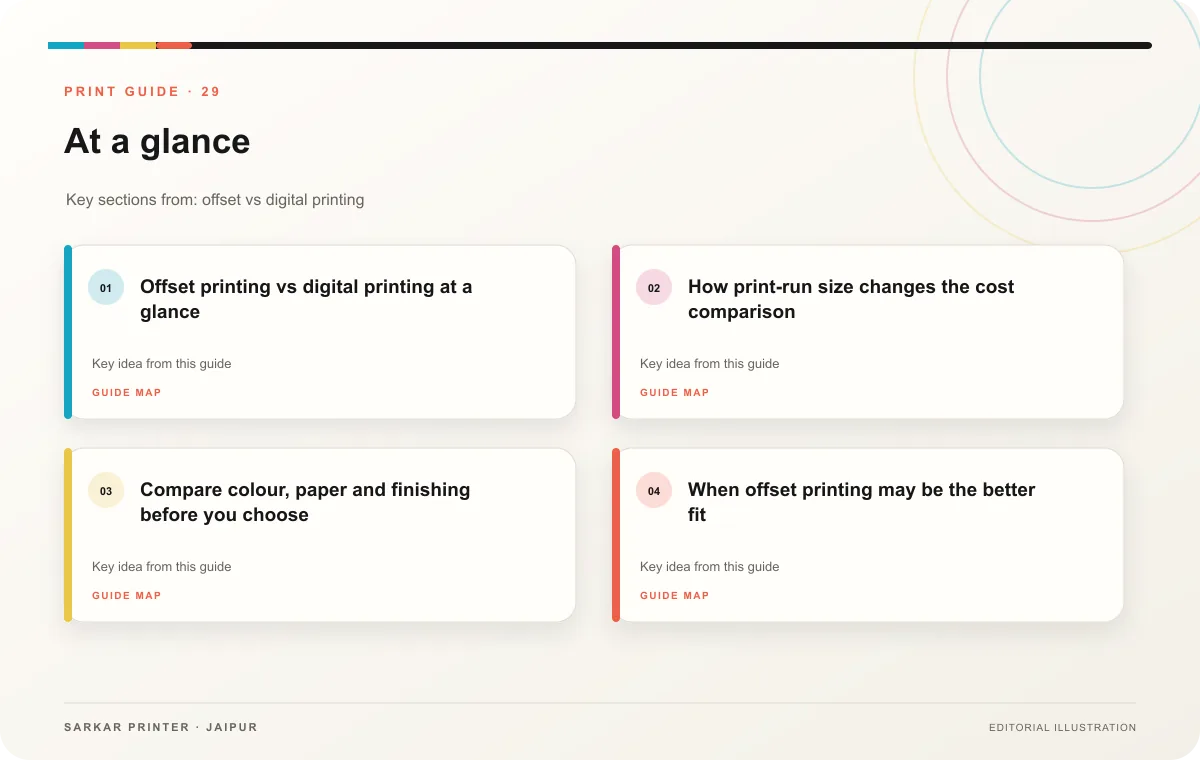
Offset printing vs digital printing at a glance
Both methods can produce professional commercial print. Differences usually come from setup, run length, press capability and job specification. The comparison below is a starting point; actual results vary by equipment, substrate and colour-management process.
How print-run size changes the cost comparison
Offset has upfront plate and make-ready work. Once the press is set, additional copies may add less cost per copy than the initial setup. Digital production normally avoids printing plates, so it can reduce setup overhead for a small batch. There is no universal quantity at which offset always becomes cheaper: paper, ink coverage, number of colours, press time, finishing and turnaround all affect the break-even point.
Ask for separate quotes at the quantities you are actually considering. Compare the total job price, cost per finished unit, setup charges, proofing, delivery and any finishing. If the artwork may change after approval, ask how a revision would affect each option.
Compare colour, paper and finishing before you choose
Colour should be judged from an agreed proof under suitable viewing conditions, not by comparing a backlit monitor with printed paper. Confirm the required colour references, coated or uncoated stock, expected tolerances and whether special colours are necessary. A printer can explain which production route is appropriate for that specification.
Also compare the complete finished item. Folding, binding, lamination, coating, die-cutting and assembly can influence cost and lead time. A method that looks cheaper before finishing may not be the best value after all production steps are included.
When offset printing may be the better fit
- Repeat jobs or larger quantities where plate setup can be spread across the run.
- Projects with a stable design and an agreed production specification.
- Jobs that need a particular spot-colour or finishing workflow available on the chosen press.
Request a press proof or production sample when colour, substrate or finishing is critical. For repeat orders, keep approved artwork and specification details together so the next run can be quoted consistently.
When digital printing may be the better fit
- Short quantities, prototypes or time-sensitive campaign material.
- Jobs that need multiple versions or copy-level personalisation.
- Projects where avoiding plate setup is valuable and the selected device supports the required stock and finish.
Check the exact digital press capability before committing: supported sheet size, substrate, colour coverage, finishing options and any minimum or maximum run requirements. These details vary between machines and suppliers.
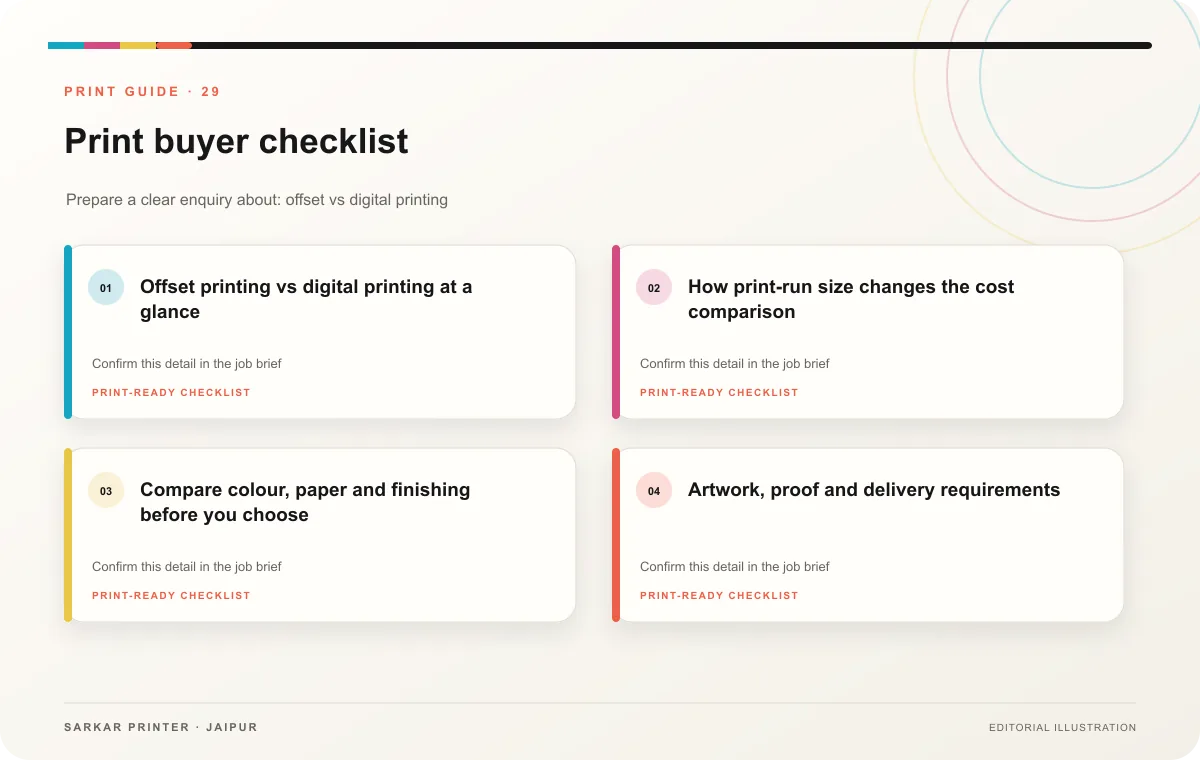
A practical checklist for selecting a print method
- Define the finished format, quantity and delivery date.
- Share print-ready artwork, page count or panel layout, and colour references.
- Specify paper or board, surface finish, binding or converting, packing and delivery.
- Request comparable quotes for each quantity under consideration.
- Review the proof, total cost and production schedule before approving the job.
What to send a printer for an accurate quote
Include the quantity, finished size, artwork status, substrate preference, colours, finishing, packing needs and delivery location. If you are unsure about a material or process, say so; a clear brief lets the printer recommend options without assuming details that have not been agreed.
Frequently asked questions
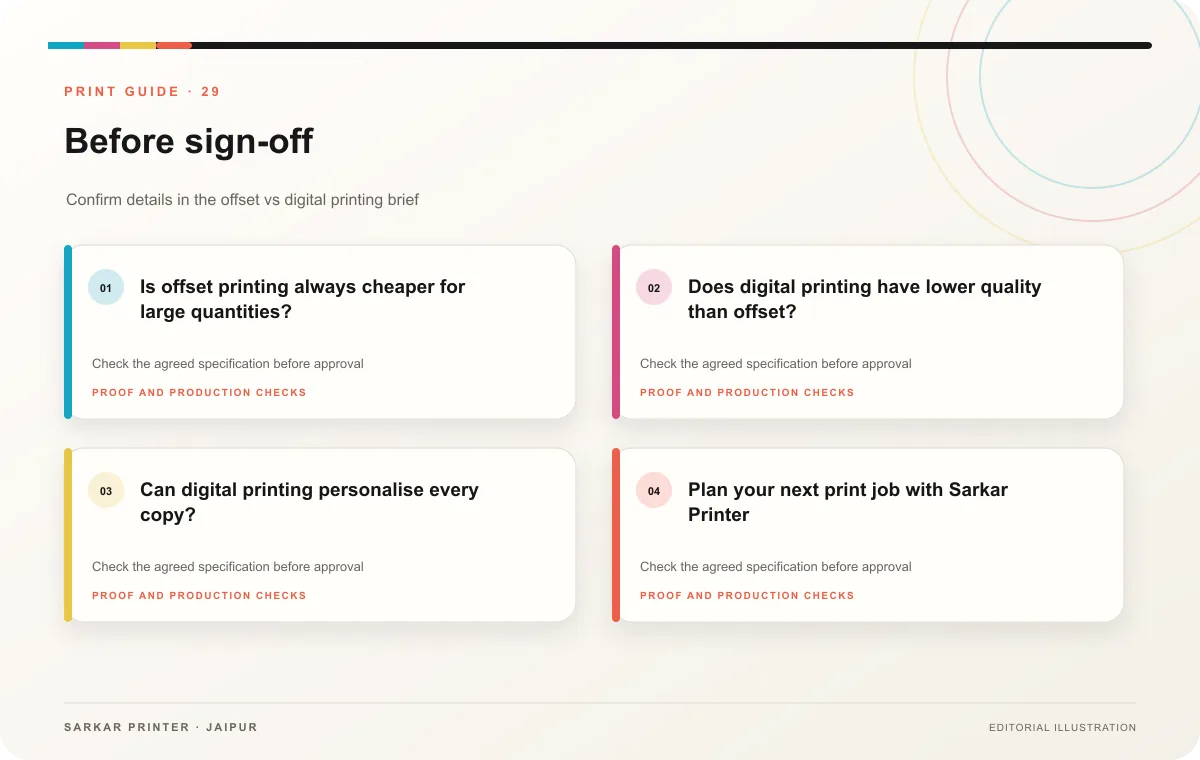
Is offset printing always cheaper for large quantities?
It can be economical when setup costs are spread across a run, but there is no fixed rule. Compare quotes for the same specification and quantity.
Does digital printing have lower quality than offset?
Not automatically. Results depend on the press, file preparation, substrate, colour management and finishing. Approve a suitable proof for the job.
Can digital printing personalise every copy?
Many digital workflows support variable data, but the data file, software and press workflow must be checked before production.
Plan your next print job with Sarkar Printer
For a job enquiry, share the artwork status, quantity, material, finish and target date with Sarkar Printer. Ask the team to confirm the available production route, any applicable process records and the delivery schedule in the written quotation.
TALK TO OUR PRESS EXPERTS
Planning high-volume brochures, mono cartons, or custom rigid boxes? Get factory-direct offset quotes with precision Pantone color matching.