
Deciding how to produce your corporate marketing collateral directly impacts your operational cash flow and overall brand presentation. As production technology advances, choosing the right production method for digital printing for your business requires balancing turnaround speeds against volume costs.
While conventional lithography still dominates massive corporate runs, modern digital engines offer remarkable agility for fast-turnaround projects. However, digital machinery is not a one-size-fits-all solution for every marketing campaign.
To make an educated procurement decision, your team must audit its core manufacturing priorities. Answering these five critical production tests will clarify whether digital press technology aligns with your current commercial goals.
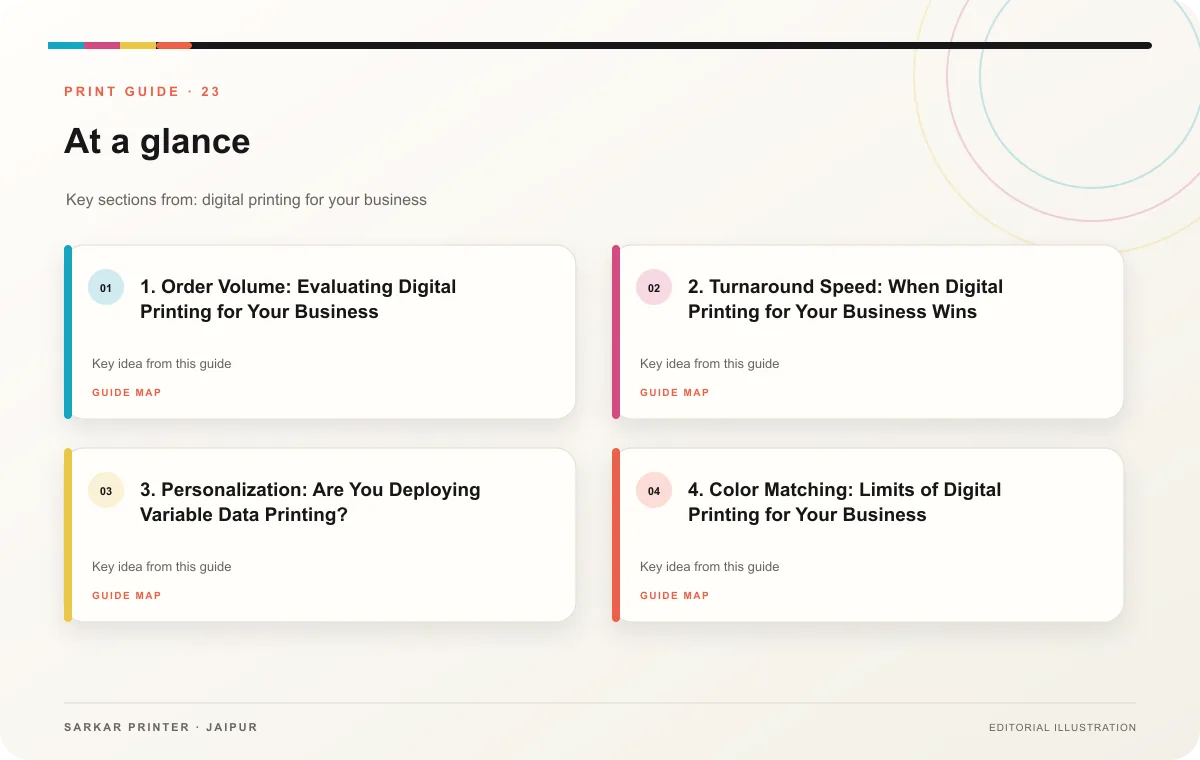
1. Order Volume: Evaluating Digital Printing for Your Business
The most critical factor in commercial manufacturing is your total requested print run. Commercial press economics depend heavily on the initial preparation fees required before the first sheet feeds through the press.
Offset lithography requires the physical engraving of custom aluminum plates for every individual color separation. Because digital equipment bypasses plate preparation entirely, selecting digital printing for your business eliminates expensive upfront tooling charges.
For short-run orders of 100 presentation folders, 250 product leaflets, or 500 business cards, this plate-free workflow keeps costs low. Because you only pay for the materials used, your capital stays liquid.
However, digital equipment operates on a steady per-click toner cost. That means printing 10,000 corporate brochures on a digital press carries nearly the exact same unit cost as printing 100.
If your order surpasses 1,500 to 2,500 units, the lack of scale will quickly erode your profit margins. That is why high-volume commercial marketing projects are better suited for heavy industrial offset presses.
2. Turnaround Speed: When Digital Printing for Your Business Wins
In fast-paced corporate environments, missing a product launch or conference deadline can cost your business valuable sales. When evaluating digital printing for your business , you must look closely at your required delivery timeline.
Conventional offset printing requires an extensive mechanical setup routine. Technicians must mount plates, adjust ink keys, and allow sufficient drying time for liquid inks before running finishing operations.
Digital presses receive artwork directly from prepress software as a digital PDF file. The machine configures toner deposition immediately, allowing production to start minutes after proof approval.
Because there is zero plate-making latency, turnaround times drop from several business days down to 24 to 48 hours. So, for sudden trade shows, emergency corporate meetings, or rapid retail promotions, digital technology provides unmatched production speed.
3. Personalization: Are You Deploying Variable Data Printing?
Modern consumer engagement relies heavily on tailored, customer-specific marketing rather than generic mass handbills. If your campaign requires custom messaging, deploying digital printing for your business is the only practical solution.
Because conventional lithography uses fixed metal plates, every single sheet that passes through the rollers is identical. Altering a single word or graphic requires stopping the press and manufacturing an entirely new set of plates.
Digital presses form images electronically on an electrostatic drum for each rotation. That enables seamless Variable Data Printing (VDP) without slowing down the machinery.
You can print custom recipient names, distinct corporate addresses, unique QR tracking codes, and individualized product serial numbers on every page. This automated customization delivers significantly higher response rates for direct-mail campaigns.
4. Color Matching: Limits of Digital Printing for Your Business
Maintaining brand identity across multi-channel campaigns requires strict color consistency. When deciding if toner-based machinery fits your workflow, you must review your corporate color tolerance levels.
Digital production engines create images by mixing microscopic Cyan, Magenta, Yellow, and Black (CMYK) toner particles. While this provides crisp, vibrant results for full-color photographs and illustrations, it relies on dot patterns to approximate specific shades.
Because of this simulation, standard digital presses cannot replicate pre-mixed Pantone Matching System (PMS) spot colors with complete fidelity. Difficult colors like vibrant oranges, deep navy blues, and metallic accents often show subtle shifts under digital toner.
Furthermore, environmental factory variables such as room humidity and fuser temperature can cause minor color shifts during continuous runs. That is why brands with strict corporate identity guidelines rely on calibrated offset presses for color-critical packaging and corporate collateral.
5. Substrate Selection: Are You Folding Heavy or Textured Cardstock?
The physical feel and durability of your collateral shapes how clients perceive your brand. Before committing to digital machinery, you must check whether your selected paper stock matches the machine's mechanical limits.
Digital toner does not soak into paper fibers like liquid ink does. Instead, heated rollers melt a thin layer of plastic polymer onto the surface of the paper.
When heavy digital toner coverage is folded, this brittle surface layer can crack and flake along the crease. This is especially noticeable on dark-colored bi-fold brochures or pocket folders, revealing unsightly white paper fibers underneath.
To prevent flaking, print operators must score heavy digital stocks before folding them. This extra step adds time and labor costs to your project.
Additionally, electrostatic toner often struggles to settle evenly into the deep grooves of heavy linen, laid, or felt papers. If your project uses textured wedding stationery or thick 400 GSM packaging board, traditional offset lithography provides much smoother ink coverage.
Strategic Comparison: Choosing Your Production Method
Choosing a Print Route for Your Job
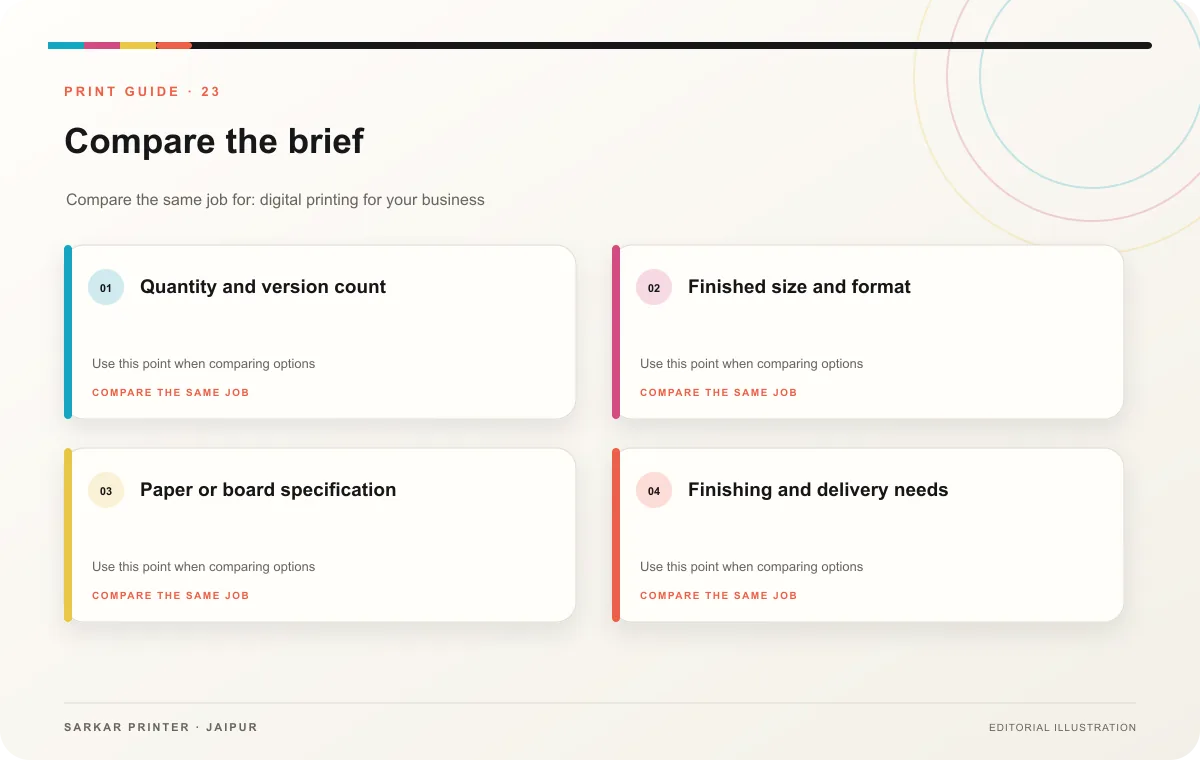
Deciding between print technologies comes down to matching your project's turnaround time, total run size, and material requirements. When you need rapid delivery, customized data, or small quantities under 1,000 units, digital printing for your business delivers excellent flexibility.
However, when managing large packaging orders, high-volume catalogs, or brand collateral that requires precise Pantone color matching, traditional offset printing remains the more cost-effective and dependable choice.
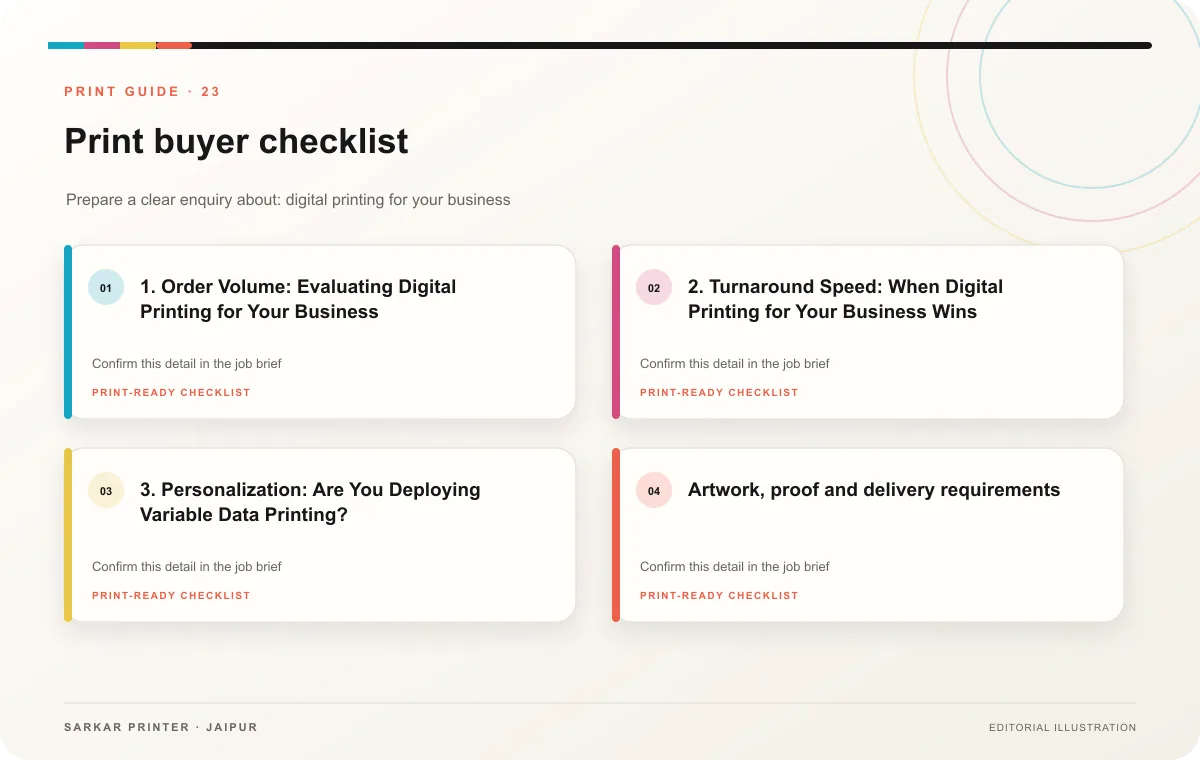
For a job enquiry, share the artwork status, quantity, material, finish and target date with Sarkar Printer. Ask the team to confirm the available production route, any applicable process records and the delivery schedule in the written quotation.
Reach out to our production team on WhatsApp today to review your project specifications, select the right production method, and receive an instant commercial quotation.
TALK TO OUR PRESS EXPERTS
Planning high-volume brochures, mono cartons, or custom rigid boxes? Get factory-direct offset quotes with precision Pantone color matching.