
Mastering precision folding carton dieline design is foundational for packaging converting. In addition, it ensures structural product integrity. According to international packaging guidelines from ECMA folding carton design standards , dieline accuracy prevents carton jams. Consequently, folder-gluers run at maximum speed. Consequently, aligning mechanical crease channels with substrate caliper guarantees sharp right-angle corners and reliable consumer unboxing.
For consumer goods manufacturers and retail brands across Rajasthan, packaging die tooling represents a critical bridge between digital vector artwork and physical paperboard. If dieline geometry overlooks paperboard thickness, folding flaps bow outward. As a result, cartons fail to lock properly. Therefore, establishing CAD dieline protocols before plate-making protects your production budget. In addition, it eliminates costly rework.
For a job enquiry, share the artwork status, quantity, material, finish and target date with Sarkar Printer. Ask the team to confirm the available production route, any applicable process records and the delivery schedule in the written quotation.
Dieline Engineering & Structural Mind Map
- 1. Vector Line Classification Solid Cutting Rules (100% Magenta spot color): Outer trim and perimeter separation.
- Dashed Creasing Rules (100% Cyan spot color): Hinge channels and folding scores.
- Perforation & Slit Rules: Tear strips, tamper slits, and reverse cut-creases.
- 2. Dimensional Tolerances & Caliper Offsets Caliper compensation: Adding 1.5x board thickness to fold allowances.
- Tuck flap friction angles and dust flap clearance notches.
- Grain direction orientation parallel to vertical load-bearing carton panels.
- 3. Prepress Manufacturing Integration Bleed extensions (minimum 3mm) beyond external cut lines.
- Glue tab knockouts free from UV varnish and heavy ink films.
- Integrating our paper GSM selection guide for caliper matching.
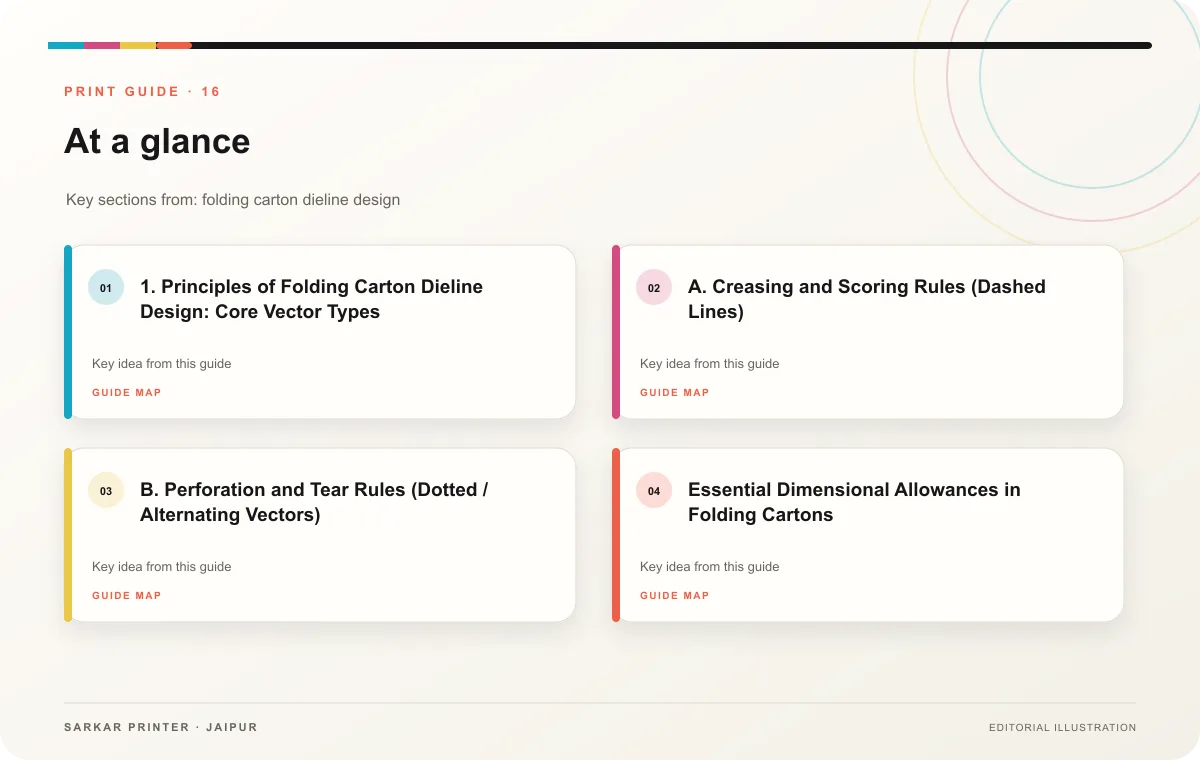
1. Principles of Folding Carton Dieline Design: Core Vector Types
In structural packaging prepress, a dieline is a two-dimensional CAD vector blueprint. Specifically, it guides steel rule cutting dies. Standard practice assigns cutting lines to a dedicated non-printing spot color. For example, designers use 100% Magenta named DieCut. As a result, prepress laser cutters and flatbed die-makers instantly identify blade paths.
A. Creasing and Scoring Rules (Dashed Lines)
Creasing rules utilize rounded steel edges. Consequently, they compress paperboard fibers into matrix channels without cutting through. In design files, creasing lines appear as dashed vector strokes. Specifically, they are commonly assigned to 100% Cyan. Consequently, creasing rules create clean hinge points. As a result, panels fold cleanly at 90-degree and 180-degree angles.
B. Perforation and Tear Rules (Dotted / Alternating Vectors)
Perforations alternate between micro-cuts and uncut fiber bridges. Therefore, they allow controlled tearing. Used extensively in retail tear-away display boxes and tamper-evident packaging, perforations facilitate easy consumer opening. In addition, pairing perforations with specialized anti counterfeit packaging printing techniques prevents unboxing tampering.
Essential Dimensional Allowances in Folding Cartons
Critical clearances required for automated folding and packaging assembly
Account for physical paper thickness across folded hinges. Prevents carton panel bulging and distorted squareness.
Provides sufficient surface area for adhesive wheel contact. Must remain 100% free of coatings, inks, and varnishes.
1.5mm – 2.0mm Clearance
Bevel dust flap shoulders at 15 degrees. Prevents mechanical collision with tuck flaps during high-speed closure.
2. Accounting for Substrate Caliper and Crease Matrix
Paperboard is a physical material with three-dimensional thickness. When creating vector lines in CAD software, designers treat lines as zero-thickness vectors. However, physical paperboard occupies space. For example, when 350 GSM Folding Box Board folds 180 degrees, paper thickness takes up volume.
Consequently, neglecting caliper compensation causes folded panels to collide. As a result, carton sides bow outward. Therefore, professional packaging designers add mathematical offsets. Specifically, they add 1.5 times the board thickness to fold dimensions.
Furthermore, steel rule die-makers calculate crease widths using calibrated formulas. Specifically, crease width equals board thickness multiplied by 1.5 plus rule width. Understanding how substrate selection influences offset printing cost in Jaipur helps you optimize carton geometry before ordering expensive steel dies.
3. Technical Dieline Specification Matrix
To assist structural designers and packaging engineers, the following table outlines standard CAD tolerances for commercial carton manufacturing:
*Note: Tolerances are designed for standard steel rule flatbed and rotary die-cutters. High-density packaging requires consultation with prepress tooling engineers.
4. Critical Prepress Rules for Artwork on Dielines
Aligning graphic artwork within your folding carton dieline design requires strict prepress discipline. Furthermore, offset printing demands high precision. Therefore, graphic designers must enforce these production safeguards:
A. Maintain Mandatory 3mm Bleed Beyond Cut Lines
Every background color and photo must extend at least 3mm past cutting rules. Consequently, this prevents unprinted paper edges. If artwork stops at the cut line, die-cutting movement reveals unprinted white slivers. Therefore, proper bleed is mandatory.
B. Observe the Safe Zone (Quiet Zone)
All vital graphics, including typography and logos, must stay 3mm inside score lines. Consequently, this protects brand assets. Placing text too close to score lines causes letters to bend across corners. As a result, legibility suffers.
C. Keep Dieline Vectors as Non-Printing Overprint Layers
Packaging dielines must always reside on a dedicated vector layer. Furthermore, set this layer to Overprint Stroke. If dieline vectors are set to knockout, the software creates white gaps. Consequently, unwanted white lines appear in print. Understanding what is offset printing plate separation requires ensures dieline vector strokes never print on actual press plates.
5. Five Procurement Best Practices for Dieline Management
To avoid costly tool modifications and press delays, enterprise procurement teams should enforce standard verification checkpoints:
- Always Produce a Cad-Cut Physical White Dummy: Before approving expensive steel rule cutting dies, request an unprinted sample carton cut on a digital sample table. Testing the dummy with actual product confirms fit, closing friction, and panel squareness.
- Verify Automated Cartoning Machine Specifications: If retail packaging is loaded on automatic high-speed cartoning machines, obtain the machine manufacturer's dieline template. Specific push tabs and flap relief angles are required to avoid line stoppages.
- Check Grain Direction Alignment: Ensure main vertical body creases run parallel to paperboard grain. Consequently, you avoid cracked spine corners.
- Ensure Complete Glue Tab Knock-Outs: Confirm that glue tabs remain completely free of inks and coatings. Therefore, cold-glue bonds securely.
- Maintain Version-Controlled CAD Files: Maintain version-controlled CAD files in standard formats like ArtiosCAD DXF or CFF2. As a result, future runs remain consistent.
6. Summary: Implementing Professional Dieline Standards
Ultimately, successful packaging manufacturing relies on the precision of your initial folding carton dieline design . By respecting paperboard physics, incorporating caliper allowances, and adhering to strict prepress bleed protocols, brand managers ensure flawless production from flat sheet die-cutting to retail store shelves.
When packaging geometry is engineered with care, finished cartons deliver robust structural protection, high-speed packing efficiency, and an exceptional tactile unboxing experience.
TALK TO OUR PRESS EXPERTS
Planning high-volume brochures, mono cartons, or custom rigid boxes? Get factory-direct offset quotes with precision Pantone color matching.