
Establishing rigorous fmcg packaging printing standards is critical for high-volume consumer goods manufacturers and retail procurement directors. According to global retail packaging guidelines from the GS1 General Packaging Standards , packaging consistency directly dictates warehouse automated sorting speeds and retail shelf legibility. Consequently, mastering high-speed offset lithography, inline defect detection cameras, and low-migration barrier varnishes ensures flawless execution across multi-million folding box board runs.
For high-volume consumer goods enterprises across Rajasthan, fast-moving consumer goods (FMCG) packaging leaves zero room for production errors. When automated filling lines pack thousands of units per hour, minor dieline variations or unreadable barcodes cause catastrophic line stoppages. Therefore, enforcing technical standardization across prepress, pressroom, and post-press conversion guarantees uninterrupted supply chain velocity.
Whether producing packaged foods, household personal care cartons, or retail consumer goods, industrial manufacturing rigor is paramount. When planning bulk production runs, this authoritative fmcg packaging printing standards manual ensures pressroom consistency. Furthermore, it protects bottom-line manufacturing margins.
FMCG High-Volume Manufacturing Mind Map
- 1. High-Speed Pressroom Throughput Sheetfed Offset Production exceeding 15,000 to 18,000 sheets per hour.
- Automated CTP plate-loading and closed-loop spectrophotometer ink keys.
- Integration with certified commercial print color accuracy tolerances.
- 2. Substrate Integrity & Speed Converting Virgin Folding Box Board (FBB) and Recycled Duplex Board benchmarks.
- Caliper consistency matching our verified paper gsm selection guide .
- Crease channel alignment per folding carton dieline design protocols.
- 3. Inline Inspection & Compliance 100% Optical Camera Inspection for hickey, streak, and misprint ejection.
- Barcode ISO/IEC 15416 verification achieving Grade A readability.
- Safe food-contact chemistries from our eco-friendly inks commercial printing portfolio.
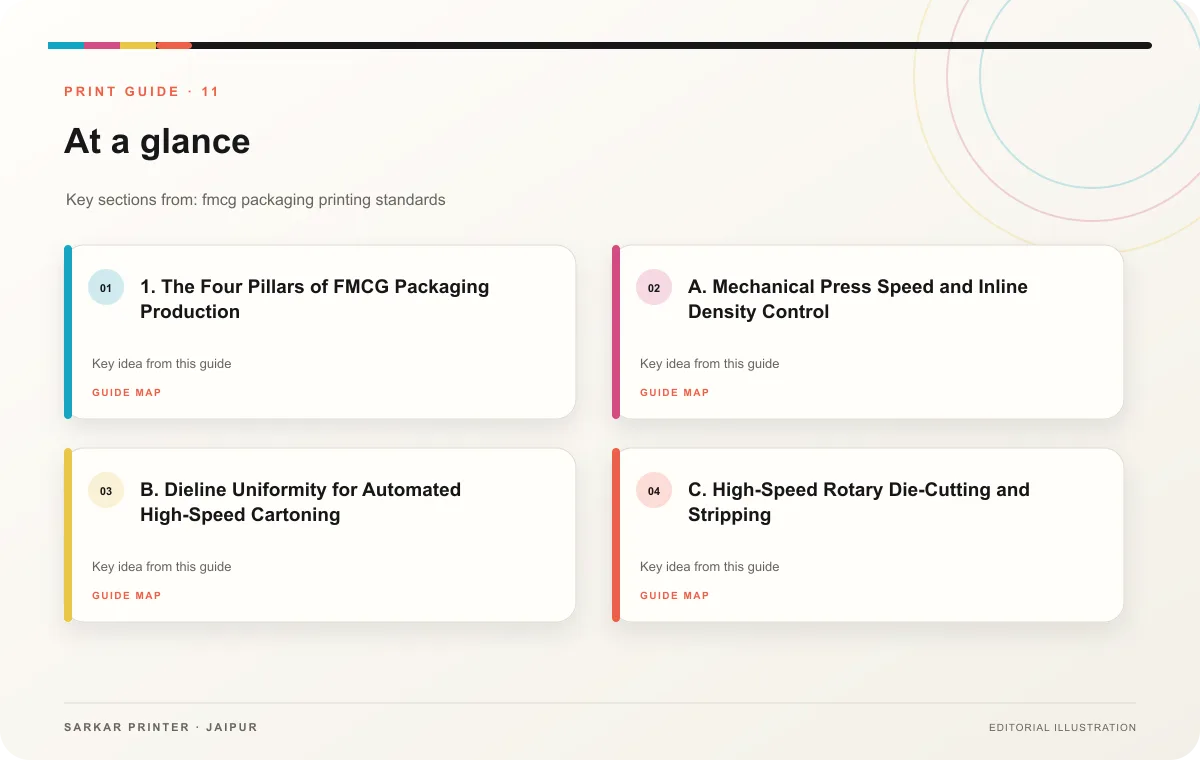
1. The Four Pillars of FMCG Packaging Production
Delivering millions of identical cartons demands automated process control. Specifically, four industrial pillars govern high-volume FMCG packaging manufacturing:
A. Mechanical Press Speed and Inline Density Control
In retail packaging runs exceeding 100,000 units, multi-unit sheetfed offset presses operate at speeds between 15,000 and 18,000 impressions per hour. Automated inline color-control bars measure spectral ink density across every individual sheet. Consequently, press operators make microscopic ink-key adjustments in real time, preventing visual color drift across long production runs.
Furthermore, evaluating run volume within our comprehensive offset printing cost in Jaipur framework demonstrates how computerized press lines drastically lower marginal piece costs as volume scales.
B. Dieline Uniformity for Automated High-Speed Cartoning
Modern FMCG brand plants utilize automated cartooning lines running at speeds of 300 to 500 cartons per minute. At these speeds, robotic vacuum cups erect cartons, slide products inside, and fold tuck flaps in fractions of a second. If board stiffness is uneven or crease resistance is excessive, the erecting mechanism jams immediately.
Consequently, dielines must maintain strict dimensional tolerances within ±0.2mm. Therefore, die-makers use precision laser-cut steel rule dies to guarantee uniform carton squareness across every batch.
C. High-Speed Rotary Die-Cutting and Stripping
After offset printing, sheets enter high-speed flatbed or rotary die-cutters equipped with automated internal dynamic stripping. Die-cutting stations simultaneously cut perimeters, score creases, and strip internal waste slugs. As a result, clean blanks move straight to automated folder-gluers without manual handling.
D. Food-Grade Low-Migration Chemistry
For food, confectionery, and dairy packaging, European and Indian regulations mandate low-migration chemistries. Specifically, inks and varnishes must be formulated with mineral-oil-free vegetable vehicles. Consequently, toxic hydrocarbons cannot migrate through paperboard fibers into edible foodstuffs.
Industrial Quality Gates in FMCG Packaging
Automated checkpoints ensuring zero-defect delivery across retail packaging runs
100% digital dieline check. Resolves overprint traps, barcode vector scaling, and font outlines prior to CTP imaging.
Closed-Loop Spectral Scan
In-line spectrophotometers scan color bars at 18,000 sheets/hour, holding Delta E variations strictly below 2.5.
Folder-Gluer Ejection
Optical sensor arrays detect glue missing and code discrepancies, automatically ejecting defective cartons at full line speed.
2. Barcode and 2D Code Verification Standards
Every FMCG folding carton carries an EAN-13, UPC-A, or GS1 DataMatrix code for point-of-sale scanning. If a barcode exhibits excessive ink bleed or poor background contrast, retail scanners reject it. In high-volume retail chains, scanning failures trigger substantial financial penalties for brand manufacturers.
Therefore, industrial printers evaluate printed codes against ISO/IEC 15416 print quality specifications . Specifically, verification instruments score symbol contrast, modulation, defects, and decodability. For high-volume FMCG lines, maintaining a verified ISO Grade A (3.5 to 4.0) score is mandatory.
3. Technical Specification Matrix: FMCG Packaging Standards
To assist procurement managers in setting contractual quality benchmarks, the following matrix details technical tolerances:
*Note: All quality control inspections are logged with automated batch serial numbers for full supply chain traceability.
4. Defect Mitigation on the Factory Floor
Operating high-speed packaging lines requires preemptive defect elimination. Specifically, three mechanical vulnerabilities must be actively managed:
A. Hickies and Lint Elimination
At press speeds exceeding 15,000 sheets per hour, loose paperboard dust from slitting blades deposits on printing blankets. Consequently, circular ring-like blemishes known as hickies form in solid ink fields. Factory lines utilize motorized blanket-washing systems and vacuum de-dusting blowers on the feeder board to eliminate fiber debris.
B. Folding Crease Cracking on High-GSM Boards
When folding heavy 350+ GSM boards, folding against paper grain causes surface fiber fracturing. Reviewing the mechanical principles of what is offset printing sheet layout helps prepress engineers align packaging dielines parallel to grain direction.
C. Static Electricity Control in High-Speed Delivery
Dry winter climates cause intense static electricity accumulation on fast-moving paperboard sheets. Consequently, sheets stick together in the delivery pile, causing scuffing and feeder jams. Modern presses deploy ionizing blower bars across sheet feeders to dissipate static charges instantly.
5. Five Procurement Best Practices for FMCG Packaging
To ensure flawless production and maintain delivery schedules, enterprise packaging buyers should establish strict procurement controls:
- Mandate In-Line 100% Vision Inspection: Require that converting facilities utilize optical cameras that automatically detect and eject misprinted or flawed cartons.
- Contractually Enforce Sutherland Rub Test Ratings: Specify minimum 500-stroke rub resistance under ASTM D5264 to prevent carton scuffing during long-distance trucking.
- Require Pre-Press Barcode Quiet Zone Audits: Ensure design artwork leaves at least 3mm unprinted clear margin around barcodes to ensure Grade A scanning.
- Audit Raw Board Consistency and Moisture Levels: Verify that paperboard lots maintain certified 6.0% ± 1.0% moisture content to prevent post-print warping.
- Establish Batch-to-Batch Color Retain Samples: Maintain physical and digital spectral targets to verify color uniformity across monthly repeat orders.
6. Summary: Delivering Consistency with FMCG Packaging Printing Standards
Ultimately, high-volume FMCG packaging manufacturing is a game of fractional millimeters and tight tolerances. By deploying comprehensive fmcg packaging printing standards across every procurement brief, consumer goods brands protect product safety, accelerate automated packing, and maintain flawless retail presentation.
When high-speed offset printing presses, automated optical inspection, and calibrated die-cutting converting operate in harmony, brand owners achieve uncompromised packaging excellence at massive production scale.
TALK TO OUR PRESS EXPERTS
Planning high-volume brochures, mono cartons, or custom rigid boxes? Get factory-direct offset quotes with precision Pantone color matching.