
Mastering the engineering mechanics of embossing and debossing for packaging is a decisive strategic advantage for luxury brand owners, cosmetic packaging designers, and corporate procurement directors. According to sensory consumer research from the Foils & Specialty Effects Association (FSEA) , tactile surface relief increases brand recall by over 70% compared to flat packaging. Consequently, mastering multi-level CNC brass tooling, counter-die durometer calibration, and board fiber elasticity allows converters to achieve sculptured three-dimensional relief without fiber rupture or surface cracking.
For luxury retail brands across Rajasthan and premium consumer markets, tactile unboxing creates an instant perception of superior product craftsmanship. When consumers run their fingertips across a cosmetic folding carton or premium rigid setup box, raised dimensional embossing delivers physical confirmation of authenticity. Therefore, establishing precise pressroom tolerances across die temperature, dwell time, and tonnage pressure guarantees uniform tactile sharpness across multi-thousand production runs.
Whether producing secondary perfume cartons, luxury confectionery gift boxes, or corporate presentation collateral, dimensional finishes require deep manufacturing discipline. When planning luxury packaging runs, this authoritative embossing and debossing for packaging manual provides comprehensive technical guidance. Furthermore, it prevents costly tooling revisions.
Tactile Tooling & Substrate Physics Mind Map
- 1. Dimensional Die Architecture Single-Level Flat Dies: Crisp uniform 0.2mm to 0.4mm raised vector plateaus.
- Multi-Level & Sculptured 3D Brass Dies: Realistic organic curves and anatomical contours.
- Beveled Edge Geometry: 45° to 60° draft angles preventing paperboard shearing.
- 2. Substrate Caliper & Fiber Elasticity Virgin Solid Bleached Sulphate (SBS) vs Recycled Board fiber tensile thresholds.
- Board thickness alignment matching our verified paper gsm selection guide .
- Synergy with luxury rigid wraps detailed in our rigid box manufacturing process .
- 3. Hybrid Finishes & Inline Registration Combination Fluted Dies: Simultaneous hot foil stamping and embossing in a single pass.
- Blind Embossing: Subtle shadow contrast on unprinted paperboard surfaces.
- Coating compatibility verified per our luxury packaging finishing techniques guide.
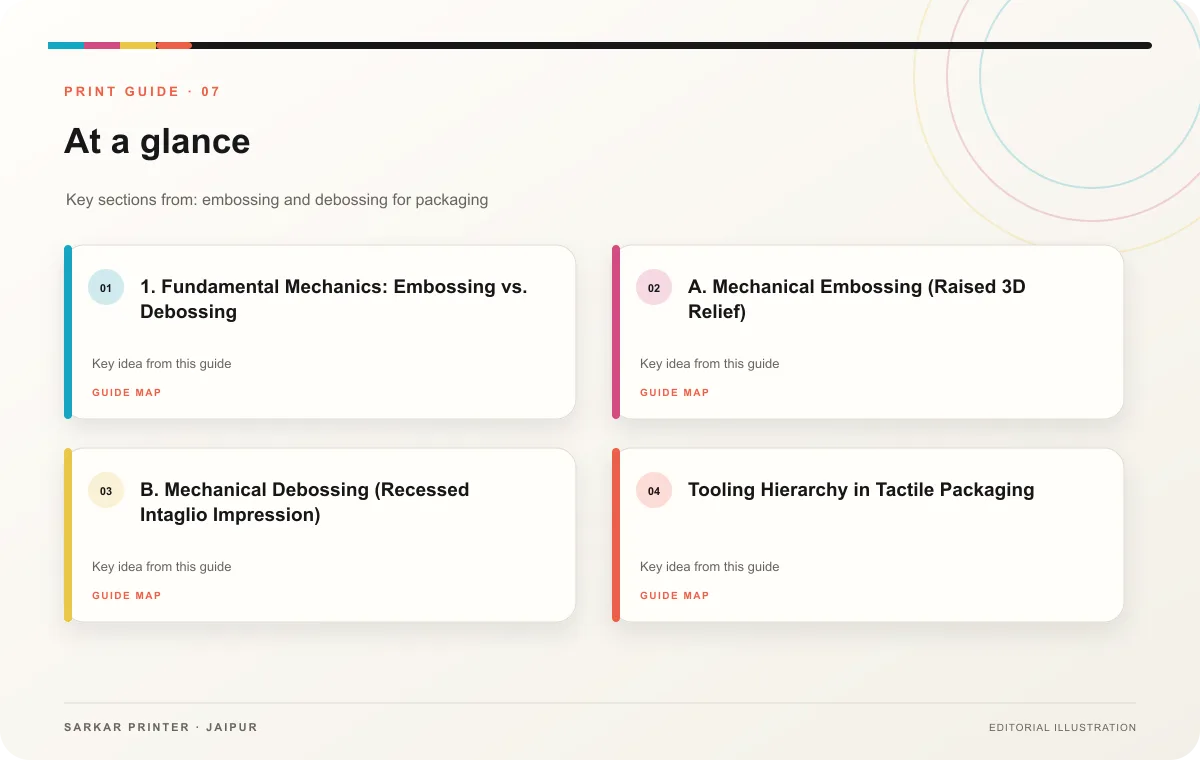
1. Fundamental Mechanics: Embossing vs. Debossing
While both processes utilize matched male and female dies to alter the physical topography of paperboard, their directional orientation creates completely different visual and tactile expressions:
A. Mechanical Embossing (Raised 3D Relief)
Embossing presses the paperboard from the reverse side upward toward the viewer. Specifically, a female die containing recessed design cavities is mounted to the upper press platen. Beneath the sheet, a male counter-force die featuring corresponding raised geometry drives the paperboard upward under hydraulic tonnage.
As the paperboard compresses into the female cavity, surface fibers stretch permanently. Consequently, the graphic element emerges raised above the plane of the carton. In addition, ambient lighting catches the raised edges, creating natural specular highlights and deep shadow contours that accentuate the design.
B. Mechanical Debossing (Recessed Intaglio Impression)
Debossing reverses the physical direction, pressing the design downward into the front surface of the paperboard. Specifically, the male die strikes the top face of the sheet, driving fibers downward into a recessed channel or resilient matrix backing.
Consequently, the graphic element appears indented or sunken into the board. Debossing creates a subtle, understated luxury aesthetic favored in corporate stationery, book covers, and minimalist cosmetic packaging. Furthermore, debossed text protects printed ink films from transit scuffing, because the ink sits below the carton's contact surface plane.
Tooling Hierarchy in Tactile Packaging
Comparing die metal metallurgy, sculpting capabilities, and production longevity
Single-level chemical etching. Fast turnaround and low tooling cost. Ideal for short runs under 5,000 units on flat vector typography.
Denser metallurgy resisting high platen pressures. Maintains sharp bevels across medium runs up to 30,000 impressions without rounding.
Sculptured 3D Master Dies
Computer-milled multi-level brass tooling. Delivers organic 3D textures, hand-chiseled crests, and unlimited pressrun durability over 500,000 units.
2. Tooling Metallurgy and Die Classification
The visual precision and dimensional depth of embossing and debossing for packaging depends entirely on tooling metallurgy. Choosing the right die material balances tooling amortization against tactile crispness:
A. Chemical Etched Magnesium Tooling
Magnesium dies are produced through photochemical acid etching. Acid dissolves exposed metal areas, leaving raised relief. Because magnesium is lightweight and soft, production is fast and inexpensive. However, chemical etching cannot produce varying depths; all relief is strictly flat single-level. Furthermore, magnesium dies compress under heavy pressure, rounding off sharp corners after 5,000 to 10,000 impressions.
B. Precision CNC-Machined Brass Tooling
Brass represents the undisputed gold standard for luxury commercial converting. Specifically, multi-axis computer numerical control (CNC) micro-milling machines sculpt solid brass billets based on 3D CAD mesh models.
Unlike acid etching, CNC milling carves infinite depth gradations, domed contours, and textured chiseled facets. Moreover, brass retains exceptional thermal stability and hardness. In high-volume production, brass dies withstand hundreds of thousands of impressions without edge degradation.
3. Technical Specification Matrix: Embossing and Debossing Parameters
To assist packaging engineers and procurement directors in setting contractual tooling standards, the following matrix compares operational tolerances:
*Note: Depth tolerances require die heating between 40°C and 70°C to soften cellulose fibers and prevent micro-fracturing.
4. Paperboard Physics: Fiber Elasticity and Crack Prevention
Achieving deep 3D embossing requires understanding paperboard physics. When metal dies deform paperboard, cellulose fibers stretch along the z-axis. If the stretch exceeds the board's tensile elongation threshold, the top surface fractures, causing unsightly white cracks.
Therefore, structural packaging engineers enforce strict substrate standards:
- Fiber Length and Virgin Pulp: Virgin Solid Bleached Sulphate (SBS) and Folding Box Board (FBB) utilize long chemical wood fibers with superior tensile elasticity. Recycled duplex boards contain short, fragmented fibers that crack easily under deep embossing.
- Paper Grain Orientation: Whenever possible, prominent horizontal embossed lines should run parallel to the paperboard grain direction. Embossing perpendicular to grain direction exerts severe shear stress on fiber bundles.
- Moisture Conditioning: Paperboard stored in excessively dry environments becomes brittle. Pressrooms must maintain 50% ± 5% relative humidity to ensure cellulose fibers retain natural flexibility during platen impression.
5. Five Procurement Best Practices for Tactile Finishes
To avoid production delays and ensure crisp, uncracked tactile finishes, enterprise packaging buyers should establish strict procurement guidelines:
- Mandate CNC Brass Dies for Brand Logos: Never compromise brand emblems with chemical-etched magnesium. Specify CNC-milled brass tooling to guarantee razor-sharp beveled definition.
- Specify 45-Degree Beveled Draft Angles: Require die-makers to bevel all sharp vector transitions to eliminate knife-like paperboard shearing.
- Utilize Heat-Assisted Platen Impression: Ensure converting platens run heated chases (45°C to 65°C) to soften paper coatings and eliminate micro-crazing.
- Evaluate Substrates in Prototype Dielines: Test embossing depths on final production paperboard before cutting master production dies.
- Partner with Integrated Precision Converters: Work with an experienced industrial packaging manufacturer like Sarkar Printer that operates automated die-cutting platens with optical registration cameras and precision counter-force matrix mounting.
6. Summary: Crafting Distinction with Embossing and Debossing for Packaging
Ultimately, tactile finishing transforms ordinary packaging into an unforgettable sensory experience. By deploying advanced embossing and debossing for packaging techniques, luxury brands communicate heritage, authenticity, and unmatched product quality.
When sculptured CNC brass tooling, virgin paperboard elasticity, and calibrated platen tonnage operate in harmony, packaging converters deliver tactile masterpieces that captivate consumers on every retail shelf.
TALK TO OUR PRESS EXPERTS
Planning high-volume brochures, mono cartons, or custom rigid boxes? Get factory-direct offset quotes with precision Pantone color matching.