
Navigating the commercial manufacturing landscape requires an exact understanding of the disadvantages of digital printing before committing corporate capital. Modern digital presses offer fast turnarounds for short batches, but high-volume commercial marketing demands a closer look at their mechanical and financial limits.
Every production system carries operational trade-offs that directly affect your unit cost, packaging durability, and visual consistency. Understanding the real disadvantages of digital printing is essential before signing off on large purchase orders.
While digital presses excel at personalized short runs, they introduce costly hurdles when applied to high-volume commercial marketing. Exploring the operational disadvantages of digital printing prevents costly delays and protects your brand's physical market presence.
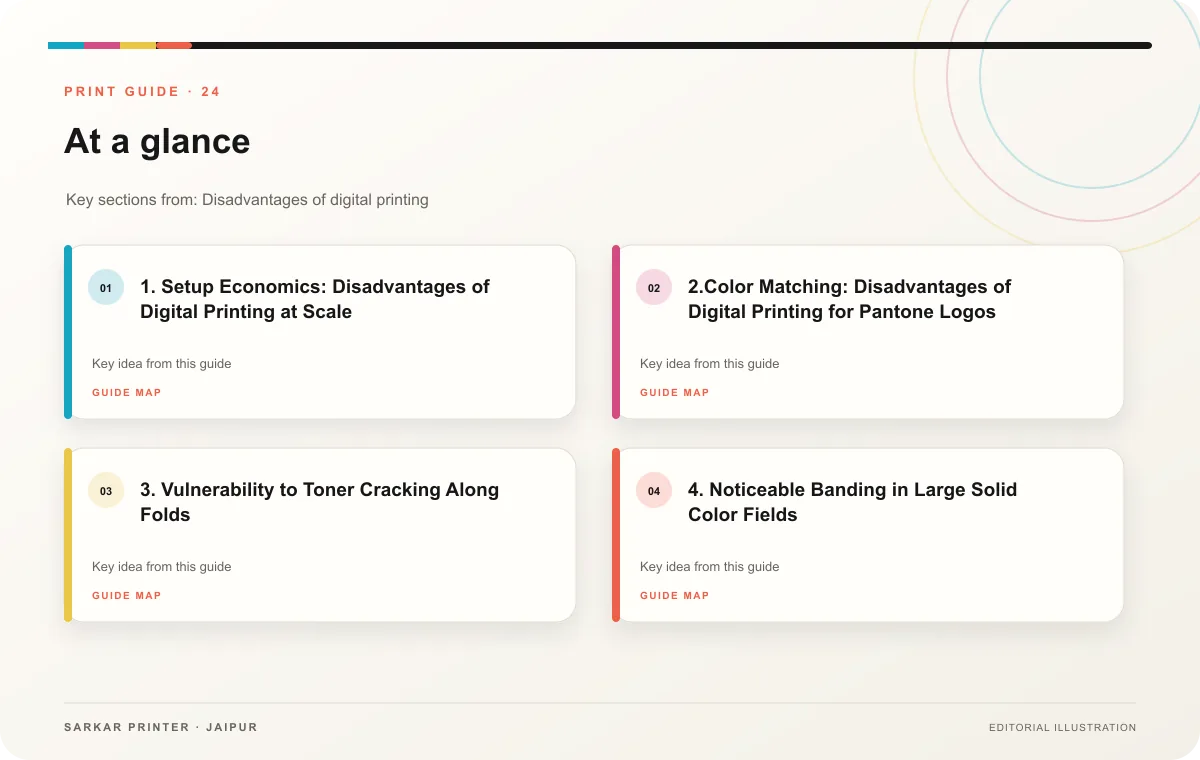
1. Setup Economics: Disadvantages of Digital Printing at Scale
The most visible financial hurdle of toner-based machinery appears during volume procurement. Traditional offset presses require upfront plate fees, but their marginal unit cost drops drastically once press cylinders start spinning.
Digital presses operate on a click-charge pricing model driven by toner consumption and machine maintenance. Because of this rigid structure, the per-unit expense remains virtually identical whether you print 500 units or 15,000 units.
This flat cost curve represents one of the major economic disadvantages of digital printing. If your campaign requires large quantities of catalogs, leaflets, or product inserts, relying on digital presses causes you to overspend significantly compared to industrial offset alternatives.
2.Color Matching: Disadvantages of Digital Printing for Pantone Logos
For corporate enterprises and growing regional brands, maintaining exact color fidelity across physical assets is non-negotiable. Brand logos rely on certified Pantone Matching System (PMS) formulas to present a unified identity across retail markets.
Digital toner presses cannot run true premixed spot colors. Instead, they simulate target shades by blending standard Cyan, Magenta, Yellow, and Black (CMYK) micro-toners.
This spot-color gap stands out as one of the critical quality disadvantages of digital printing. Even with advanced color profiling, toner-based processes produce noticeable color shifts when trying to hit deep royal blues, bright corporate oranges, or metallic pigments.
3. Vulnerability to Toner Cracking Along Folds
How marketing collateral holds up in a customer’s hands directly shapes their impression of product quality. Traditional lithographic inks soak deep into the raw cellulose fibers of the sheet, creating a resilient, flexible image layer.
Laser presses use static electricity and heated rollers to bake a thin layer of plastic polymer toner onto the paper surface. This structural difference creates major hurdles when producing multi-fold brochures, presentation folders, or folding cartons.
Crease flaking is one of the most visible physical disadvantages of digital printing. When heavy toner coverage crosses a fold line, the brittle plastic layer snaps and flakes away, revealing bare white paper underneath. Print coordinators must add dedicated pre-scoring procedures to reduce this damage.
4. Noticeable Banding in Large Solid Color Fields
Premium retail packaging depends on smooth, consistent ink coverage across large areas. Industrial offset ink trains utilize multiple oscillating rollers to distribute an unbroken film of wet ink across the entire sheet.
Toner engines often struggle to maintain uniform density across wide, uninterrupted blocks of solid color. This produces faint horizontal streaks or stepped tonal transitions known as banding.
Color banding remains one of the aesthetic disadvantages of digital printing in packaging. Microscopic variations in toner drum voltage, roller wear, or electrostatic charges cause visible variations. Eliminating these defects requires continuous operator adjustments and frequent machine calibration stops.
5. Substrate Restrictions: Material Disadvantages of Digital Printing
Tactile paper selection allows luxury brands to differentiate their collateral from cheap promotional handbills. Graphic designers frequently choose linen stocks, felt textures, or heavy paperboard to create an upscale tactile experience.
Because offset lithography uses a flexible rubber blanket cylinder, it pushes liquid ink directly into the microscopic grooves of rough paper. Digital electrostatic charges, however, pull dry toner particles unevenly across textured paper, leaving white voids inside deep grooves.
Material incompatibility is among the most restrictive disadvantages of digital printing for packaging buyers. Standard digital engines cannot feed dense packaging boards above 350 to 400 GSM without risking internal paper jams and fuser errors.
6. Mechanical Throughput Limits on High-Volume Orders
A common misconception in corporate procurement is that digital presses are universally faster than conventional machinery. While digital printing wins short-run turnarounds because it bypasses plate making, it falls behind over long print runs.
An industrial sheet-fed offset press feeds between 12,000 and 18,000 large parent sheets per hour. Digital production engines run significantly slower and must pause regularly for automated cleaning and calibration cycles.
Throughput drop-offs highlight the mechanical disadvantages of digital printing for mass runs. When distributing product manuals or regional marketing flyers on strict deadlines, running thousands of copies on digital equipment creates severe delivery bottlenecks.
7. Incompatibility with Inline Luxury Finishes
Modern consumer packaging relies heavily on sensory finishing techniques to stand out on crowded retail shelves. Cosmetic cartons, confectionery boxes, and premium labels use foil stamping, drip-off varnishes, and 3D embossing to drive consumer interest.
Standard toner surfaces make applying these decorative treatments difficult. The high temperatures and silicone fuser oils applied during toner printing prevent cold foils and UV varnishes from adhering cleanly.
Finishing hurdles represent practical disadvantages of digital printing for luxury packaging. Applying high-end embellishments usually requires moving sheets to secondary offline finishing presses, which drives up production costs and extends manufacturing timelines.
Production Feasibility Matrix
Making the Right Procurement Decision for Bulk Runs
Selecting print technology requires balancing turnarounds, budget ceilings, and finish requirements. If your project involves fast prototyping, personalized direct-mail addresses, or short runs under 500 copies, digital production is a dependable option.
However, when producing regional brand campaigns, heavy folding packaging, or high-volume corporate brochures, digital limitations quickly cut into profit margins. Weighing the disadvantages of digital printing against bulk offset capabilities ensures your business secures the best possible return on investment.
For a job enquiry, share the artwork status, quantity, material, finish and target date with Sarkar Printer. Ask the team to confirm the available production route, any applicable process records and the delivery schedule in the written quotation.
Review our production capabilities or reach out to our prepress specialists today to evaluate your specifications, select the right print method, and secure an accurate commercial quote.
TALK TO OUR PRESS EXPERTS
Planning high-volume brochures, mono cartons, or custom rigid boxes? Get factory-direct offset quotes with precision Pantone color matching.