
A3 poster paper is not one fixed product. A3 defines the trimmed sheet size—297 × 420 mm—while paper surface, weight and finish affect how a poster looks and handles. Choose stock around the display conditions and artwork, then confirm the production template. Standardize sheet proportions against the ISO 216 paper size standard, and export final layout geometry following Adobe InDesign print-ready PDF guidelines.
Define the poster’s job first
Write down where the poster will be displayed, how long it will remain there and whether people will handle it. An event notice, indoor retail display and framed poster have different needs. Describe the lighting and mounting method too: a glossy surface can reflect nearby light, while uncoated paper has a more paper-like feel.
If the poster will be near moisture, sunlight or frequent handling, tell the printer. Standard paper and coatings do not automatically make a poster weatherproof. Ask which material and finish suit the environment, and test a sample if conditions are demanding.
Compare paper surfaces
Coated paper has a treated surface that changes sheen and image appearance. Matte-coated stock has less shine than gloss-coated paper, but it is not glare-proof. Gloss can create a brighter visual impression, though reflections may distract in some spaces. Uncoated paper has a lower-sheen, more natural feel and can suit text-led artwork.
These are starting points, not promises of identical colour on every stock. The same design can look different across surfaces. Review a sample if colour, skin tones, small type or brand shades matter closely.
Understand GSM, thickness and stiffness
GSM means grams per square metre and describes paper weight. It does not directly tell you sheet thickness, stiffness, opacity or resistance to handling. Different grades with the same GSM can feel different because their composition and finish differ.
Explain how the poster will be mounted and whether it needs to stay flat, be rolled or be handled. Ask for suitable samples. If it sits in a frame or holder, check that its thickness fits the hardware.
Choose a finish for the viewing environment
Lamination adds a film layer; varnish applies a coating. Each may change surface feel and appearance, and neither is automatically suitable for every stock, size or quantity. Ask about the final surface, trimming and any additional production time.
For a simple indoor poster, an unlaminated sheet may be enough. For frequent handling, ask whether a protective finish makes sense. If the design relies on subtle colour or fine type, request a proof that represents the final stock and surface.
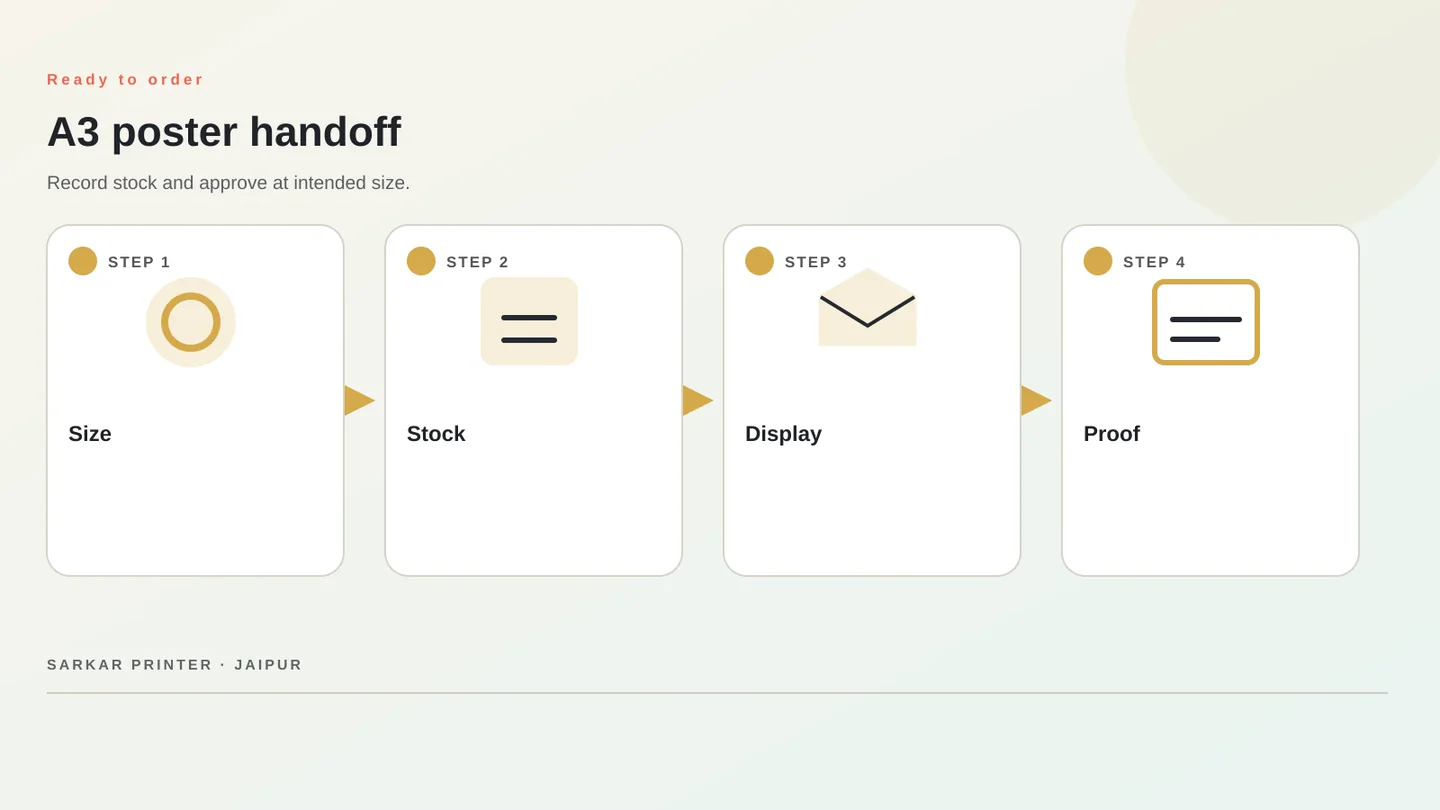
Prepare an A3 poster file
Set the page to 297 × 420 mm in the chosen orientation and use the bleed specified by the print supplier. Keep important text and logos inside the safe area. Check that photographs remain sharp at their placed size.
Verify the PDF opens correctly, has the expected page size, and includes fonts and linked images as requested. For other sizes, compare the poster-size chart; for production, visit poster printing in Jaipur.
Quick stock comparison for an A3 poster
| Stock | Surface impression | Discuss before ordering |
|---|---|---|
| Matte coated | Lower sheen than gloss | Lighting, colour and hand feel |
| Gloss coated | Shiny with stronger reflections | Glare and image appearance |
| Uncoated | Paper-like, low-sheen feel | Image detail and ink appearance |
| Firmer display stock | More substantial feel | Holder compatibility and curl |
PLAN YOUR PRINT
Share the format, use and quantity.
Include material, artwork status and delivery needs so the print team can review the specification.
Start an enquiry ↗Frequently asked questions
What is the size of A3 poster paper?
A3 measures 297 × 420 mm before printer-specific bleed. In landscape orientation, use 420 × 297 mm.
Which GSM is best for an A3 poster?
There is no single best GSM. Weight does not define thickness or stiffness by itself, so explain how the poster will be used and compare samples.
Is matte or gloss better for a poster?
Matte has less sheen than gloss; gloss reflects more light. Choose for the lighting, artwork and viewing conditions.
Can I use A3 poster paper outdoors?
Do not assume standard paper is weatherproof. Ask the printer about materials and finishes suitable for that environment.