
Deploying advanced anti counterfeit packaging printing techniques is now essential for manufacturers facing illicit cloning. According to OECD global illicit trade data , counterfeit products account for over $500 billion annually. Consequently, brand owners face severe revenue losses and catastrophic safety liabilities.
Historically, brand managers attempted to stop product forgery with a single standalone tactic. Specifically, they affixed an off-the-shelf holographic sticker over the box opening. Today, however, criminal syndicates operate sophisticated commercial printing lines. In addition, they easily purchase stock foils on open markets. Therefore, a standalone sticker is no longer a deterrent.
To defeat modern illicit cloning, industrial converters deploy a multi-layered defense in depth. First, manufacturers combine physical paperboard converting with reactive chemical inks. Next, they integrate mathematical prepress algorithms and serialized digital tracking. As a result, counterfeiters find it economically impossible to replicate the packaging. When evaluating brand protection strategies, procurement heads must master the technical mechanics of anti counterfeit packaging printing techniques.
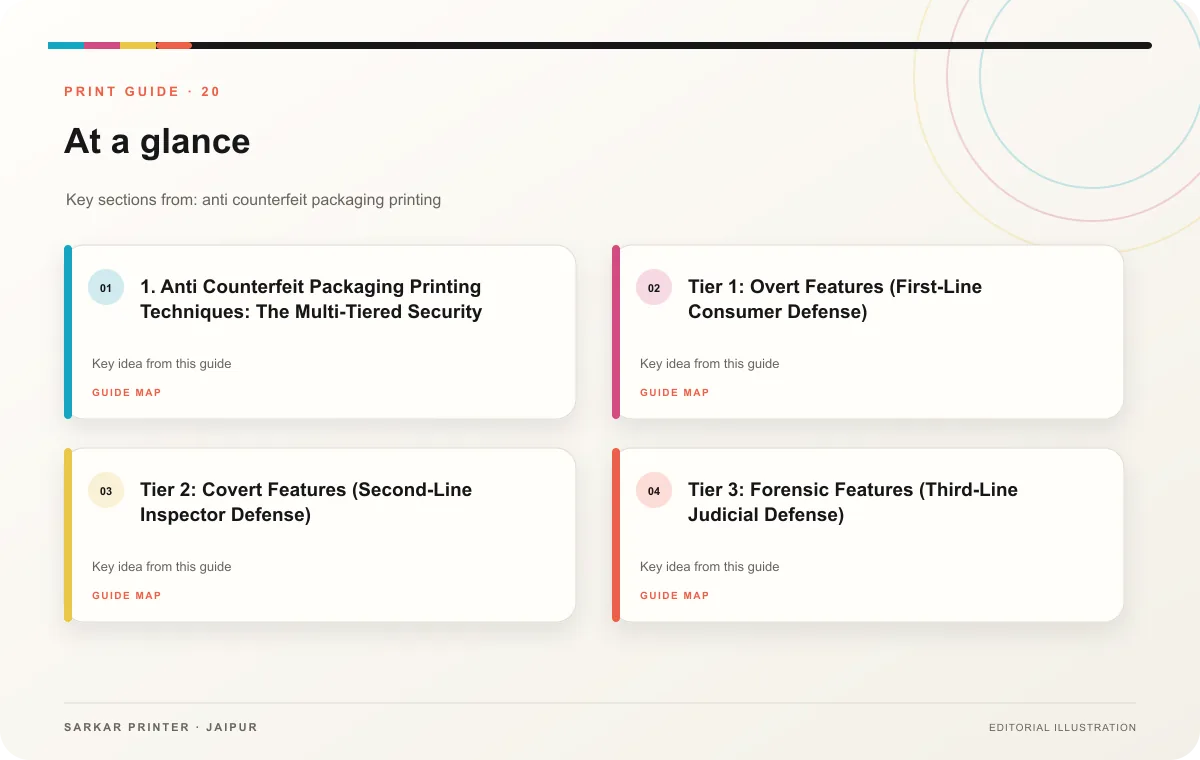
1. Anti Counterfeit Packaging Printing Techniques: The Multi-Tiered Security Hierarchy
A robust anti-counterfeiting strategy relies on defense-in-depth. If a package relies on a single security element, counterfeiting rings will reverse-engineer it quickly. Therefore, a truly protected folding carton integrates features across three distinct operational tiers:
Tier 1: Overt Features (First-Line Consumer Defense)
Overt features are public-facing elements. Any consumer can verify them on a store shelf in seconds. In addition, they require no special training or optical equipment.
- Optically Variable Inks (OVI): These pigments contain microscopic multi-layer flakes. As a result, colors shift dramatically when the carton is tilted. For example, the hue transitions from emerald green to deep violet. Counterfeit flat scanners capture only one fixed angle. Consequently, scanners fail completely to replicate the dynamic color shift.
- Custom Registered Holographic Hot Stamping: These devices feature kinetic motion, 3D depth, and micro-grooves. Specifically, operators emboss them into aluminum foil under 130°C heat. Crucially, converters tool these dies with custom brand crests. Therefore, this process completely eliminates the risk of stock foil replication.
Tier 2: Covert Features (Second-Line Inspector Defense)
Covert elements remain invisible during normal retail shopping. However, they provide secure verification for warehouse managers, customs officials, and brand enforcement agents.
- UV-Fluorescent Invisible Inks: These varnish layers remain completely invisible under standard daylight. However, they emit brilliant fluorescence when exposed to a 365 nm UV blacklight. For instance, the ink glows neon green, crimson, or cyan.
- Thermochromic Temperature-Sensitive Inks: These formulations contain microencapsulated leuco dyes. Because of body heat, the printed ink turns completely transparent at 31°C (88°F). Then, it reveals an underlying verification wordmark. Afterward, it cools back to its original opaque state.
Tier 3: Forensic Features (Third-Line Judicial Defense)
Forensic security features are reserved for proprietary brand defense and legal litigation. Specifically, engineers blend invisible inorganic chemical markers or synthetic DNA taggants into the overprint varnish. These taggants remain at concentrations below 50 parts per billion (ppb). Consequently, counterfeiters cannot detect the taggant using standard commercial laboratory equipment. Thus, brand owners gain decisive, courtroom-admissible proof during anti-counterfeiting enforcement actions.
Overall, understanding this hierarchical structure when designing anti counterfeit packaging printing techniques ensures complete protection. In fact, it covers every touchpoint from consumer unboxing to courtroom enforcement.
Security Engineering Infographic
The 3-Tier Packaging Security Architecture
Multi-layered defense-in-depth framework for commercial packaging & folding cartons
Consumer Verification
Instant visual recognition under ambient light without tools.
- Optically Variable Inks: Dynamic color shifting upon tilt
- Custom Registered DOVIDs: Bespoke holographic embossing
- Tamper-Evident Die Cuts: Irreversible fiber-tear slits
Supply Chain Verification
Hidden features requiring low-cost handheld tools for field inspection.
- 365nm UV Inks: Invisible under daylight, glows under blacklight
- Thermochromic Pigments: Vanishes under thumb heat friction
- Microtext ( 0.8 pt): Legible only under 15x–20x loupe
- Guilloche Mesh: Moiré destruction on digital scanners
Court-Admissible Proof
Proprietary molecular markers decipherable only in accredited laboratories.
- Chemical Taggants: Inert micro-emitters in varnish ( 50 ppb)
- Synthetic DNA: Unique biological code sequence verification
- Spectral Spectroscopy: Conclusive legal evidence in litigation
Digital Intelligence Layer
Automated Inline GS1 DataMatrix Serialization
2. Prepress Anti Counterfeit Packaging Printing Techniques: Guilloche and Microtext
Notably, one of the most cost-effective security layers is applied before the press starts. Specifically, engineers build security geometry directly into the prepress vector artwork.
Counterfeiters typically recreate artwork by scanning genuine cartons on flatbed scanners. Alternatively, they photograph samples with digital cameras and vectorize the graphics. However, prepress security engineers defeat this process intentionally. They weaponize the optical limits of raster image processors (RIPs) and optical scanning sensors.
Guilloche Vector Line Networks
A Guilloche pattern is an intricate geometric mesh. Specifically, prepress software constructs it from continuous mathematical curves.
- Line Width and Pitch: Engineers design vector lines with thicknesses of 25 to 40 microns (0.025 mm to 0.040 mm). In addition, they space lines closely across the background.
- The Anti-Copy Scanner Trap: Flatbed scanners sample images using a discrete pixel grid. Typically, this grid operates at 600 to 1,200 DPI. However, a 30-micron Guilloche vector mesh creates severe optical interference. As a result, the scan produces optical moiré patterns, jagged lines, and muddy closures.
Microtext and Nano-Typography
Microtext consists of continuous typographic strings rendered at microscopic scales. Consequently, it delivers rapid verification under magnification.
- Point Size: Prepress artists set microtext between 0.5 and 0.8 points. That equals letter heights between 0.15 mm and 0.25 mm.
- Visual Camouflage: To the naked eye, the text string appears as a solid border line. For example, it resembles an innocent 0.5-point divider beneath a product title.
- Optical Verification: However, the line resolves clearly under a 10x to 20x pocket loupe. Observers can instantly read the crisp individual alphanumeric characters.
- Counterfeiting Failure: In contrast, commercial toner copiers lack the optical resolution to image microtext. Therefore, copies render only a broken, blurred smudge.
Thermal CTP Laser Imaging Standards
To successfully reproduce Guilloche patterns and microtext in commercial offset printing , converters must bypass standard 2,400 DPI plate units. Instead, converters utilize high-definition security plate-setters operating at 4,000 to 5,080 DPI. As a result, microscopic vector curves maintain flawless edge definition on aluminum printing plates.
3. Anti Counterfeit Packaging Printing Inks: Functional Chemical Formulations
Furthermore, ink duct chemistry provides an active barrier against illicit packaging replication. Unlike standard CMYK process inks, security inks use specialized physical chemistry. Specifically, these formulations react immediately to optical, thermal, or chemical stimuli.
4. Structural Anti Counterfeit Packaging Techniques: Tamper-Evident Die-Cutting
A carton can feature impeccable security printing. However, security fails if counterfeiters can open boxes and replace products undetected. Thus, the entire protection chain collapses without structural integrity.
Therefore, structural packaging engineers combat this issue through tamper-evident die-cutting physics:
- Structural Fiber-Tear Security Slits: Dieline engineers incorporate precision fracture patterns on tuck flaps. For example, they use zig-zag teeth and perforated shear bridges. When a consumer opens the flap, the paperboard tears irreversibly. Consequently, the tear strips away the exterior liner and exposes inner pulp. As a result, the carton cannot be re-glued without clear visual damage.
- Void-Polymer Destructible Seals: For rigid setup boxes, converters apply multi-layer polymer labels across closing seams. In addition, these labels bond with high-shear acrylic adhesive. Attempting to peel the sticker delaminates the film permanently. Therefore, it leaves an indelible "VOID" or "OPENED" imprint on the board.
5. Digital Serialization Techniques: Inline GS1 DataMatrix Traceability
The pinnacle of modern brand protection is the convergence of physical printing with digital serialization. In contrast, static packaging is highly vulnerable. When 100,000 cartons carry identical barcodes, a counterfeiter needs only one working plate to replicate millions of units.
Deploying advanced variable data printing protocols allows converters to assign a unique, globally serialized digital identity to every individual carton leaving the manufacturing facility via inline thermal inkjet (TIJ) or continuous inkjet (CIJ) printing heads mounted directly on automated folder-gluers.
The GS1 DataMatrix Standard:
Certified under the global GS1 DataMatrix standard , it features Reed-Solomon Error Correction (ECC 200). Consequently, scanners achieve accurate reading even if 30% of the code is scuffed in transit.
When consumers or field auditors scan the serialized code, they unlock real-time cloud authentication. For instance, consider a code designated for retail distribution in Jaipur. If that code is scanned repeatedly across distant cities, the cloud platform triggers instant automated alerts. Consequently, brand managers detect supply chain diversion or unauthorized cloning immediately.
Ultimately, deploying digital track-and-trace alongside physical anti counterfeit packaging printing techniques turns every individual carton into an active security beacon.
6. Anti Counterfeit Packaging Printing Techniques: Key Procurement Takeaways
When deploying advanced anti counterfeit packaging printing techniques and issuing tooling requisitions for commercial packaging, procurement executives and quality assurance auditors should enforce these operational guidelines:
- Mandate Defense-in-Depth Across Multiple Tiers: Never rely exclusively on a standalone sticker. Instead, combine at least one overt consumer feature, two covert inspection features, and serialized digital tracking.
- Eliminate Generic Stock Holograms: Specify custom-tooled registered holographic hot stamping dies. In particular, feature proprietary corporate emblems to prevent counterfeiters from sourcing matching foils.
- Require 4,000+ DPI CTP Imaging for Security Prepress: Verify that the commercial printer operates high-resolution thermal plate-setters. Consequently, this ensures accurate reproduction of 30-micron Guilloche curves and sub-0.8 pt microtext.
- Deploy UV Invisible Inks on Non-Critical Blank Zones: Print covert UV-fluorescent batch codes or authentication emblems on interior flaps. As a result, warehouse teams can conduct instant audit verification under blacklight.
- Incorporate Structural Tamper-Evident Die Cuts: Design carton dielines with deliberate fiber-tear stress slits on tuck flaps. Therefore, you prevent illicit product substitution without visible carton destruction.
- Implement Unit-Level GS1 DataMatrix Serialization: Integrate high-speed inline thermal inkjet printing on folder-gluers. In addition, pair them with vision verification cameras to generate unique cryptographically secure codes per carton.
- Partner with Certified Security Converting Facilities: Select an established industrial packaging manufacturer like Sarkar Printer that enforces strict cleanroom access controls, secure waste destruction protocols, and audited chain-of-custody tracking for all security plates, dies, and finished inventory.
TALK TO OUR PRESS EXPERTS
Planning high-volume brochures, mono cartons, or custom rigid boxes? Get factory-direct offset quotes with precision Pantone color matching.