
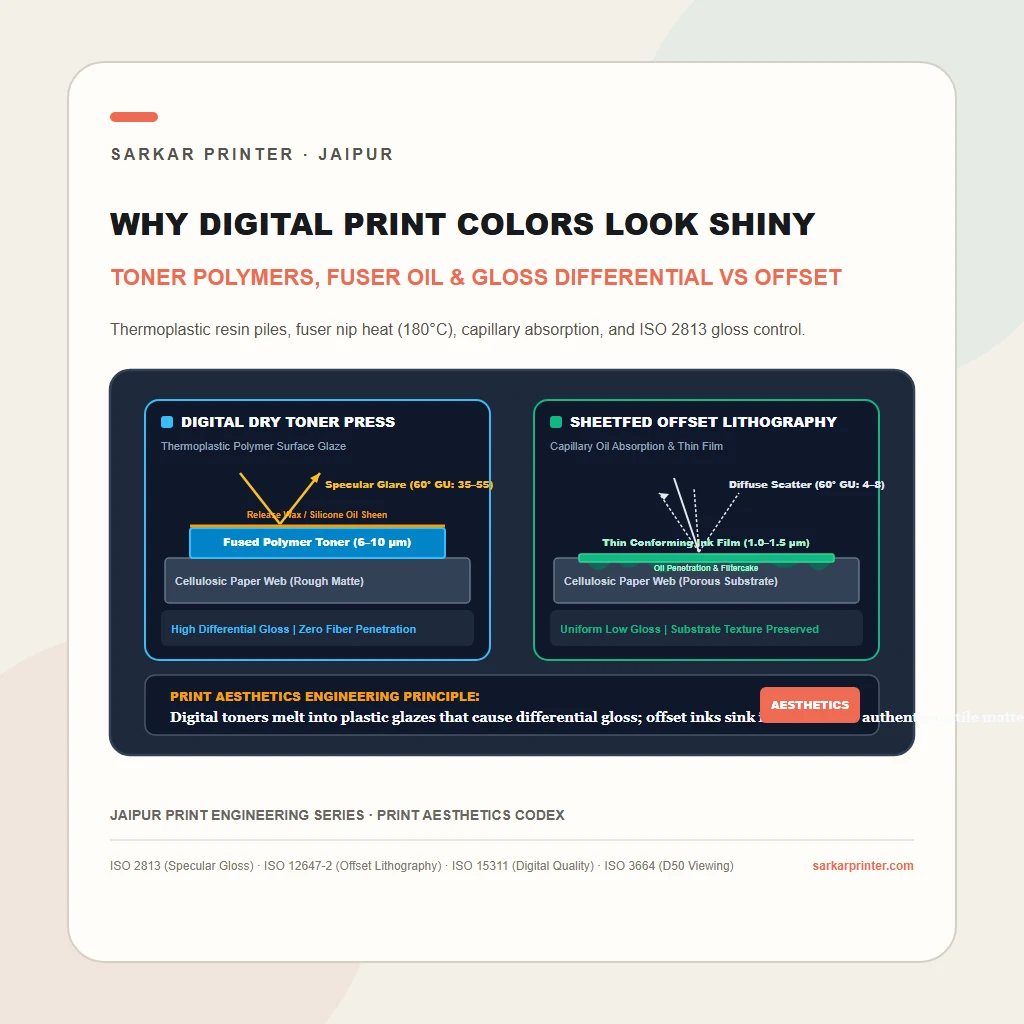
The Aesthetic Paradox: High Saturation vs Specular Glare
Every graphic designer, art director, and print buyer encounters this visual puzzle: you select a luxurious, textured 300 gsm uncoated cotton paper for an art monograph or corporate brochure. You want an understated, tactile, organic feel. Yet when the digital proof arrives from a high-end production color laser press, dark photographs and rich solid typography gleam with an unmistakable plastic sheen. Under ambient office lights, the printed elements reflect intense specular glare, while the surrounding unprinted paper remains dead matte. The finished sheet looks as though someone ironed shiny plastic stickers directly onto raw artist paper.
In contrast, when you inspect that exact same layout printed on a commercial sheetfed offset lithographic press, the ink colors integrate seamlessly into the paper surface. The deep blacks and saturated hues preserve the natural, velvety, non-reflective texture of the substrate. Light scatters softly across both ink and fiber without creating blinding reflections or distracting glare. The design feels grounded, premium, and restful to read.
This striking optical contrast stems directly from fundamental differences in ink chemistry, particle size, and thermodynamic drying physics. Dry toner electrophotography and sheetfed offset lithography treat the cellulosic fiber structure of paper in completely opposing manners. Understanding these mechanical mechanisms allows print buyers and packaging designers to make informed production decisions, calibrate prepress files, and select the precise printing technology that honors their brand aesthetic. For commercial procurement requirements across Rajasthan, explore our specialized digital printing in Jaipur and high-precision offset printing in Jaipur production hubs.
The Mechanics of Toner Fusing: Creating a Molten Plastic Glaze
To understand why dry toner digital printing produces a shiny surface, you must first examine how a digital press transfers and fixes colorants to paper. Electrophotographic production presses (such as Xerox, Canon, Ricoh, and Konica Minolta production engines) do not use liquid ink. Instead, they operate with dry toner: microscopic, solid powder particles measuring roughly 5 to 8 microns in diameter.
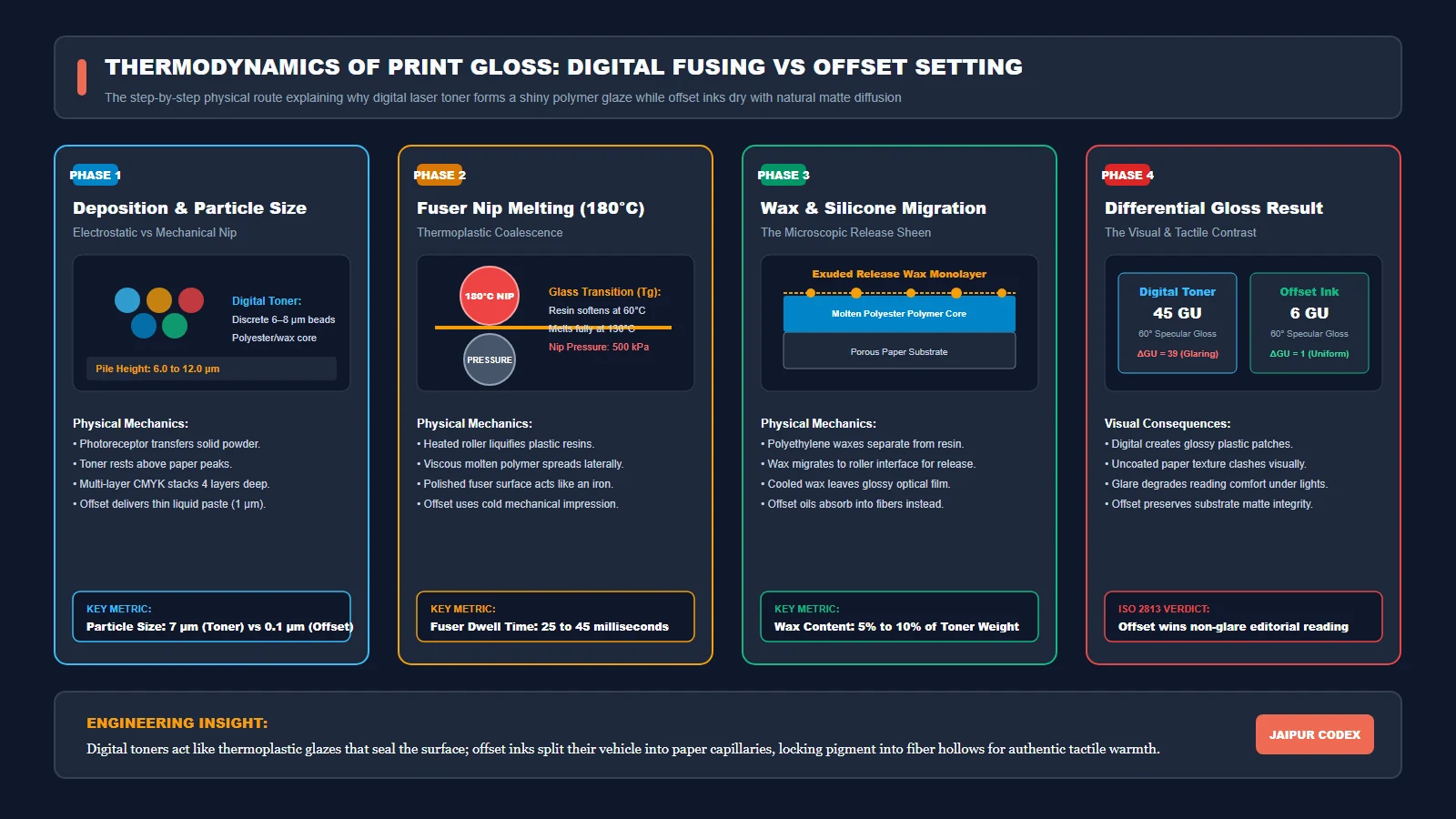
Chemical toner manufacturers formulate these particles from three primary components: organic color pigments, charge control agents, and thermoplastic polymer resins (predominantly polyester or styrene-acrylic copolymers). Crucially, thermoplastic resin accounts for eighty to ninety percent of each toner particle by weight. When the laser engine forms an electrostatic latent image on the photoreceptor drum, electrostatic fields attract these dry plastic beads and transfer them onto the moving paper web.
At this intermediate transfer stage, the toner sits on the paper face as a loose, fragile powder pile. In dark shadow areas where cyan, magenta, yellow, and black toners overlap (reaching Total Area Coverage levels of 280% to 320%), this dry powder pile reaches a vertical height of 8 to 14 microns. To permanently fix this loose plastic powder to the substrate, the paper must pass through the fuser assembly.
The fuser unit consists of a high-precision heated roller or belt mechanism operating against a heavy silicone pressure roll. The fuser roller maintains a continuous surface temperature between 160°C and 195°C, exerting mechanical nip pressures between 300 and 700 kilopascals. As the paper traverses this heated nip for 25 to 45 milliseconds, the intense thermal energy rapidly drives the thermoplastic toner past its glass transition temperature (Tg ≈ 55°C–65°C) and above its polymer melting point (110°C–130°C).
Under this intense heat and pressure, the discrete toner beads collapse, melt, and flow together into a continuous liquid pool. The mirror-smooth, highly polished surface of the heated fuser belt functions like an iron, pressing the molten polymer flat against the paper surface. When the sheet exits the nip into the cooling zone, the liquified plastic rapidly hardens into a solid, continuous resin glaze. Because the cooled polymer forms a planar, non-porous surface, incoming light bounces off the resin in a unified, directional beam: specular reflection. This mirror-like bounce is the exact optical phenomenon that human eyes register as gloss and shine.
The Hidden Contributor: Fuser Release Oil and Internal Wax Emulsions
Beyond the thermal flattening of the polymer resin, an essential chemical lubricant adds to the shiny finish: fuser release oil. In high-speed electrophotographic printing, molten plastic presents a severe mechanical hazard. Without an effective release agent, sticky molten polyester resin adheres to the hot fuser roller, creating catastrophic paper wraps, image ghosting, and press shutdowns.
Legacy production presses solved this challenge by continuously applying a microscopic film of polydimethylsiloxane (silicone oil) across the fuser roller face using an oil donor roll or saturated metering pad. While this silicone fluid prevented paper wraps, the heated nip transferred a noticeable volume of oil directly onto the finished print surface. This residual silicone oil formed an oily monolayer over the cured toner, generating a characteristic iridescent, rainbow-like specular sheen under fluorescent lighting.
Modern production digital presses utilize "oil-less" chemical toners, such as Emulsion Aggregation (EA) formulations. To eliminate external silicone oil application systems, chemical engineers embed microscopic paraffin or polyethylene ester wax cores (accounting for 5% to 10% of total toner volume) directly inside each toner bead. During the 180°C fusing stroke, this low-melting-point wax liquifies before the outer polymer shell, migrating rapidly to the interface between the molten toner and the hot roller. This blooming wax forms a temporary barrier that releases the paper cleanly without external oil.
However, this internal wax does not disappear. As the paper cools upon exiting the fuser, the exuded wax solidifies into a micro-thin, low-surface-energy layer directly across the outer face of the print. This wax film fills remaining microscopic pits in the toner, boosting the specular gloss rating by an additional 5 to 12 Gloss Units. When evaluating materials for packaging and corporate branding, review our engineering guides for brochure printing and custom folding carton packaging.
How Offset Lithography Differs: Capillary Absorption and Fiber Conformance
To appreciate why offset lithography avoids this shiny appearance, you must contrast the plastic glaze of toner against the fluid surface chemistry of commercial paste ink. Offset lithography does not utilize dry plastic powders or heated fusing irons.
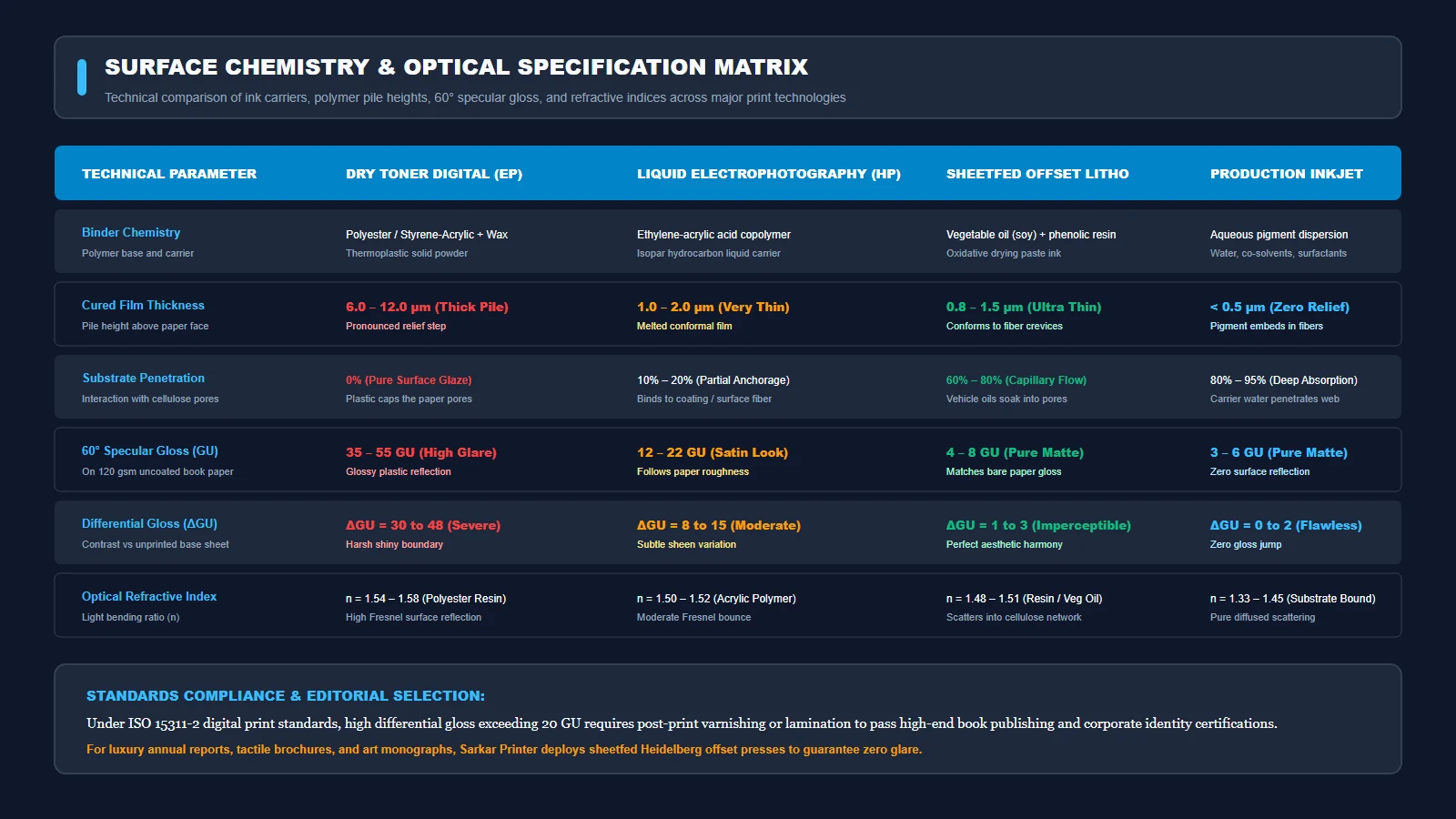
Offset printing presses deposit high-viscosity paste inks formulated from refined vegetable oils (such as soybean and linseed oil), modified phenolic hard resins, aliphatic hydrocarbon distillates, and finely dispersed organic pigments (particle size 0.05 to 0.15 microns). When the rubber blanket cylinder contacts the paper under gentle kiss impression pressure, it deposits an ultra-thin ink film measuring merely 0.8 to 1.5 microns: less than one-fifth the thickness of a digital toner pile.
The instant this thin ink film touches the paper, intense capillary forces take over. The porous cellulosic network of the paper fibers, combined with the microporous structure of any calcium carbonate or kaolin clay surface coating, exerts immense capillary suction. Within 10 to 50 milliseconds of blanket separation, the low-viscosity hydrocarbon distillates and vegetable oil vehicles drain away from the pigment phase, sinking deep into the internal fiber capillaries of the sheet.
This rapid capillary drainage leaves behind a dense "filtercake" of concentrated pigment particles and high-molecular-weight phenolic resins anchored firmly inside the surface valleys of the paper. As the remaining linseed oil oxidizes and cross-links over subsequent hours, the ink layer shrinks down tight against the microscopic peaks and valleys of the paper fibers. The cured ink film conforms completely to the physical texture of the paper substrate.
Consequently, when light strikes an offset-printed sheet of uncoated paper, the micro-roughness of the underlying paper fibers scatters the incoming light rays randomly in all directions (diffuse scattering). Under international standard ISO 2813 specular gloss measurement at a 60-degree angle, both the unprinted uncoated paper and the offset-printed image areas register nearly identical gloss readings: between 4 and 8 Gloss Units (GU). Because no reflective plastic layer forms, the printed image maintains total aesthetic unity with the raw paper.
The Core Visual Culprit: Differential Gloss (ΔGU)
The most visually jarring flaw of digital printing on non-gloss substrates is not simply high gloss, but differential gloss (also known in print quality circles as "gloss artifacting" or "delta gloss"). Human vision does not evaluate absolute reflection in isolation; our eyes perceive contrast.
When you print a digital color photograph onto a matte or uncoated sheet, the unprinted margins reflect light diffusely at 4 to 6 GU. However, within the image, light highlight tones (10% ink coverage) deposit few toner beads, registering a low gloss of 8 to 12 GU. Meanwhile, midtones jump to 25 GU, and deep shadows (300% TAC) melt into a continuous resin glaze registering 45 to 55 GU. This produces a massive internal gloss shift of up to 48 Gloss Units across a single photograph!
| Substrate & Print Process | Unprinted Sheet Gloss (60° GU) | Solid Print Gloss (60° GU) | Differential Gloss (ΔGU) | Visual Perception & Glare Rating |
|---|---|---|---|---|
| Uncoated Book Paper (Dry Toner Digital) | 4 – 6 GU | 42 – 55 GU | ΔGU = 38 – 49 | Severe glare; shiny plastic sticker appearance |
| Uncoated Book Paper (Sheetfed Offset) | 4 – 6 GU | 5 – 8 GU | ΔGU = 1 – 3 | Flawless aesthetic harmony; soft velvety matte |
| Matte Coated Art Paper (Dry Toner Digital) | 14 – 18 GU | 48 – 60 GU | ΔGU = 32 – 44 | High gloss differential; harsh edge reflections |
| Matte Coated Art Paper (Sheetfed Offset) | 14 – 18 GU | 16 – 22 GU | ΔGU = 2 – 5 | Uniform satin sheen; restful reading comfort |
| Gloss Coated Paper (Dry Toner Digital) | 68 – 75 GU | 65 – 78 GU | ΔGU = 0 – 5 | Excellent gloss match; toner blends into sheet |
| Liquid ElectroInk (HP Indigo Uncoated) | 4 – 6 GU | 12 – 18 GU | ΔGU = 7 – 12 | Moderate sheen; subtle conformal contouring |
Under international digital print quality standard ISO 15311-2, commercial print certification requires differential gloss values below 15 GU for high-grade commercial work and below 8 GU for premium book production. Dry toner electrophotography on uncoated paper fails this benchmark dramatically unless press operators apply post-print remedies.
Diagnostic Troubleshooting: Eliminating Glare and Surface Flaws
When digital shine threatens the aesthetic success of a commercial print campaign, production engineers execute structured diagnostic workflows to mitigate surface artifacts.
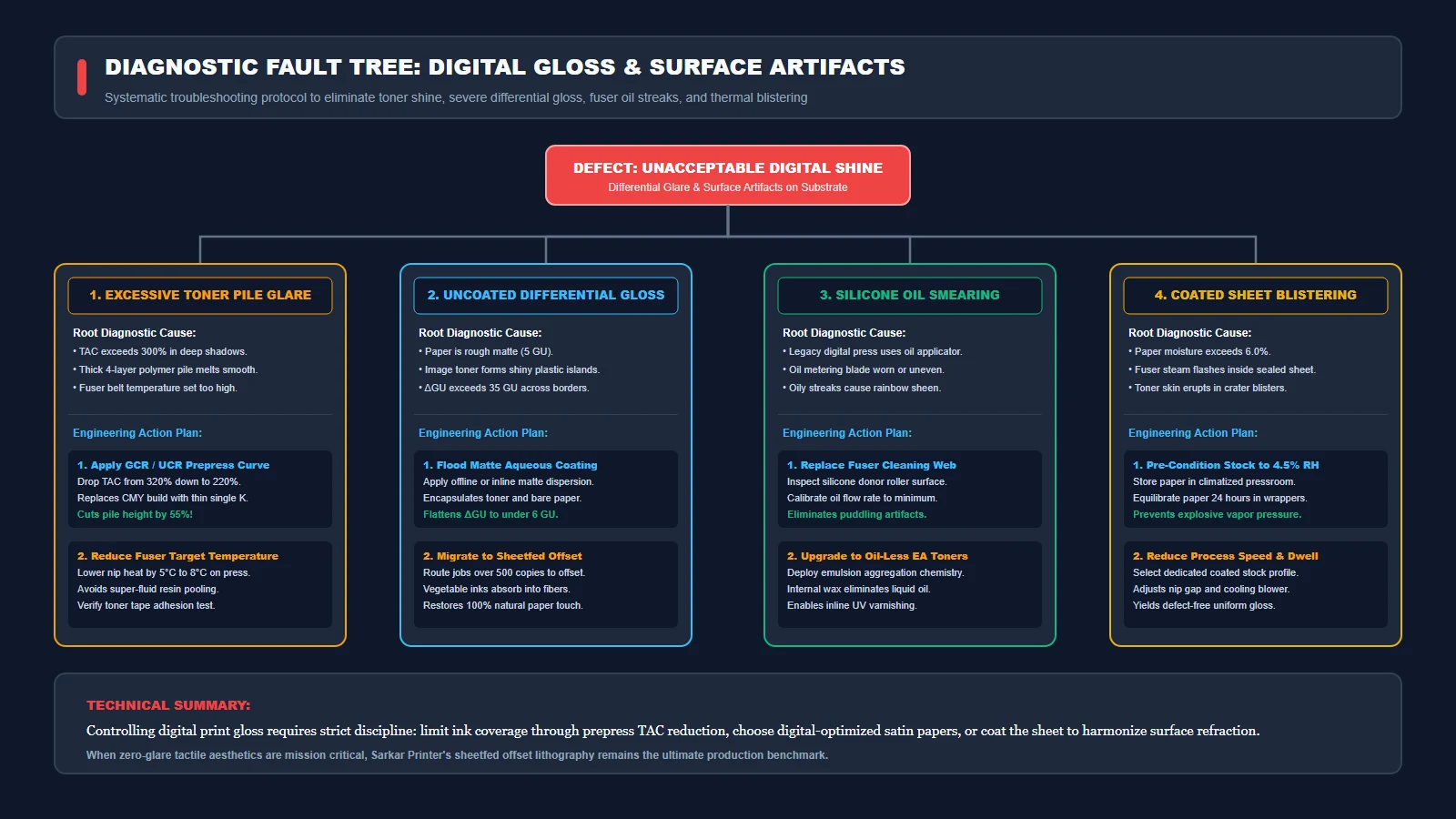
To eliminate excessive toner shine and balance surface reflection, print production teams utilize four primary engineering strategies:
- Prepress Total Area Coverage (TAC) Reduction via GCR: High toner piles create the most severe glare. By applying aggressive Gray Component Replacement (GCR) or Under Color Removal (UCR) ICC device link profiles during prepress PDF rendering, prepress technicians replace overlapping cyan, magenta, and yellow ink builds in neutral shadow areas with a single thin black (K) separation. This drops the maximum ink limit from 320% down to 220%–240%, slashing toner pile thickness by over fifty percent and dramatically reducing fused resin volume.
- Application of Full-Flood Matte Overprint Coatings: If you must run high-coverage artwork on a digital toner press, apply an offline or inline full-flood matte aqueous dispersion coating or soft-touch thermal lamination film. A flood coating encapsulates both the shiny plastic toner and the bare unprinted paper beneath a single, uniform refractive index layer (n ≈ 1.49). This drops differential gloss to under 4 GU, restoring a luxurious matte finish.
- Digital Press Fuser Temperature Calibration: Skilled digital press operators adjust the fuser temperature profile in the press media catalog. By lowering fuser belt target temperatures by 5°C to 8°C on heavy text stocks, operators prevent the polymer from melting into a super-fluid liquid mirror, leaving a more diffuse, semi-matte toner finish. The operator must cross-check this lower temperature against ASTM D3359 tape peel adhesion tests to prevent toner flaking.
- Substrate Harmonization: If a job requires digital laser printing without secondary coatings, specify silk, satin, or velvet coated art papers rather than raw uncoated stock. A satin sheet with a base gloss of 25 to 35 GU matches the natural melting sheen of modern EA toners closely, reducing differential gloss to acceptable visual thresholds.
For large catalogs, books, and corporate branding suites, explore our high-volume commercial print services in Jaipur.
Quality Control Standards: Fogra PSD, ISO 15311, and ISO 2813 Verification
At Sarkar Printer, our quality assurance laboratory benchmarks every production batch against internationally recognized optical and mechanical testing protocols established by Fogra Graphic Technology Research Association (ProcessStandard Digital PSD) and ISO 12647-2 offset standards.

Our pressroom technical audit follows rigorous standardized testing stages:
- ISO 2813 Specular Gloss Measurement: We audit incoming substrates and finished prints using precision multi-angle reflectometers at a 60-degree optical geometry. Technicians sample five distinct target zones across the sheet: highlight vignettes, 50% halftone midtones, 100% solid color patches, 300% shadow builds, and unprinted margin paper.
- Differential Gloss Audit: We calculate delta gloss across critical subject-to-background boundaries. For premium book publications, corporate annual reports, and luxury packaging, our production standard enforces a strict ceiling of ΔGU ≤ 10 GU.
- ASTM D3359 Method B Cross-Hatch Adhesion Testing: To confirm that reduced fuser temperatures do not compromise resin cure, technicians scribe an eleven-blade cross-hatch lattice through the toner film, apply standardized pressure-sensitive tape (3M 610), and pull firmly at a 90-degree angle. Production must achieve a Class 4B or 5B rating (zero flaking).
- ASTM D5264 Sutherland Rub Resistance: Printed samples endure 100 dry rub cycles under a four-pound weighted block to ensure internal toner waxes do not smear across adjacent white text panels during finishing and shipping.
- ISO 3664 D50 Viewing Booth Signoff: Art directors and print engineers inspect finished proofs inside standardized D50 (5000 Kelvin) light booths featuring a Color Rendering Index (CRI) exceeding Ra 95. We inspect sheets at grazing angles (45°/0° observation geometry) to guarantee optimal typographic legibility without blinding glare reflections.
Procurement Strategy: When to Choose Offset Lithography for Pure Matte
Selecting between digital and offset printing involves balancing run-length economics against non-negotiable tactile aesthetics. Digital production printing delivers unmatched agility for short runs under 500 copies, variable data personalization, and rapid same-day turnaround. When printing corporate business cards or promotional flyers on high-gloss coated stock, digital toner delivers stunning, vibrant saturation.
However, when your design philosophy prioritizes understated luxury, tactile warmth, and non-glare readability, sheetfed offset lithography remains the undisputed champion. If your project utilizes premium uncoated stocks, textured linen papers, kraft board, or heavy cotton stationery, offset printing provides significant advantages:
- Zero Differential Gloss: Offset paste inks penetrate the fiber hollows, ensuring that solid headers, photographic images, and blank paper margins maintain identical velvety matte reflectance.
- Superior Typographic Sharpness: Because offset inks do not form thick polymer piles, fine 6-point serif type remains crisp and legible without the rounded plastic edges characteristic of fused toner.
- True Brand Spot Color Integrity: Sheetfed offset presses run authentic Pantone Matching System (PMS) spot inks formulated with natural matte mineral pigments, eliminating the need to simulate vibrant brand colors using multi-pass CMYK toner builds.
- Eco-Friendly Recyclability and De-Inking: Vegetable-based offset inks formulated from soy and linseed oils break down easily in paper recycling repulping systems, earning superior de-inking scores compared to non-biodegradable fused thermoplastic toner skins on FSC certified papers.
By aligning your prepress file setup and process selection with the physical realities of toner fusing versus ink absorption, you guarantee that your finished print collateral commands authority, elevates brand perception, and delivers a flawless reading experience.
Frequently Asked Questions About Digital Print Shine & Glare
Why do colors printed on a digital laser press look shiny while offset print looks matte?
Digital laser presses use dry toner composed of thermoplastic polyester resins and internal release waxes. During printing, a heated fuser roll at 160°C to 195°C melts these plastic particles into a continuous, non-porous resin film that sits on top of the paper fibers, creating high specular gloss. In contrast, sheetfed offset presses use vegetable-oil paste inks. The porous paper fibers rapidly absorb the low-viscosity ink oils through capillary action, leaving an ultra-thin 1-micron ink layer that preserves the natural diffuse matte texture of the substrate.
What is differential gloss and why does it look bad on uncoated paper?
Differential gloss occurs when the printed image areas exhibit significantly higher specular reflection than the surrounding unprinted paper. On uncoated paper, the bare substrate reflects light diffusely with a 60-degree gloss rating of 3 to 8 Gloss Units (GU). When heavy digital toner melts across this sheet, the fused plastic patches register 35 to 55 GU. This steep contrast of over 30 GU creates an artificial, plastic sticker appearance that clashes with the tactile texture of the paper.
What role does fuser oil play in digital print glossiness?
In production digital presses, fuser rollers apply heat and pressure to melt toner. To prevent molten plastic resin from wrapping around the roller, older presses applied a microscopic film of polydimethylsiloxane (silicone) release oil. This residual silicone oil transfers directly to the print face, producing a distinct oily sheen and rainbow glare. Modern presses use oil-less emulsion aggregation toners containing embedded polyethylene wax, but this wax still blooms to the surface upon heating to form a glossy release layer.
How can print buyers reduce unwanted shine on digital print jobs?
Print buyers can eliminate unwanted digital shine through three primary techniques: first, instruct prepress to apply aggressive Gray Component Replacement (GCR) or Under Color Removal (UCR) to drop Total Area Coverage (TAC) from 320% down to 220%, reducing toner pile height; second, specify full-flood matte aqueous coating or soft-touch thermal lamination to unify the refractive index across the entire sheet; third, select liquid toner (HP Indigo) or high-speed production inkjet instead of dry toner electrophotography.
When should commercial brands choose offset printing over digital to control glare?
Commercial brands should choose sheetfed offset printing for luxury annual reports, high-end book publishing, corporate stationery, and premium product packaging printed on uncoated, textured, or cotton substrates. Offset lithography transfers thin ink films that integrate seamlessly into the paper fibers without building an artificial plastic glaze. This delivers authentic non-glare legibility, soft shadow depth, and superior tactile elegance under standard ISO 3664 D50 reading lights.