
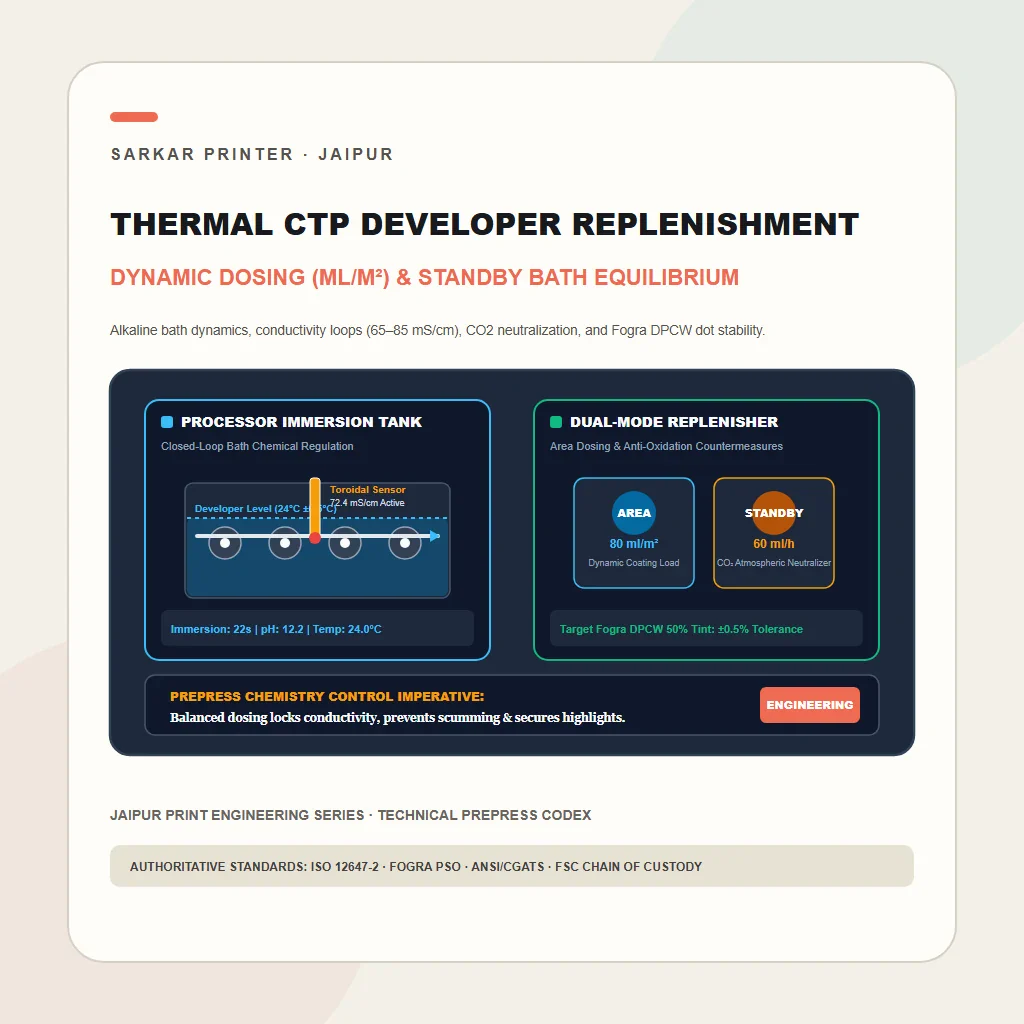
The Chemistry of Plate Processing: Why Replenishment Dictates Pressroom Stability
Every commercial offset press run succeeds or fails in the prepress plate processing tank. While print buyers evaluate finished sheets for register precision and ink density, press operators trace more than sixty percent of pressroom print defects directly back to computer-to-plate (CTP) chemical instability. In modern thermal CTP workflows, automated processors image anodized aluminum lithographic plates using 830-nanometer infrared lasers before developing the chemical coating in an alkaline immersion bath. Maintaining consistent developing chemical activity across thousands of square meters demands a rigorous understanding of developer replenishment rates.
A thermal CTP developer bath is an active, living chemical reactor. The alkaline liquid (typically formulated with potassium hydroxide KOH or potassium silicates) dissolves organic novolac resin coatings to expose the hydrophilic, water-receptive grain of the aluminum substrate. As plates transit through the bath, chemical reactions continuously consume active hydroxyl ions (OH⁻). Concurrently, ambient carbon dioxide (CO₂) in the pressroom atmosphere dissolves into the open tank, neutralizing alkaline hydroxides into carbonates. Without precise chemical replenishment, the developer bath drifts out of equilibrium within hours, triggering catastrophic background scumming or destructive highlight dot loss on press.
Prepress engineers calibrate developer chemistry according to established international technical frameworks, including ISO 12647-2 for offset lithographic process control and Fogra PSO plate production tolerances. To maintain predictable halftone dot transfer from digital one-bit TIFF bitmaps to physical aluminum plates, print operations must master dynamic area dosing, standby anti-oxidation compensation, and closed-loop conductivity sensor feedback.
Processor Architecture and Dual-Channel Replenishment Workflow
The modern thermal CTP plate processor coordinates four synchronized mechanical and chemical stages to transform laser-exposed plates into press-ready printing masters. Prepress operators must understand this sequential workflow to isolate chemical drift from mechanical transport errors.
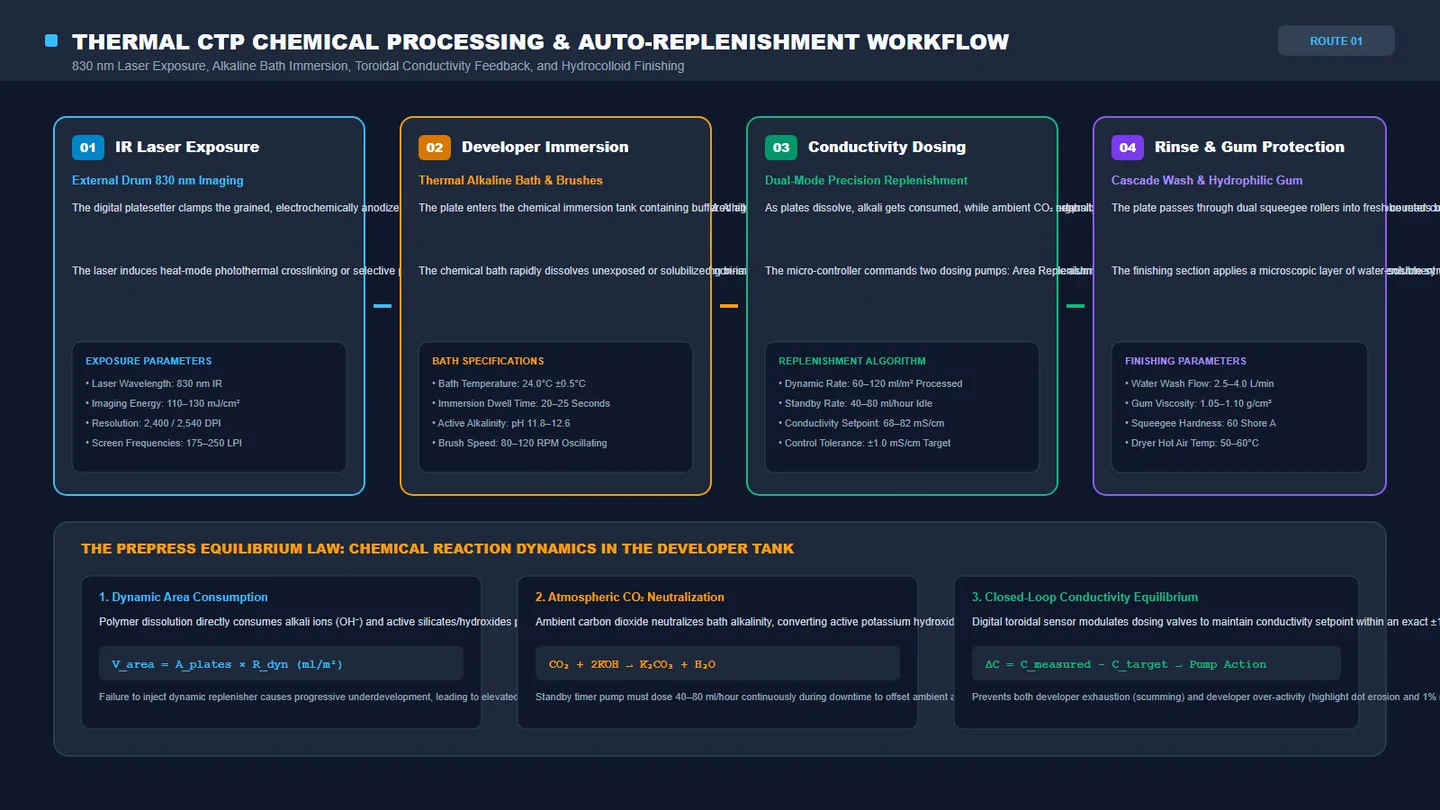
The processing cycle begins inside the external drum CTP platesetter. An array of 830 nm infrared laser diodes exposes the thermal coating at energy densities between 100 and 140 mJ/cm². In standard positive-working thermal plates, thermal laser energy breaks hydrogen bonds within the novolac phenolic resin matrix, rendering the exposed image areas instantly soluble in alkaline chemistry. The platesetter feed table delivers the imaged plate into Stage 1 of the chemical processor.
In Stage 2, motor-driven feed rollers immerse the plate into the alkaline developer bath. High-density oscillating plush nylon roller brushes sweep the plate surface at 80 to 120 RPM. These rotating brushes generate mechanical shear that dislodges softened non-image polymer chains, dispersing them into the fluid. The bath immersion dwell time requires exact regulation: standard positive thermal plates demand between 20 and 25 seconds of immersion at a controlled bath temperature of 24.0°C ±0.5°C.
In Stage 3, the processor executes dual-channel chemical replenishment. As the plate sensor detects the physical surface area of the entering sheet, the microprocessor activates a high-precision diaphragm pump to inject dynamic replenisher. Simultaneously, an in-line electrodeless toroidal conductivity probe reads bath electrical conductance. If ambient air carbonation drops conductivity below the pre-programmed baseline, the system triggers secondary anti-oxidation dosing.
In Stage 4, squeegee rollers wipe residual chemistry from the plate before entering a counter-current cascade water rinse. Clean spray bars flush dissolved polymer residue and alkali traces from the aluminum grain. Finally, a finishing roller applies a calibrated, microscopic film of synthetic hydrocolloid gum Arabic. This desensitizing gum seals the microscopic pores of the aluminum oxide against airborne grease and atmospheric oxidation while the plate travels through the 55°C hot-air impingement drying section. For commercial operations producing intricate publication work and folding cartons, explore our technical offset printing in Jaipur and custom rigid and folding carton packaging production capabilities.
Replenishment Parameters, Bath Dynamics, and Operating Windows
Prepress technicians maintain developer bath stability by balancing two independent chemical consumption vectors: dynamic plate throughput consumption and standby atmospheric oxidation. Calculating exact dosing rates requires quantitative chemical analysis.
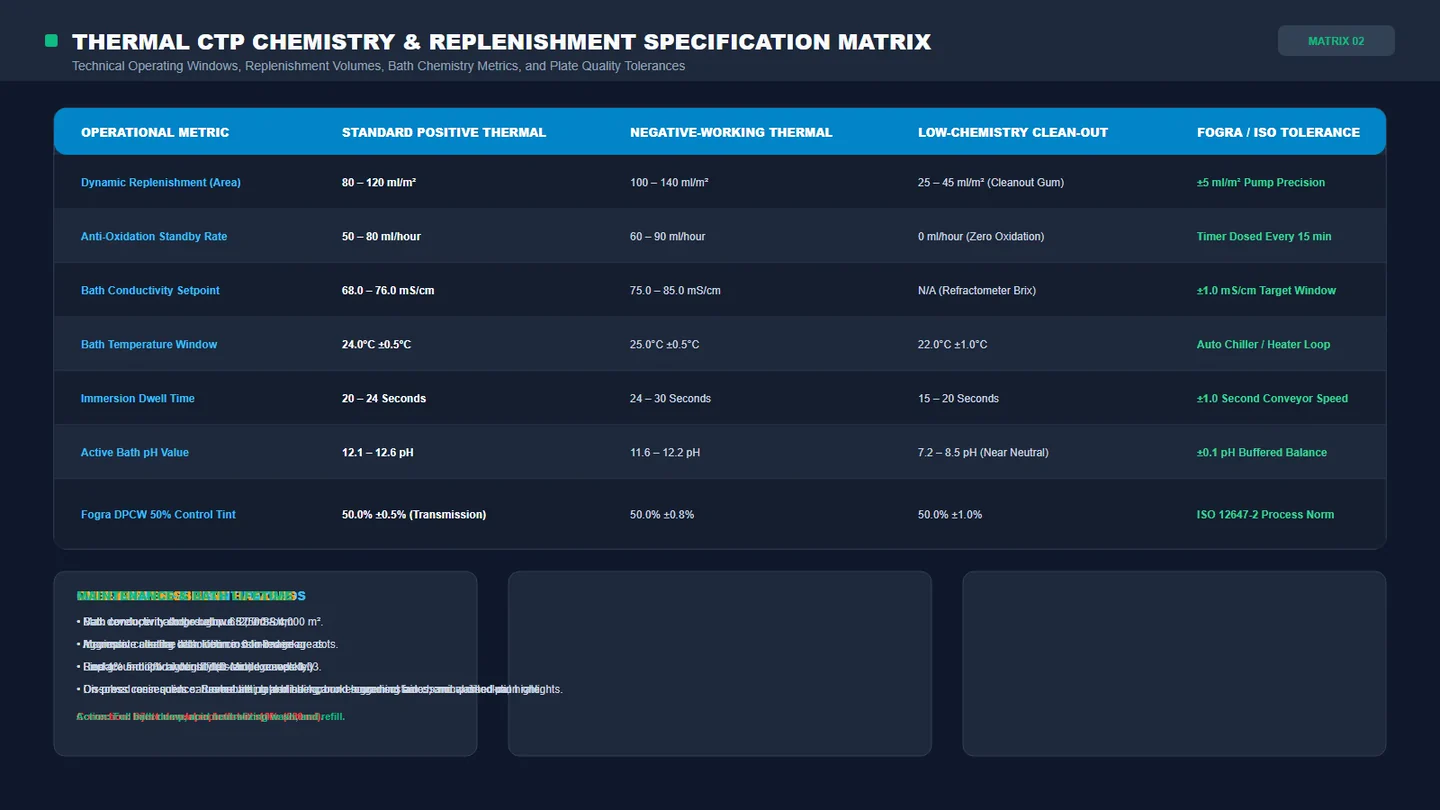
Dynamic replenishment compensates for active chemical components spent during coating dissolution. Each square meter of imaged plate consumes a predictable volume of alkali ions and surfactant wetting agents. Standard positive thermal plates require 80 to 120 milliliters of replenisher per square meter (ml/m²) of processed plate surface. Negative-working thermal plates, which feature photopolymer crosslinking coatings, require higher dynamic dosing rates ranging between 100 and 140 ml/m² to prevent residual monomer buildup in the bath.
Standby replenishment counteracts the natural carbonation of the developer solution. Alkaline developer contains dissolved potassium hydroxide or sodium metasilicate. Ambient air contains roughly 420 parts per million of carbon dioxide. When pressroom air contacts the turbulent liquid surface inside the processor tank, carbon dioxide dissolves and forms carbonic acid, which instantly reacts with potassium hydroxide:
The Atmospheric Carbonation Equation
CO₂ (air) + 2 KOH (bath) → K₂CO₃ (carbonate) + H₂O (water)
This neutralization reaction converts strong, active hydroxide ions into weak, inactive potassium carbonate, causing active bath pH to decline. To neutralize this ongoing degradation, the CTP processor timer injects 40 to 80 milliliters of replenisher per hour of idle standby time, even when the platesetter outputs zero plates over an entire weekend.
| Operating Parameter | Standard Positive Thermal | Negative-Working Thermal | Processless Direct-on-Press | Quality Control Standard |
|---|---|---|---|---|
| Dynamic Replenishment | 80 – 120 ml/m² | 100 – 140 ml/m² | 0 ml/m² (Eliminated) | Dosing pump volume verification ±2% |
| Standby Rate (Idle) | 50 – 80 ml/hour | 60 – 90 ml/hour | 0 ml/hour (Zero bath) | Automated timer pulse every 15 min |
| Conductivity Window | 68.0 – 76.0 mS/cm | 75.0 – 85.0 mS/cm | Not Applicable | ±1.0 mS/cm closed-loop tolerance |
| Bath Temperature | 24.0°C ±0.5°C | 25.0°C ±0.5°C | Ambient Pressroom | Microprocessor chiller & immersion heater |
| Immersion Dwell Time | 20 – 24 Seconds | 24 – 30 Seconds | On-Press Makeready | Conveyor tachometer speed ±1.0 sec |
| Bath pH Setpoint | 12.1 – 12.6 pH | 11.6 – 12.2 pH | Neutral (No chemistry) | Calibrated glass-electrode pH buffer test |
| Fogra DPCW 50% Patch | 50.0% ±0.5% | 50.0% ±0.8% | 50.0% ±1.0% | ISO 12647-2 transmission densitometry |
| Max Bath Throughput | 3,000 – 4,000 m² | 2,000 – 3,000 m² | Unlimited (Zero tank) | Full tank purge every 6–8 calendar weeks |
Modern prepress departments utilize closed-loop conductivity control rather than fixed volumetric replenishment. Because replenisher concentrate possesses a significantly higher electrical conductivity (typically 95 to 115 mS/cm) than working tank chemistry, the processor measures the solution resistance using an electrodeless toroidal induction probe. When coating dissolution and CO₂ neutralization drop the bath conductivity by 0.8 mS/cm, the controller injects short replenishment bursts until conductivity returns to the target setpoint. This closed loop eliminates human estimating errors during variable production shifts.
Diagnostic Fault Trees: Solving Under-Replenishment and Over-Replenishment
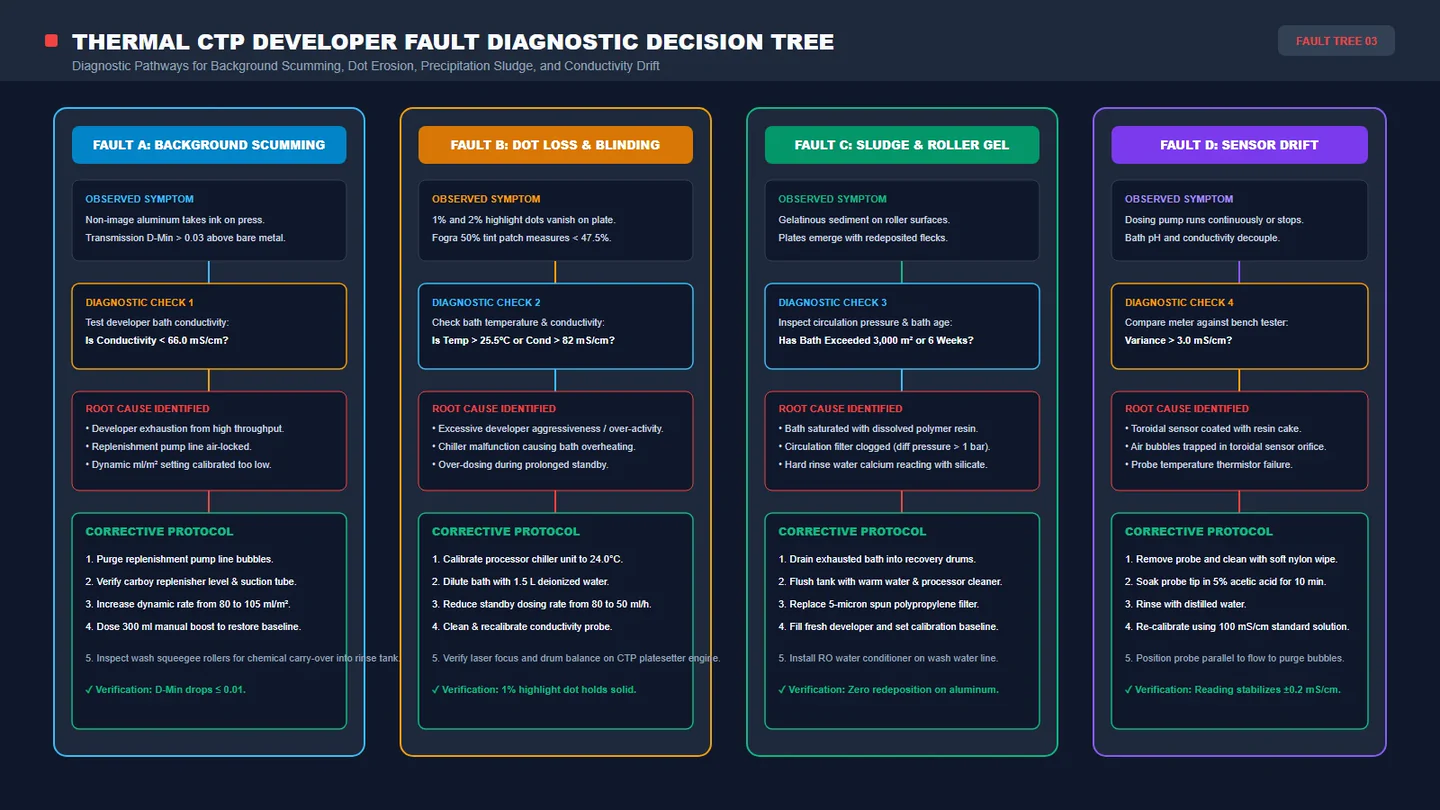
Chemical deviations in the developer tank produce distinct physical symptoms on the printing plate and on the offset press. Prepress supervisors must systematically isolate chemical root causes using standardized fault-tree diagnostics.
Symptom 1: Background Scumming and Elevated D-Min
When the developer bath suffers from under-replenishment, bath conductivity plummets below 66 mS/cm and active pH declines. The weakened chemistry lacks sufficient alkalinity to dissolve the non-image coating resins completely. A residual organic film remains bonded to the microscopic peaks of the grained aluminum surface. On press, the dampening fountain solution cannot wet these contaminated non-image areas. The ink rollers deposit ink across unprinted sheet margins, creating catastrophic background scumming. Measuring the non-image aluminum with a transmission densitometer reveals an optical background density (D-Min) exceeding 0.03 above bare aluminum. Operators must verify replenisher supply lines, eliminate airlocks in pump valves, and raise the dynamic replenishment rate by 15 to 25 ml/m².
Symptom 2: Highlight Dot Erosion and Premature Plate Blinding
Conversely, setting replenishment rates too high causes bath conductivity to spike above 82 mS/cm. The hyper-aggressive alkaline solution attacks not only the non-image areas but also begins chemically etching the crosslinked image pixels. Fine 1% and 2% highlight dots dissolve and vanish from the plate surface. Shadow halftone dots open up uncontrollably, and Fogra 50% control patches measure below 47.5%. On the printing press, highlights blow out to stark white paper, creating harsh tonal banding across smooth photographic gradients. Over-active chemistry also weakens coating adhesion, causing solid print areas to shed ink and blind prematurely after merely 15,000 impressions. To restore equilibrium, technicians must immediately dilute the bath with deionized water and recalibrate the standby dosing timer.
Symptom 3: Sludge Formation and Particulate Redeposition
Even with flawless replenishment, every developer bath possesses a finite lifespan. As plates dissolve, dissolved resin solids accumulate within the fluid. Once total throughput crosses 3,500 square meters or six calendar weeks of operation, the bath becomes chemically saturated. Dissolved polymers precipitate out of solution, forming sticky gelatinous sludge that coats roller surfaces, tank walls, and heat exchangers. These floating polymer flecks redeposit onto passing plates, baking into non-image areas and creating pinhole voids or hickeys on press. Running plates through saturated chemistry also clogs the circulation system, triggering pump cavitation. Operations must execute a complete bath dump, sanitize the processor with neutralizing wash, and replace the 5-micron wound filter cartridge.
Quality Assurance Protocols: Daily Fogra DPCW Measurement and Maintenance
Maintaining ISO 12647-2 compliance requires a structured preventative maintenance schedule. Prepress technicians must execute standardized daily inspections, weekly pump calibrations, and monthly mechanical overhauls.
At the start of every production shift, the operator verifies bath temperature on a secondary calibrated digital thermometer, ensuring the chiller maintains 24.0°C ±0.5°C. The technician inspects the replenisher carboy level, verifies smooth water flow across the cascade rinse spray nozzles, and confirms that the finishing gum rollers rotate freely without dried crust deposits.
Before releasing production jobs to the pressroom, the prepress team images and processes a certified Fogra Digital Plate Control Wedge (DPCW). Using a calibrated transmission densitometer or high-resolution plate reader (such as a Techkon SpectroPlate), the technician records the 50% reference halftone tint patch. Under Fogra PSO standards, the processed plate must measure 50.0% ±0.5%. Any deviation exceeding ±1.0% triggers an immediate chemical audit before imaging production plates for our specialized commercial brochure printing and high-run corporate publication services.
Every week, technicians isolate the circulation canister and replace the 5-micron spun polypropylene filter core. The team scrubs the plush nylon developer brushes, tests squeegee roller nip pressures using paper pull strips, and audits the volumetric discharge of the replenishment pumps into a graduated 100 ml cylinder. Every month, the department empties the developer tank, circulates a 5% citric acid descaling solution to dissolve mineral silicate deposits, and conducts a 2-point calibration of the toroidal conductivity probe using certified 50 mS/cm and 100 mS/cm reference standards.
Processless Plates vs Chemical CTP: Economic and Environmental Realities
The operational overhead of developer replenishment, chemical waste disposal, and water rinsing has driven significant innovation in lithographic plate technology. Over the past decade, manufacturers have introduced processless (direct-on-press) thermal plates that eliminate processor chemistry entirely.
Processless plates utilize an 830 nm infrared laser to expose a dual-layer polymer coating. Instead of passing through a chemical processor, the operator mounts the exposed plate directly onto the offset press cylinder. During the initial makeready impressions, the press dampening system softens the unexposed coating, and the ink rollers carry the dissolved polymer away onto the initial makeready waste sheets. This eliminates developer chemistry, processor electricity, rinse water consumption, and hazardous chemical disposal fees.
However, conventional chemically processed thermal plates retain significant advantages in high-demand packaging and commercial environments. Processless plates remain more sensitive to ambient pressroom lighting, feature lower run-length durability under aggressive UV inks (typically 100,000 impressions compared to 300,000+ for baked chemical plates), and exhibit lower contrast between image and non-image areas during visual pressroom mounting. For high-volume packaging converters and commercial houses running continuous shifts, finely calibrated chemical CTP systems deliver rock-solid run durability, sharp contrast, and predictable dot gain compensation. To compare digital print agility with high-volume lithographic production, explore our on-demand digital printing in Jaipur facilities.
Furthermore, responsible commercial printers align prepress chemical recycling with environmental stewardship certifications, including the Forest Stewardship Council (FSC) Chain of Custody standards. Spent developer chemistry undergoes neutralization and precipitation in licensed industrial effluent treatment plants, recovering aluminum hydroxides and preventing toxic chemical discharge into municipal water systems.
Frequently Asked Questions: Prepress Chemistry & Replenishment
Why do thermal CTP plates require both dynamic and standby replenishment?
Thermal CTP plate developer baths face two distinct chemical degradation mechanisms. First, developing plates physically consume active alkali ions proportional to the square meters of dissolved coating resin. Second, the open developer liquid absorbs ambient carbon dioxide from pressroom air, converting active potassium hydroxide into inactive carbonate. Dynamic replenishment doses replenisher per square meter processed, while standby replenishment injects chemistry per idle hour to neutralize atmospheric carbonation.
What happens if a prepress operator sets the replenishment rate too low?
An under-replenished developer bath loses active chemical strength, causing bath conductivity to drop below manufacturer specifications. The weakened developer fails to dissolve unexposed non-image coating completely, leaving a microscopic layer of organic resin on the anodized aluminum. This elevates background D-Min above 0.03 and causes severe background scumming and ink tinting across clean paper margins on the offset press.
What are the consequences of over-replenishing a CTP plate developer bath?
Over-replenishing drives bath conductivity past upper limits (typically exceeding 82 to 85 mS/cm). Excessive caustic alkalinity attacks the crosslinked image dots, eroding fragile 1% and 2% highlight halftone dots and thinning delicate typography. On press, this results in washed-out highlights, broken vignette transitions, and premature plate blinding during long print runs.
How does conductivity measurement maintain developer bath equilibrium?
Toroidal electrodeless conductivity probes measure the electrical conductance of the developer solution in milliSiemens per centimeter (mS/cm). Because fresh replenisher possesses higher conductivity than exhausted or carbonated bath chemistry, the processor microprocessor continuously samples conductance and commands high-precision dosing pumps to inject micro-bursts of replenisher whenever conductivity drops 0.5 to 1.0 mS/cm below the target baseline.
How often should prepress technicians completely change the CTP developer chemistry?
Prepress operations should dump and replace the complete developer bath every 2,500 to 4,000 square meters of plate throughput, or every 6 to 8 calendar weeks, whichever threshold occurs first. Over time, dissolved polymer resin solids accumulate to saturation limits, rendering replenishment ineffective and increasing the risk of roller sediment redeposition.