
Master the chemical equilibrium of offset dampening systems. Learn how to manage pH buffering, electrical conductivity, water hardness, and surface tension for clean, scum-free press runs. For certified industrial production, calibrate pressroom settings in alignment with Fogra graphic technology research specifications and ISO 12647 offset process control standards.
The Chemistry of Dampening: Why pH and Conductivity Matter
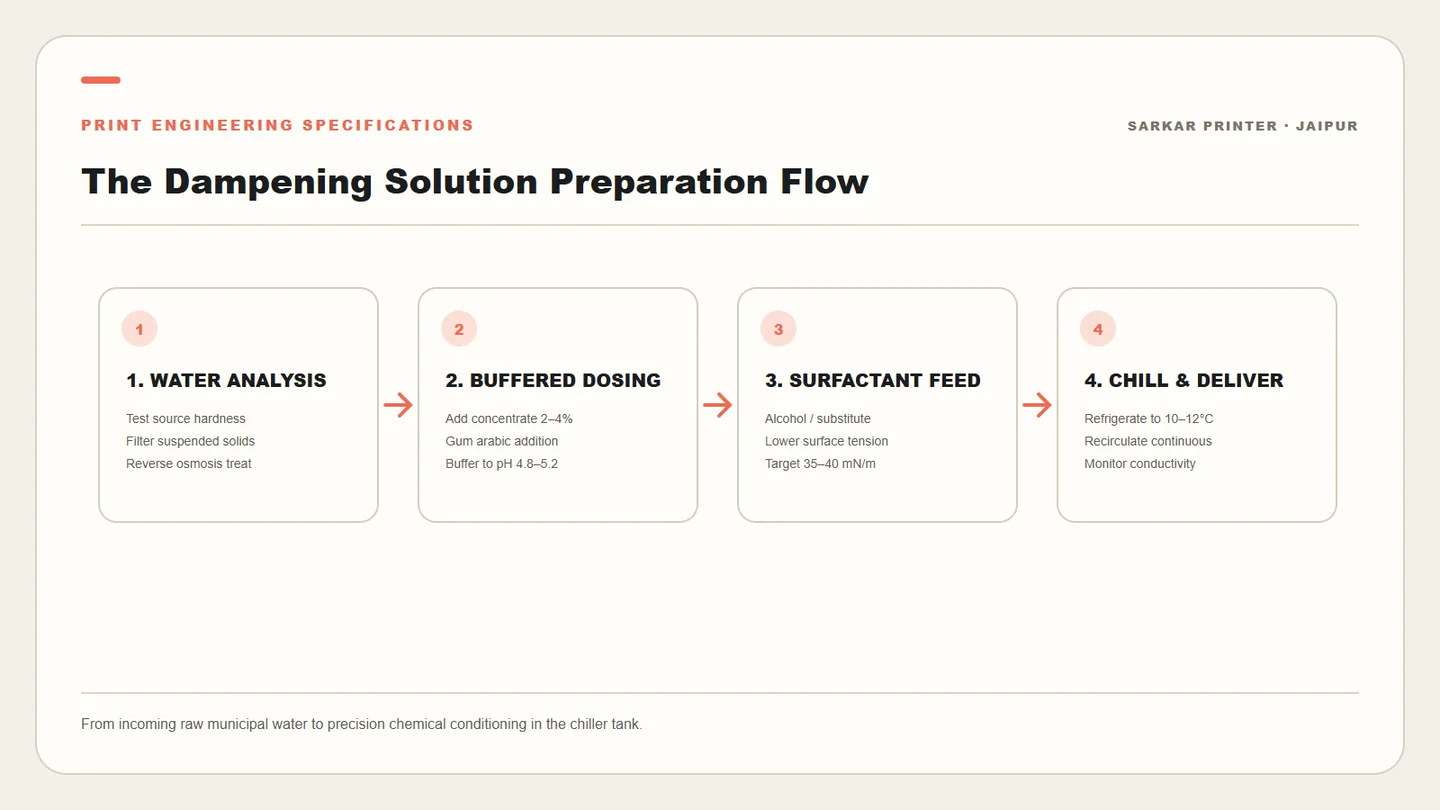
Offset lithography relies entirely on the chemical principle that oil and water do not mix. The printing plate carries oleophilic (ink-receptive) image areas and hydrophilic (water-receptive) non-image areas. The dampening system applies a micro-thin film of fountain solution across the rotating plate to keep non-image areas clean before the inking form rollers make contact. Maintaining chemical balance requires tracking two vital variables: pH and electrical conductivity. The standard pH target for commercial offset printing lies strictly between 4.8 and 5.2. If the pH climbs above 5.5, the gum arabic fails to desensitize the aluminum non-image areas, causing rapid background scumming. If the pH drops below 4.5, the acid attacks plate coatings, strips ink rollers, and retards oxidative ink drying. Calibrate press chemistry in accordance with Fogra graphic technology research specifications.
Conductivity vs. pH: Why Conductivity is the True Measure of Contamination
Many novice press operators rely solely on digital pH pens to monitor their dampening tanks, but this is a critical mistake. Fountain concentrates contain chemical buffer salts designed to keep the pH flat even as foreign contaminants enter the solution. Consequently, a tank can become heavily contaminated with paper coating dust, dissolved calcium carbonate, and wash solvents while still displaying an innocent 5.0 pH reading. Electrical conductivity (measured in microSiemens per centimeter, $\mu$S/cm) directly gauges total dissolved ions. When mixing fresh solution with treated reverse-osmosis water, record the baseline conductivity (typically 800 to 1,500 $\mu$S/cm depending on brand). During press operation, as paper calcium and ink additives dissolve into the tank, conductivity steadily rises. When conductivity climbs more than 800 to 1,000 $\mu$S/cm above the initial baseline, dump and refresh the tank immediately to preserve ISO 12647 offset process control standards.
Pressroom Failures: Scumming, Roller Stripping, and Emulsification
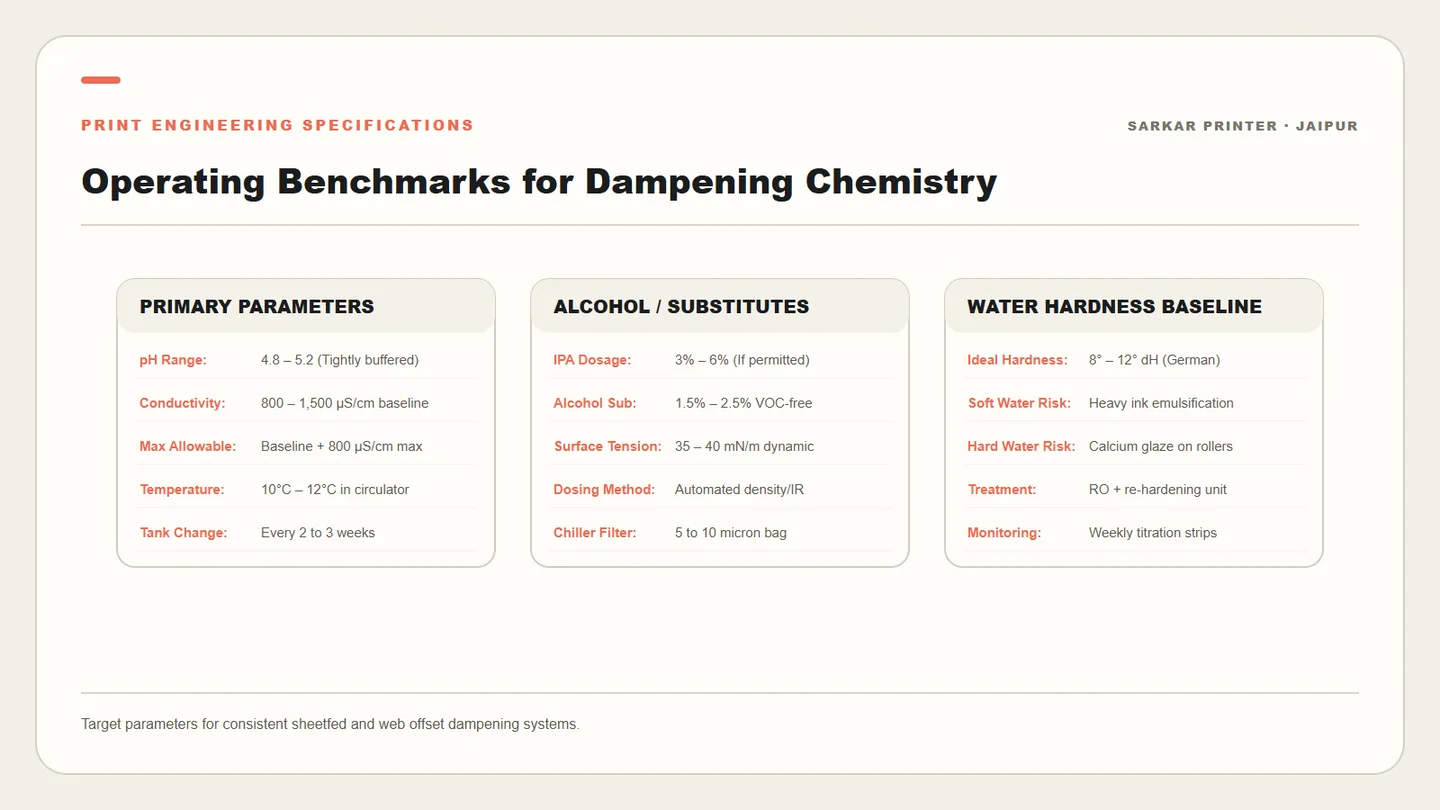
Improper chemical balance quickly manifests as expensive print room defects. If the dampening solution is too weak or the pH is too high, aluminum oxide layers lose their desensitization. The press develops "scumming"—a fine tint of ink adhering across entire unprinted borders. Conversely, if the pressman adds excessive acid to fight scumming, the acidic bath etches the copper and steel oscillating rollers, turning them hydrophilic. This causes "roller stripping," where inking rollers refuse to take ink, resulting in severe starvation and horizontal color banding. Furthermore, excessive surfactant causes over-emulsification (water-in-ink absorption beyond 25%), which washes out color density, creates chalky dry prints, and causes severe set-off in the delivery stack.
Standard Operating Procedure: Water Tank Maintenance Protocol
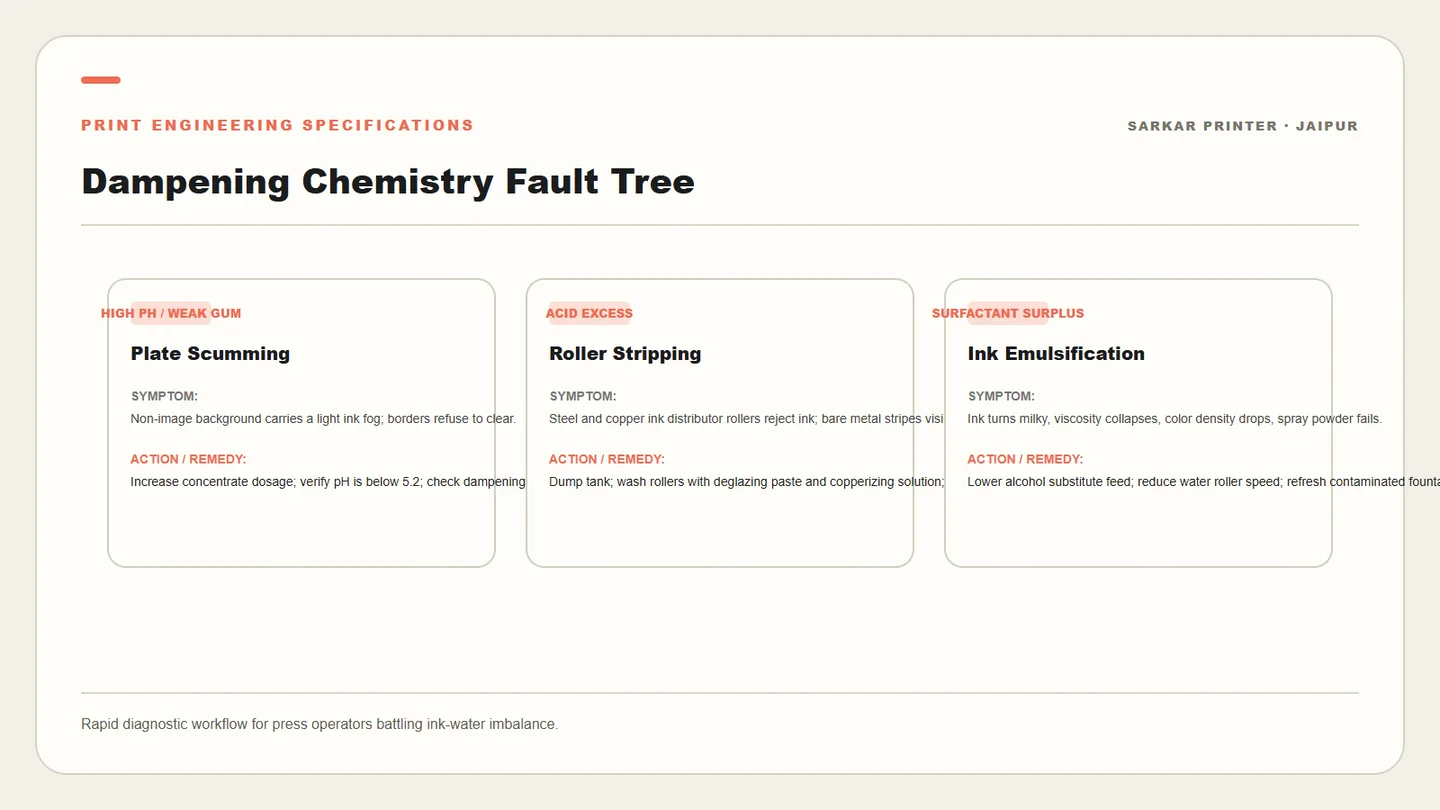
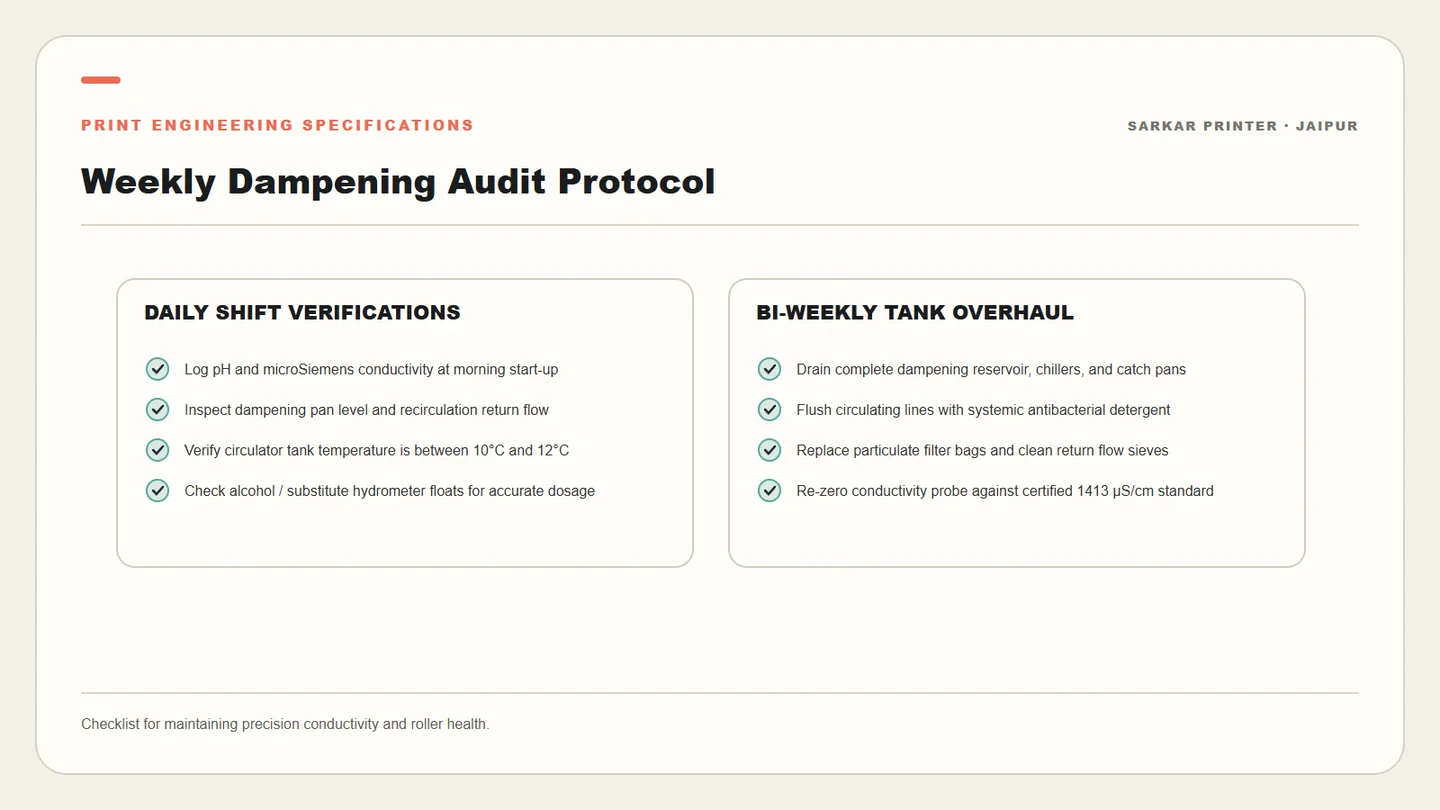
Consistent dampening performance requires disciplined tank maintenance. Establish a routine where dampening circulator tanks are completely drained, descaled, and refilled every two to three weeks. Use food-grade biocide flushes during cleaning to eliminate algae and bacteria that colonize dampening lines and digest organic gum arabics. Calibrate dosing pumps monthly using manual graduated cylinders to confirm that metered percentages match digital display inputs. Keep refrigeration units set between 10°C and 12°C; warm fountain solution evaporates alcohol rapidly, increases ink emulsification, and causes unpredictable viscosity swings on press.
Frequently asked questions
Why does paper dust cause fountain solution conductivity to spike?
Uncoated and coated paper stocks contain mineral fillers like calcium carbonate ($CaCO_3$). In an acidic dampening environment, calcium carbonate dissolves into soluble calcium ions ($Ca^{2+}$). This rapid influx of free ions drives conductivity upward and leads to calcium deposits on inking rollers.
What is the danger of running the dampening solution too cold?
If dampening temperature falls below 8°C, condensation forms on press frames and roller journals. Additionally, cold water stiffens ink tack, which can pluck fibers from delicate coated paper and cause blanket picking.
How do alcohol substitutes differ from Isopropyl Alcohol (IPA)?
IPA lowers surface tension and evaporates quickly, cooling the press rollers. Alcohol substitutes (glycol ethers) lower surface tension with zero evaporation and zero VOC emissions. However, they require precise dampening roller ductor adjustments because they do not evaporate if over-fed.
CONTINUE THE PRINT PLAN
Plan Your Commercial Print Project in Jaipur
From precision multi-color offset runs to high-end rigid luxury boxes and folding cartons, Sarkar Printer delivers certified color accuracy and structural integrity for businesses across India.