
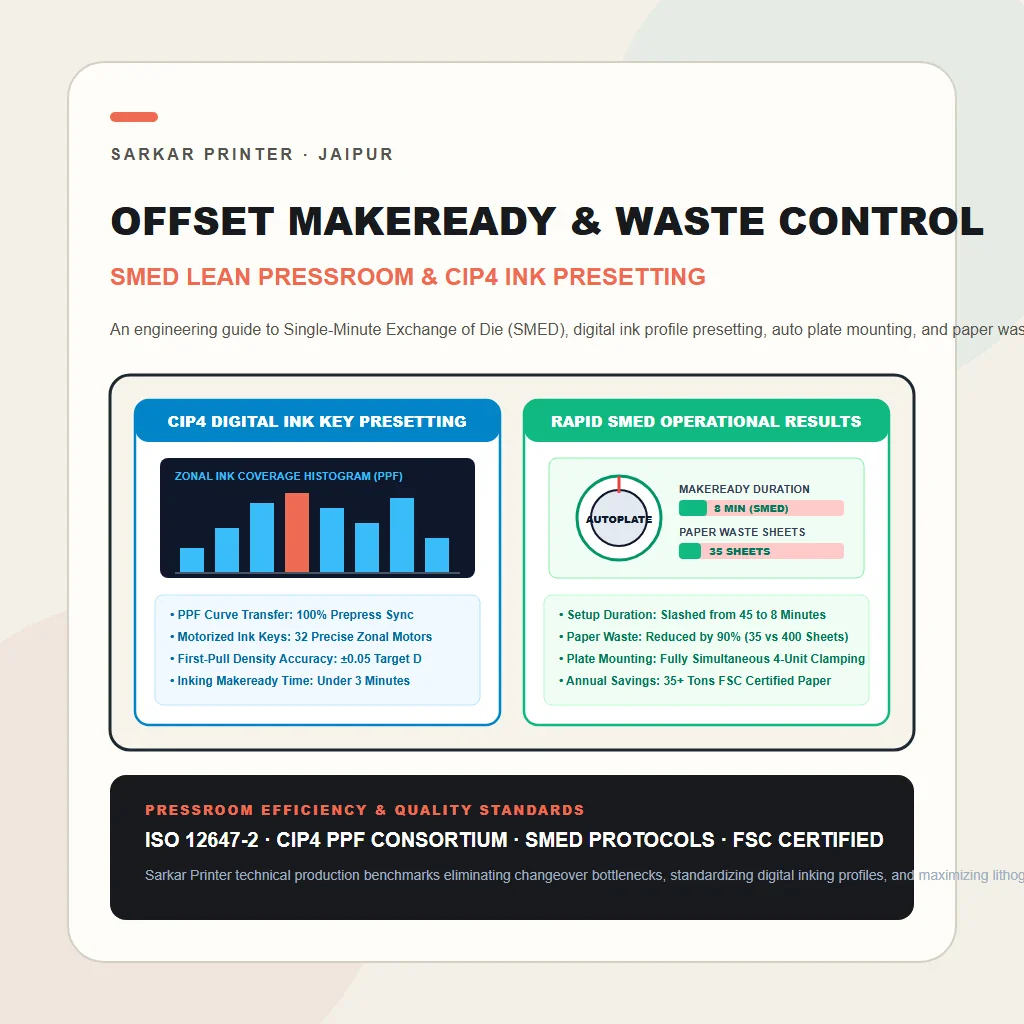
The Economic Imperative of Makeready Optimization
In modern commercial offset printing, profitability hinges directly on pressroom changeover velocity. Print buyers demand smaller production runs, faster delivery schedules, and tighter color tolerances. When an offset press sits idle during job changeovers, plant productivity plummets. Every minute spent washing blankets, hand-cranking plate clamps, and tweaking fountain keys burns valuable billable machine hours. Furthermore, burning hundreds of setup sheets to achieve ink-water balance squanders expensive paper substrates certified by the Forest Stewardship Council (FSC).
At Sarkar Printer in Jaipur, our press engineers apply lean manufacturing methodologies to transform sheetfed lithography. We combine Single-Minute Exchange of Die (SMED) workflow design with digital prepress automation compliant with CIP4 PPF standards and ISO 12647-2. By systematically eliminating pressroom bottlenecks, our production crews achieve complete four-color job changeovers in under nine minutes while holding setup waste below thirty-five sheets. Understanding these pressroom mechanics enables print production managers to boost machine capacity, lower unit costs, and protect manufacturing margins.
Rapid Makeready Workflow Route: The 5-Phase SMED Model
To eliminate press downtime, industrial engineers deploy the SMED framework, which Shigeo Shingo originally developed for automotive stamping presses. SMED classifies all changeover operations into two distinct categories: external setup tasks and internal setup tasks.
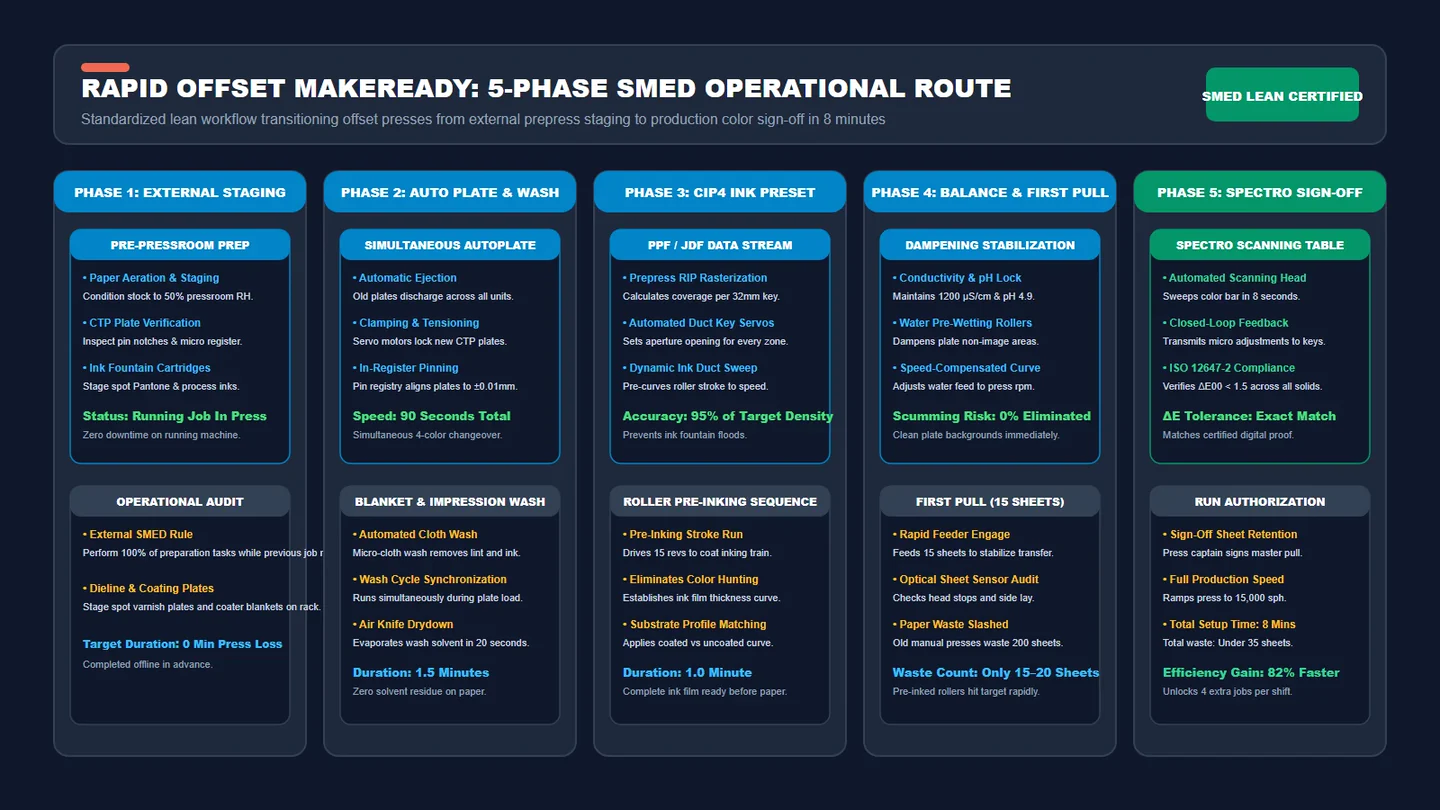
External setup operations represent tasks that press crews perform while the press runs the previous job at full production speed. These tasks include retrieving paper pallets from humidity-controlled conditioning bays, inspecting incoming Computer-to-Plate (CTP) aluminum plates, preparing spot Pantone Matching System (PMS) inks, and downloading CIP4 print profiles across the factory network. By preparing every substrate and chemical component in advance, operators eliminate waiting delays.
Internal setup operations represent tasks that crews execute only after the press stops. Our engineering protocol sequences these internal actions into an unbroken, automated eight-minute chain:
- Simultaneous Plate Ejection & Clamping (90 Seconds): Servo-driven Autoplate mechanisms automatically unclamp and eject four spent printing plates into receiving cassettes. The system simultaneously pulls new plates into position, seating Bacher registration notches over hardened steel registration pins with repeatable precision.
- Synchronized Blanket & Impression Cylinder Wash (90 Seconds): High-speed automated cloth wash systems apply Fogra-certified solvents to scrub dried ink, paper dust, and coatings from blanket surfaces, concluding with high-velocity air-knife evaporation.
- CIP4 Digital Ink Key Setting (60 Seconds): The central press computer reads prepress Print Production Format (PPF) files and activates motorized ink duct motors across thirty-two zones per unit, establishing precise ink film apertures.
- Pre-Inking Roller Stroke (60 Seconds): Inking trains spin for fifteen revolutions against oscillating distributor rollers, distributing a uniform, calibrated ink profile across form rollers before paper arrives.
- First-Pull Sheet Feed & Closed-Loop Scanning (180 Seconds): The feeder delivers fifteen setup sheets to establish stable ink-water emulsification. The press technician pulls sheet fifteen onto a motorized scanning table, where polarized spectrophotometers sweep the color bar and transmit micro-adjustments directly to inking keys.
The Physics of Makeready Waste: Ink-Water Dynamics
Why do conventional offset presses waste three hundred to five hundred sheets before reaching commercial color approval? The answer lies in the delicate fluid mechanics of lithographic ink and water interaction. Lithography relies on mutual repulsion between oily printing ink and acidic dampening solution. When an operator starts a press from a dead stop, ink form rollers carry cold, unworked ink possessing elevated viscosity and tack.
Simultaneously, the dampening system must coat the non-image areas of the aluminum plate with a microscopic fountain solution film measuring approximately one to two microns in thickness. If the operator introduces paper before the ink and water establish dynamic chemical equilibrium, two severe defects emerge: plate scumming (where ink sticks to water-starved non-image areas) or ink emulsification (where excessive water breaks into the ink body, collapsing optical density). In older presses, operators manually adjust water dials and thumb screws through trial and error, burning reams of paper while waiting for the ink train to react.
Automated press control eliminates this fluid lag. By maintaining fountain solution conductivity strictly between 1100 and 1400 microSiemens per centimeter (µS/cm) and solution temperature at 10°C to 12°C, our press systems stabilize surface tension instantly. Pre-wetting plate dampening cycles lubricate the non-image plate areas for three revolutions prior to form roller contact, ensuring pristine background clarity on the very first impression.
Engineering Specification Matrix: Traditional vs Rapid SMED
Quantifiable data demonstrates how automated press features alter factory throughput and material consumption. The matrix below benchmarks conventional manual changeovers against Sarkar Printer's standardized SMED workflow.
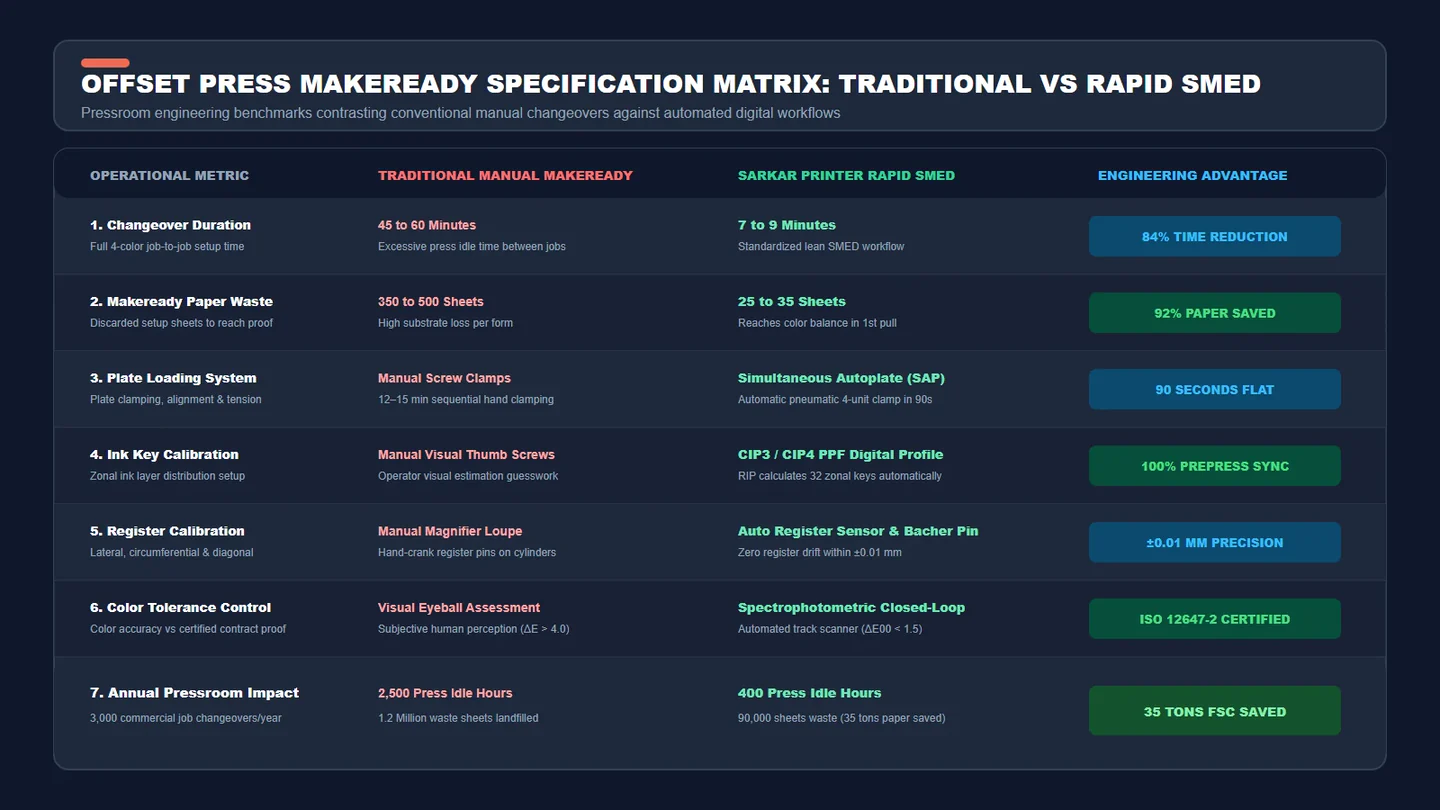
Examining these engineering metrics reveals substantial capacity gains. A commercial printing plant executing six changeovers per shift on a conventional four-color press loses four hours of daily production to makeready shutdowns. By collapsing changeover duration to under nine minutes, the press recovers three hours of productive run time every single shift. Over an annual operating cycle of three thousand jobs, our SMED protocols eliminate over 1.1 million wasted sheets of heavy paperboard and fine text papers, saving more than thirty-five tons of forest resources while lowering procurement costs for our commercial clients.
Prepress Digital Integration: CIP4 PPF and JDF Workflows
Digital ink presetting represents the single most impactful technological advance in makeready waste mitigation. In traditional pressrooms, press operators squint at printed contract proofs and manually twist thirty-two individual ink fountain thumb screws per printing unit, guessing the ink feed required across the sheet width. This subjective practice causes massive color swings and extends setup times.
Modern digital workflows eliminate visual guesswork entirely through standardized CIP4 data integration:
- Prepress RIP Area Calculation: During digital plate rasterization, the RIP software divides each separation into thirty-two discrete lateral zones matching the press ink keys. The software calculates exact image pixel density percentages for each zone.
- PPF File Generation: The prepress server exports these geometric values into a standardized Print Production Format (PPF) data stream containing precise ink coverage curves.
- Zonal Motor Execution: The press console ingests the PPF file over local Ethernet. Stepper motors instantly position each ink duct blade key to its mathematical aperture opening, accounting for substrate absorbency and ink tack profiles.
- Closed-Loop Density Control: When the operator scans the first pull on the spectrophotometer console, closed-loop software compares measured Lab values against Fogra PSO characterization data, calculating immediate micro-corrections and driving color drift below Delta E 1.50 across all zones.
Pressroom Troubleshooting: Makeready Fault Tree & Diagnostics
Even automated offset presses encounter mechanical and chemical anomalies during rapid changeovers. Press technicians must follow systematic diagnostic decision trees to isolate root causes and restore production stability without burning excess paper.
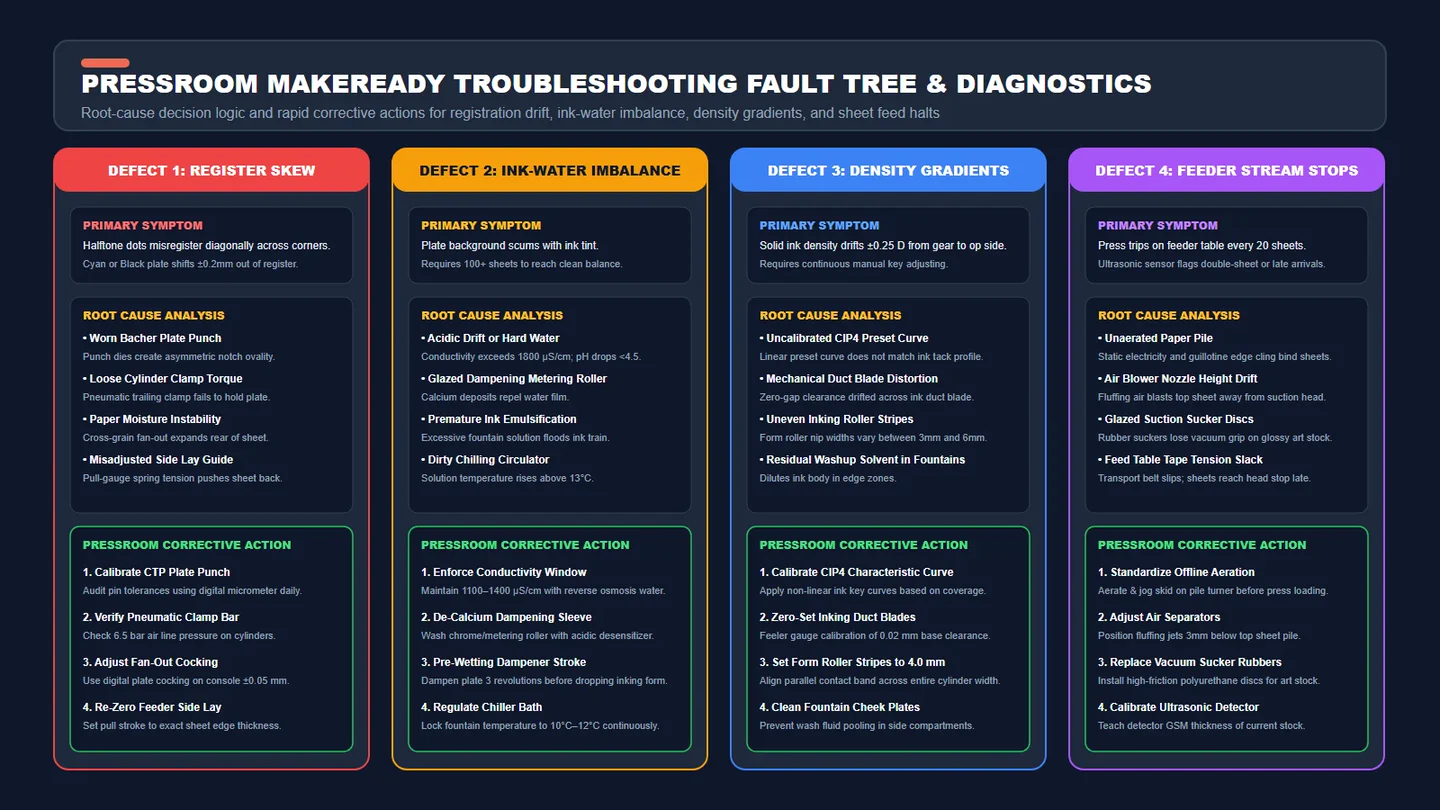
When plates exhibit diagonal register skew across opposite corners, operators frequently blame cylinder gear backlash. However, root cause analysis typically traces the issue to worn Bacher plate punch pins in prepress or inconsistent pneumatic clamping pressure on the plate cylinder. Re-punching master gauge plates and auditing cylinder air pressure at 6.5 bar immediately restores lateral and circumferential alignment within ±0.01 mm.
Similarly, when ink density varies erratically across the sheet width despite active CIP4 presetting, technicians must inspect the mechanical zero-gap clearance of the inking duct blade. Over months of continuous operation, paper dust and dried ink pigments accumulate behind fountain cheek plates, forcing blade tips out of true parallel alignment. Calibrating base clearances with feeler gauges to exactly 0.02 mm re-establishes linear ink flow and ensures that CIP4 mathematical curves translate flawlessly onto the paper.
Standard Operating Procedures: 6-Point Makeready Audit Protocol
To ensure repeatable color fidelity and eliminate makeready drift, Sarkar Printer enforces a six-point quality control standard operating procedure across every production run.
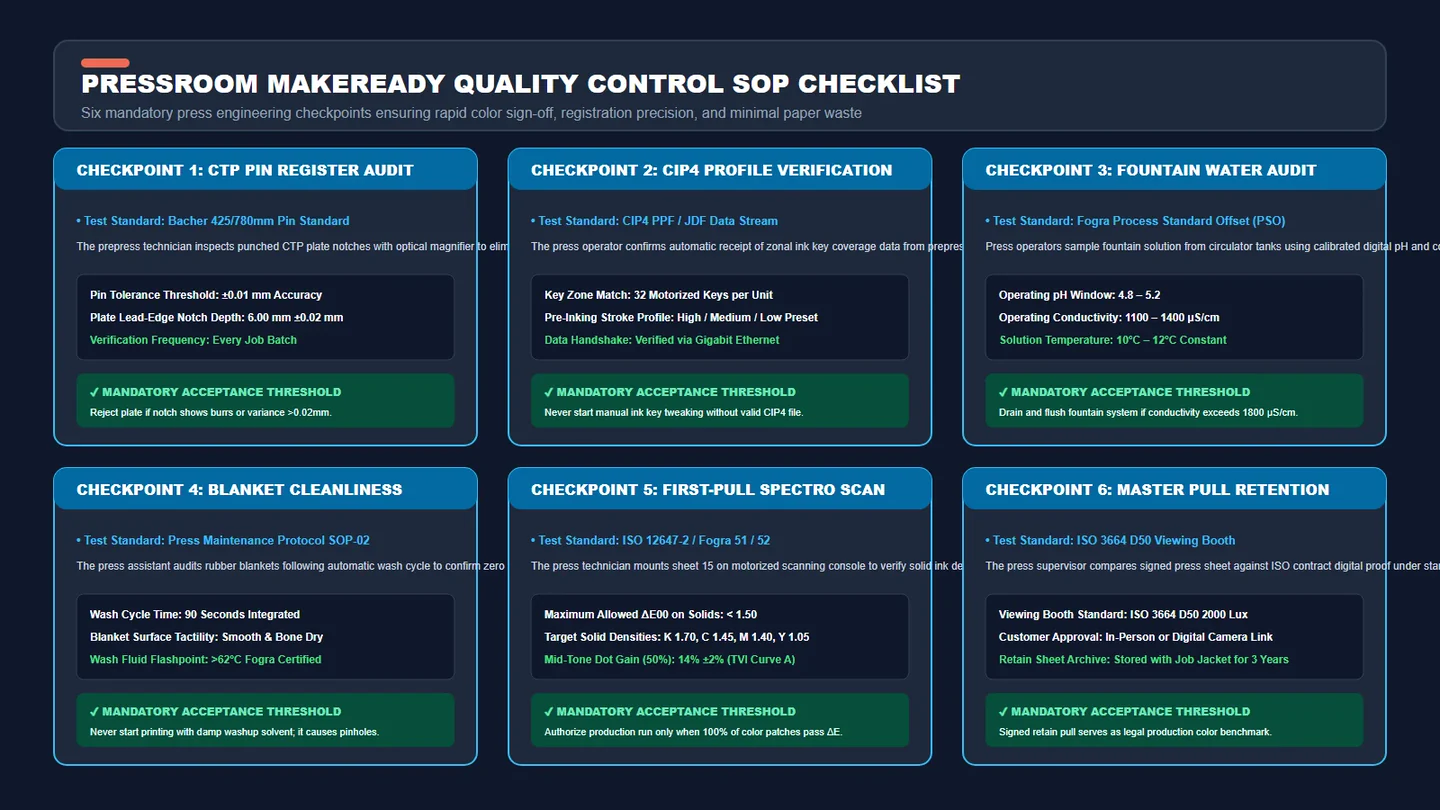
Our quality assurance technicians verify the following six checkpoints before authorizing high-speed production:
- CTP Pin Register Audit: Prepress technicians inspect plate punch notches using 50x optical measuring microscopes, guaranteeing notch depth tolerance within 6.00 mm ±0.02 mm to prevent mechanical plate skew.
- CIP4 Digital Profile Handshake: Operators verify Gigabit network transfer of PPF ink coverage curves into the press console, confirming thirty-two active zonal motor channels per unit.
- Fountain Solution pH & Conductivity Check: Technicians audit dampening tanks using digital probes, ensuring conductivity rests between 1100 and 1400 µS/cm and pH measures 4.8 to 5.2 at a stable 11°C.
- Automated Blanket Cleanliness Inspection: Crews inspect blanket surfaces after the automated wash cycle, confirming zero chemical residue or solvent wetness before feeding paper.
- First-Pull Spectrophotometric Scan: Technicians sweep sheet fifteen across the automated scanning table, verifying that solid ink densities (K: 1.70, C: 1.45, M: 1.40, Y: 1.05) and tone value increase (TVI) meet ISO 12647-2 tolerances with Delta E under 1.50.
- Master Retain Sheet Sign-Off: The press supervisor compares the approved sheet against the contract proof inside an ISO 3664 D50 lighting booth, signing and archiving the retain sheet with the production jacket for three years.
B2B Procurement Economics: Slashing Total Cost per Impression
Optimizing makeready protocols provides compelling commercial benefits for corporate print procurement managers, publishing houses, and packaging brand owners. In conventional printing operations, printers hide massive makeready paper waste and labor hours inside inflated unit prices or setup surcharges. When an inefficient pressroom requires four hundred sheets to set up an eight-page catalog form, the print buyer ultimately pays for those destroyed paper reams.
By slashing makeready time to eight minutes and reducing setup waste to thirty-five sheets, Sarkar Printer drastically lowers manufacturing overhead. This lean efficiency makes short and medium-run offset printing highly economical, bridging the cost gap between digital printing and industrial mass production. Whether your organization requires high-precision commercial offset printing, custom folding carton packaging, corporate brochures and marketing collateral, or high-volume books and booklets, our optimized pressroom guarantees rapid delivery and unyielding color precision. Consult directly with our engineering specialists through our print consultation desk to audit your print specifications and capture immediate cost efficiencies.
Frequently Asked Questions
How does SMED methodology reduce offset press makeready time?
Single-Minute Exchange of Die (SMED) divides all changeover tasks into external and internal operations. Press crews perform external operations—such as staging paper pallets, verifying CTP plates, mixing inks, and downloading CIP4 PPF profiles—while the previous production job runs at full speed. By converting former internal shutdown operations into external prep tasks, press crews cut press downtime from 50 minutes down to less than 9 minutes.
What role does CIP3 or CIP4 PPF ink presetting play in cutting paper waste?
CIP4 Print Production Format (PPF) files rasterize digital prepress separation data to calculate exact image area coverage across every 32-millimeter inking zone. The central press console receives this data over local networks and commands motorized ink duct keys to match target ink films before the press feeds a single sheet. This digital calibration replaces manual thumb screw guesswork and reduces setup paper waste by over 90%.
How many waste sheets does a modern automated offset press generate during makeready?
Modern automated offset presses equipped with simultaneous plate changers, CIP4 digital ink presetting, and closed-loop spectrophotometry reach target ISO 12647-2 color densities within 25 to 35 sheets. Older conventional presses lacking digital inking presets frequently consume 350 to 500 sheets per form to establish stable ink-water balance and register alignment.
Why does fountain solution conductivity control stabilize makeready color balance?
Fountain solution conductivity directly reflects dissolved mineral salts and acid buffer concentrations. Maintaining conductivity within 1100 to 1400 microSiemens per centimeter (uS/cm) and pH between 4.8 and 5.2 prevents premature ink emulsification. Proper chemical balance ensures that dampening form rollers cleanly desensitize non-image plate areas on the very first sheet pass, eliminating background tinting and scumming.