
Learn how to detect, prevent, and eliminate ink ghosting in offset lithography. Discover prepress layout strategies, roller oscillation adjustments, and sheet ventilation controls. For certified industrial production, calibrate pressroom settings in alignment with Fogra graphic technology research specifications and Adobe InDesign print-ready PDF export specifications.
Mechanical vs. Chemical Ghosting: Two Completely Different Problems
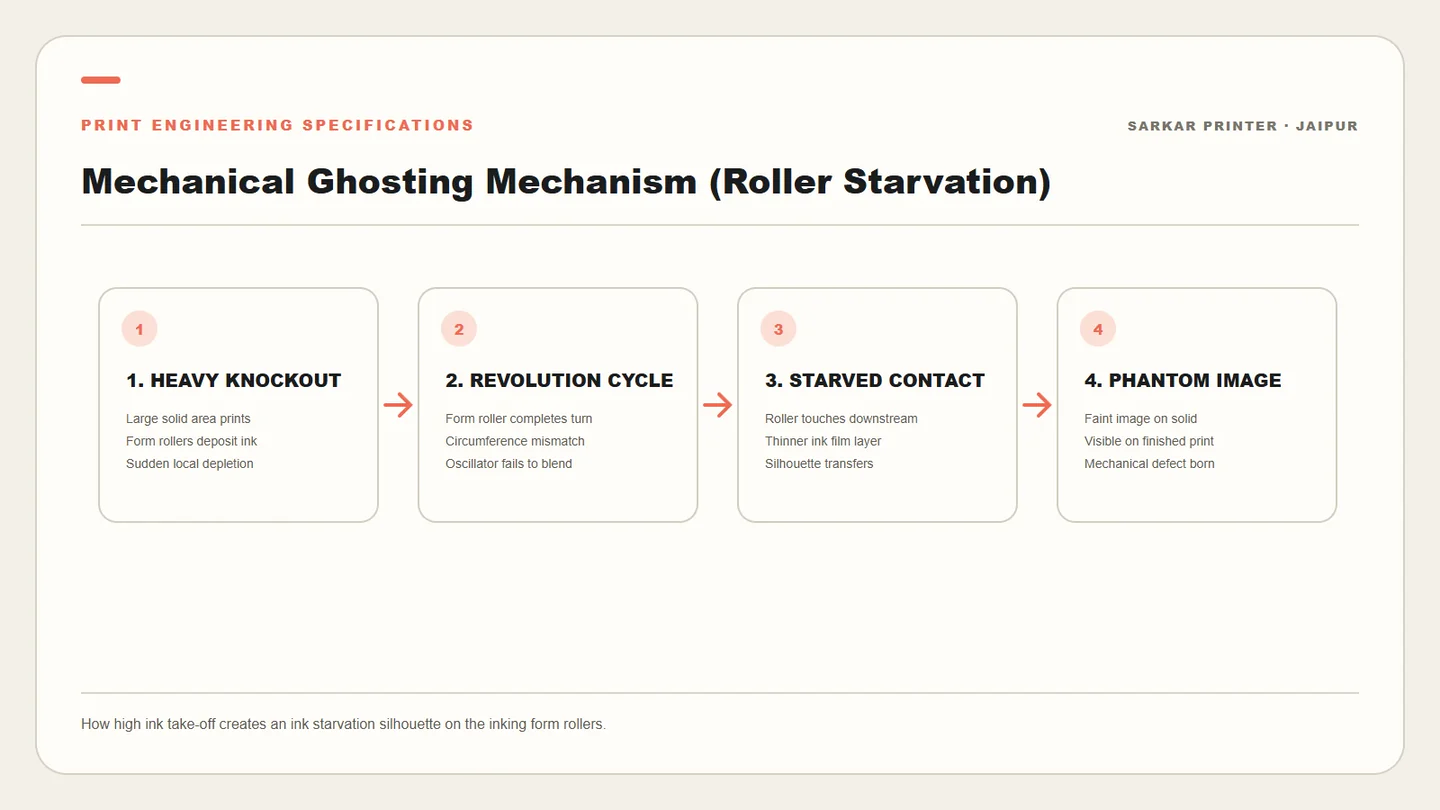
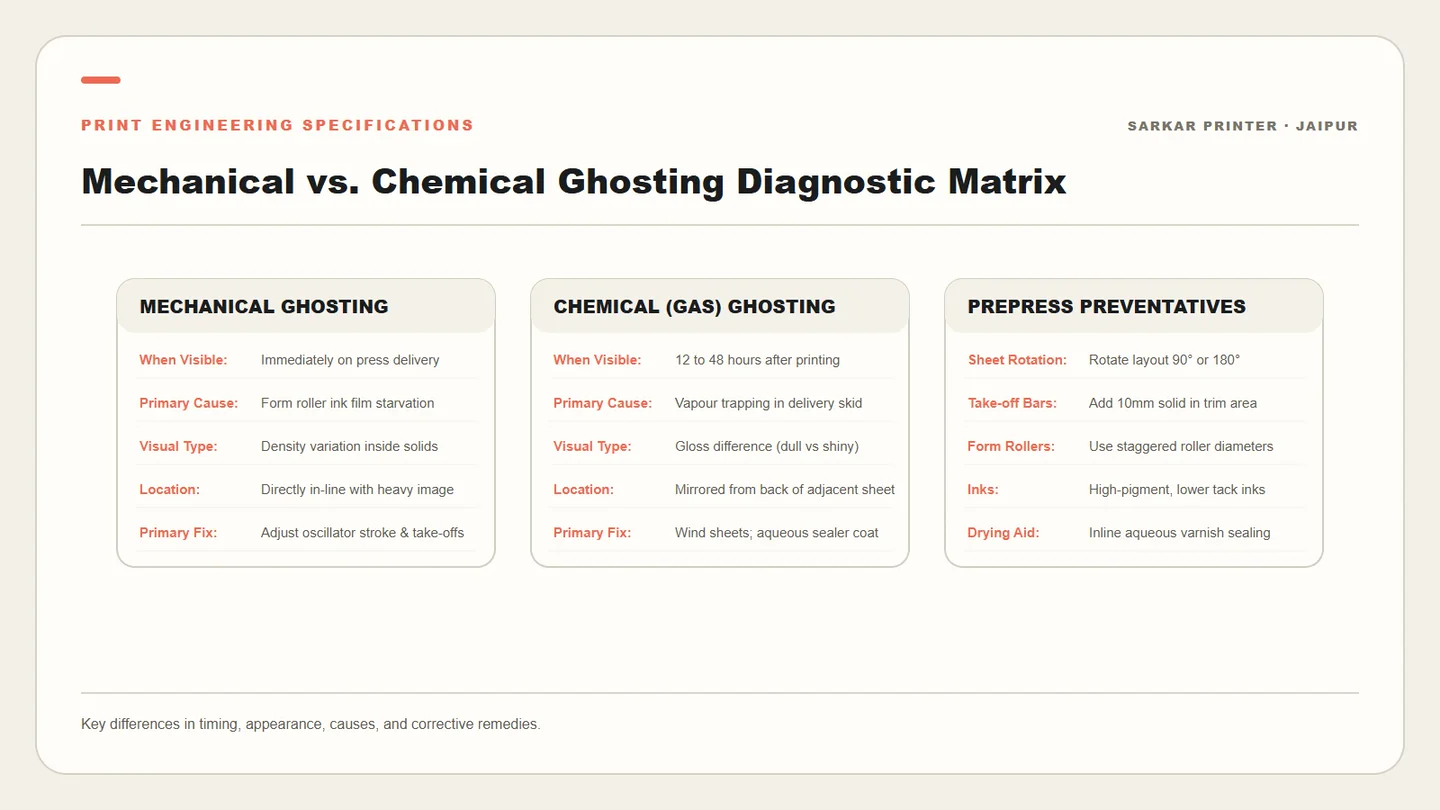
Few defects frustrate press operators and print buyers more than ink ghosting. Ghosting appears as a faint, unwanted phantom image or silhouette of artwork from one area of the sheet reproduced inside a solid color elsewhere on the sheet. However, solving ghosting requires recognizing that two completely separate defects share the name: mechanical starvation ghosting and chemical vapor ghosting. Mechanical ghosting happens live on press within a fraction of a second. It occurs when a large heavy-coverage image consumes ink from the inking form rollers, and the rollers rotate around to print a second section before the distributor rollers can replenish the depleted ink film. Chemical ghosting, by contrast, develops hours or days later inside the tightly stacked drying delivery pile. During oxidative ink drying, gaseous aldehydes and volatile fatty acids evaporate and get trapped against the overlying sheet, causing localized gloss variations. Follow prepress file layout guidelines under Adobe InDesign print-ready PDF export specifications.
Pressroom Remedies for Mechanical Ghosting: Roller Oscillation and Take-Off Bars
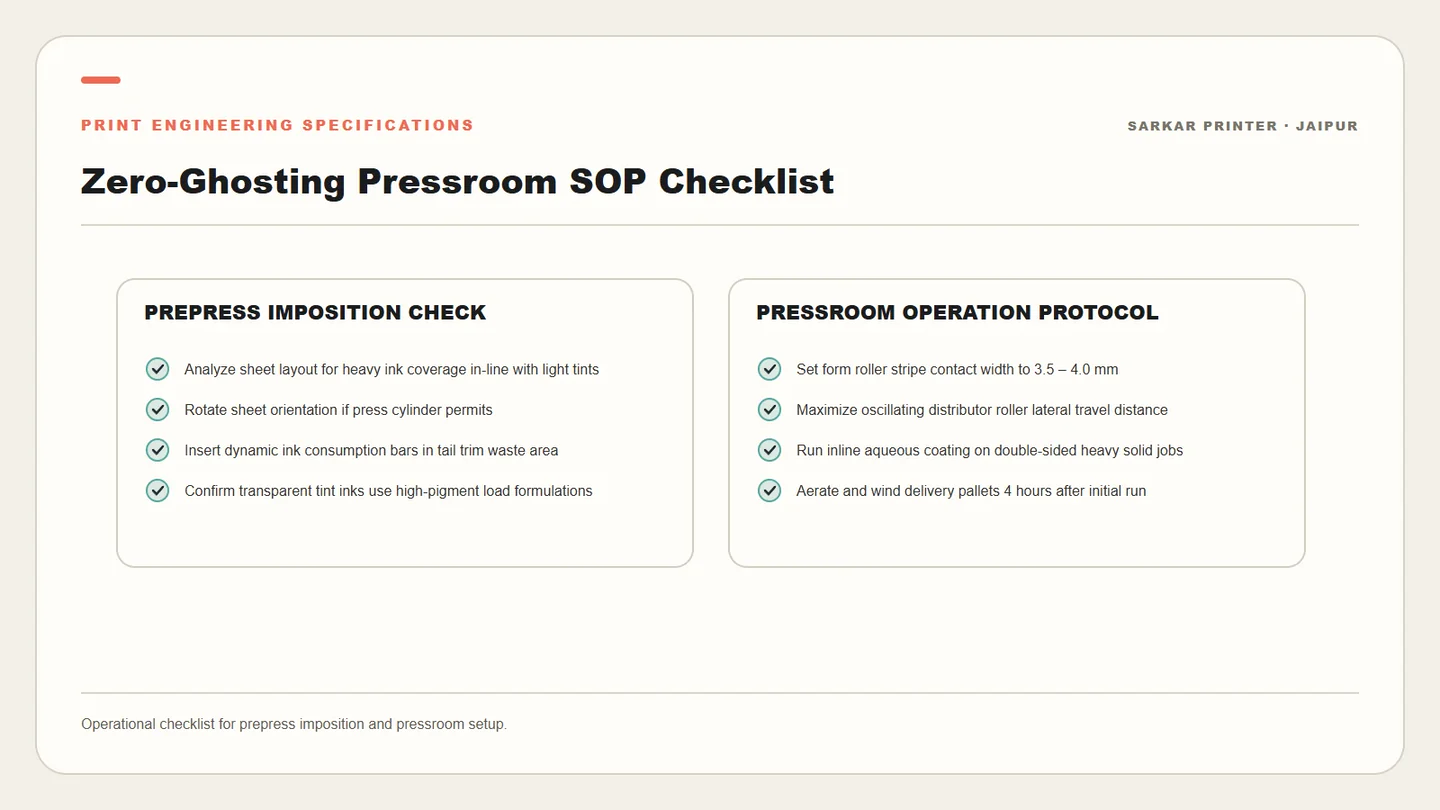
When mechanical ghosting strikes during a press run, pressmen have several mechanical adjustments at their disposal. The primary tool is oscillating roller timing. High-speed offset presses feature copper or rilsan oscillating distribution rollers that stroke laterally side-to-side across the cylinder width. By adjusting the phase and lateral stroke length of the oscillating rollers, the pressman blends the ink boundary across the roller face, blurring the starved edge. If mechanical adjustments on press fail, prepress intervention becomes mandatory. Prepress engineers add "take-off bars" (also called ink consumption bars or waste bands) along the sheet trim margin directly opposite the starved area. These take-off bars continuously draw ink across the starved channels of the form rollers, equalizing ink demand across the entire cylinder circumference. Always check pressroom diagnostics against Fogra graphic technology research specifications.
Preventing Chemical Gas Ghosting: Skid Management and Aqueous Sealing
Chemical ghosting occurs when oxidation-drying inks release volatile gaseous byproducts inside a dense, poorly ventilated delivery skid. The trapped gases react with the overlying sheet's ink film, accelerating or retarding the surface curing of the adjoining sheet. When the sheets are unpacked, a ghost image appears—not as a color density change, but as a striking differential in surface gloss. The absolute best preventative against chemical ghosting is applying an inline aqueous coating. Water-based aqueous sealers dry instantly via infrared heating and hot air knives, sealing the wet ink beneath an impervious, breathable acrylic barrier that stops gas migration. If printing without an inline coater, keep delivery pile heights below 1 meter to reduce hydrostatic pressure, and aerate (wind) the skids 4 to 6 hours after printing to vent trapped drying vapors.
Standard Prepress & Pressroom Inspection Checklist
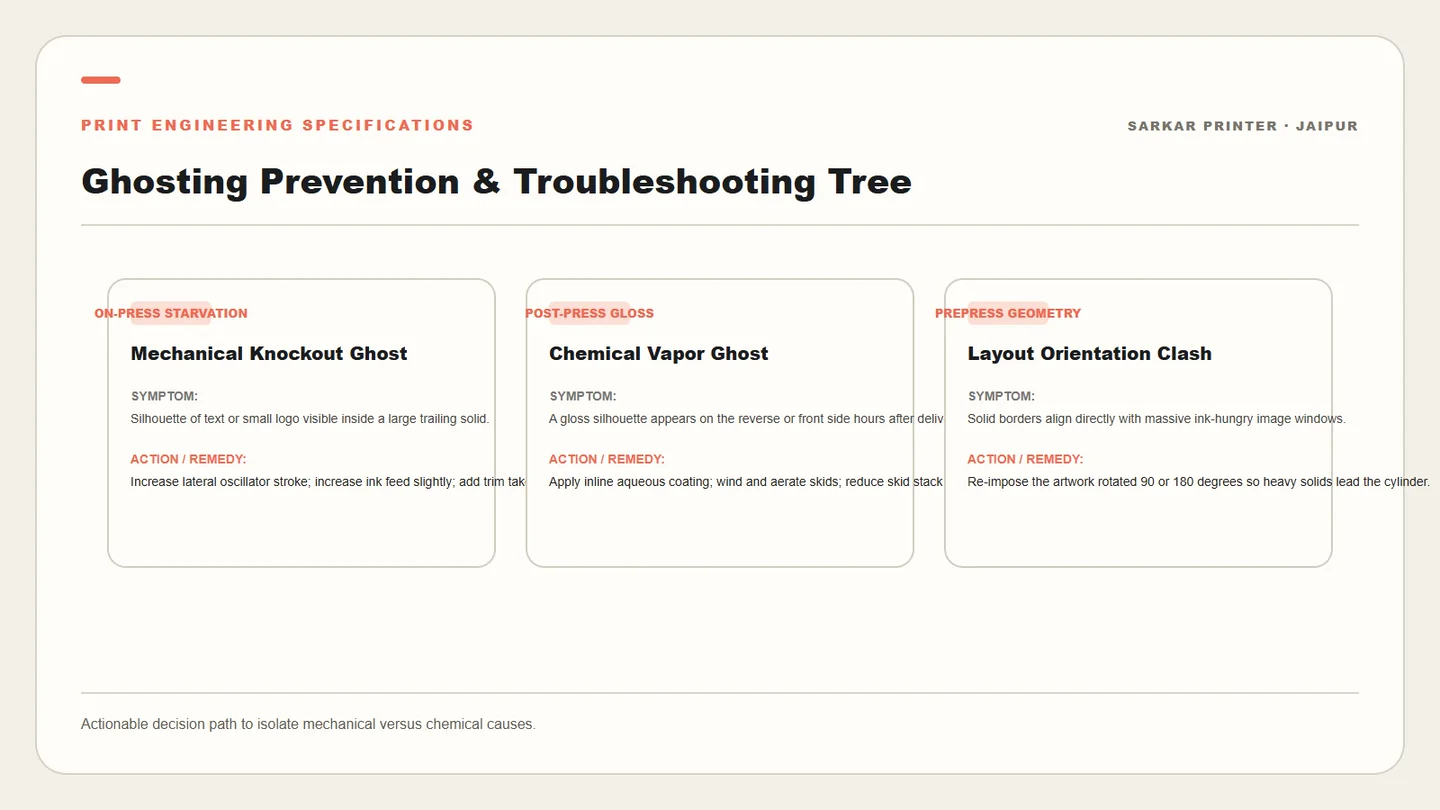
Eliminating ghosting permanently requires seamless cooperation between graphic designers, prepress operators, and press engineers. Graphic designers should avoid placing delicate reverses and high-density solids in the exact same vertical cylinder track whenever possible. Prepress technicians must inspect imposition layouts for ink balance before plating. Finally, press operators must maintain their inking train, ensuring that form roller durometer (hardness) measures between 25 and 30 Shore A, and that roller stripe nips are set evenly to 3.5 mm across all units.
Frequently asked questions
Why do modern presses use form rollers of different diameters?
Modern offset presses deliberately use three or four form rollers of varying diameters (e.g., 60mm, 66mm, 72mm). Because each roller has a different circumference, their repeat starvation patterns never land in the exact same spot on subsequent rotations, dispersing the ink film evenly and virtually eliminating mechanical ghosting.
Can transparent inks cause more ghosting than opaque inks?
Yes. Highly transparent inks (such as reflex blues, light pastel tints, and process yellows) lack opaque pigment coverage. Even a microscopic 0.05 variation in ink film thickness becomes starkly visible to the naked eye as an unsightly shadow.
Does anti-setoff spray powder prevent chemical ghosting?
Spray powder provides microscopic air gaps between stacked sheets to prevent ink set-off, but it does NOT stop volatile chemical vapors from evaporating and attacking adjacent sheets. Only inline aqueous sealing or active skid aerating prevents chemical ghosting.
CONTINUE THE PRINT PLAN
Plan Your Commercial Print Project in Jaipur
From precision multi-color offset runs to high-end rigid luxury boxes and folding cartons, Sarkar Printer delivers certified color accuracy and structural integrity for businesses across India.