
Discover the mechanical anatomy of offset printing blankets. Learn how multi-ply carcasses, compressible microsphere layers, and surface roughness dictate ink release and dot sharpness. For certified industrial production, calibrate pressroom settings in alignment with ISO 12647 offset process control standards and Fogra graphic technology research specifications.
Anatomy of the Modern Compressible Offset Blanket
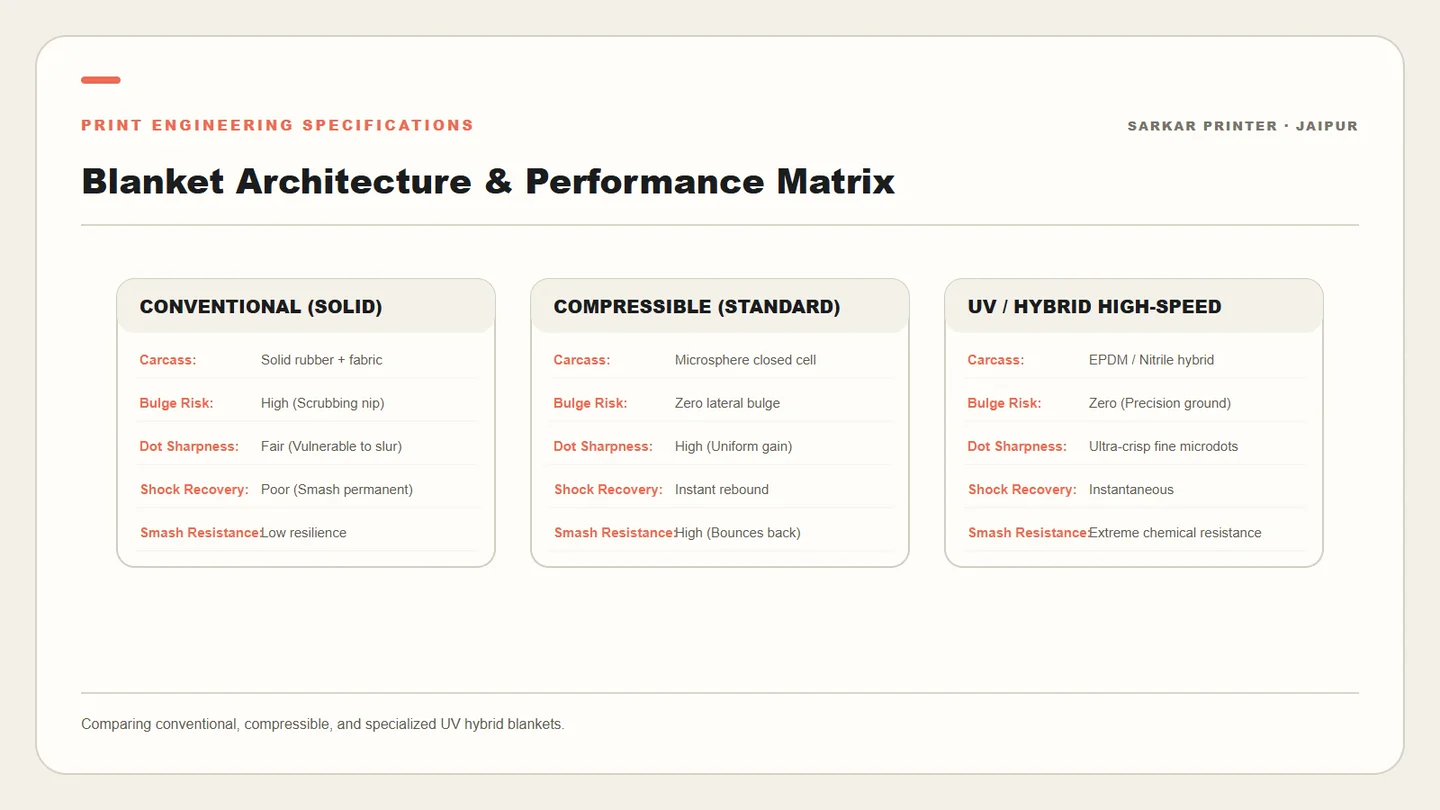
At the heart of every offset lithographic press sits the blanket cylinder, acting as the vital intermediary between the hard aluminum printing plate and the paper substrate. An offset blanket is not a simple sheet of rubber; it is an engineered multi-layer composite. The base consists of three to four plies of tightly woven, low-stretch cotton or synthetic fabric bonded with elastomeric adhesives to prevent stretching under press tension. Above this base lies a compressible layer containing millions of microscopic gas-filled closed-cell elastomeric microspheres. The top surface features a precision-ground synthetic rubber face (typically nitrile butadiene or cast polyurethane) engineered to a specific surface roughness ($R_a$ between 0.8 and 1.4 $\mu$m). Under press impression, this multi-ply architecture compresses vertically without bulging laterally forward into the printing nip, maintaining true rolling diameter and preventing dot elongation. For certified press operations, ensure blanket resilience conforms to Fogra graphic technology research specifications.
Compressible vs. Conventional Blankets: The Physics of True Rolling
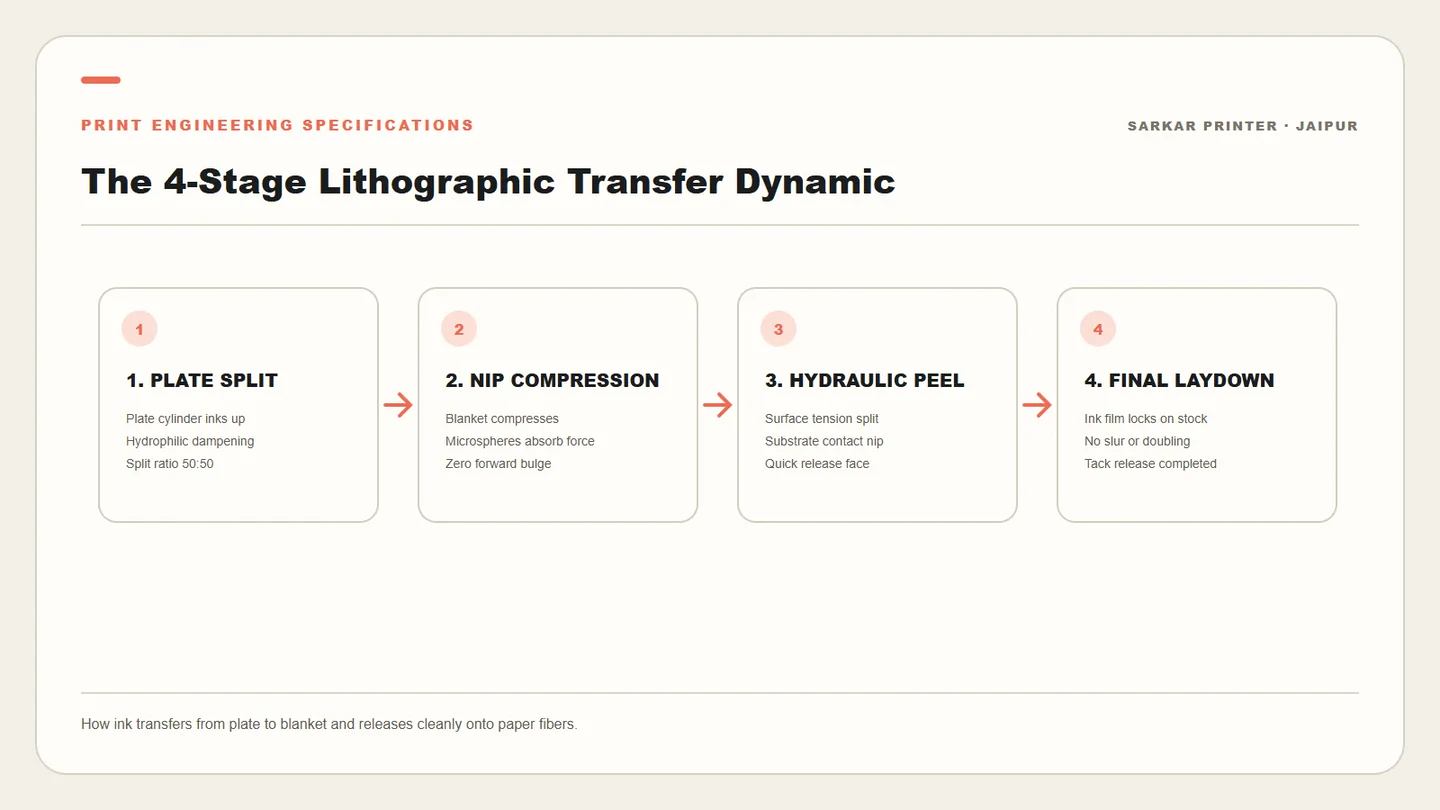
Before the advent of compressible blankets, older pressrooms utilized solid conventional blankets. When solid rubber is compressed inside a narrow nip, rubber volume cannot decrease; instead, the displaced volume bulges outward ahead of and behind the contact point. This forward bulge creates friction, scrubs against the printing plate, wears out halftone dots, and causes severe mechanical slurring. Modern compressible blankets solve this through volume displacement within the closed-cell foam layer. Under pressure, the nitrogen-filled microspheres contract, allowing true vertical compression without lateral displacement. This delivers true rolling geometry, reduces drive torque, dampens press vibration, and provides generous latitude for varying paper calipers. Specify blanket thickness tolerances within ±0.01 mm according to ISO 12647 offset process control standards.
Troubleshooting Blanket Defects: Glazing, Smashing, and Pinhole Sinks
Even premium compressible blankets suffer wear during rigorous production shifts. The three most common pressroom failures are surface glazing, localized smashing, and blanket swelling. Glazing occurs when dried ink binders, micro-fine paper dust, and gum arabics build up on the rubber surface, hardening into a glass-like glaze that destroys ink receptivity and causes mottled solid print coverage. Smashing occurs when double sheets, folded carton flaps, or foreign debris pass through the cylinder nip, depressing the carcass beyond its elastic yield point. While conventional blankets permanently deform after a smash, high-performance compressible blankets frequently bounce back within minutes if treated with dedicated swelling restorers and warm wash solutions. Regular micrometer torque inspection ensures consistent nip pressure across all cylinder units.

Pressroom Inspection Protocol: Packing, Torque, and Tensioning
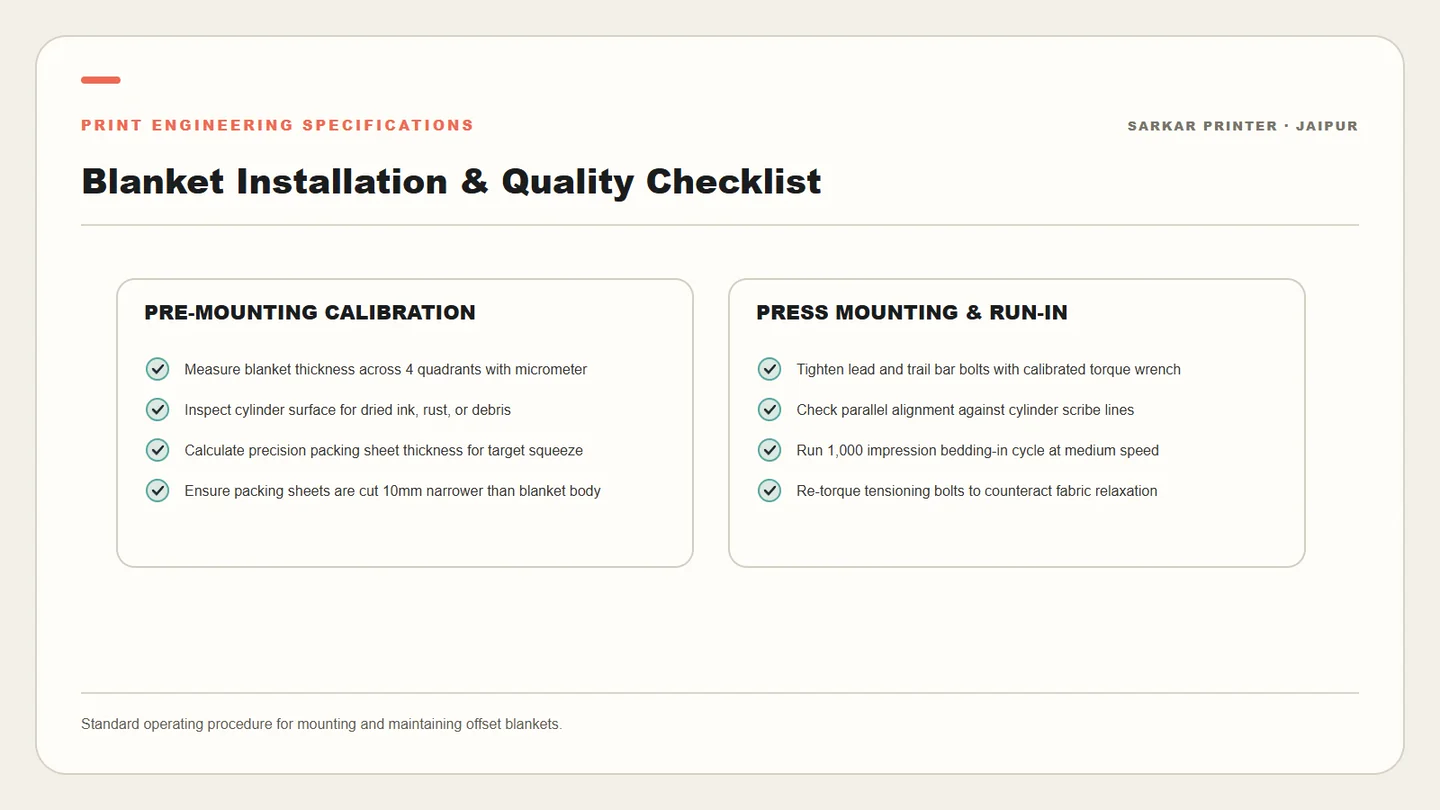
Achieving optimal print sharpness requires strict adherence to blanket packing procedures. Never guess cylinder undercut packing. A calibrated packing gauge must verify that total blanket and packing height matches the machine manufacturer's specified undercut (typically +0.05 to +0.10 mm squeeze over bearers). When mounting a new blanket, tighten tensioning bars evenly using a calibrated torque wrench. An unevenly tensioned blanket twists on the cylinder, creating diagonal wrinkles and chronic gear streaking. Re-torque the blanket after running the first 1,000 sheets to take up initial carcass bedding-in slack.
Frequently asked questions
What is the ideal surface roughness for an offset printing blanket?
The industry benchmark for commercial sheetfed printing is a ground surface roughness ($R_a$) of 0.8 to 1.2 micrometers. This micro-buffed texture provides sufficient mechanical bite to hold the ink film while allowing rapid, clean tack release onto coated paper.
How does blanket packing affect dot gain and print register?
Over-packing increases cylinder diameter and surface speed, causing the blanket to travel faster than the plate. This scrubs the image, causing forward dot gain, slurring, and early plate wear. Under-packing leads to weak ink transfer and mottled solids.
Can you use the same blanket for conventional and UV inks?
No. Conventional offset inks use mineral or vegetable oils that require nitrile rubber blankets. UV curable inks use aggressive acrylate monomers that cause nitrile rubber to swell and blister within hours. UV printing requires EPDM (ethylene propylene diene monomer) or hybrid specialty compounds.
CONTINUE THE PRINT PLAN
Plan Your Commercial Print Project in Jaipur
From precision multi-color offset runs to high-end rigid luxury boxes and folding cartons, Sarkar Printer delivers certified color accuracy and structural integrity for businesses across India.