
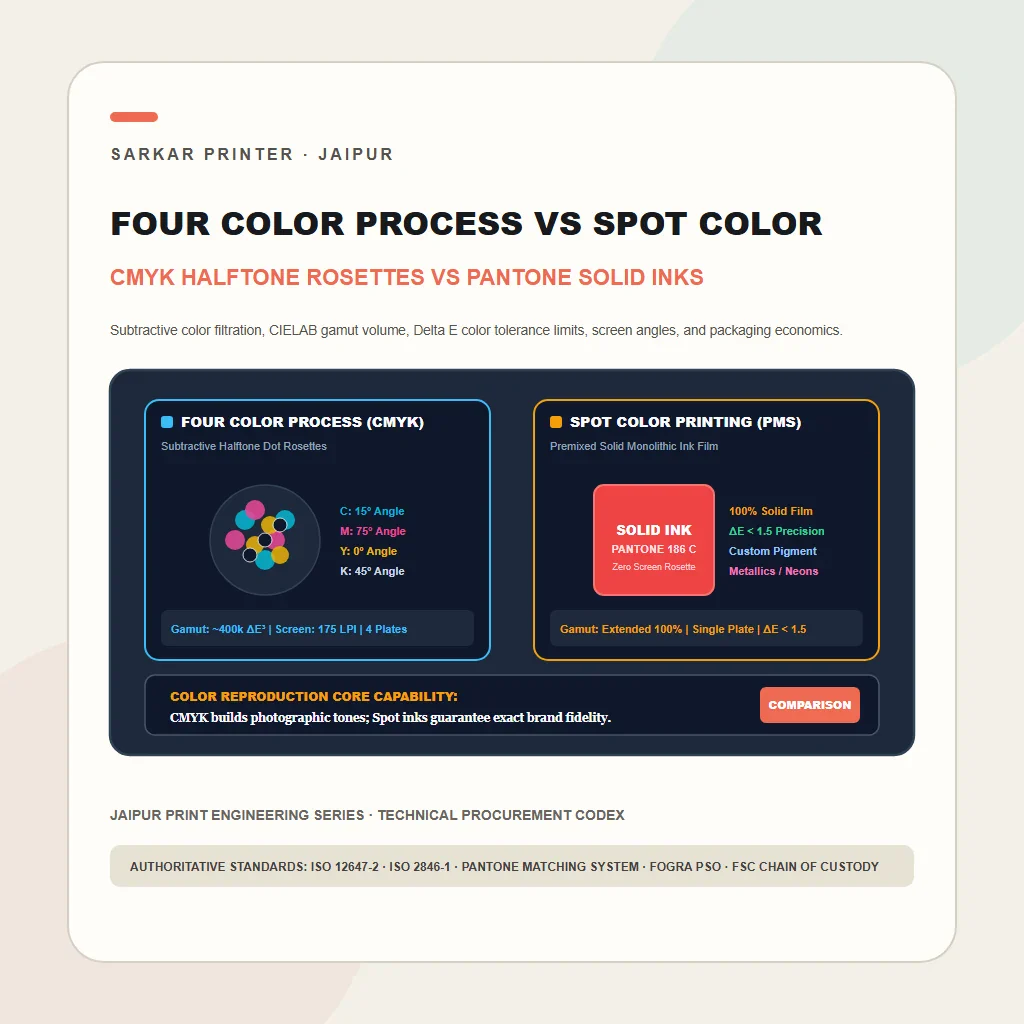
The Physics of Color Reproduction: Subtractive Synthesis vs Direct Inks
Every commercial print procurement decision hinges on how a printing press creates color on paper. In commercial sheetfed lithography, press operators face two distinct color reproduction mechanisms: four color process printing (CMYK) and spot color printing (most commonly formulated via the Pantone Matching System). Selecting the wrong color method causes severe visual discrepancies, unacceptable brand color drift, registration fringing, and costly press makeready overruns.
Four color process printing relies on subtractive color synthesis. The press splits full-color photographic imagery into four standardized process inks: Cyan, Magenta, Yellow, and Key Black. Each ink acts as a spectral light filter. White light strikes the printed paper; the transparent ink layers absorb specific electromagnetic wavelengths while reflecting others back to the human eye. By depositing these four inks as microscopic halftone dots at differing screen angles, the press constructs the visual illusion of continuous photographic tones. Pressrooms operate under rigorous international standards, including ISO 12647-2 for offset lithographic process control and ISO 2846-1 for process ink transparency and chromaticity.
In contrast, spot color printing bypasses subtractive halftone synthesis entirely. A pressroom technician blends pure concentrated pigments in an ink kitchen to formulate a single, homogeneous liquid ink matching a precise target formula from the Pantone Matching System. When transferred to paper, the spot ink forms a continuous, monolithic 100% solid film. The resulting color does not rely on overlapping screen rosettes or optical dot blending. The ink reflects the exact target spectrum directly off the substrate surface, delivering pure visual saturation and absolute color repeatability across millions of sheets.
Mechanical Architectures and Press Routing Workflows
The operational workflow between four color process and spot color printing diverges at every stage of production, beginning in prepress raster image processing (RIP) and extending through CTP imaging, press inking unit assignment, and post-press inspection.
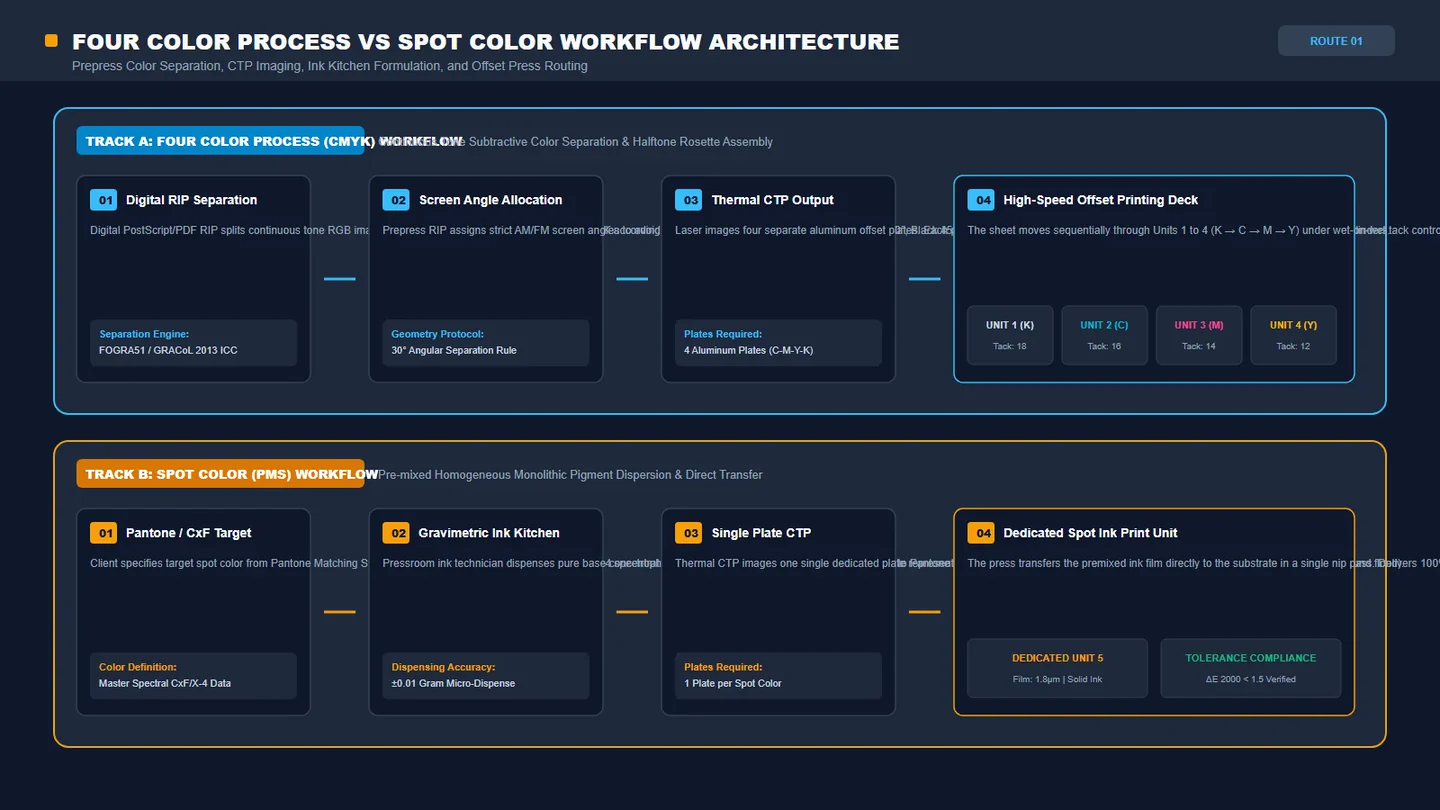
In the four color process workflow, prepress software rasterizes incoming digital vector artwork and high-resolution raster photographs into four discrete 1-bit separation bitmaps. The RIP assigns precise amplitude modulated (AM) screen angles to each channel to prevent destructive optical moiré interference patterns. The industry standard geometry sets Black at 45° (the most visually prominent angle), Magenta at 75°, Cyan at 15°, and Yellow at 0° (the least visible color). A thermal computer-to-plate (CTP) platesetter images four separate aluminum plates. On a multi-unit offset press, the paper sheet moves through four consecutive printing units, receiving Black, Cyan, Magenta, and Yellow in a strictly calibrated wet-on-wet tack sequence.
In the spot color workflow, prepress software isolates the dedicated brand color channel onto its own single vector separation plate. Concurrently, the ink kitchen technician formulates the physical spot ink batch. Using a digital micro-scale measuring to 0.01-gram precision, the technician dispenses exact weight ratios of base Pantone concentrates into a solvent or vegetable-oil vehicle. The press operator fills a dedicated printing unit with this pre-blended ink. When the press cycles, the plate deposits a uniform 1.2 to 2.5-micron ink film directly onto the sheet in a single printing impression.
Commercial printers in Jaipur and high-volume packaging converters utilize hybrid 5-color and 6-color presses. In these configurations, Units 1 through 4 print standard CMYK photographic artwork, while Units 5 and 6 simultaneously deposit corporate spot brand colors and protective functional coatings. For specialized commercial collateral, explore our full spectrum of offset printing in Jaipur and bespoke custom packaging and folding carton manufacturing workflows.
Color Gamut Limits, Delta E Tolerances, and Technical Parameters
The physical boundaries of color reproduction define why spot inks remain irreplaceable in high-tier commercial printing and packaging. Understanding the mathematical representation of color in CIELAB space clarifies the limitations of four color process printing.
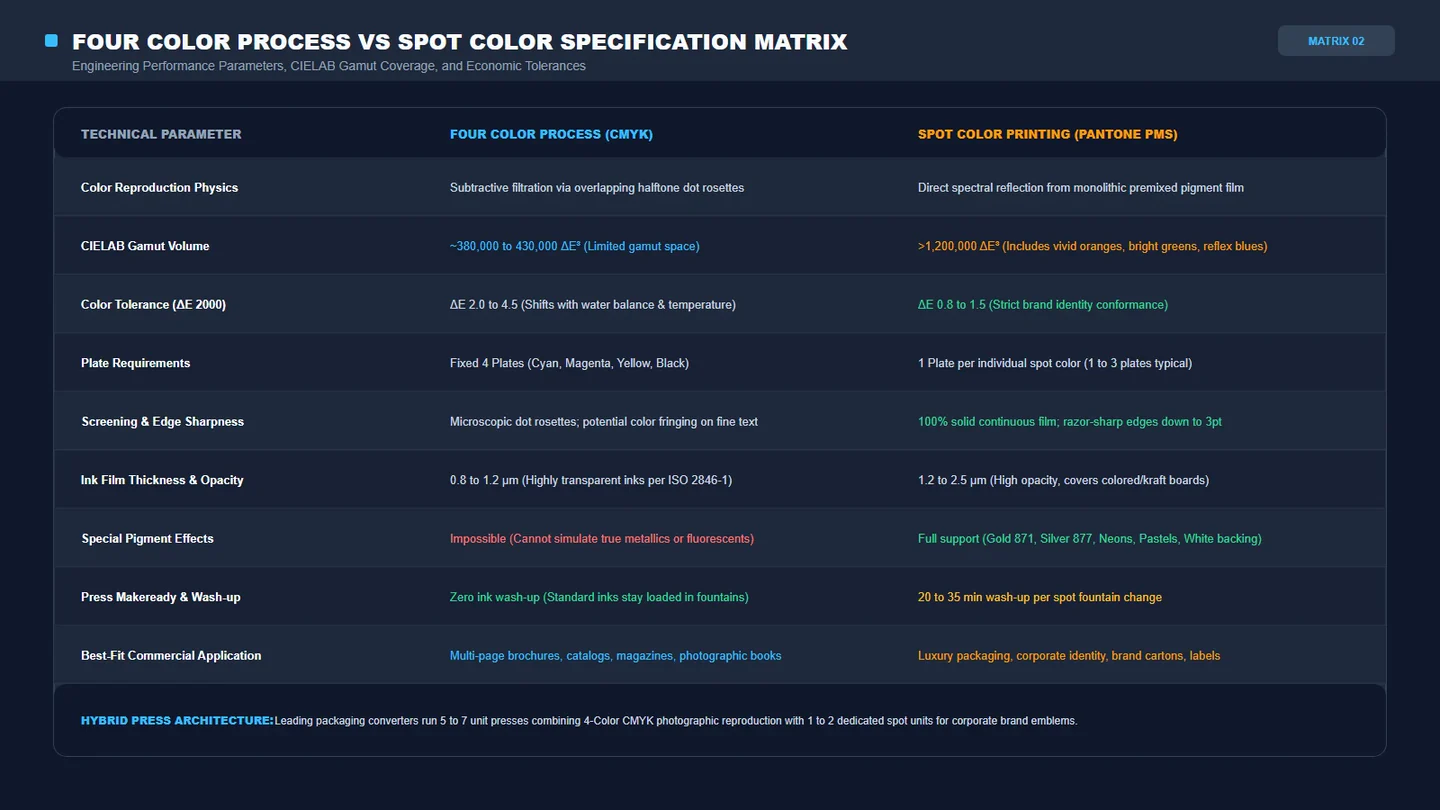
The standard four color offset process gamut encompasses approximately 380,000 to 430,000 Delta E³ color volume units under Fogra PSO characterization data (such as FOGRA51 for premium coated papers). In stark contrast, the human eye perceives colors across a volume exceeding 2,000,000 Delta E³, while RGB monitors display roughly 800,000 to 1,000,000 units. More than 55% of the colors in the standard Pantone Formula Guide fall outside the achievable CMYK gamut boundary.
Vibrant warm oranges, deep reflex blues, bright purples, intense emerald greens, and fluorescent hues cannot exist as pure CMYK process blends. When prepress software forces an out-of-gamut Pantone color into a CMYK build, the gamut mapping algorithm compresses the color toward the gamut perimeter, introducing muddiness and visual desaturation. A vibrant corporate orange (such as Pantone 021 C) converts to an impure mixture of roughly 60% Magenta and 100% Yellow, appearing dull and brownish compared to the pure mono-pigment solid ink.
| Engineering Metric | Four Color Process (CMYK) | Spot Color Printing (PMS) | Technical Significance |
|---|---|---|---|
| CIELAB Gamut Volume | ~380,000 – 430,000 ΔE³ | >1,200,000 ΔE³ | CMYK truncates over 55% of solid Pantone library colors. |
| Color Variance (ΔE 2000) | ΔE 2.0 to 4.5 | ΔE 0.8 to 1.5 | Spot inks provide uncompromised brand color consistency across re-runs. |
| Plate Count | Fixed 4 Plates (C, M, Y, K) | 1 Plate per color channel | CMYK handles unlimited imagery with four standardized plates. |
| Screen Structure | AM/FM Halftone Dot Rosettes | 100% Solid Continuous Film | Spot inks eliminate rosette grain on logos and fine text. |
| Ink Film Thickness | 0.8 to 1.2 microns | 1.2 to 2.5 microns | Thicker spot ink film yields superior opacity on kraft and colored stocks. |
| Specialty Pigments | Unavailable | Metallics, Neons, Pastels, Opaque White | True metallics (Gold 871, Silver 877) require metallic flake spot inks. |
| Fountain Wash-up Time | 0 minutes (Inks stay in press) | 20 to 35 minutes per unit | Spot inks require labor-intensive roller wash-ups between color runs. |
Color tolerance measurement reinforces the supremacy of spot inks for corporate brand governance. Pressrooms measure color variation using the spectrophotometric Delta E 2000 (ΔE 2000) formula. Under standard offset press conditions, microscopic fluctuations in fountain solution conductivity, ambient pressroom humidity, and ink key adjustments cause individual CMYK ink densities to shift by ±0.05. In a composite CMYK build, these microscopic shifts compound across all four colors, producing visible color shifts between ΔE 2.5 and ΔE 4.5 across an 8-hour shift.
Conversely, a spot color ink consists of a single homogeneous dispersion. Even if the press operator slightly adjusts overall ink film thickness, the color shifts only along its lightness axis, preserving chromatic hue and saturation. Consequently, spot color inks maintain strict ΔE 2000 tolerances below 1.2 to 1.5 across tens of thousands of printed packaging sheets. To maintain brand consistency across multi-page collateral, review our commercial brochure printing services and high-precision corporate print solutions.
Substrate Interactions and Production Economics
Substrate physics and job economics govern the practical selection between four color process printing and spot color inks. Ink behavior differs drastically depending on whether paper fibers absorb liquid vehicles or hold pigments on a sealed surface barrier.
On uncoated paper stocks and recycled folding boxboards, ink vehicles rapidly soak into raw cellulose capillaries, pulling pigments into the sheet in an effect known as dry-back. Because four color process inks feature thin, highly transparent formulations (designed to satisfy ISO 2846-1 transparency requirements for subtractive overprinting), uncoated paper absorbs the light-filtering dots unevenly. This absorption causes dramatic optical dot gain (reaching 22% to 28% at 50% tint) and significant chromatic dullness.
Spot inks formulate with higher pigment volume concentrations and opaque mineral fillers. When printed on kraft paperboard, grey-back duplex board, or unbleached packaging liners, opaque spot inks obscure the underlying dark fibers, maintaining vibrant visual brilliance. Furthermore, specialized spot inks (including opaque white undercoats) allow high-end packaging converters to print vibrant graphics onto dark substrates or metallized polyester films.
From an economic perspective, print buyers must evaluate the crossover threshold between plate costs, press makeready time, and consumable pricing:
- Photographic and Multi-Color Imagery: When a print project contains color photographs, continuous gradients, and multi-colored illustrations (such as a 64-page product catalog or art book), four color process printing delivers unmatched cost efficiency. Four plates reproduce an infinite spectrum of photographic hues. Attempting to reproduce photographic artwork using spot inks remains physically impossible.
- Single and Two-Color Stationery: For corporate letterheads, presentation folders, envelopes, and business cards containing only one or two corporate brand colors, spot color printing proves substantially cheaper than CMYK. Imaging one or two CTP plates and running a compact two-unit offset press requires half the setup time and plate material of a four-plate CMYK run.
- High-End Brand Packaging: Packaging converters achieve optimal cost-performance by marrying both methodologies into a 5-color or 6-color pass: four standardized CMYK process units reproduce photographic product shots, while dedicated spot units print critical corporate logos, solid background flood coatings, and micro-text, eliminating out-of-gamut branding disputes.
Pressrooms enforce responsible environmental stewardship across both process and spot ink workflows, utilizing vegetable-oil based vehicles and procuring paperboard certified under FSC (Forest Stewardship Council) chain-of-custody standards. Explore our comprehensive commercial print services in Jaipur for customized procurement consulting.
Pressroom Troubleshooting Fault Tree and Root Cause Analysis
Press operators encounter recurring optical and mechanical defects during color reproduction. Understanding the root causes of screen moiré, registration halos, color drift, and out-of-gamut banding enables print engineers to remediate issues immediately on the pressroom floor.
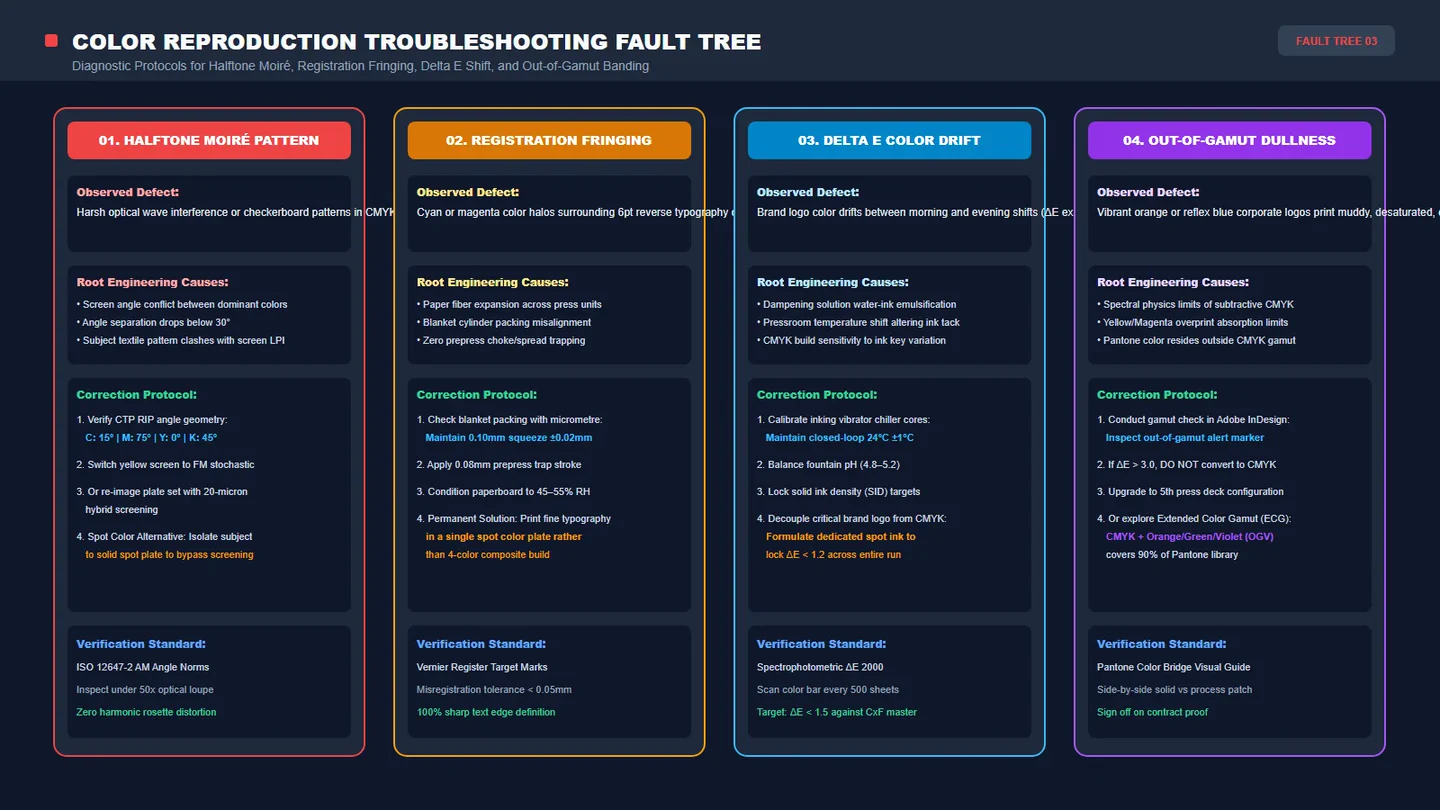
When press sheets exhibit visual defects, press operators follow structured diagnostic pathways:
1. Halftone Screen Moiré Distortion
Halftone moiré presents as severe optical wave interference or unwanted geometric checkerboard patterns across secondary color builds, skin tones, or fabric textures. This defect occurs when prepress screen angles diverge from the 30° angular separation rule. If Cyan (15°) and Black (45°) run with incorrect angle offsets, their overlapping dot patterns generate harmonic visual beats. Pressrooms remediate moiré by auditing CTP RIP output, resetting screen angles to the standardized ISO 12647-2 geometry, or replacing amplitude modulated (AM) screening with frequency modulated (FM) stochastic screening. For critical vector brand logos, assigning the artwork to a solid spot plate completely eliminates screening moiré.
2. Microscopic Registration Color Fringing
When viewing 6-point corporate typography, barcode lines, or intricate vector emblem contours, press inspectors frequently discover cyan, magenta, or yellow color halos bleeding beyond the text boundary. This misregistration occurs when paperboard fibers stretch or swell after absorbing dampening fountain moisture across consecutive press nips. A mechanical sheet stretch of merely 0.08 mm displaces microscopic CMYK dots, producing visible color fringing. Prepress engineers mitigate fringing by applying 0.08 mm to 0.12 mm choke and spread traps. However, for razor-sharp typography down to 3-point size, print engineers specify a single dedicated spot ink plate, eliminating multi-plate registration vulnerability entirely.
3. Ambient Delta E Color Drift Across Long Runs
On high-volume print runs exceeding 25,000 sheets, corporate logos printed in composite CMYK often drift noticeably away from approved contract proofs. Fluctuations in pressroom temperature alter ink viscosity and roller train tack, disrupting the ink-water emulsion equilibrium. To control color drift, pressrooms maintain closed-loop water chilling systems circulating through inking roller cores at 22°C to 24°C ± 1°C, and balance fountain solution pH between 4.8 and 5.2. To eliminate color drift risks completely on critical corporate assets, packaging engineers decouple the logo from the CMYK separation and transfer it as a pure, pre-blended spot ink.
4. Out-of-Gamut Muddy Solids
When prepress operators automatically convert bright RGB brand files or vivid Pantone swatches into CMYK without gamut verification, the resulting printed solids appear muddy, dull, or brownish. The subtractive physics of Cyan, Magenta, and Yellow cannot produce spectral reflectance peaks matching pure mono-pigment spot inks. If digital gamut auditing reveals a predicted ΔE 2000 greater than 2.5, pressrooms mandate upgrading the press job to include a dedicated spot ink unit, or employing Extended Color Gamut (ECG) 7-color printing (CMYK + Orange, Green, and Violet).
Quality Control Protocols and Spectrophotometric Standards
Achieving repeatable color accuracy requires systematic quality control gates throughout the production cycle, bridging digital pre-press file exchange, ink room dispensing, and inline pressroom measurement.
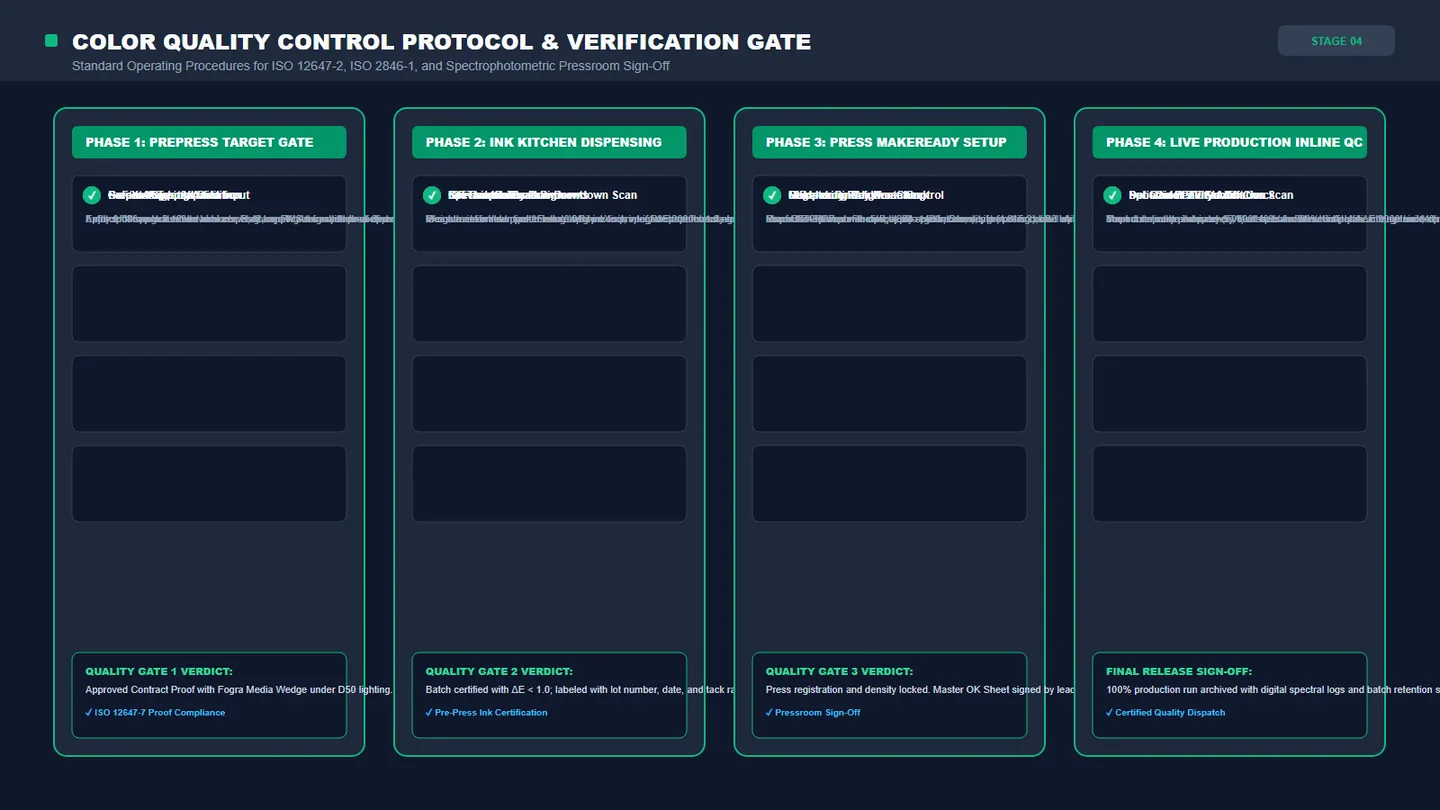
The Sarkar Printer color quality assurance protocol enforces four mandatory verification gates:
- Phase 1: Pre-Press File Verification and Gamut Auditing: Prepress engineers ingest client digital assets and extract spectral color definitions utilizing CxF/X-4 (Color Exchange Format) data. Software simulates printability against target press ICC profiles. Any spot-to-process conversion yielding a ΔE 2000 exceeding 2.0 triggers an automatic client notification recommending a dedicated spot ink deck. Technicians output calibrated contract proofs verified with an inline Fogra media wedge under standardized D50 viewing booths (ISO 3664).
- Phase 2: Gravimetric Ink Dispensing and Drawdown Verification: In the pressroom ink kitchen, technicians weigh base pigment concentrates on digital scales accurate to 0.01 grams. Prior to filling press fountains, the technician executes a calibrated ink drawdown on the production paperboard stock using an automated IGT printability tester. A spectrophotometer scans the drawdown patch, confirming ΔE 2000 compliance under 1.0 against master digital standards.
- Phase 3: Automated Press Makeready and Lay Alignment: Press operators load CIP4 Print Production Format (PPF) data directly into the press console, automatically presetting all 32 ink zone keys along the fountain. Operators verify registration targets using optical video magnification, ensuring alignment within ±0.03 mm across all units.
- Phase 4: Inline Spectrophotometric Production Monitoring: During the live press run, operators pull sample sheets every 500 impressions, scanning color bars using automated reflection spectrophotometers under ISO 13655 M1 measurement condition (incorporating optical brightener compensation). The system tracks solid ink density (SID), dot gain curves (TVI), and spot color ΔE 2000 in real time, guaranteeing uncompromising commercial consistency. For short-run digital prototypes, examine our agile digital printing in Jaipur capabilities.
Procurement Verdict: Engineering the Right Color Strategy
Choosing between four color process printing and spot color inks requires balancing aesthetic brand protection against unit manufacturing economics. Modern packaging and commercial print procurement does not treat these two methodologies as mutually exclusive competitors; rather, intelligent print engineering combines them into an optimized hybrid production system.
Specify Four Color Process Printing (CMYK) when producing:
- Continuous tone photographic brochures, product catalogs, and corporate magazines.
- Multi-page publications and pictorial books containing diverse imagery.
- Direct mail flyers and marketing collateral where budget constraints require standardized low makeready press runs.
Specify Spot Color Printing (Pantone PMS) when producing:
- Rigid corporate identity materials (letterheads, business cards, corporate stationery) requiring exact logo replication.
- Primary brand packaging, pharmaceutical cartons, and retail boxes where brand identity guidelines mandate strict ΔE 2000 < 1.5 tolerance across recurring reprint batches.
- Designs featuring specialty metallic finishes (Pantone Gold 871, Silver 877), intense fluorescents, or crisp reverse micro-typography.
- Packaging cartons utilizing dark kraft paperboard or colored substrates requiring high-opacity monolithic coverage.
Consult with Sarkar Printer's senior print engineers in Jaipur to audit your digital dielines, analyze ink gamut coverage, and configure the most cost-effective printing press routing for your next commercial production run.
Frequently Asked Questions
What is the primary difference between four color process and spot color printing?
Four color process printing recreates full-spectrum photographic imagery by overlapping microscopic halftone dot rosettes using four standard transparent inks (Cyan, Magenta, Yellow, and Key Black). Spot color printing utilizes individual, pre-mixed homogeneous pigment inks formulated to exact Pantone Matching System standards, depositing a solid, monolithic ink film with zero halftone rosette patterns.
Why do brand logos require Pantone spot inks instead of CMYK process builds?
Over 55% of solid Pantone colors fall outside the achievable subtractive CMYK color gamut. Furthermore, slight microscopic dampening shifts or ink key adjustments on a four-color press cause noticeable color drift (Delta E > 3.0 to 5.0) in composite CMYK builds. Dedicated spot inks guarantee rigorous brand color fidelity with Delta E 2000 under 1.5 across millions of packaging impressions.
Can an offset press run four color process and spot colors simultaneously?
Yes. Modern commercial packaging offset presses feature five, six, seven, or eight printing units. Pressrooms configure Units 1 through 4 to print the CMYK photographic imagery, while assigning Units 5 and 6 to transfer dedicated brand spot inks, solid metallic inks, or tactile spot varnishes in a single pass.
How do makeready costs compare between CMYK process and spot color printing?
CMYK printing requires minimal makeready between runs because standard inks remain loaded in press fountains, requiring only automated plate changes and CIP4 ink presetting. Spot colors require draining the fountain, thorough solvent roller wash-ups (adding 20 to 35 minutes per unit), custom gravimetric ink batch mixing, and dedicated wash-up waste disposal, increasing setup expense on short runs.
When does spot color printing prove more cost-effective than four color process?
Spot color printing proves significantly more cost-effective for corporate stationery, business cards, letterheads, and single-shade packaging cartons containing only one or two brand colors. In these cases, imaging one or two spot plates and running a single-pass two-unit press costs substantially less than producing four CTP plates and operating a four-unit CMYK press.