
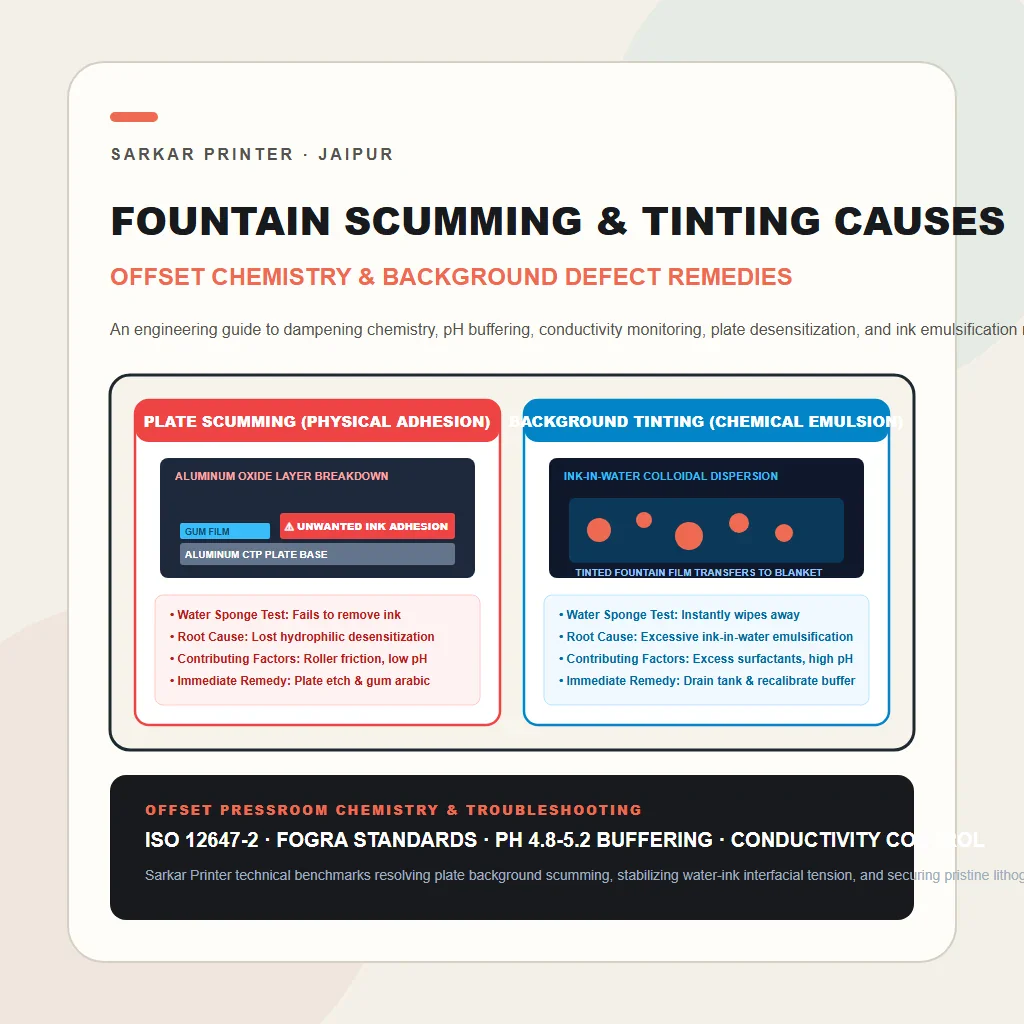
The Chemical Physics of Offset Lithography: Interfacial Dynamics
Offset lithography relies on a foundational chemical principle: the thermodynamic immiscibility between oily printing ink and aqueous fountain solution. Unlike relief printing or gravure, an offset plate possesses a planar surface without raised or recessed image features. Lithographic printers achieve image separation entirely through surface energy differentiation across the aluminum substrate.
During Computer-to-Plate (CTP) manufacturing, prepress thermal imaging lasers cure oleophilic (oil-receptive, water-repellent) photopolymer resins to form printing image areas. In contrast, non-image areas consist of electrochemically grained and anodized aluminum oxide (Al2O3). This porous ceramic microstructure exhibits intense hydrophilic (water-receptive, oil-repellent) energy. When the dampening system applies a micro-thin water film measuring one to two microns across the plate, water molecules fill the anodized pores, establishing a protective hydraulic barrier that rejects ink.
However, running an industrial printing press creates immense hydrodynamic forces. At operating speeds exceeding twelve thousand impressions per hour, high-speed roller nips generate shear rates surpassing ten thousand reciprocal seconds. Under these intense kinetic conditions, chemical instability or mechanical misalignment causes unwanted ink transfer onto non-image paper margins. Press operators broadly classify these failures into two distinct phenomena: plate scumming and background tinting. Successfully diagnosing and eliminating these defects demands a rigorous understanding of pressroom fluid mechanics compliant with ISO 12647-2 and ISO 2846-1 standards.
Diagnostic Workflow Route: Isolating Physical Scumming from Chemical Tinting
When an operator notices haze or color cast across unprinted paper margins, misidentifying the root defect wastes valuable production hours and destroys expensive substrate stock certified by the Forest Stewardship Council (FSC). Press technicians must execute a structured diagnostic workflow route to isolate physical plate failure from chemical fountain contamination.
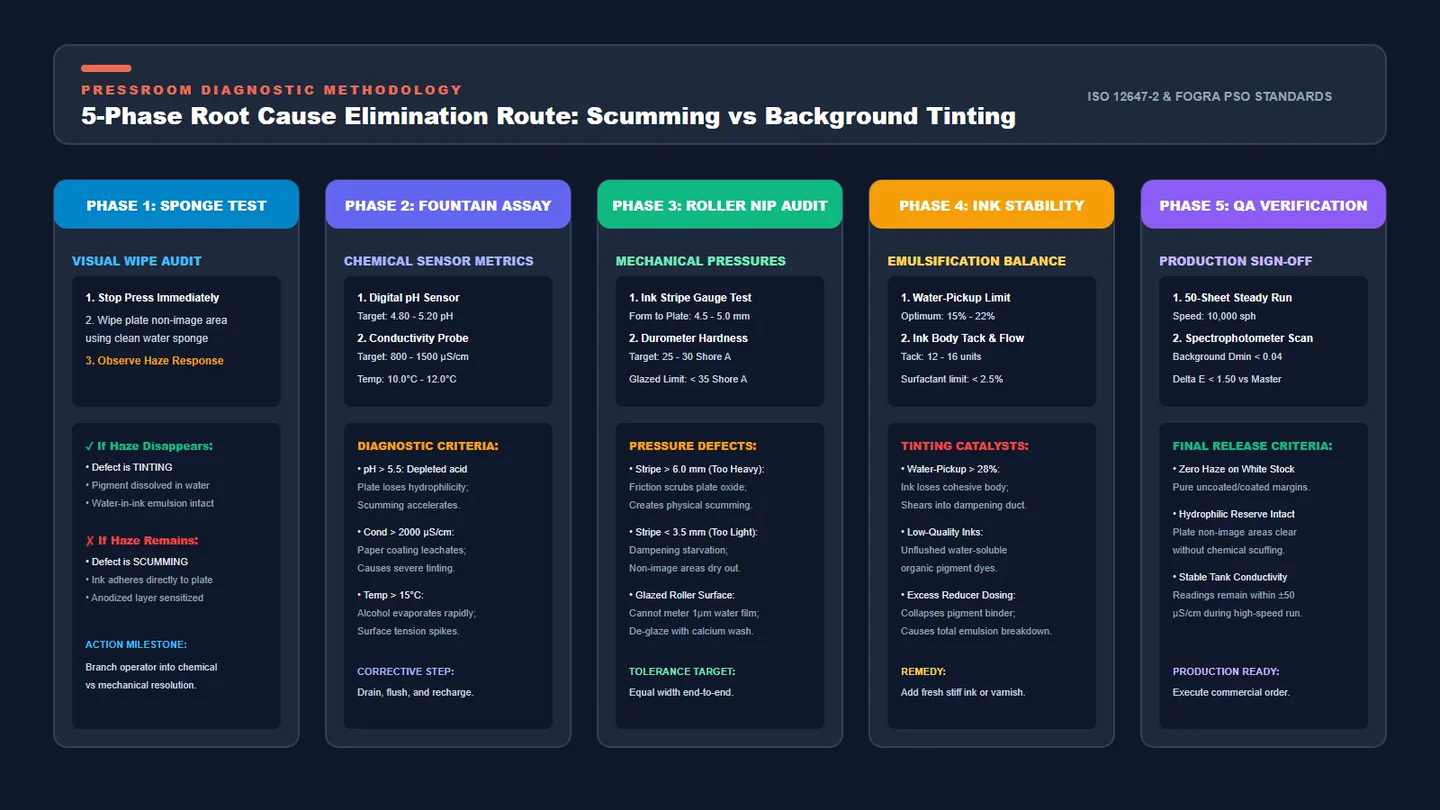
Our press engineers at Sarkar Printer enforce a five-phase elimination route that separates symptoms from underlying mechanisms:
- Phase 1: The Water Sponge Wipe Test: The technician immediately halts the press feeder and wipes the tainted non-image area of the plate with a clean cellulose sponge saturated with pure water. If the ink haze disappears instantly, the defect is background tinting (chemical emulsion). If the ink remains firmly adhered to the plate metal, the defect is plate scumming (physical sensitization).
- Phase 2: Fountain Chemical Sensor Assay: Technicians insert calibrated digital probes into the dampening reservoir, recording pH, electrical conductivity, and fluid temperature to identify acid depletion or dissolved mineral contamination.
- Phase 3: Roller Nip & Stripe Geometry Audit: Operators evaluate dampening form roller contact stripes against the CTP plate cylinder using ink gauge strips, confirming parallel alignment and proper rubber durometer.
- Phase 4: Ink Emulsification & Body Evaluation: Technicians inspect the inking train, testing ink tack, water-pickup percentage, and excessive reducer additives that collapse ink cohesion.
- Phase 5: Quality Assurance Verification: Following corrective adjustments, the crew prints fifty consecutive proof sheets, scanning background optical density to confirm complete defect elimination.
Plate Scumming Mechanics: Hydrophilic Breakdown and Friction
Plate scumming represents a physical or chemical condition where non-image aluminum areas lose their water-loving properties and begin accepting ink directly. Press technicians identify scumming because the ink adheres tenaciously to the plate cylinder, transferring onto blankets and appearing as distinct streaks, localized spots, or solid background toning.
Three primary mechanisms cause plate scumming in modern pressrooms:
- Loss of Desensitizing Gum Arabic Film: Fountain solution concentrates contain natural acacia gum arabic (polysaccharide arabinogalactan). Arabinogalactan molecules possess polar carboxyl groups that chemically adsorb onto the anodized aluminum oxide pores. This molecular layer forms an impenetrable hydrophilic shield. If the fountain solution lacks sufficient gum or if pressroom pH drifts into alkaline territory above 5.50, the gum layer detaches. Oily fatty acids from printing ink then bind directly to the exposed aluminum, causing chemical scumming.
- Excessive Dampening Form Roller Pressure: When press mechanics adjust dampening form rollers too tightly against the plate cylinder, measuring contact stripes wider than 6.0 millimeters, excessive friction generates intense abrasive shear. This mechanical grinding literally wears down the microscopic anodized oxide pore structure. Once friction strips the anodized pores bare, water cannot adhere, resulting in mechanical friction scumming.
- CTP Prepress Exposure and Storage Errors: If Computer-to-Plate laser optics deliver insufficient thermal energy, residual un-polymerized coating remains in non-image areas. Similarly, storing processed plates in hot, humid pressrooms without a protective gum coating causes ambient aluminum oxidation, sensitizing the metal before mounting.
Background Tinting Mechanics: Micro-Emulsification and Surfactants
Background tinting differs fundamentally from scumming. In a tinting condition, the aluminum plate remains completely clean and fully hydrophilic. Instead, printing ink chemically breaks down and emulsifies directly into the fountain solution, turning the dampening fluid into a colored colloidal ink-in-water emulsion.
Lithographic printing requires a controlled water-in-ink emulsion, where the ink body absorbs approximately fifteen to twenty-two percent microscopic water droplets to maintain smooth transfer. However, if this relationship reverses into an ink-in-water emulsion, catastrophic tinting erupts. The dampening form rollers coat the entire plate—both image and non-image areas—with a tinted fluid film. This tinted water film transfers onto the offset blanket and prints a uniform, faint colored haze across unprinted paper borders. Because the pigment does not adhere to the plate, wiping the plate with a wet sponge instantly removes the haze.
The primary culprits driving background tinting include:
- Surfactant Overdosing and Alcohol Substitutes: Alcohol substitutes contain glycol ethers and surfactants designed to reduce water surface tension from seventy-two millinewtons per meter (mN/m) down to thirty-eight mN/m. If dosing systems accidentally introduce excessive substitute concentrations above three percent, surface tension collapses below thirty mN/m. The surfactant acts as an industrial detergent, washing ink resins into the dampening water.
- Calcium Carbonate Contamination from Paper Substrates: Low-cost alkaline papers contain heavy calcium carbonate (CaCO3) filler coatings. As paper feeds through the press, acidic fountain solutions dissolve microscopic calcium ions off the sheet surface. Calcium salts accumulate inside the dampening pan, reacting with ink fatty acids to form sticky calcium soaps that trigger rapid pigment bleeding.
- Inferior Pigment Flush and Soft Ink Varnishes: Low-quality printing inks manufactured without proper varnish flushing contain residual water-soluble organic dyes. Under high shear, these pigments dissolve directly into the fountain solution, causing severe color tinting matching spot Pantone Matching System (PMS) shades.
Fountain Chemistry Specification Matrix: Tolerances and Thresholds
Maintaining pristine print margins requires precise control over chemical and physical press parameters. The engineering specification matrix below outlines target operating ranges, defect trigger thresholds, and corrective protocols.
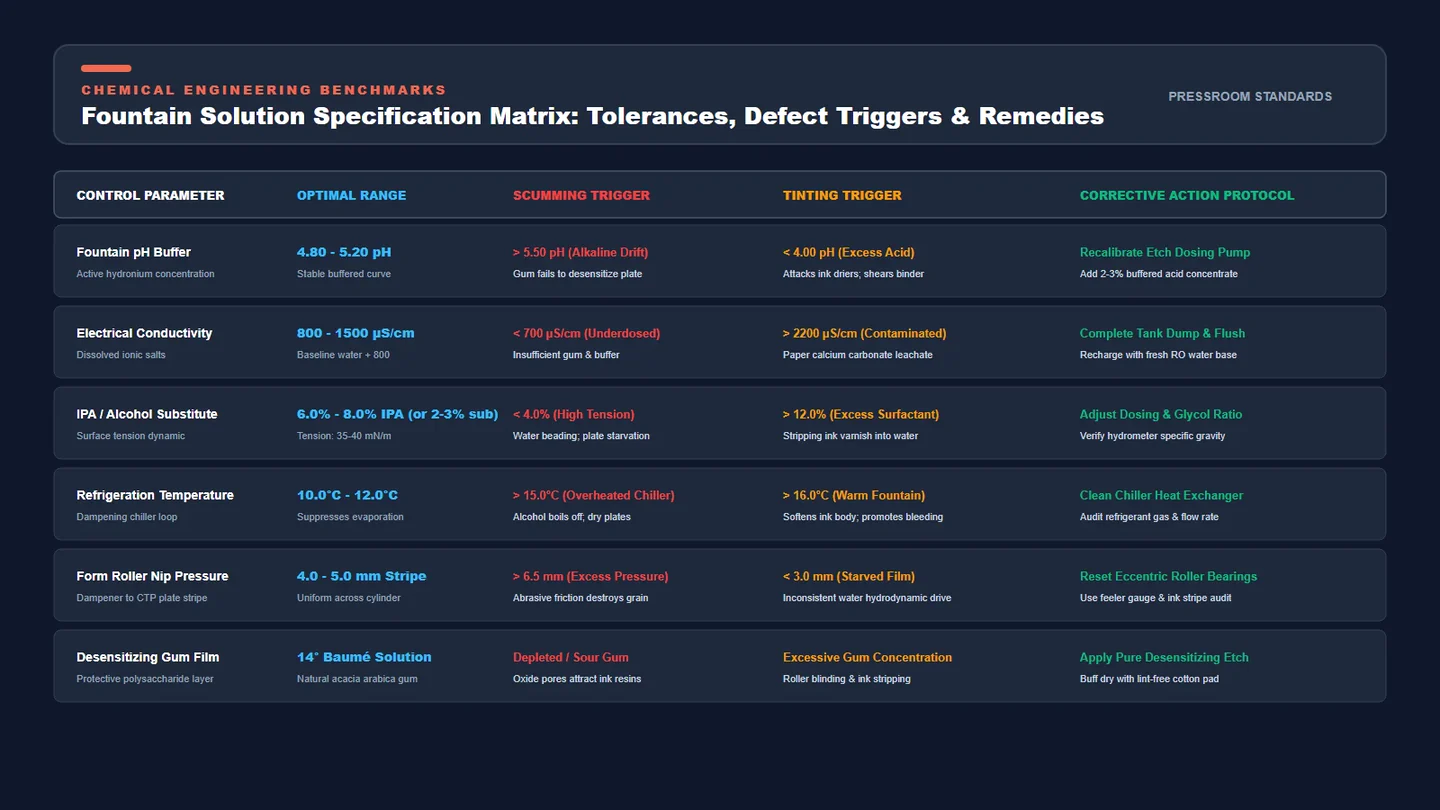
Adhering strictly to these chemical benchmarks protects production runs from catastrophic quality halts. For example, maintaining dampening chiller temperature at 10.5°C suppresses volatile alcohol evaporation, prevents ink varnish softening, and maintains stable fluid surface tension throughout twenty-four-hour continuous manufacturing shifts.
Pressroom Troubleshooting Fault Tree: Systematic Root Cause Resolution
When press operators encounter background discoloration during live production, panic often leads to counter-productive adjustments—such as flooding the plate with excessive water, which exacerbates ink emulsification. Pressroom supervisors must guide technicians through a rigorous fault tree analysis.
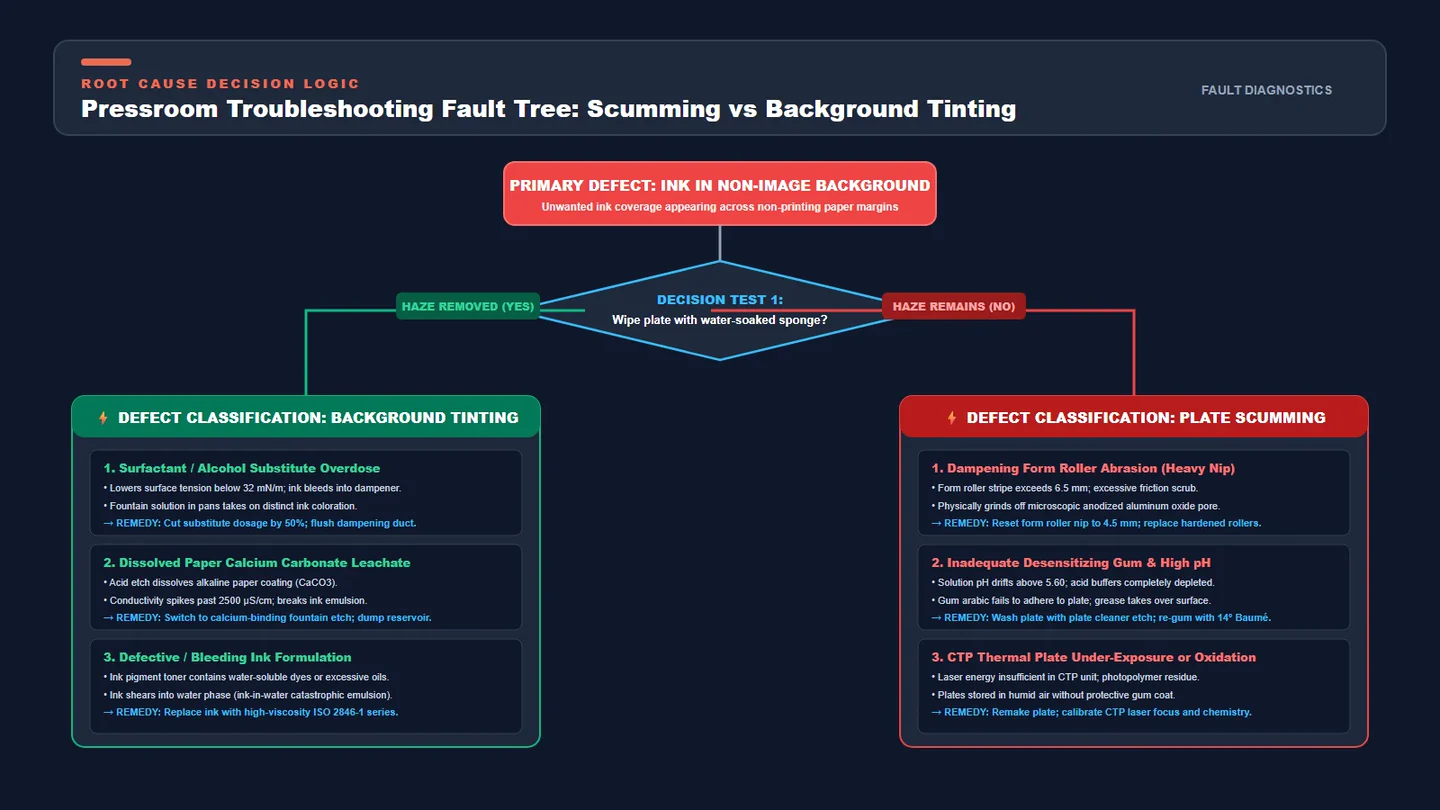
When the sponge wipe test confirms background tinting, operators must immediately audit dampening pan conductivity. If conductivity exceeds twenty-two hundred microSiemens per centimeter (µS/cm), adding more fountain concentrate will not solve the issue because the bath suffers from heavy calcium and paper dust contamination. Technicians must immediately dump the reservoir, flush circulation lines with hot water, and refill the tank with fresh Reverse Osmosis (RO) water base.
Conversely, if the sponge test confirms plate scumming, the technician applies an acidic plate cleaner and desensitizing etch containing fourteen-degree Baumé gum arabic. If the etch cleans the plate and printing proceeds cleanly, the press crew increases fountain acid concentrate dosing by zero point five percent to restore chemical buffering. If scumming reappears within five hundred sheets in the exact same track, the technician inspects dampening form roller nips for mechanical abrasion.
Standard Operating Procedures: 6-Point Daily Dampening Quality Audit
To eliminate background defects proactively, Sarkar Printer implements a mandatory six-point dampening and plate quality control standard operating procedure across all sheetfed presses.
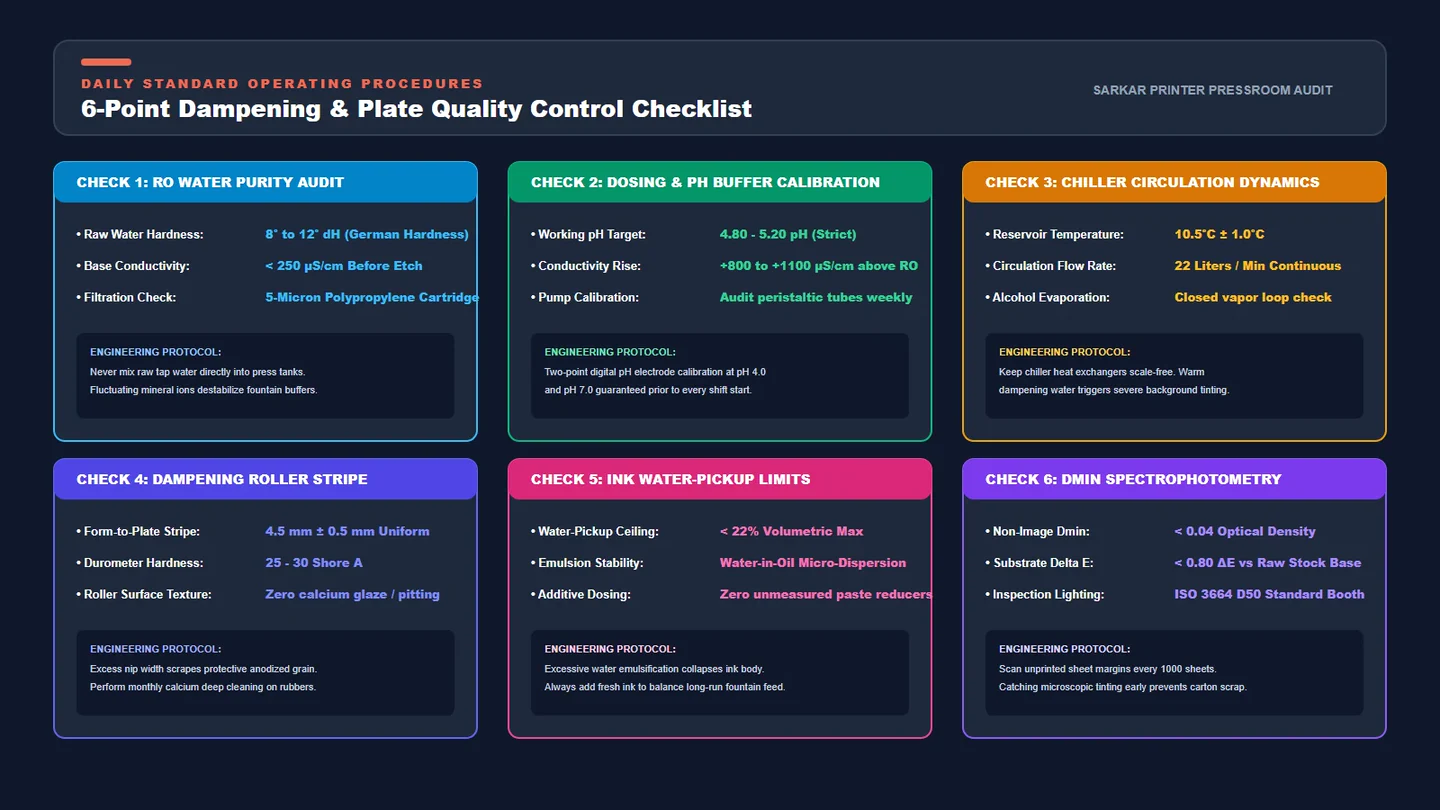
Our quality assurance technicians audit the following six checkpoints prior to authorizing commercial production runs:
- RO Water Purity Audit: Technicians measure incoming Reverse Osmosis water, ensuring base conductivity remains below two hundred fifty µS/cm and German hardness rests between eight and twelve degrees dH to prevent mineral swings.
- Dosing & pH Buffer Calibration: Operators calibrate digital pH electrodes using standard buffer solutions (pH 4.01 and pH 7.00), verifying working solution pH strictly between 4.80 and 5.20.
- Chiller Circulation Dynamics: Technicians inspect the refrigeration chiller loop, confirming stable bath temperature at 10.5°C ± 1°C and continuous twenty-two-liter-per-minute circulation flow.
- Dampening Form Roller Stripe Audit: Operators measure roller contact stripes against the CTP plate using ink thickness gauges, confirming uniform 4.5 mm width end-to-end and checking rubber hardness below thirty Shore A.
- Ink Water-Pickup Verification: Press crews sample ink from distribution rollers, verifying that volumetric water-pickup does not exceed twenty-two percent.
- Spectrophotometric Dmin Verification: Technicians measure unprinted paper margins with polarized spectrophotometers, guaranteeing non-image optical density (Dmin) remains below 0.04 above raw substrate and Delta E remains below 0.80 according to Fogra PSO guidelines.
B2B Procurement Impact: Defect Prevention and Substrate Yield Optimization
Controlling pressroom chemistry directly impacts procurement economics and product quality for brand owners, publishing houses, and corporate print buyers. When an offset printer battles chronic scumming or tinting, production lines suffer massive waste. Hundreds of paperboard sheets end up in recycling dumpsters, while print crews repeatedly halt presses to scrub plates and wash blankets.
Furthermore, subtle background tinting often escapes notice under dim pressroom lighting, only to appear under retail supermarket LED lamps as a dirty gray or yellow cast across crisp white packaging designs. By enforcing strict chemical standards and automated closed-loop spectrophotometry, Sarkar Printer delivers flawless, snow-white margins and pristine brand fidelity on every run.
Whether your organization requires premium commercial offset printing services, high-durability folding carton packaging, corporate marketing brochures and flyers, or high-volume catalogues and publication printing, our precision engineering eliminates defect risks and maximizes manufacturing yield. Connect directly with our technical team through our print consultation desk to review your packaging specifications and schedule production.
Frequently Asked Questions
What is the primary technical difference between plate scumming and background tinting?
Plate scumming occurs when non-image areas on the aluminum CTP plate physically lose their hydrophilic protective water film, allowing oily lithographic ink to bind directly to bare aluminum oxide pores. A water-soaked sponge cannot wipe away scumming ink. Background tinting occurs chemically when ink pigment particles emulsify into the fountain solution itself, creating an ink-in-water colloidal suspension that tints the dampening fluid film without adhering to the plate. A clean water sponge immediately wipes away background tinting.
How does fountain solution pH control prevent plate background scumming?
Fountain solution acid concentrates contain phosphoric or citric acid buffers and gum arabic. Maintaining pH strictly between 4.80 and 5.20 provides the exact ionic environment required for gum arabinogalactan molecules to chemically adsorb onto anodized aluminum micro-pores. If pressroom pH rises above 5.50 due to alkaline paper coating leachates, the desensitizing gum layer dissolves away, exposing bare aluminum to ink resins and triggering immediate background scumming.
Why does electrical conductivity provide a more reliable pressroom metric than pH alone?
Modern commercial fountain concentrates incorporate sophisticated chemical buffer salts that hold pH steady around 5.0 even when large volumes of contaminants enter the dampening system. Electrical conductivity measures the total concentration of dissolved ionic salts. As paper coatings leach calcium carbonate and dissolved pigments into the water pan, conductivity skyrockets from 1200 up to 3000 microSiemens per centimeter (uS/cm). Tracking conductivity exposes contamination before chemical emulsification causes catastrophic background tinting.
How do excessive dampening form roller pressures cause plate scumming?
When dampening form rollers press too tightly against the CTP plate cylinder, measuring an ink stripe width above 6.0 millimeters, mechanical friction creates intense hydrodynamic scrub. This excessive shear wears away the microscopic anodized aluminum oxide grain that mechanically anchors the hydrophilic water film. Once friction strips the anodized pores bare, the plate permanently accepts oily printing ink, causing severe friction scumming that requires plate re-imaging.