
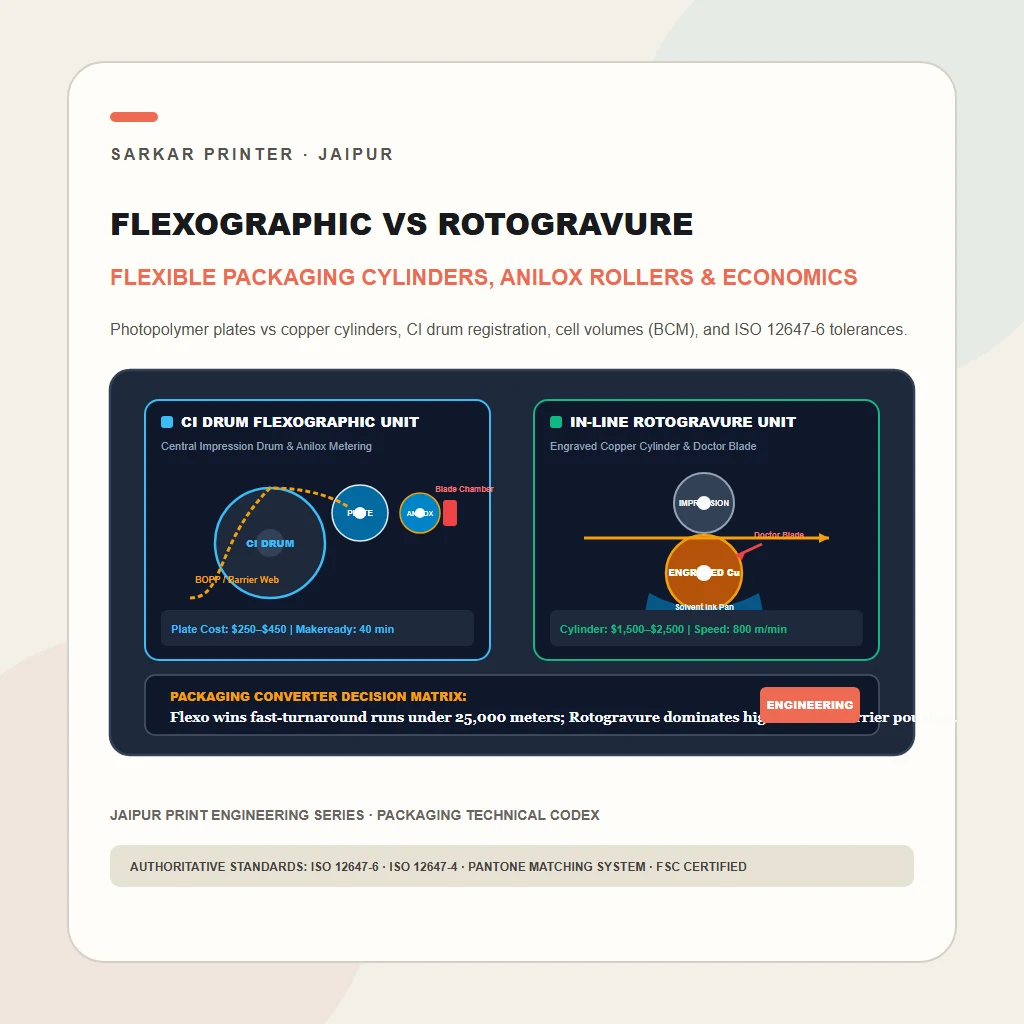
The Flexible Packaging Landscape: The Engineering Choice Between Two Giants
Modern retail packaging demands uncompromising visual appeal, barrier shelf-life protection, and rigorous production economics. FMCG consumer brands package snack foods, confectionery, dairy products, pharmaceuticals, and agricultural commodities inside multi-layer flexible laminates. These complex barrier structures combine biaxially oriented polypropylene (BOPP), polyethylene terephthalate (PET), aluminum foil, and co-extruded polyethylene (PE). Printing across these high-speed, non-absorbent polymer webs requires specialized ink transfer physics. Two dominant industrial printing methods control more than ninety percent of global flexible packaging production: flexographic printing and rotogravure.
Historically, commercial converters drew a sharp dividing line between these two competing technologies. Packaging engineers selected rotogravure whenever high-volume runs demanded supreme photographic depth, rich ink densities, and razor-sharp typographic legibility. Rotogravure dominated the mass consumer goods sector through solid steel cylinders and long-life copper engraving. Flexography previously occupied a secondary tier, battling mechanical plate squish, visible halo edges around halftone dots, and unstable tonal curves. However, the commercial advent of high-definition digital flexo (HD Flexo), flat-top dot chemistry, laser-engraved ceramic anilox rollers, and servo-driven Central Impression (CI) press architecture closed the historical quality chasm.
Today, print procurement managers and packaging engineers evaluate these two processes through rigorous technical frameworks. Converters benchmark production against international quality standards, including ISO 12647-6 for flexographic packaging printing, ISO 12647-4 for gravure publication and packaging operations, and the Pantone Matching System for brand spot colors. Selecting the optimum process dictates initial prepress tooling capital, changeover makeready waste, linear press velocity, and the final unit cost per thousand finished pouches.
Mechanical Architectures: Central Impression (CI) Flexo vs In-Line Gravure
The mechanical web path represents the most fundamental engineering difference between flexographic and rotogravure presses. Understanding how each press platform transports delicate, extensible polymer webs reveals why specific substrates favor one process over the other.
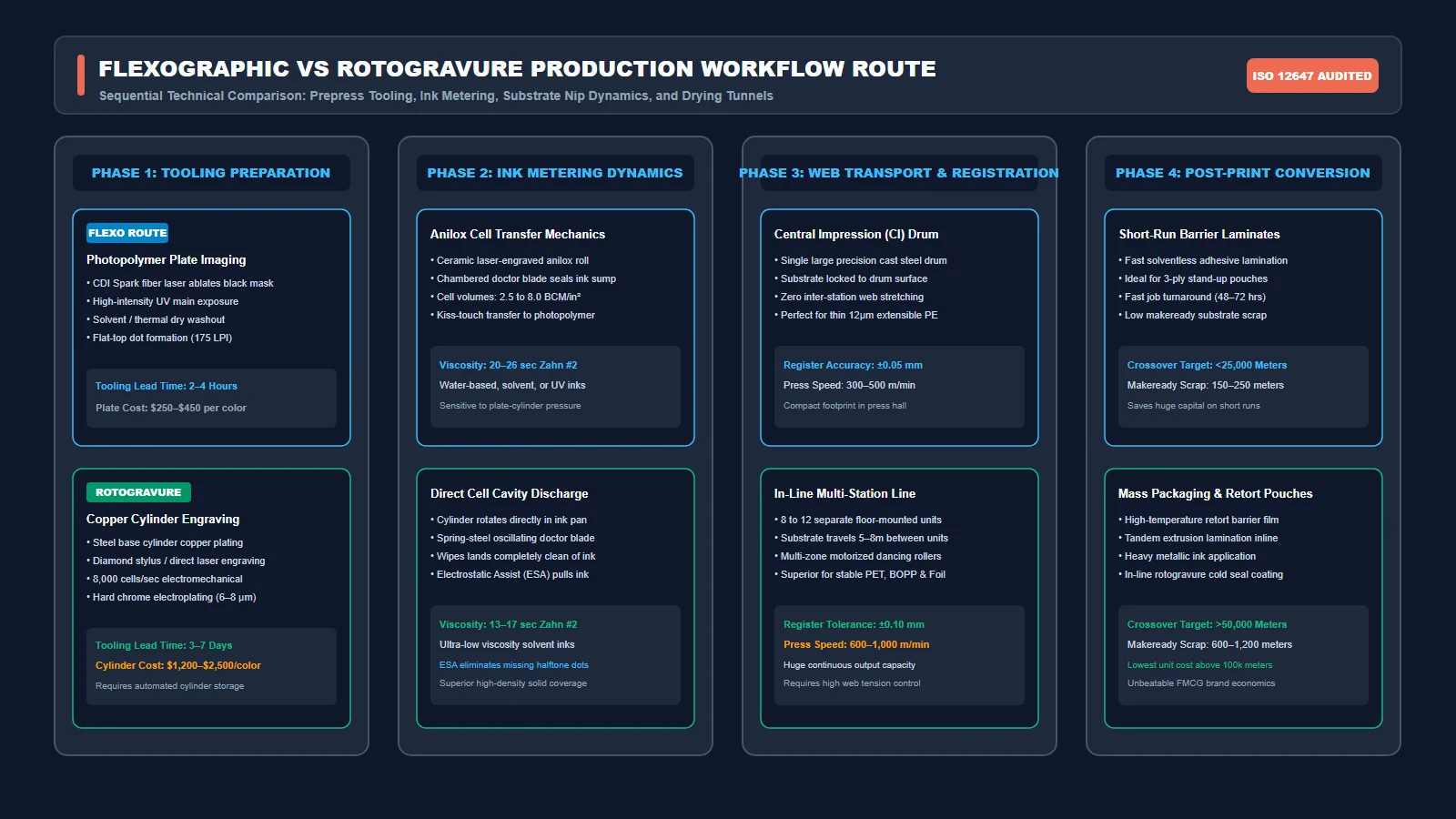
Modern high-speed flexible packaging flexo operations almost universally deploy Central Impression (CI) drum presses. A CI press mounts all eight to ten color printing stations radially around a single, massive, ground-steel impression cylinder measuring upwards of two to three meters in diameter. During production, a motorized unwinder feeds the polymer substrate directly onto the surface of this central drum. Electrostatic tackers or chilled drum surfaces lock the moving web securely against the metal face. As the drum rotates, the web contacts each plate sleeve cylinder under calibrated kiss impression. Because the substrate remains firmly pinned to a single rigid steel cylinder throughout the entire color sequence, the web experiences zero inter-deck stretching or lateral drift. This mechanical architecture delivers astonishing color register precision (within ±0.05 mm), making CI flexo the undisputed champion for thin, extensible films such as 12-micron blown polyethylene and biodegradable PLA webs.
In contrast, rotogravure presses utilize an in-line architecture consisting of multiple standalone printing towers arranged linearly across the pressroom floor. Each print unit features its own impression roller, doctor blade mechanism, ink reservoir sump, and overhead hot-air drying hood. The substrate web travels through open space across a series of motorized dancer rolls, load cells, and idle guide rollers, covering five to eight meters of web distance between consecutive color stations. To prevent misregistration, advanced optical sensors read microscopic registration marks between towers, commanding high-speed servo drives to adjust web tension dynamically. While this in-line configuration provides enormous drying capacity for heavy solvent inks, it introduces mechanical elasticity into the web. Consequently, rotogravure presses achieve their highest registration stability on thermally dimensionally stable, rigid films such as BOPP, oriented polyamide (OPA/Nylon), and metalized PET. For folding carton work and publication inserts, explore our commercial offset printing in Jaipur and custom folding carton packaging engineering solutions.
Prepress Tooling, Ink Metering, and Cell Discharge Physics
The mechanism of ink transfer dictates the optical density, tonal range, and visual brilliance of the printed flexible package. Examining the microscopic physics of anilox cavities versus gravure cells highlights the distinct strengths of both systems.
Flexographic printing relies on a dual-transfer mechanism. First, a fully enclosed chambered doctor blade assembly charges low-viscosity ink into the microscopic cells of a rotating ceramic anilox roller. The dual carbon-fiber or steel doctor blades sheer away surplus ink, leaving a precisely metered volume inside the microscopic laser-engraved anilox cavities. The anilox roller then contacts the raised elastomeric relief dots of a photopolymer plate sleeve, depositing a uniform ink film. Finally, the plate cylinder transfers this fluid film onto the passing web. Advanced flat-top dot photopolymer plates eliminate oxygen inhibition during UV LED exposure, creating microscopic plateaus that transfer crisp 150 to 180 LPI halftone screens without dot squishing.
Rotogravure completely bypasses intermediate metering rollers through direct intaglio printing. The heavy steel printing cylinder, electroplated with a precision copper layer, immerses directly into an open or enclosed ink sump. An oscillating spring-steel doctor blade wipes the smooth un-engraved copper lands completely clean, leaving fluid ink solely inside the sunken engraved cell cavities. As the cylinder rotates against the rubber impression roller, immense mechanical nip pressure pulls the ink out of the cells directly onto the web substrate. Many modern rotogravure presses employ Electrostatic Assist (ESA) systems, creating an electrical field at the impression nip that charges ink droplets and lifts them effortlessly from deep copper cells. ESA completely eliminates missing halftone dots (snowflaking) in light highlights.
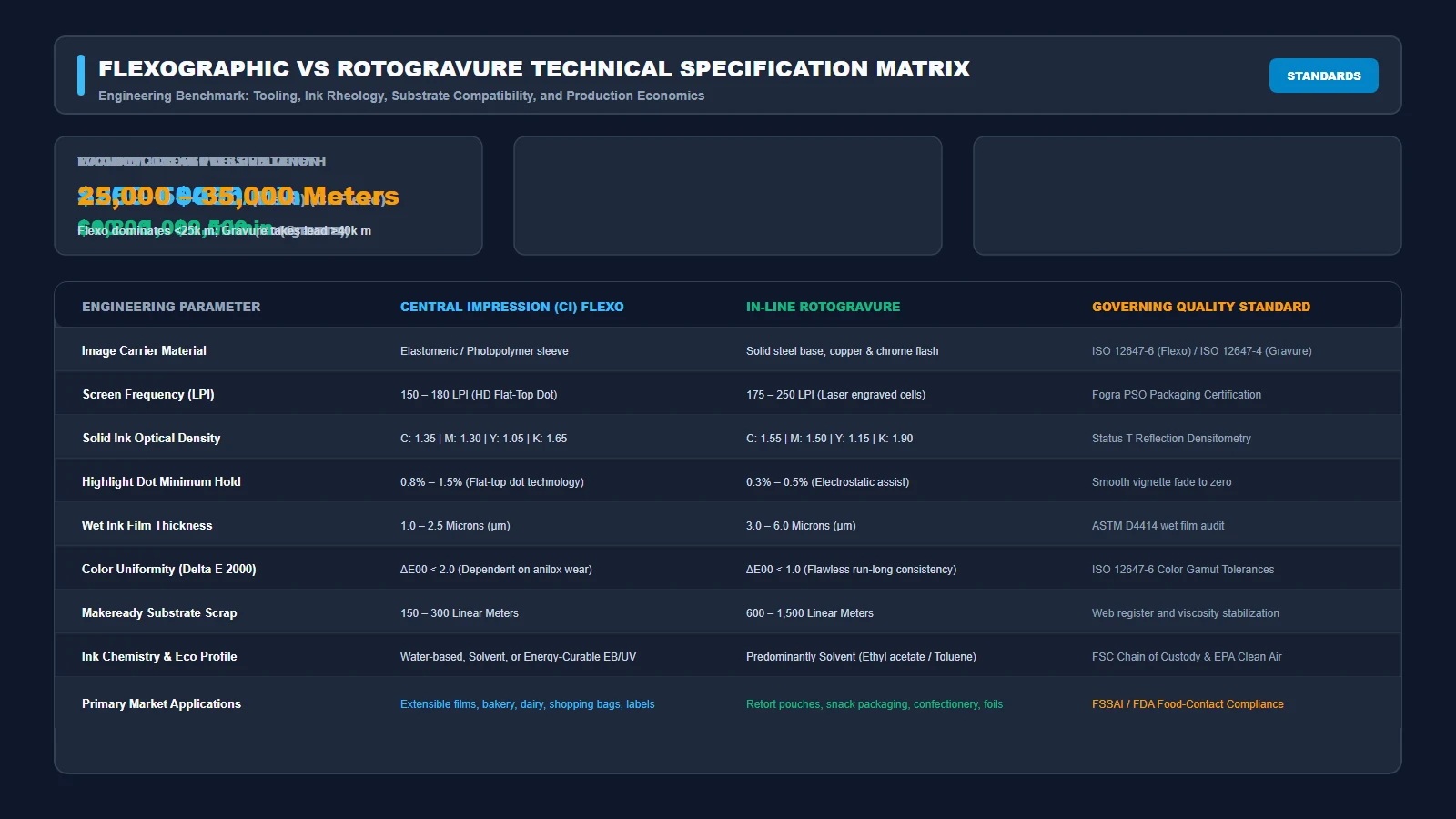
| Technical Parameter | CI Flexographic Printing | In-Line Rotogravure | Operational Significance |
|---|---|---|---|
| Image Carrier Type | Photopolymer Plate / Elastomer Sleeve | Copper-Plated Steel Cylinder + Chrome | Flexo plates mount in minutes; cylinders require heavy hoists |
| Tooling Cost (per unit) | $250 – $450 | $1,200 – $2,500 | Gravure demands 5x to 8x higher initial capital commitment |
| Tooling Turnaround | 2 to 4 Hours (In-House CTP) | 3 to 7 Business Days (Plating & Engraving) | Flexo allows rapid creative versioning and SKU testing |
| Ink Film Thickness | 1.0 – 2.5 Microns (µm) | 3.0 – 6.0 Microns (µm) | Gravure deposits heavier solid layers and high-opacity whites |
| Ink Viscosity (Zahn #2) | 20 – 26 Seconds | 13 – 17 Seconds | Gravure utilizes ultra-low viscosity fast-solvent chemistries |
| Solid Ink Density (Cyan) | 1.30 – 1.40 Status T | 1.50 – 1.65 Status T | Gravure yields richer color saturation on transparent barrier films |
| Linear Operating Speed | 300 – 500 Meters / Min | 600 – 1,000 Meters / Min | Gravure delivers unmatched hourly output on massive volume runs |
| Makeready Substrate Scrap | 150 – 300 Linear Meters | 600 – 1,500 Linear Meters | Flexo minimizes costly multi-ply film waste during changeovers |
| Economic Crossover | < 25,000 Linear Meters | > 35,000 Linear Meters | Defines the profitability boundary for packaging converters |
Furthermore, rotogravure cylinders exhibit virtually indefinite mechanical longevity. A micro-thin 6-to-8 micron hard chrome electroplating layer shields the underlying copper engraving from abrasive doctor blade friction. Converters frequently run individual cylinder sets for two to three million linear meters without perceptible dot erosion or color shift. When the chrome layer eventually thins, specialized refurbishing facilities strip the worn chrome and re-plate fresh chromium without altering the engraved copper cell volumes underneath. In contrast, photopolymer flexographic plates suffer elastomeric fatigue, edge rounding, and solvent swelling over time, necessitating plate re-imaging after roughly 300,000 to 500,000 impressions.
Diagnostic Fault Trees: Eliminating Printing Defects on the Pressroom Floor
Both printing platforms experience distinct physical defects during commercial production runs. Press supervisors and quality auditors systematically diagnose mechanical and chemical root causes using standardized fault-tree protocols.
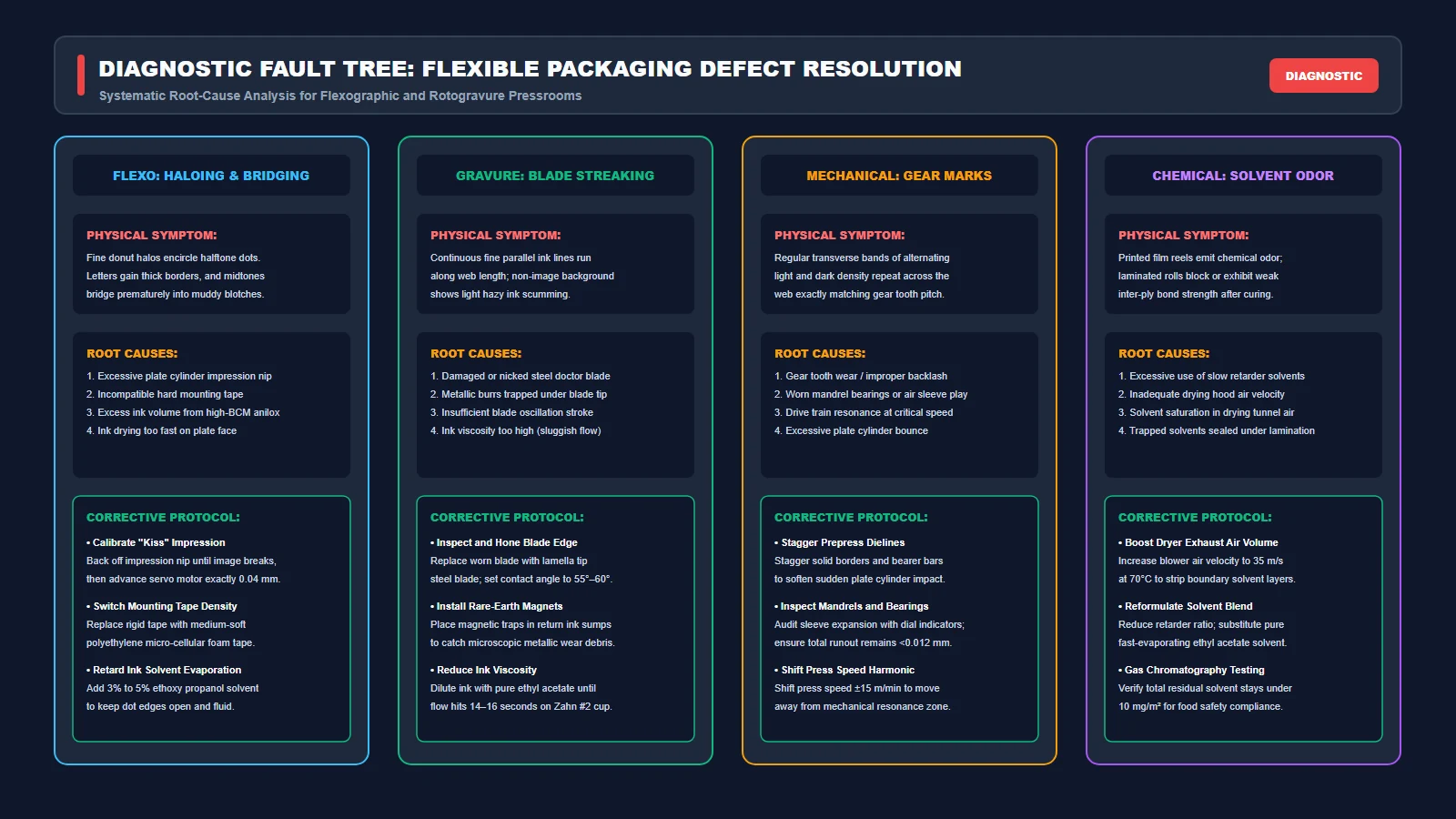
Defect 1: Haloing and Dot Bridging in Flexography
When flexographic operators apply excessive mechanical impression nip between the plate cylinder and the CI drum, the elastomeric photopolymer dots compress and deform under pressure. Ink squeezes outward toward the dot perimeters, creating an irregular ring or donut halo around halftone dots and fine serif typography. Under transmission microscopy, midtone areas bridge prematurely, shifting tonal values upward and triggering catastrophic dot gain. To eliminate haloing, press operators must calibrate exact kiss-touch impression. Technicians back off the plate cylinder servo motors until the printed image breaks, then advance the impression in calibrated 0.02 mm increments until full ink transfer occurs. Selecting medium-soft micro-cellular polyurethane mounting tapes also dampens mechanical vibration and cushions dot impact.
Defect 2: Doctor Blade Streaking and Chrome Hazing in Rotogravure
Rotogravure cylinders face harsh hydrodynamic forces beneath the doctor blade edge. If microscopic metallic wear debris or dried pigment agglomerates wedge under the blade tip, the blade lifts slightly off the copper lands, leaving continuous longitudinal ink streaks running parallel down the printed web. Furthermore, setting an improper doctor blade contact angle (below 50 degrees) causes the blade to skate across the cylinder surface rather than shearing the ink cleanly. The resulting fluid residue forms a fine background haze or scum across unprinted film margins. Press engineers resolve streaking by installing dual lamella-profile steel doctor blades, tuning oscillation stroke lengths to 10 to 15 mm, and placing rare-earth magnetic filters inside ink circulation sumps to capture microscopic iron particles.
Defect 3: Solvent Retention Odor and Delamination in Barrier Pouches
Flexible packaging converters formulate inks with volatile organic solvents, including ethyl acetate, ethanol, and ethoxy propanol, to achieve rapid drying at high press speeds. If drying tunnels operate with insufficient hot-air velocity or excessive web speed, residual solvent remains trapped inside the dried resin film. When converters laminate this printed film against barrier aluminum foil or polyethylene sealant plies, the trapped solvent cannot escape. Over time, residual volatile organic compounds (VOCs) migrate through inner sealant layers, causing offensive chemical odors in sensitive food products and weakening adhesive bond strength until pouches delaminate on retail shelves. Packaging engineers prevent solvent retention by increasing exhaust air exchange rates to 35 m/s at 70°C and conducting mandatory gas chromatography testing before releasing laminated reels.
Quality Assurance Protocols: ISO 12647-6, Dyne Levels, and Gas Chromatography
Delivering high-barrier retail packaging for pharmaceutical, confectionery, and personal care brands demands strict quality gate governance throughout every manufacturing shift.
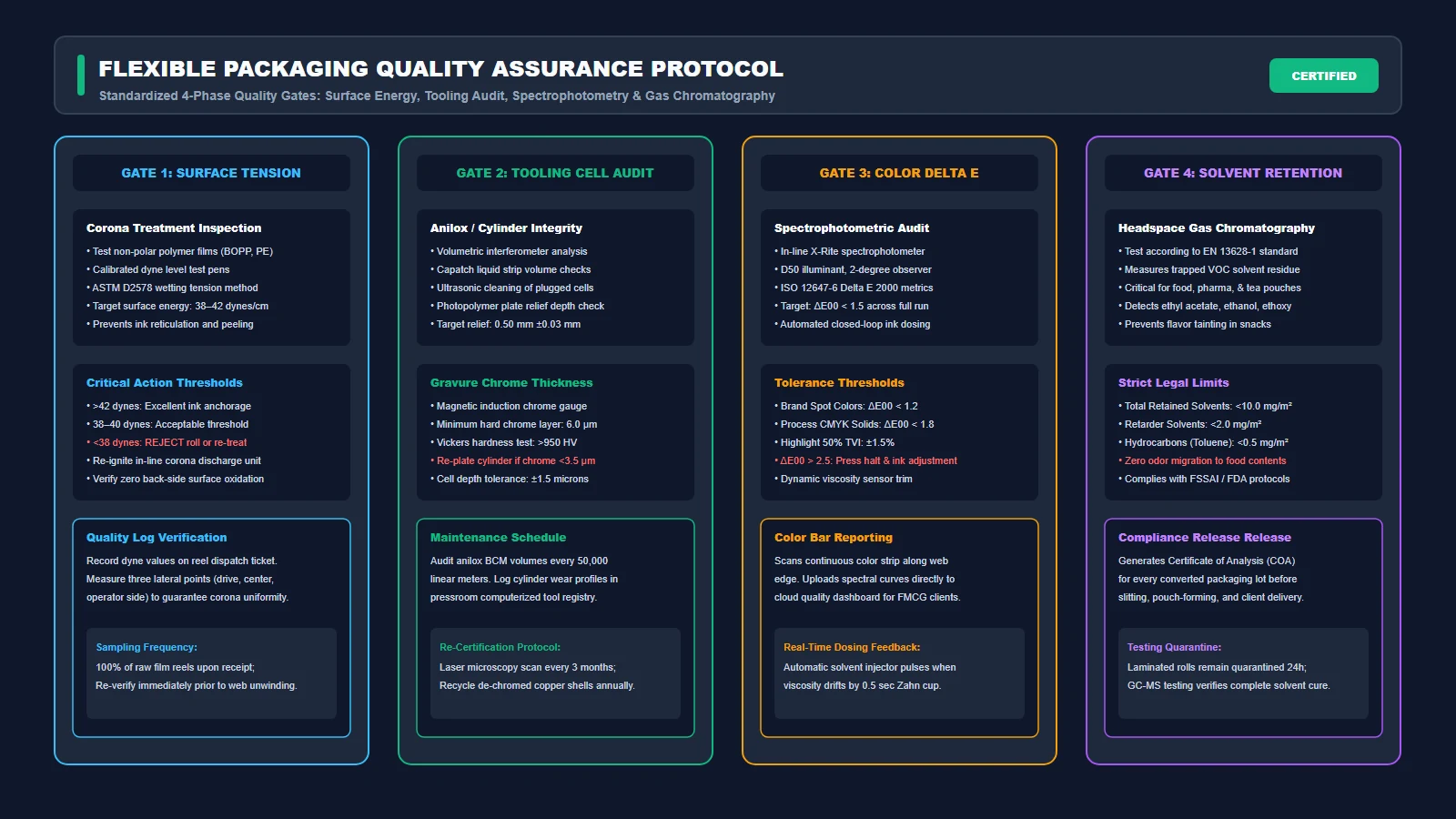
At Quality Gate 1, laboratory technicians inspect the surface energy of all incoming polymer film reels. Non-polar plastic films (especially BOPP and PE) possess naturally low surface energy (typically 30 to 32 dynes/cm), causing liquid inks to bead up and peel away. Operators apply calibrated dyne level test solutions in accordance with ASTM D2578 standards. The substrate must demonstrate a surface wetting tension between 38 and 42 dynes/cm. Any roll falling below 38 dynes undergoes secondary in-line corona discharge treatment prior to entering the printing decks.
At Quality Gate 2, prepress technicians verify anilox roller cell volume and gravure cylinder geometry. Using 3D white light interferometers or laser micro-measuring systems, technicians measure anilox carrying capacity in billion cubic microns per square inch (BCM/in²). For process CMYK flexo, anilox volumes must adhere to tight tolerances of 2.8 ±0.2 BCM. For rotogravure, technicians audit hard chrome thickness with magnetic induction gauges, ensuring a minimum protective barrier of 6.0 microns and a Vickers hardness exceeding 950 HV.
At Quality Gate 3, in-line spectrophotometers scan continuous color bars along the web trim margins. To satisfy Fogra PSO and ISO 12647-6 process control standards, press runs must maintain color variation within a Delta E 2000 threshold under 1.5 across millions of packaging impressions. When producing high-visibility retail collateral and corporate marketing pieces, explore our specialized brochure printing in Jaipur and enterprise commercial print services.
Finally, at Quality Gate 4, certified quality control analysts conduct headspace gas chromatography (GC-MS) testing under European standard EN 13628-1. Technicians seal 100 square centimeters of printed film inside an airtight vial, heat the specimen to 100°C, and inject the vapor into a chromatographic capillary column. Total retained solvent levels must measure below 10.0 milligrams per square meter (mg/m²), with toxic aromatic hydrocarbons (toluene) strictly banned from food-contact cartons and pouches under FSSAI and FDA packaging safety regulations.
Procurement Economics and Environmental Realities: Finding the True Crossover
Choosing between flexo and rotogravure is ultimately an economic calculation balancing initial tooling capital against long-term running costs. Packaging procurement teams evaluate total cost of ownership (TCO) across the entire product lifecycle.
Consider a standard eight-color stand-up snack pouch job. Developing an eight-color flexographic plate set costs approximately $2,800 to $3,200, with plates ready for mounting within half a shift. Outfitting an eight-color rotogravure press requires eight custom-engraved steel cylinders, totaling roughly $14,000 to $18,000 with a five-to-seven day production delay. For product launches, seasonal promotions, or regional brand variants requiring 10,000 to 20,000 linear meters of film, rotogravure tooling expenses impose a crippling cost penalty per unit. Here, Central Impression flexography delivers unbeatable economic agility. Converters achieve swift press setups, minimal startup scrap, and identical shelf appearance at a fraction of the initial capital commitment. When exploring on-demand, variable-data print runs, compare these metrics with our fast-turnaround digital printing in Jaipur capabilities.
However, when FMCG conglomerates order 100,000 to 1,000,000+ linear meters for national snack food or detergent packaging, the financial dynamic reverses decisively. On massive volume contracts, the $16,000 cylinder tooling charge amortizes down to mere fractions of a cent per pouch. Meanwhile, rotogravure presses operate continuously at blistering speeds up to 1,000 meters per minute—nearly double the practical velocity of high-speed flexo lines. Over millions of linear meters, gravure delivers lower unit ink costs, zero plate replacement downtime, and absolute color consistency from the first meter to the millionth.
Environmental compliance also shapes modern procurement choices. Water-based and electron-beam (EB) curable inks expand rapidly in flexographic packaging, eliminating hazardous volatile organic compound (VOC) emissions and reducing pressroom carbon footprints. In contrast, rotogravure remains heavily reliant on solvent-borne inks, requiring multi-million-dollar regenerative thermal oxidizers (RTO) or solvent recovery distillation systems to comply with clean air mandates. Furthermore, sustainable packaging converters certify operations under Forest Stewardship Council (FSC) Chain of Custody standards, ensuring eco-friendly sourcing for paper-poly barrier structures.
Frequently Asked Questions: Flexo vs Rotogravure Packaging
What is the primary mechanical difference between flexographic and rotogravure printing?
Flexographic printing uses flexible raised relief photopolymer plates mounted onto cylinders, metering ink through laser-engraved ceramic anilox rollers. Rotogravure printing utilizes solid steel cylinders electroplated with copper, where electromechanical diamond styli or laser systems engrave microscopic recessed image cells directly into the metal. While flexo transfers ink from raised plate plateaus under light kiss pressure, rotogravure fills sunken cells with low-viscosity ink and shears excess surface fluid with a steel doctor blade before transferring ink under heavy impression pressure.
How do tooling costs compare between flexo photopolymer plates and gravure cylinders?
Flexographic photopolymer digital plates typically cost between $250 and $450 per color station, requiring merely two to four hours of prepress imaging and washout. In contrast, heavy steel rotogravure cylinders require copper plating, high-precision grinding, diamond cell engraving, and hard chrome electroplating, pushing tooling costs to $1,200 to $2,500 per cylinder with lead times of three to seven days. For an eight-color packaging design, flexo tooling totals roughly $2,500 compared to over $14,000 for rotogravure.
At what run length does rotogravure become more economical than flexography?
The economic crossover point between Central Impression flexo and rotogravure typically falls between 25,000 and 35,000 linear meters of printed flexible web (equivalent to roughly 1,500 to 2,000 kilograms of polymer film). For print runs under 25,000 meters, flexography offers substantial cost savings through lower initial plate investments and rapid makeready setup. For continuous production runs exceeding 50,000 meters, rotogravure achieves lower overall unit costs due to its extraordinary press speeds of up to 1,000 meters per minute and zero plate wear.
Why does Central Impression (CI) flexography excel on thin, extensible polymer films?
Central Impression flexo presses support the moving flexible web against a single, massive, temperature-regulated steel drum throughout the entire printing cycle. All eight to ten color decks surround this central cylinder. Because the film never leaves the drum surface between color stations, the press completely prevents stretching, distortion, and misregistration on thin 12-micron polyethylene or low-density films. In contrast, in-line rotogravure presses transport the substrate across lengthy unsupported spans between standalone towers, increasing web tension vulnerability.
Which printing process delivers superior solid ink density and metallic luster on pouch packaging?
Rotogravure delivers significantly higher solid ink optical densities (exceeding 1.90 for black and 1.55 for cyan) compared to flexography (typically 1.65 black and 1.35 cyan). Gravure cells carry heavy ink film thicknesses of 3.0 to 6.0 microns, allowing thick fluid transfer without feathering or plate squeeze. This cell depth advantage enables rotogravure to print rich opaque whites, lustrous metallic golds, and dense barrier lacquers on retort pouches with flawless pinhole-free uniformity.