
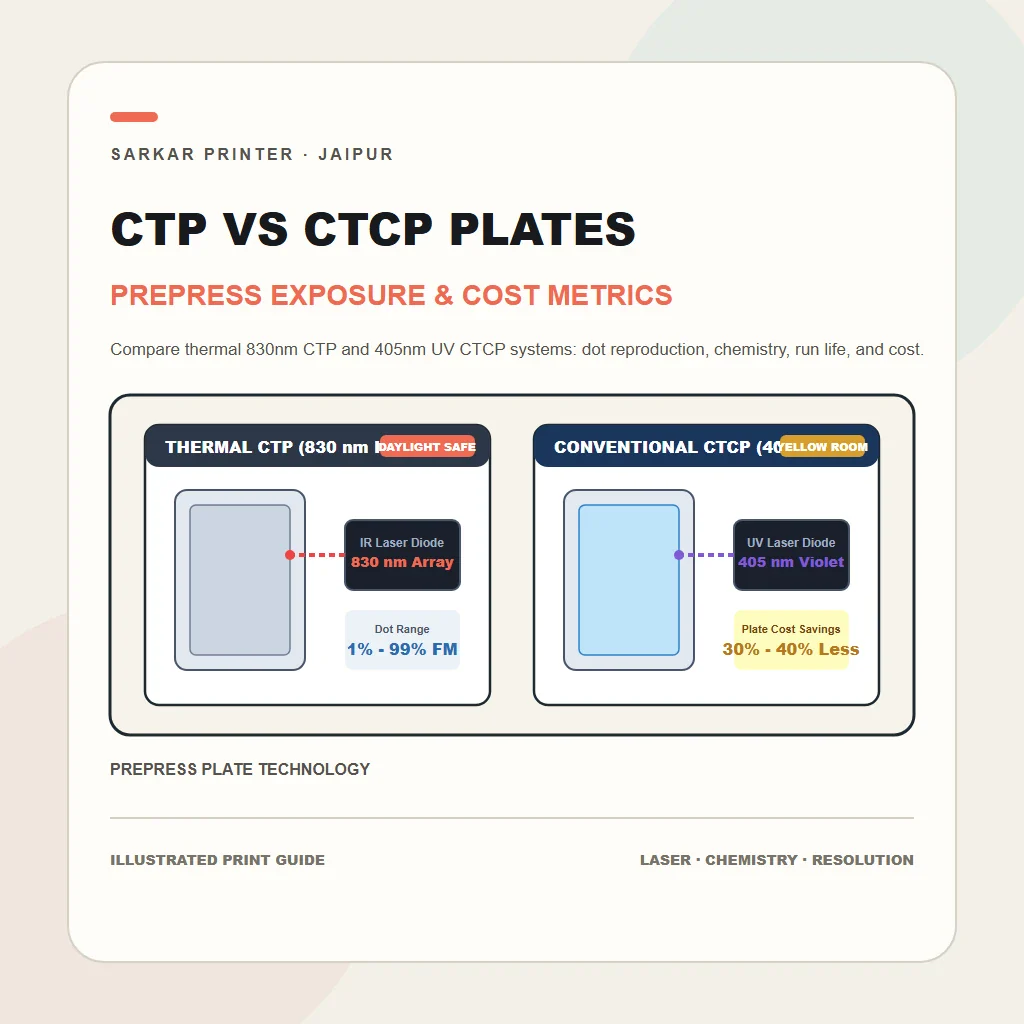
Modern commercial offset pressrooms rely heavily on digital prepress plate making to achieve rapid turnarounds and microscopic registration. Print production engineers evaluate two competing direct-to-plate technologies: Computer-to-Plate (CTP), which predominantly utilizes 830nm thermal infrared lasers, and Computer-to-Conventional-Plate (CTCP), which deploys 405nm ultraviolet laser diodes onto traditional presensitized offset plates. Choosing between these platforms dictates plate room operating costs, imaging resolution limits, chemical waste volumes, and pressroom run durability. For certified industrial manufacturing, calibrate plate exposure and tonal reproduction according to ISO 12647-2 process control standards and Fogra graphic technology research specifications.
Optical Exposure Physics: 830nm Thermal Infrared vs 405nm UV Diode
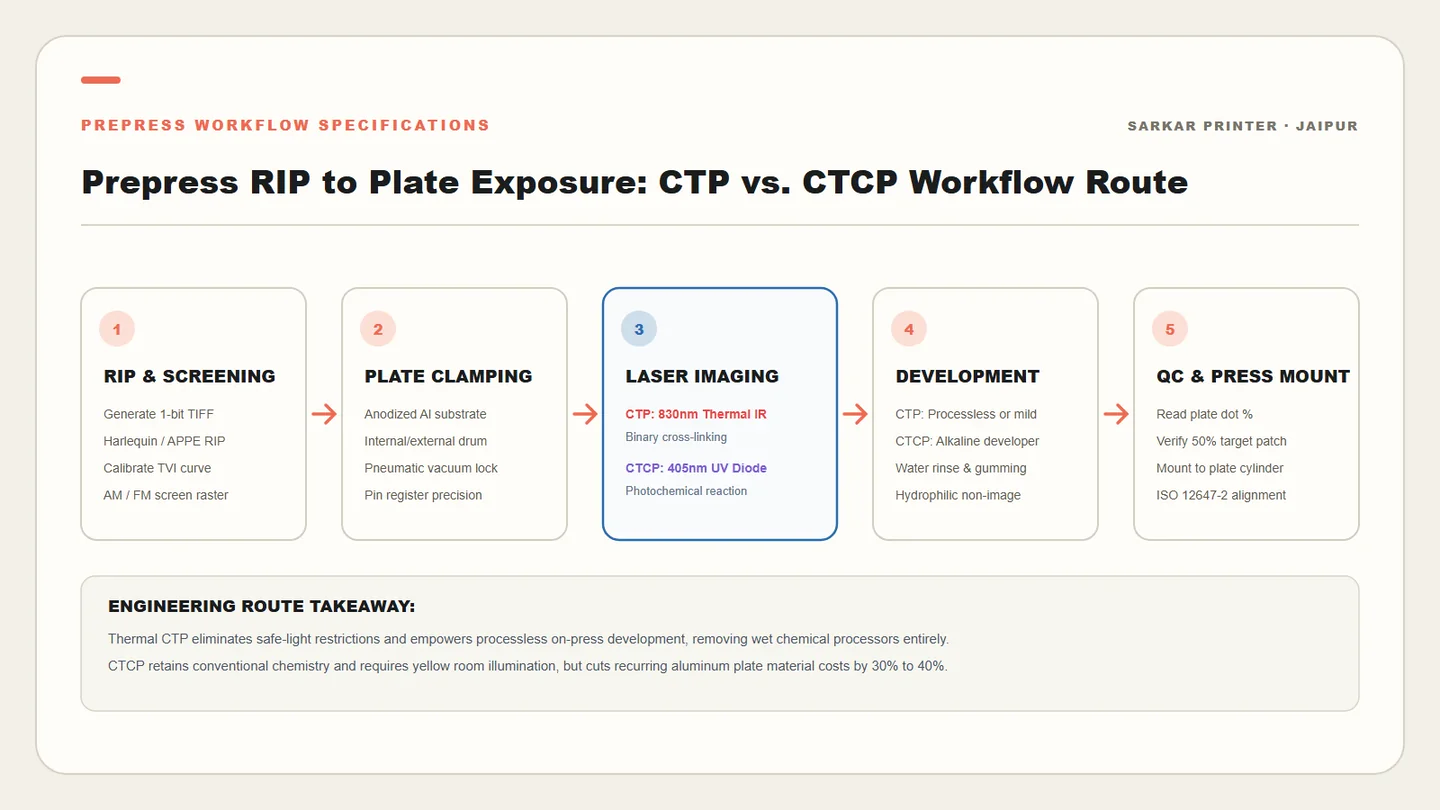
The primary engineering distinction between CTP and CTCP centers on exposure physics and laser wavelength. Thermal CTP systems direct a high-precision laser array emitting at 830 nanometers (or occasionally 1064 nanometers in specialty equipment). Thermal imaging relies on heat rather than light absorption. The thermal coating requires a sharp, non-linear activation threshold, typically between 100 and 120 millijoules per square centimeter. When the infrared beam strikes the plate, heat triggers immediate polymer cross-linking or physical ablation. If the laser energy falls below this activation threshold, no chemical change occurs. This binary threshold mechanism produces microscopic dot edges with near-vertical wall structures and zero fringe diffusion.
CTCP systems take a fundamentally different optical path. CTCP uses high-output ultraviolet laser diodes emitting at 405 nanometers to expose conventional, analog presensitized (PS) offset plates. These plates feature a diazo or photopolymer coating formulated decades ago for contact vacuum frames under broad-spectrum mercury lamps. The 405nm violet laser initiates a photochemical reaction that alters emulsion solubility. Because conventional coatings exhibit a linear sensitivity gradient to optical exposure, ambient scattered light and optical flare within the emulsion layer soften dot boundaries. Press operators must handle CTCP plates inside dedicated yellow safe-light rooms (filtering all wavelengths below 500 nanometers) to prevent background fogging. Thermal CTP plates, conversely, remain completely inert under standard office fluorescent and LED daylight illumination.
Technical Specification Matrix: Dot Reproduction, Resolution, and Screening
Print buyers and quality control engineers evaluate prepress plates through tonal reproduction accuracy and screening capability. The binary nature of thermal CTP allows prepress technicians to record halftone dots from 1% up to 99% across a linear response curve at 250 to 300 lines per inch (LPI) in conventional Amplitude Modulated (AM) screening. Furthermore, thermal CTP effortlessly resolves 10 to 20 micron micro-dots required for Frequency Modulated (FM / stochastic) and hybrid screening. This capability enables ultra-smooth highlight fades, crisp micro-text down to 2-point sizes, and flawless vignettes on premium brochures, luxury cosmetic packaging, and high-end art books.
CTCP imaging achieves dependable results for commercial publications, but encounters physical resolution limits. Optical light scattering inside the thicker conventional diazo coating prevents clean holdout of highlight dots below 2% and shadow dots above 98% at line rulings exceeding 175 LPI. Attempting FM stochastic screening on CTCP plates frequently causes highlight dot loss or mid-tone dot gain bridging on press. Nonetheless, for standard commercial jobs, including regional book publishing, high-volume flyers, and corrugated secondary packaging, CTCP delivers reliable, repeatable contrast that satisfies customer expectations at significantly lower production overhead.
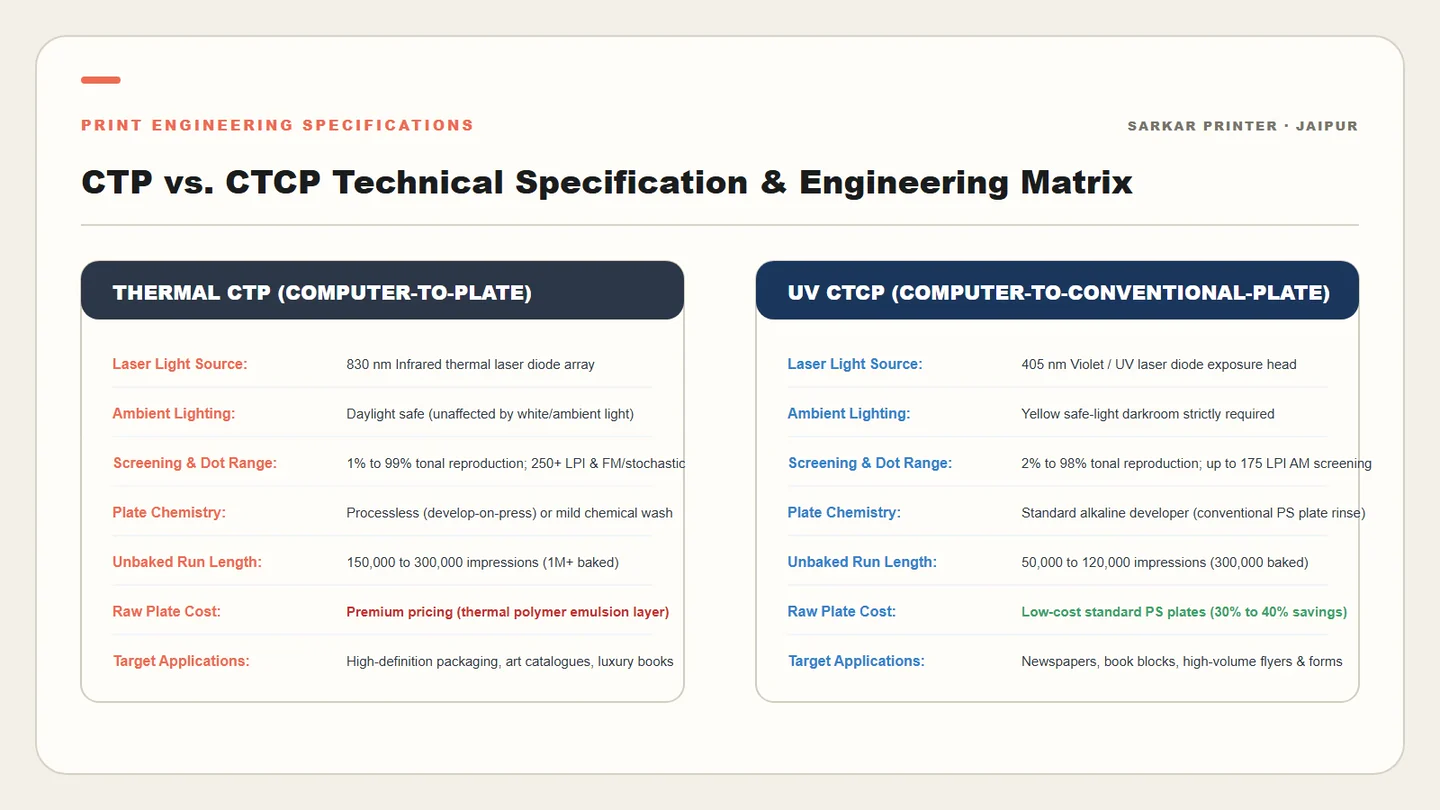
| Performance Metric | Thermal CTP (830nm) | Conventional CTCP (405nm UV) |
|---|---|---|
| Laser Light Source | 830 nm Infrared thermal laser diodes | 405 nm Violet / UV optical laser diodes |
| Operating Environment | 100% Daylight safe (White ambient light) | Strict yellow safe-light room (>500nm cutoff) |
| Dot Reproduction Range | 1% to 99% at 250+ LPI / FM screening | 2% to 98% at 150–175 LPI AM screening |
| Screening Capabilities | AM, FM / Stochastic, Hybrid (Sublima/XM) | Standard AM screening (150–175 LPI) |
| Plate Chemistry | Processless (on-press) or mild washout | Standard alkaline developer and replenisher |
| Unbaked Run Durability | 150,000 to 300,000 impressions | 50,000 to 120,000 impressions |
| Post-Baked Run Durability | 1,000,000+ impressions | 300,000 to 500,000 impressions |
| Consumable Plate Cost | Standard baseline (higher per square meter) | 30% to 40% lower plate procurement cost |
Plate Chemistry, Effluent Management, and Processless Evolution
Environmental compliance and chemical management heavily influence prepress infrastructure investments. Conventional CTCP systems require a dedicated chemical processor equipped with high-alkaline silicate or solvent-based developers. The chemical bath dissolves unexposed diazo resin, generating liquid chemical effluent that requires neutralization and hazardous waste disposal. Plate room operators must regularly replace developer filters, clean chemical gum buildup, and continuously replenish active baths to stabilize solution conductivity and pH balance. Failure to maintain developer chemistry results in background scumming or premature highlight burnout.
Thermal CTP technology revolutionized environmental sustainability through the introduction of processless (develop-on-press) plates. Processless thermal plates contain an infrared-sensitive photopolymer layer that requires zero chemical processors, water wash sinks, or finishing gums. The operator transfers the exposed plate directly from the imaging drum onto the offset press cylinder. When the press activates its dampening form rollers during makeready, fountain solution softens unexposed coating areas. Subsequent ink tack lifts and transfers the non-image emulsion harmlessly onto the first few startup waste sheets. By eliminating chemical processors, print facilities eliminate hazardous effluent, lower electrical consumption, save square footage, and conserve fresh water, supporting environmental initiatives under Forest Stewardship Council (FSC) responsible print standards.
Pressroom Durability: Run Length, Abrasion, and UV Curable Inks
Once pressmen mount plates onto the press cylinder, mechanical abrasion and chemical resistance govern plate longevity. In standard sheetfed printing using conventional mineral or vegetable oil-based inks, unbaked thermal CTP plates comfortably yield 150,000 to 300,000 clean impressions on smooth coated art paper. Unbaked CTCP plates typically deliver 50,000 to 120,000 impressions before showing dot sharpening or image blinding. Coarse paperboard fillers, such as calcium carbonate pigments in duplex boards and recycled kraft stocks, accelerate abrasive wear on the plate image emulsion.
When running aggressive energy-curable UV, LED-UV, or electron-beam inks, raw monomers and reactive photoinitiators aggressively attack unbaked plate resins. Both thermal CTP and CTCP plates require post-baking in a dedicated conveyor oven at 240 degrees Celsius for 4 to 6 minutes prior to mounting. Post-baking cross-links the phenolic resins into an ultra-tough, vitrified polymer barrier. Baked thermal CTP plates routinely endure over 1,000,000 impressions on web offset publication presses, while baked CTCP plates reach 300,000 to 500,000 impressions. Press operators must maintain plate-to-blanket cylinder squeeze between 0.08mm and 0.10mm and stabilize fountain solution pH between 4.8 and 5.2 to prevent chemical stripping and plate blinding across extended press runs.
Troubleshooting Plate Imaging & Pressroom Defects
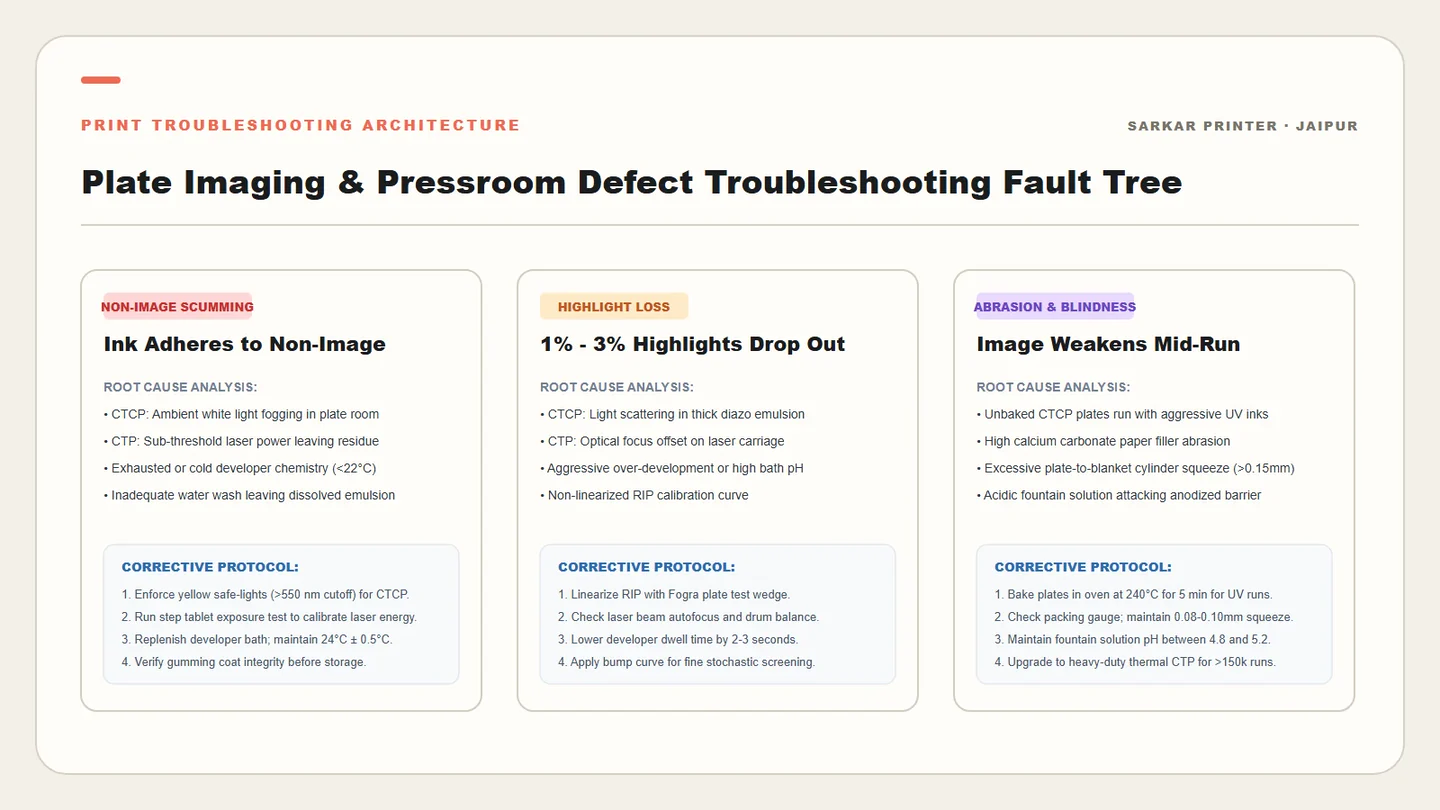
Prepress technicians and press operators must diagnose plate defects systematically to prevent press downtime. Defective plates cause significant paper waste, color shifts, and registration loss during press makeready. The troubleshooting fault tree below outlines root cause analyses and corrective protocols for the three most frequent plate-related press defects: background scumming, highlight dot loss, and premature image abrasion.
1. Non-Image Background Scumming on Press
Background scumming occurs when ink adheres to non-image areas on the aluminum plate cylinder. On CTCP lines, ambient white light leaking through doors or unshielded inspection lights causes background photo-fogging. On thermal CTP systems, sub-threshold laser power leaves a microscopic polymer residue in unexposed areas. In chemical processors, exhausted developer chemistry, cold bath temperatures below 22 degrees Celsius, or clogged water spray nozzles prevent complete emulsion washout. Operators resolve scumming by testing safe-light integrity, executing laser step-wedge energy calibrations, and replenishing chemical baths.
2. Highlight Dot Loss in the 1% to 3% Tonal Range
Highlight dropouts occur when delicate highlight micro-dots detach during plate development or fail to hold ink on press. On CTCP devices, light scattering within the diazo emulsion undercuts fine highlight dots during exposure. In automatic processors, excessively high developer temperatures or aggressive roller agitation washes away fragile dot pedestals. Operators restore tonal stability by linearizing Raster Image Processor (RIP) curves using transmission plate densitometers and aligning calibration targets to Pantone color management tolerances.
3. Premature Plate Blinding and Image Breakdown
Plate blindness happens when image areas lose ink receptivity mid-run, causing print density to fade. Running unbaked CTCP plates with UV curable inks or aggressive roller wash solvents rapidly strips image polymers. Excessive cylinder underpacking that generates blanket nip squeeze above 0.15mm physically scours the plate surface. Press crews resolve blindness by strictly baking plates intended for UV inks, checking cylinder packing with micrometers, and rebalancing fountain solution alcohol substitutes.
Total Cost of Ownership (TCO) & Break-Even Economic Analysis
The economic decision between CTP and CTCP hinges on plate volume consumption versus initial capital expenditure. Conventional PS plates used in CTCP systems represent a mature, globally commoditized supply chain. Conventional plates cost approximately 30% to 40% less per square meter than specialized thermal CTP plates. For large-scale publishing houses, high-volume carton packaging converters, and commercial printers exposing more than 3,000 square meters of plates monthly, conventional plate savings aggregate into tens of thousands of dollars annually, easily offsetting chemical processor operating costs and darkroom construction expenses.
Conversely, for boutique commercial printers, high-definition luxury packaging specialists, and quick-turnaround print shops consuming under 1,500 square meters of plates monthly, thermal CTP—especially processless thermal technology—delivers superior return on investment. Thermal CTP eliminates chemical developer purchases, chemical disposal contracts, processor water consumption, and regular technician service hours. Furthermore, thermal CTP provides the microscopic dot fidelity and FM screening capability essential for high-margin, color-critical packaging and corporate collateral.
Quality Control Protocols: Calibration & Press Makeready
Maintaining repeatable color across multi-shift production demands rigorous quality control throughout prepress and pressroom handoffs. Prepress operators must calibrate imaging engines daily using standardized digital control wedges to ensure dot gain stability on press.
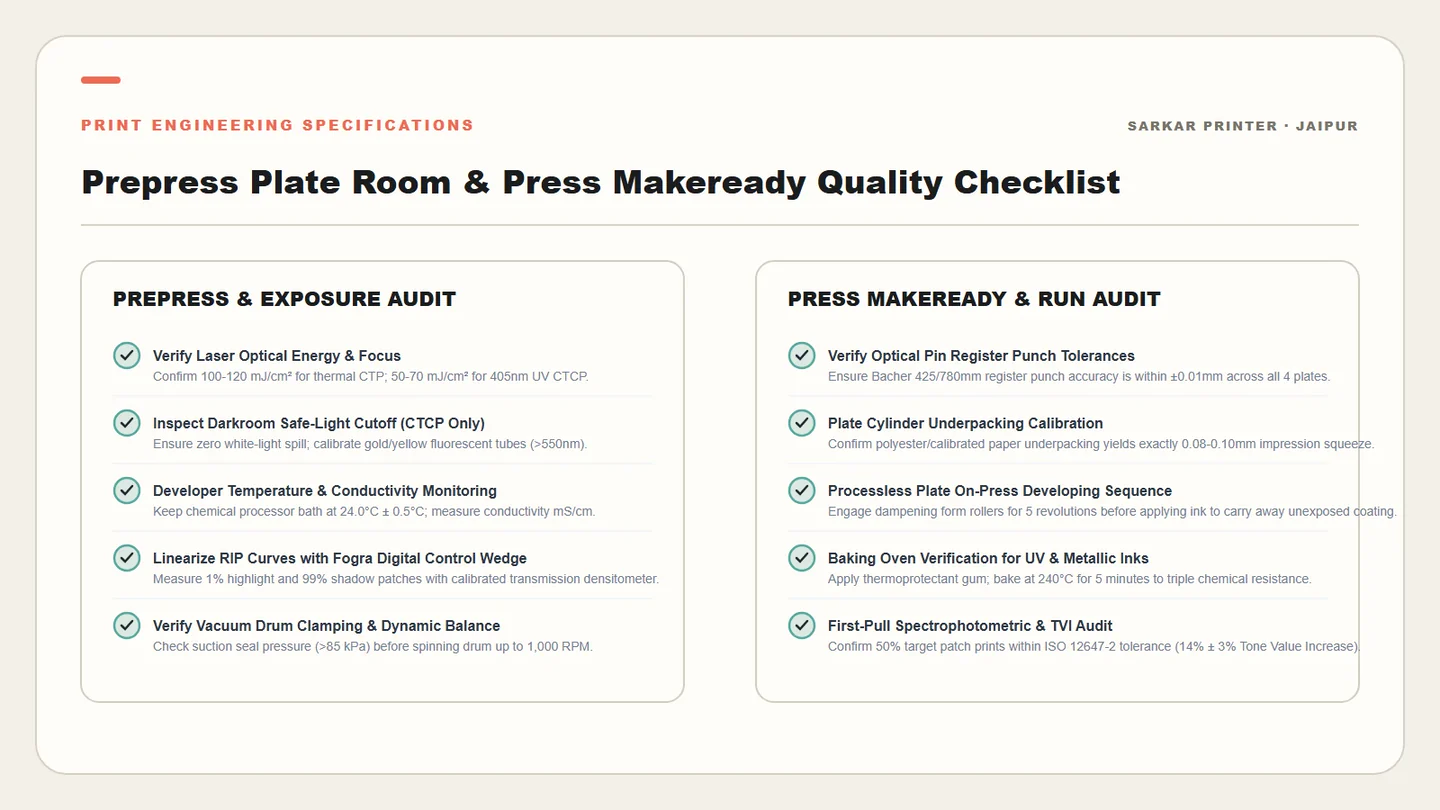
Prepress technicians verify laser diode energy output and optical carriage focus daily. For CTCP systems, technicians measure darkroom ambient light with a lux meter, confirming zero light transmission below 500 nanometers. In chemical processors, digital sensors monitor developer temperature at 24.0 degrees Celsius (+/- 0.5 degrees) and track electrical conductivity in millisiemens per centimeter. Technicians image a Fogra digital plate control wedge on every plate flat, measuring the 50% target patch with a calibrated reflection/transmission plate densitometer to confirm dot area tolerances within +/- 1.0% prior to releasing plates to the pressroom.
Frequently asked questions
Can CTCP plates run with high-frequency FM stochastic screening?
Pressrooms rarely run FM stochastic screening on CTCP plates. The 405nm UV diode exposure triggers a gradual photochemical gradient in conventional diazo coatings, producing slightly softened dot edges that struggle to stabilize 10 to 20 micron stochastic micro-dots. Thermal CTP systems, by contrast, utilize a binary heat threshold that creates razor-sharp microscopic dot perimeters, making thermal CTP the definitive choice for FM screening and 250+ LPI high-definition artwork.
Why do thermal CTP plates eliminate the need for yellow darkroom safe-lights?
Thermal CTP plates utilize an imaging coating that responds exclusively to intense infrared thermal energy (830 nanometers) above a precise heat threshold, such as 100 to 120 millijoules per square centimeter. Visible ambient light carries insufficient thermal energy to trigger this chemical cross-linking. Operators handle thermal plates under standard daylight white illumination without risking background exposure fogging.
How does processless thermal CTP compare to conventional CTCP in operational cost?
Processless thermal CTP plates carry a 20% to 35% higher raw material purchase price per square meter than conventional CTCP plates. However, processless plates completely eliminate chemical developer purchases, water rinse bills, electrical chiller consumption, hazardous effluent disposal fees, and processor maintenance downtime. Facilities imaging under 1,500 square meters of plates monthly often achieve lower total production costs with processless CTP.
Does post-baking benefit both thermal CTP and CTCP plates equally?
Yes. Passing either thermal CTP or conventional CTCP plates through a dedicated baking oven at 240 degrees Celsius for 5 minutes thoroughly polymerizes and hardens the image resin coating. Baking triples the mechanical abrasion resistance against coarse paperboard fibers and shields the image area against chemical attack from aggressive UV curable monomer inks and solvent washes.
CONTINUE THE PRINT PLAN
Plan Your Commercial Print Project in Jaipur
From high-definition multi-color offset runs to luxury rigid boxes, product packaging cartons, and corporate publications, Sarkar Printer combines precision digital plate making with certified pressroom color management across India.