
Master the science of anti-set-off spray powder in sheetfed offset printing. Learn how to choose between vegetable starch and calcium carbonate, calibrate micron sizes, and avoid post-print finishing defects. For certified industrial production, calibrate spray delivery systems according to Fogra graphic technology research specifications and ISO 12647 offset process control standards.
Why Spray Powder is Essential: The Physics of Sheet Separation
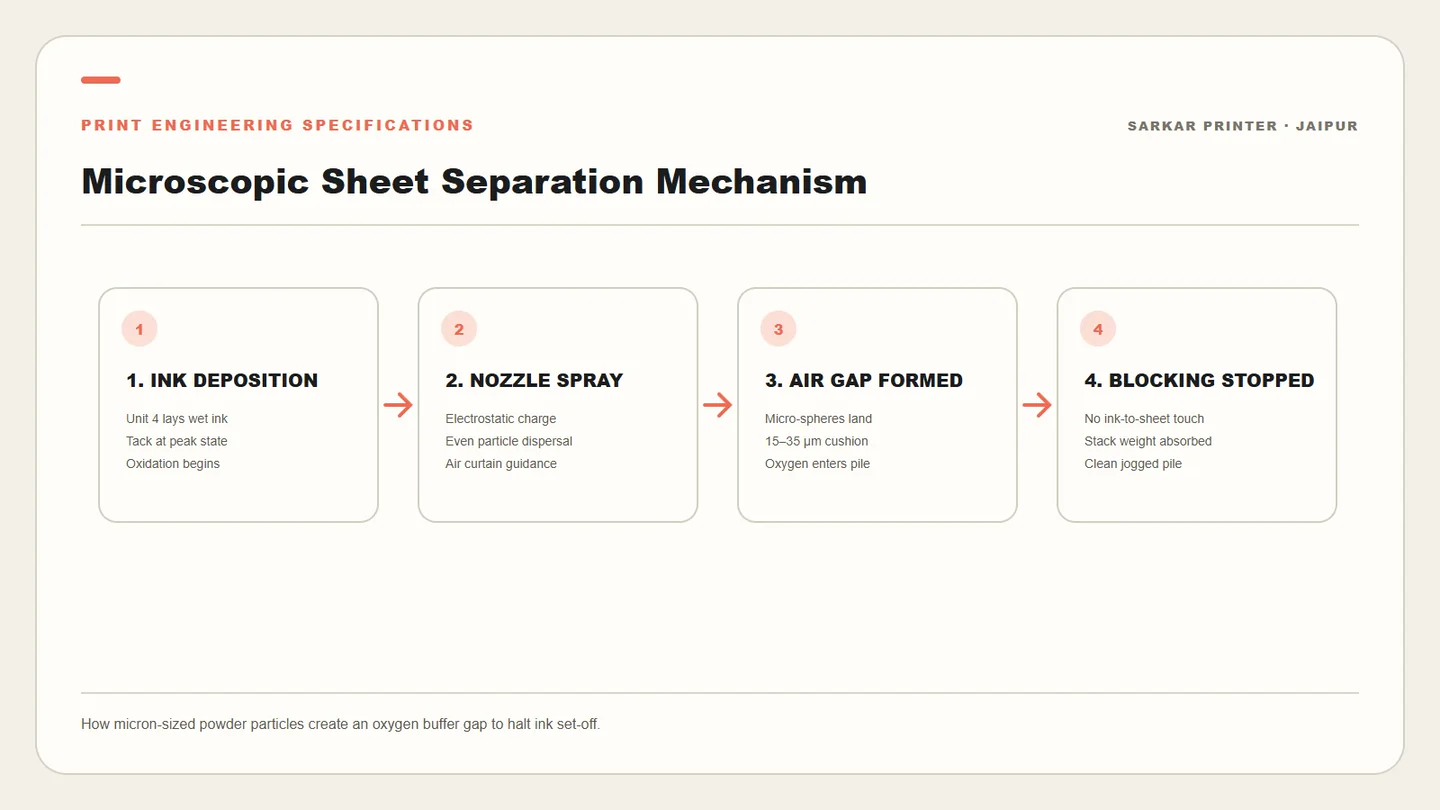
In high-speed sheetfed offset lithography, printed sheets drop onto the delivery pile every fraction of a second. At press speeds exceeding 12,000 sheets per hour, heavy piles build immense hydrostatic downward pressure. Because sheetfed inks dry via slow chemical oxidation (which requires atmospheric oxygen over 4 to 12 hours), wet ink on the top of one sheet presses directly against the unprinted underside of the following sheet. Without intervention, the wet ink film adheres to the overlying sheet, causing catastrophic "set-off" (ink blocking) that ruins entire print runs. Anti-set-off spray powder prevents this by acting as millions of microscopic ball bearings. As each sheet passes through the delivery chute, electrostatic nozzles spray a calibrated cloud of fine micro-particles across the wet ink surface. These particles create a uniform physical air gap of 15 to 35 micrometers between sheets, allowing ambient oxygen to circulate while preventing hydraulic ink contact. Formulate pressroom operating procedures following Fogra graphic technology research specifications.
Material Comparison: Vegetable Starch vs. Calcium Carbonate Powders
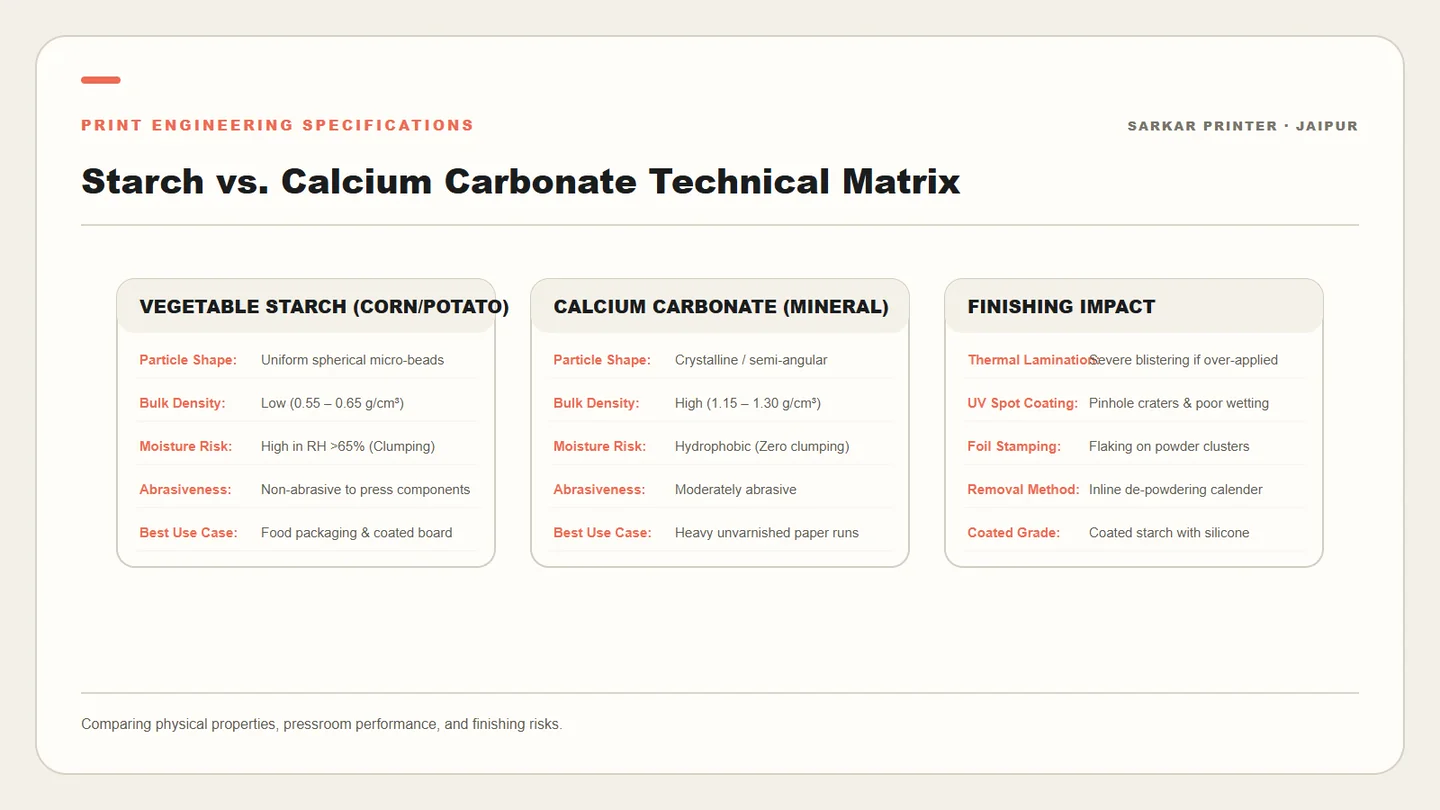
Pressrooms typically choose between two primary raw material compounds: modified vegetable starches (derived from corn, potato, or wheat) and mineral calcium carbonate ($CaCO_3$). Each compound possesses distinct density, particle sphericity, and post-press finishing behaviors. Vegetable starch particles are naturally spherical, non-abrasive, and relatively lightweight (bulk density ~0.6 g/cm³). Because starch is organic, it causes less mechanical wear on press delivery grippers and jogger mechanisms. However, starch powders are hydrophilic; in humid pressrooms (relative humidity >65%), starch absorbs atmospheric moisture, clumps together, and forms coarse gritty aggregates that mar delicate varnishes. Calcium carbonate powders are mineral-based and heavier (bulk density ~1.2 g/cm³), requiring higher air velocity at the spray nozzles. They resist moisture absorption and maintain consistent particle dispersion in monsoon conditions. However, calcium carbonate is abrasive and significantly more chemically active, posing severe risks of roller stripping if drawn backward into the dampening fountain system under ISO 12647 offset process control standards.
Calibrating Micron Particle Size to Paper Weight (GSM)
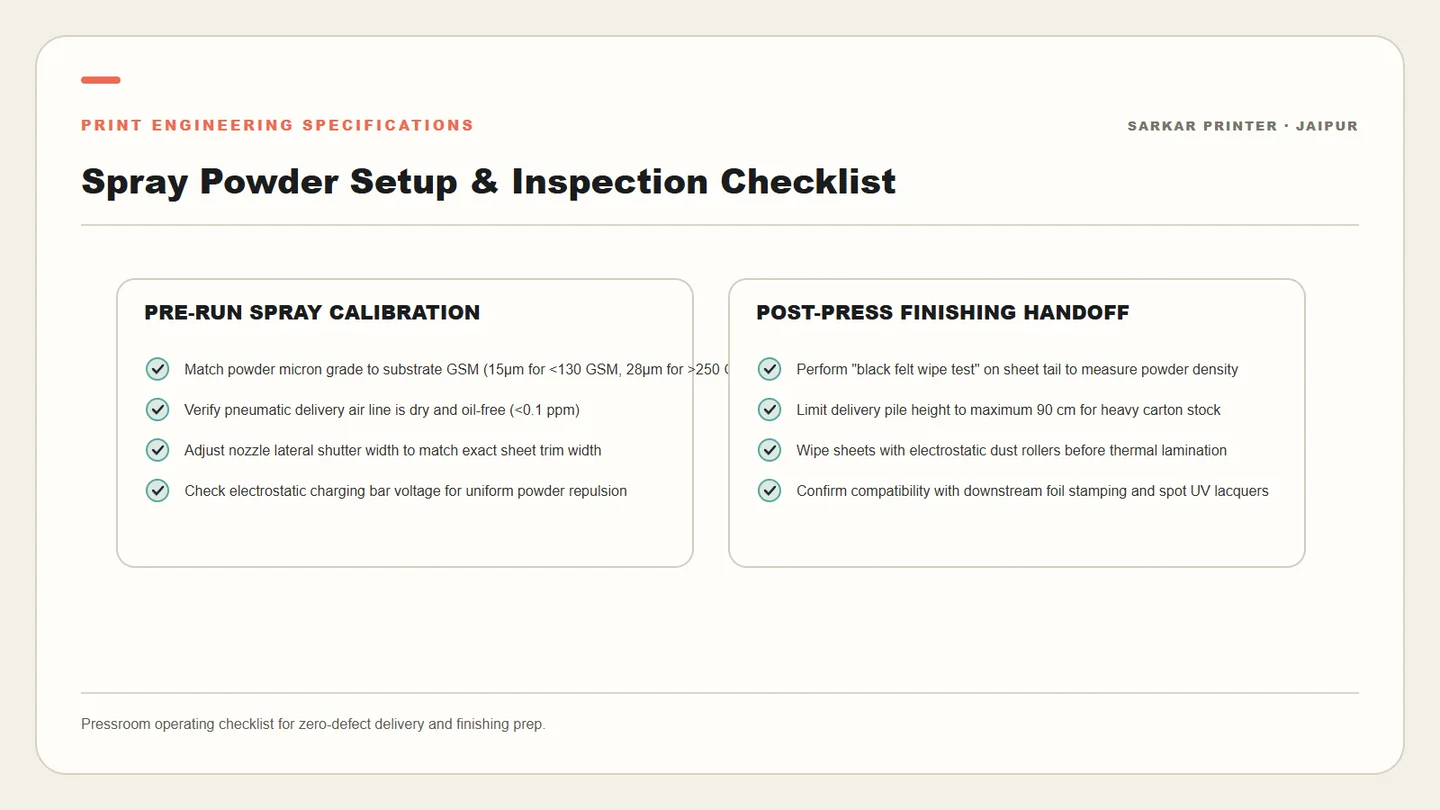
The golden rule of anti-set-off powder selection is simple: particle diameter must exceed wet ink film thickness plus paper surface roughness, but never exceed what is required to cushion the sheet weight. Using particles that are too small fails to stop set-off; using particles that are too large creates a rough sandpaper-like texture that ruins the aesthetic feel of premium marketing collateral. Particle sizing is categorized in micrometers ($\mu$m). For light commercial papers (70 to 130 GSM), specify fine powder grades (15 to 20 $\mu$m). For medium coated boards and book covers (150 to 250 GSM), step up to medium grades (22 to 30 $\mu$m). For heavy folding boxboard and corrugated micro-flute linerboard (300 to 500 GSM), utilize coarse particles (32 to 50 $\mu$m) to withstand the massive hydrostatic tonnage of the completed pallet.
Post-Press Finishing Protocols: Preventing Lamination and Spot UV Failures
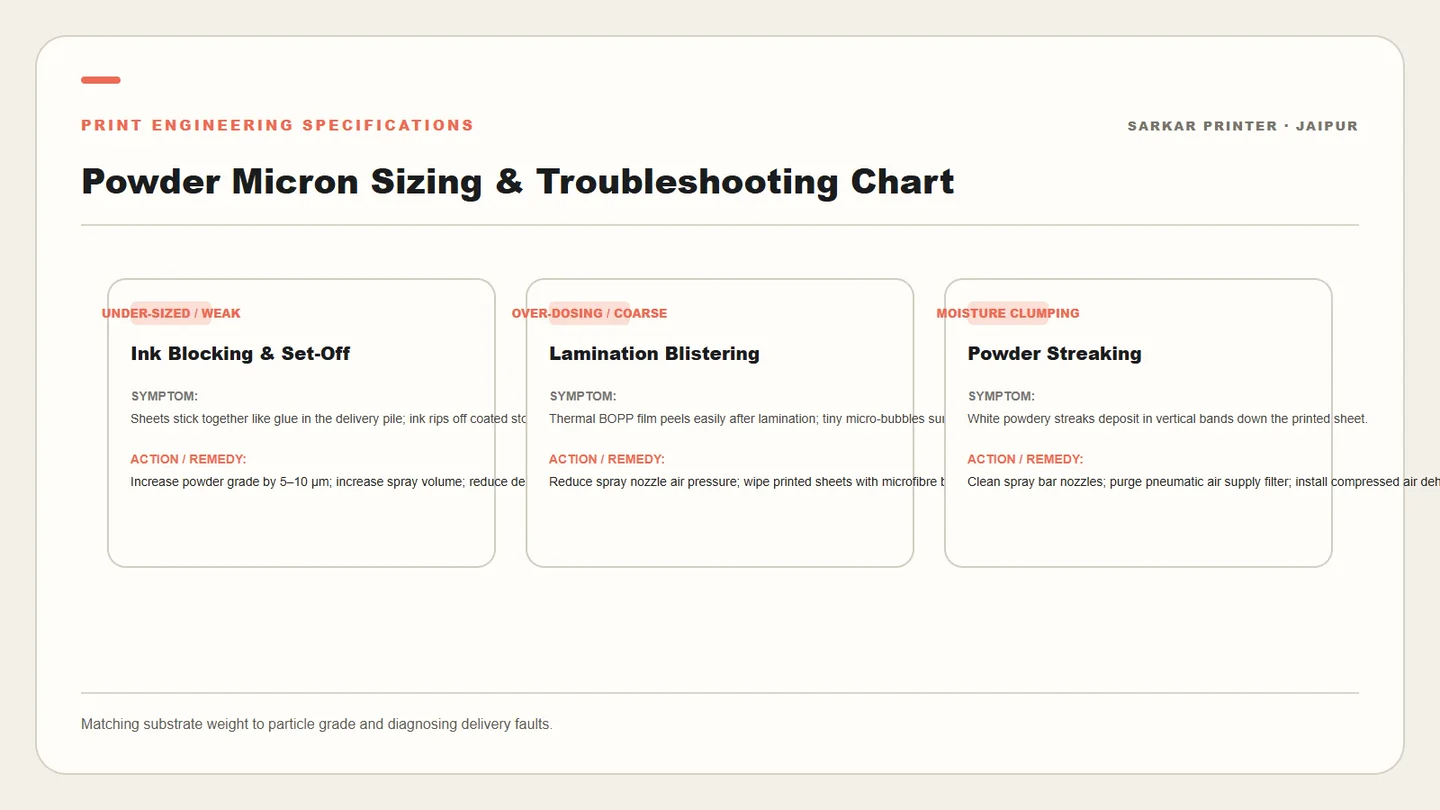
Excessive spray powder is the number one cause of post-press finishing rejections in commercial packaging. When a printed sheet undergoes thermal film lamination, the adhesive layer must achieve intimate 100% molecular contact with the paper fibers and ink film. Trapped powder grains act as microscopic pillars, propping the hot lamination film away from the ink surface and creating thousands of micro-air pockets (silvering or blisters). Similarly, in spot UV screen printing, powder particles disrupt the surface tension of the liquid UV varnish, causing pinhole voids, fish-eyes, and flaking. If a job requires secondary lamination or foil stamping, press operators must calibrate spray powder volume to the absolute bare minimum, utilize coated silicone-treated starches that blend into adhesives, or run an inline aqueous dispersion primer to eliminate the need for powder entirely.
Frequently asked questions
Can you completely eliminate spray powder on an offset press?
Yes. Pressrooms equipped with inline aqueous coating units (water-based dispersion varnishes) dry their sheets instantly under hot-air knives and infrared (IR) lamps. Because the acrylic coating hardens before reaching the delivery stack, the sheets do not require spray powder, leaving a glass-smooth surface perfect for immediate lamination and foil stamping.
How do you perform the black felt wipe test on press?
Press operators wrap a piece of clean black felt cloth around a wooden block and drag it across the tail edge of a dried sample sheet. Inspecting the white dust deposit on the black cloth provides an instant visual gauge of powder coverage, ensuring sufficient anti-blocking without over-dosing.
What is coated spray powder vs uncoated spray powder?
Coated spray powders feature a microscopic micro-encapsulated silicone or fatty acid coating around each starch grain. This hydrophobic barrier prevents the starch from absorbing humidity and allows downstream lamination adhesives to wet out more effectively around the particles.
CONTINUE THE PRINT PLAN
Plan Your Commercial Print Project in Jaipur
From precision multi-color offset runs to high-end rigid luxury boxes and folding cartons, Sarkar Printer delivers certified color accuracy and structural integrity for businesses across India.