
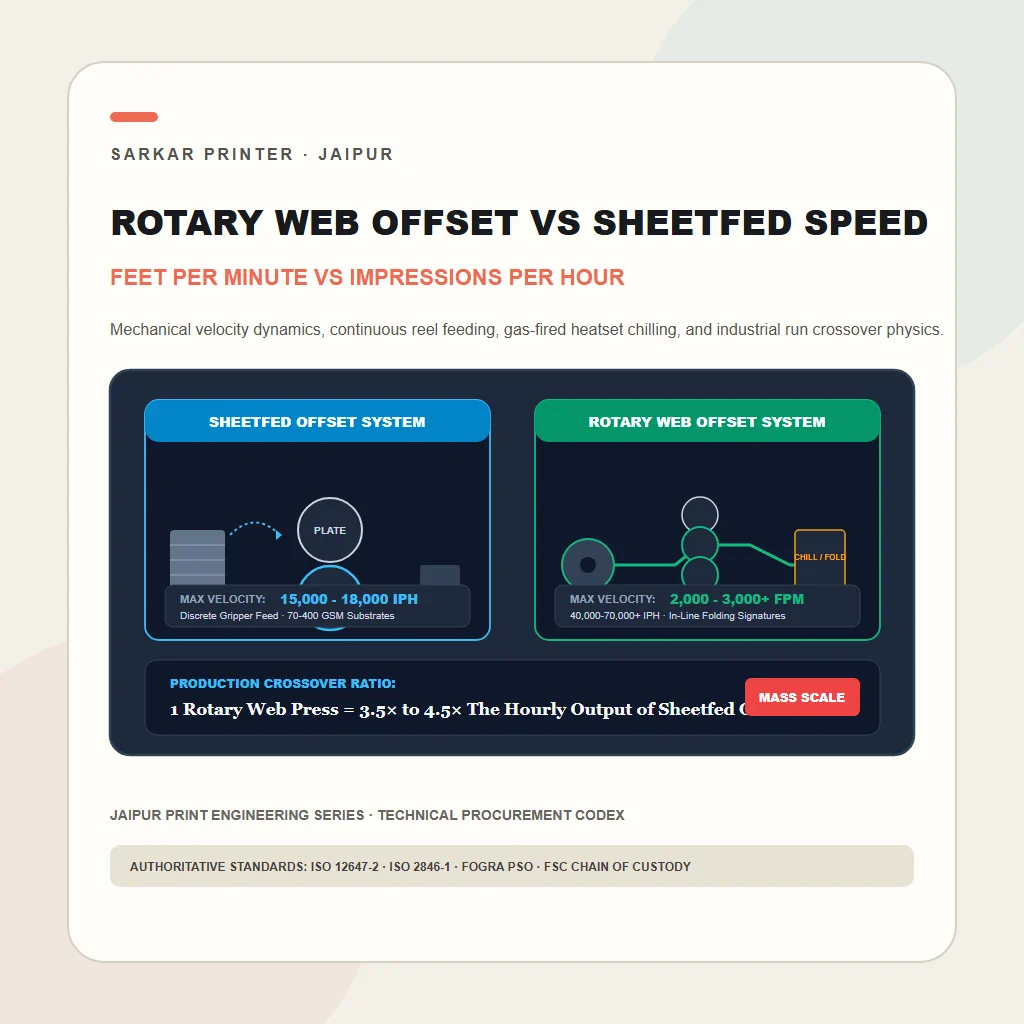
The Physics of Press Velocity: Linear Web Speed vs Discrete Sheet Acceleration
Commercial printing press engineering revolves around a fundamental mechanical divide: transporting individual cut sheets of paper through reciprocating mechanical grippers versus pulling an unbroken paper ribbon through continuously rotating cylinder couples. This mechanical difference dictates the operational velocity, production economics, and physical substrate limits of modern lithography.
Modern sheetfed offset presses, such as our Heidelberg Speedmaster XL fleet at Sarkar Printer Jaipur, operate at peak mechanical speeds between 15,000 and 18,000 impressions per hour (IPH). At 18,000 IPH, the feeder head must separate, lift, register, and accelerate five individual sheets of paper every single second. Each sheet enters the press at rest, accelerates rapidly along the feeder table, squares against front and side registration lays, and transfers into swinging gripper bars. These mechanical accelerations and decelerations impose severe physical limits. Exceeding 18,000 IPH causes sheet corner flutter, air turbulence misregistration, and gripper bounce, even when using carbon-fiber components and ultrasonic double-sheet detectors.
Rotary web offset presses eliminate start-stop sheet acceleration entirely. A heavy reelstand unwinds a continuous paper web directly into the printing units. Because the paper moves continuously without reciprocating stops, press designers optimize cylinder dynamics purely for rotary motion. Web press velocities do not measure in impressions per hour; press operators measure speed in Feet Per Minute (FPM) or Meters Per Second (m/s). Standard commercial heatset web offset presses run between 2,000 and 3,000 FPM (10 to 16 m/s), while advanced publication presses exceed 3,600 FPM (18 m/s). As the paper web speeds through four double-sided printing units, both sides receive full-color impressions simultaneously in a blanket-to-blanket configuration compliant with ISO 12647-2 color standards.
To visualize the output difference, consider an estimator calculating equivalent production. A commercial 16-page heatset web press with a 578 mm (22.75 inch) cutoff running at 2,500 FPM outputs approximately 79,150 cutoff impressions per hour. Each cutoff delivers a fully printed, two-sided 16-page signature. In contrast, an eight-up B1 sheetfed press running at 15,000 IPH prints one side per pass, requiring a perfecting unit or second pass to equal the same page count. A single commercial rotary web press easily matches the hourly throughput of four large sheetfed presses.
Decision Workflow: Pressroom Dispatch & Speed Routing Pipeline
Production schedulers at Sarkar Printer evaluate customer specifications across five rigorous engineering stages before dispatching print jobs to our sheetfed litho bay or our web offset printing plant in Jaipur. Routing a job to the wrong press architecture erodes operating margins and risks substrate failure.
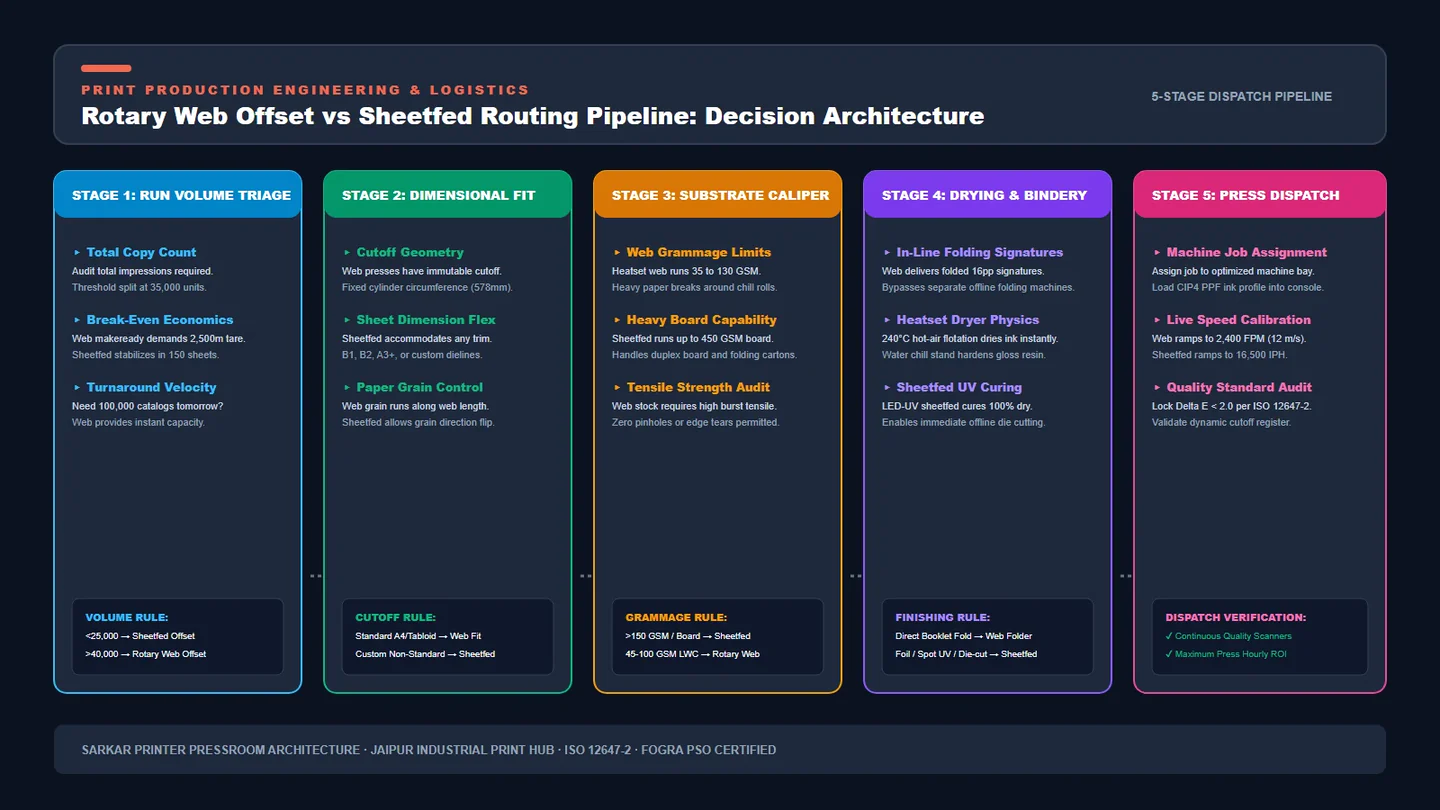
Stage 1 focuses on production run volume. Short and medium runs under 25,000 units always route to sheetfed presses because sheetfed makeready consumes minimal time and scrap paper. High-volume publication orders exceeding 40,000 units enter the web offset queue where continuous velocity unlocks massive economies of scale.
Stage 2 audits dimensional page trims against cylinder cutoff geometry. Sheetfed presses handle arbitrary sheet dimensions, allowing custom die-cut folders, square brochures, and oversized posters. Web presses feature a permanent, fixed cylinder cutoff. Unless the publication trims efficiently out of standard A4, A5, or tabloid geometries matching the cylinder circumference, paper cutoff waste negates the web press speed advantage.
Stage 3 qualifies paper caliper and grammage. High-speed web offset presses demand paper reels with high tensile burst strength, running lightweight coated (LWC) and uncoated stocks from 35 GSM to 130 GSM. Projects utilizing heavy packaging board, 350 GSM art card, or rigid boxes immediately route to our sheetfed press lines, which handle stocks up to 450 GSM without difficulty.
Stage 4 evaluates finishing requirements. If a publication requires saddle-stitched or folded signatures, the web press in-line folder delivers ready-to-pack units directly at the delivery conveyor. Conversely, if a job requires embellishments like spot UV, embossing, or custom die-cutting, sheetfed presses deliver flat pallets ready for offline post-press processing.
Stage 5 dispatches the job to the designated machine bay, locks prepress CIP4 ink presetting curves into the console, and verifies live production against certified Fogra PSO targets.
Thermal Drying Physics: Heatset Gas Flotation vs Sheetfed Oxidative & UV Curing
Operating a continuous paper web at 2,500 feet per minute introduces a massive chemical challenge: how do press operators dry wet lithographic ink before the paper reaches folding cylinders? In sheetfed printing, paper settles onto a delivery pile where operators apply starch anti-setoff spray powder to create micro-air gaps between sheets. Conventional sheetfed inks dry slowly over four to eight hours through oxidative polymerization, where atmospheric oxygen cross-links vegetable oil binders into hard films. Alternatively, modern sheetfed presses utilize LED-UV lamps operating at 385–395 nm to cure photoinitiator inks instantaneously.
A rotary web press running at 2,500 FPM cannot use slow oxidative drying or powder spray. Moving at twelve meters per second, wet ink would smear catastrophically across turning bars and former folder jaws within 1.5 seconds of impression. Therefore, commercial web offset divides into two distinct drying technologies: coldset and heatset.
Coldset web offset printing, widely used for regional newspapers and high-volume trade directories, relies on porous uncoated newsprint. Low-viscosity mineral oil inks penetrate directly into porous cellulose fibers within milliseconds. Coldset ink never truly dries through resin polymerization; it solidifies through capillary absorption. Consequently, coldset printing yields lower ink densities and remains susceptible to rub-off on human fingers.
Heatset web offset printing, utilized for premium retail catalogs, glossy magazines, and high-volume book publishing, relies on sophisticated thermal drying ovens and chill roll stands. Heatset inks incorporate volatile petroleum hydrocarbon solvents, hard synthetic resins, and specialized wax compounds manufactured per ISO 2846-1 standards. Immediately after leaving the final printing tower, the web enters a 10 to 15-meter horizontal hot-air flotation dryer. Gas burners heat the chamber between 200°C and 240°C (390°F to 465°F). High-velocity air nozzles suspend the paper web without physical touch, evaporating 85% to 90% of the solvent fraction in under one second.
As the web exits the hot oven at 130°C, it immediately wraps in an S-wrap pattern around four to six chrome-plated chill rollers. Internal pumps circulate chilled water at 12°C to 16°C through the chill roll barrels. This rapid thermal shock drops the web temperature below 30°C in fractions of a second, solidifying the melted resin and wax binder into a high-gloss, scuff-resistant ink film. A silicone applicator then applies a microscopic water-silicone emulsion onto the web to restore paper moisture and eliminate static before in-line folding.
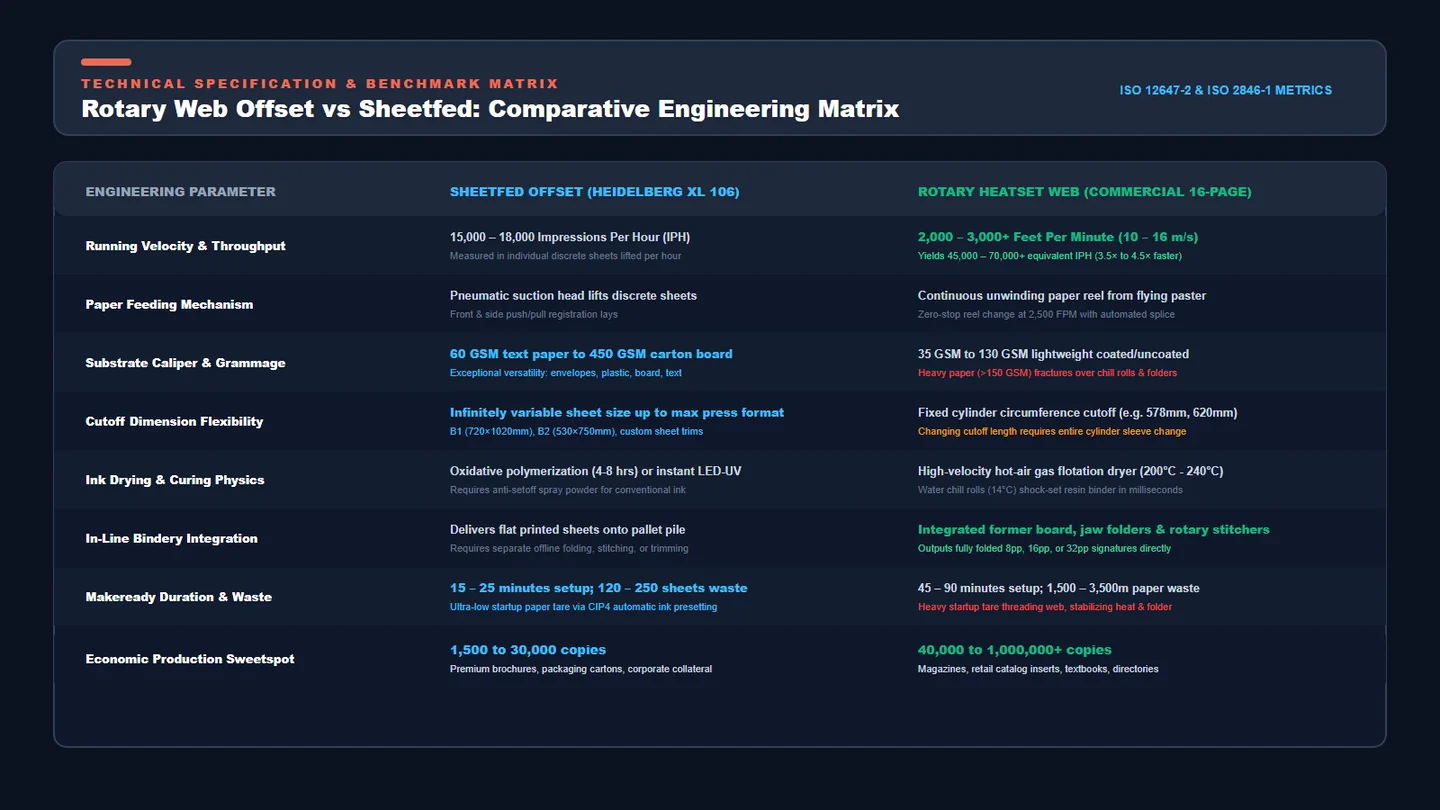
Technical Specification Matrix: Web vs Sheetfed Engineering Benchmark
Engineers and procurement teams compare operating specifications directly to determine which press platform maximizes return on investment for given production parameters.
| Operating Parameter | Commercial Sheetfed Offset | Rotary Heatset Web Offset |
|---|---|---|
| Operating Velocity | 15,000 – 18,000 Impressions / Hour | 2,000 – 3,000+ Feet / Minute (10–16 m/s) |
| Equivalent Hourly Output | 15,000 sheets (single-side or perfected) | 45,000 – 70,000+ folded 16pp signatures |
| Substrate Feed Format | Pre-cut discrete rectangular paper sheets | Continuous paper reel (up to 1,500 kg rolls) |
| Grammage Compatibility | 60 GSM text paper to 450 GSM carton board | 35 GSM to 130 GSM lightweight coated/uncoated |
| Cutoff Dimension Adjustability | Infinitely flexible up to maximum bed size | Fixed cylinder circumference (e.g. 578 mm) |
| Makeready Duration & Waste | 15 – 25 minutes; 120 – 250 waste sheets | 45 – 90 minutes; 1,500 – 3,500 m web waste |
| Primary Market Applications | Cartons, brochures, books, premium cards | Magazines, catalogs, retail inserts, directories |
Diagnostic Fault Tree: Web Runnability & Sheetfed Transport Troubleshooting
Operating multi-unit printing presses at extreme mechanical velocities exposes mechanical assemblies and paper webs to immense physical stresses. When press speeds exceed 2,000 FPM on web lines or 15,000 IPH on sheetfed presses, minor inconsistencies in paper tension, fountain solution chemistry, or gripper pad force trigger immediate production stoppages.
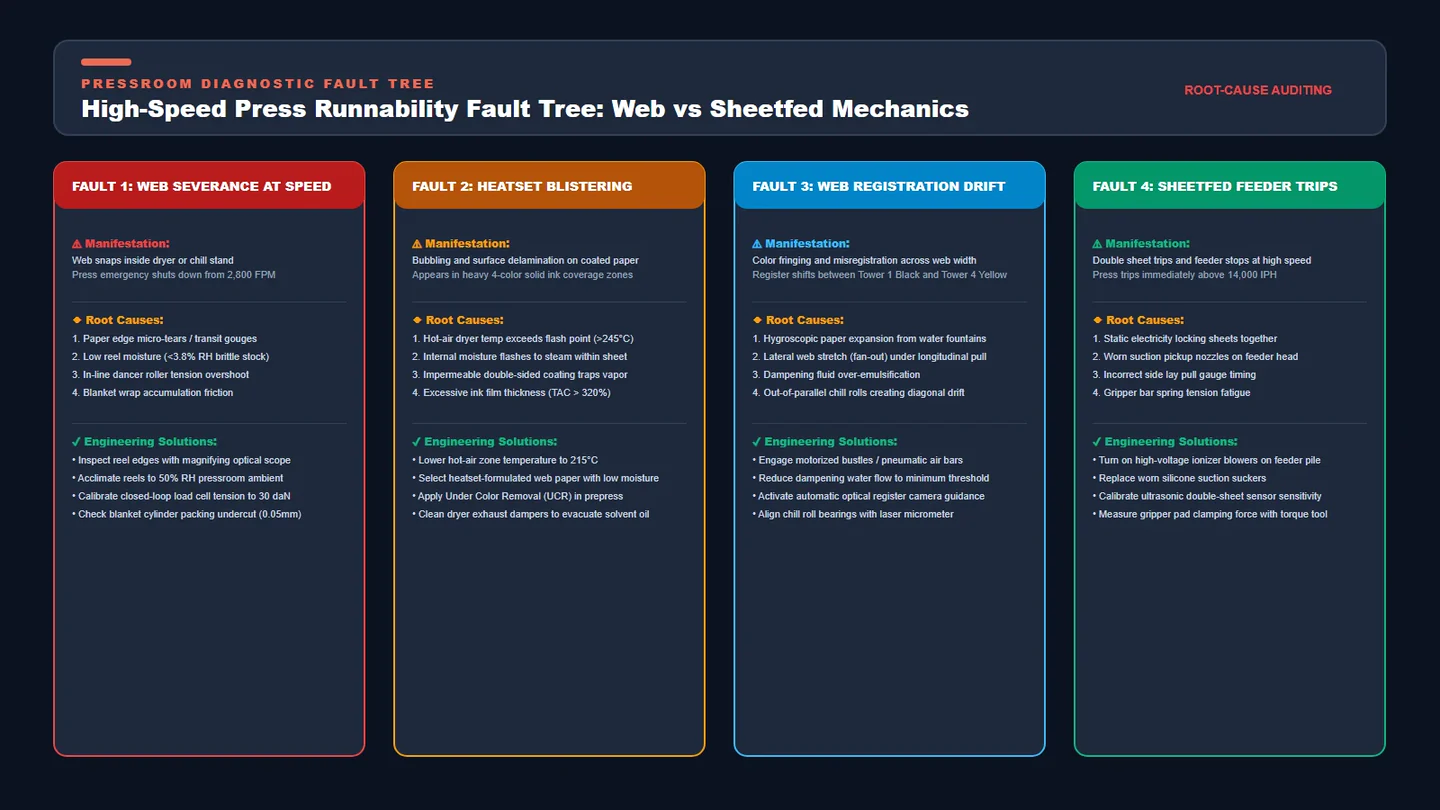
Fault 1: Catastrophic Web Severance at 2,800 FPM
A web break at full production speed creates immediate hazards: the severed paper ribbon wraps violently around blanket cylinders or jams inside the hot-air dryer, triggering automatic web catchers and emergency stops. Press technicians trace 80% of web breaks to paper reel transit damage. Even a microscopic 1 mm nick on the reel edge concentrates tension stresses during unwinding, tearing the entire web across its width. Technicians inspect reel edges under optical magnifying lenses before loading. Furthermore, maintaining pressroom relative humidity between 45% and 55% prevents edge moisture loss. When paper reels dry out, brittle edges snap under the 30 daN pull of closed-loop dancer tension rollers.
Fault 2: Heatset Paper Blistering & Surface Delamination
Heatset blistering manifests as crater-like bubbles and surface delamination on heavily inked sections of coated stock as the paper exits the dryer. Blistering occurs when internal paper moisture vaporizes into steam before the water vapor can escape through the outer ink and clay coating layers. Trapped steam expands violently, popping the paper surface open. Press operators resolve blistering by lowering hot-air dryer temperatures from 240°C down to 210°C, verifying that web exit temperatures do not exceed 130°C. In prepress, technicians apply Under Color Removal (UCR) and Gray Component Replacement (GCR) algorithms to keep Total Area Coverage (TAC) below 300% on coated web substrates.
Fault 3: Dynamic Registration Drift & Fan-Out
As the continuous paper web speeds through four consecutive printing units, it absorbs water from offset dampening systems. Damp cellulose fibers swell laterally across the web width while stretching longitudinally under web tension. This phenomenon, known as web fan-out, causes the cyan, magenta, and yellow dots to land wider than the first-down black unit. To counteract fan-out, modern web presses employ pneumatic bustle wheels and motorized lateral register compensators that physically bow the paper ribbon between printing towers, maintaining dot registration within ±0.04 mm across a 38-inch web width.
Fault 4: Sheetfed Feeder Trips at 18,000 IPH
On high-speed sheetfed presses, double-sheet detector trips and feeder jams occur when static electricity glues lightweight sheets together, or when suction nozzles wear unevenly. At 18,000 IPH, operators activate high-voltage alternating-current ionizer blowers across the feeder pile. Ionized air neutralizes static charges instantly, allowing blast air nozzles to float the top sheet into a frictionless air cushion before suction pickup heads engage.
Quality Assurance Codex: High-Speed Production Inspection Checklist
Maintaining color consistency and mechanical integrity across high-speed runs demands strict adherence to documented quality control checklists. Technicians at Sarkar Printer audit every shift against rigorous parameters before clearing print batches for distribution.
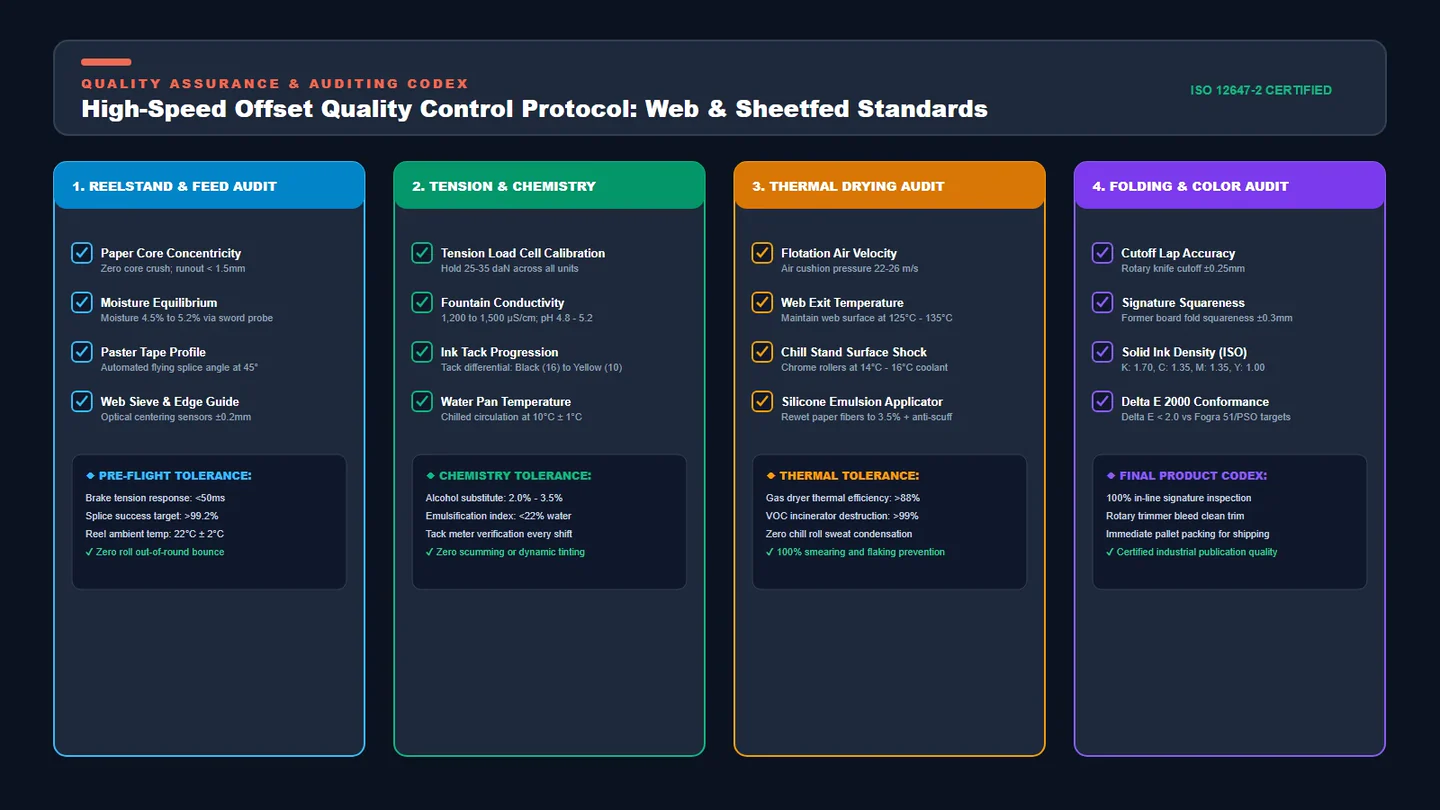
Our quality assurance workflow enforces four comprehensive audit pillars:
- Reelstand & Mechanical Feed Integrity: Technicians audit paper core concentricity using dial indicators, rejecting reels with runout exceeding 1.5 mm to prevent high-speed rotational bounce. Operators prep automatic flying paster splices with high-tack adhesive tape at exact 45-degree angles, ensuring 99.5%+ splice success rates at 2,500 FPM.
- Dynamic Tension & Dampening Chemistry: Digital tensiometers monitor web tension across five distinct press zones, maintaining continuous tension between 25 and 35 daN. Automated dosing systems regulate fountain solution conductivity between 1,200 and 1,500 µS/cm at pH 4.9, preventing plate background scumming without weakening ink tack progression.
- Thermal Oven & Chill Stand Equilibrium: Infrared pyrometers track web exit temperatures continuously, keeping the paper surface within the 125°C to 135°C window. Cooling water circulation chills roll surfaces to 14°C, shocking ink resins without causing airborne sweat condensation. Micro-metered silicone applicators reintroduce 3.5% moisture back into the dehydrated sheet.
- In-Line Folding & Colorimetric Standards: Technicians inspect former board fold squareness within ±0.3 mm and cutoff registration within ±0.25 mm. Spectrophotometers measure solid ink densities (Black 1.70, Cyan 1.35, Magenta 1.35, Yellow 1.00) and verify that Delta E 2000 color variances remain strictly under 2.0 against ISO 12647-2 references.
Crossover Run Economics: Selecting Between Web and Sheetfed Platforms
When print buyers, corporate procurement managers, and publishing houses negotiate commercial print contracts, selecting the correct press technology directly determines the cost per thousand units. Neither technology is universally superior; each excels within distinct operational parameters.
Commercial sheetfed offset lithography represents the premier choice for luxury marketing collateral, corporate brochures, folding boxboard packaging, and print runs under 30,000 units. Sheetfed presses achieve operational color approval within 15 minutes, wasting less than 200 sheets of paperboard. Furthermore, sheetfed printing accommodates virtually any substrate—from thin Bible paper to 24-point coated packaging board—and interfaces seamlessly with offline embellishments like hot foil stamping, blind embossing, and intricate dielines.
Rotary heatset web offset printing represents the undisputed champion of mass publication, high-volume retail circulars, educational textbooks, and magazine printing exceeding 40,000 units. While web presses incur heavy setup costs—requiring up to an hour of makeready time and wasting 2,500 meters of paper during startup thermal calibration—their continuous speed of 2,500+ FPM and integrated in-line folding deliver dramatic unit cost savings on large production runs. Furthermore, purchasing paper in continuous master rolls rather than pre-cut sheets slashes raw material procurement costs by 12% to 18%.
At Sarkar Printer in Jaipur, our engineering team operates both multi-color Heidelberg sheetfed presses and high-speed web offset production lines under certified FSC chain-of-custody standards. We assist clients in modeling precise crossover quantities, ensuring every commercial publication, marketing brochure, and retail packaging order runs on the most cost-effective and technically superior press platform available.
Frequently Asked Questions About Rotary Web vs Sheetfed Press Speed
How does press speed compare between rotary web offset and sheetfed offset presses?
Commercial rotary heatset web offset presses run at linear web velocities between 2,000 and 3,000+ feet per minute (10 to 16 meters per second), producing between 45,000 and 70,000+ folded 16-page signatures per hour. Premium commercial sheetfed offset presses run at mechanical speeds between 15,000 and 18,000 impressions per hour. A rotary web offset press delivers approximately 3.5 to 4.5 times the finished hourly page throughput of a modern sheetfed press.
Why do sheetfed presses excel at paperboard packaging while web offset dominates publishing?
Sheetfed presses utilize individual mechanical gripper bars and flat paper transport beds capable of feeding heavy calipers from 70 GSM paper up to 450 GSM rigid folding boxboard and corrugated micro-flute. Rotary web offset presses pull continuous paper ribbons under intense tension around cylinder nips, gas-fired flotation ovens, chill stands, and former folding jaws. Paper heavier than 130 GSM fractures along spine folds or breaks under high-speed web tension, restricting web presses to lightweight coated and uncoated publication papers.
What is the difference between impressions per hour (IPH) and feet per minute (FPM)?
Impressions Per Hour (IPH) measures the discrete number of individual cut paper sheets that pass through the gripper cylinders of a sheetfed press in sixty minutes. Feet Per Minute (FPM) measures the continuous linear surface distance of the paper ribbon unwinding from a paper reel through the printing units. To convert FPM to equivalent IPH on a web press, engineers divide linear speed by the cylinder cutoff length. For example, a web running at 2,500 FPM with a 22.75-inch (1.895-foot) cutoff produces 79,155 cutoff impressions per hour.
How does in-line signature folding give web offset presses an insurmountable delivery advantage?
A sheetfed press delivers flat printed sheets onto a pallet pile, requiring offline transport to standalone folding machines, guillotines, and saddle-stitching lines. A commercial rotary web offset press incorporates an integrated combination folder directly after the water chill roll stand. The moving paper web travels over triangular former boards, slitting knives, and rotary jaw cylinders, outputting fully folded, perforated, and collated 8-page, 16-page, or 32-page publication signatures directly onto delivery conveyors at full press velocity.
What run length represents the economic crossover threshold between sheetfed and web offset?
The economic crossover threshold typically occurs between 35,000 and 50,000 finished copies. Sheetfed offset presses feature fast makereadies of 15 to 25 minutes and generate only 120 to 250 waste sheets during startup, making them cost-effective for runs between 1,500 and 30,000 copies. Web offset presses require 45 to 90 minutes of setup time and consume 1,500 to 3,500 meters of paper to stabilize thermal drying, ink-water balance, and folder geometry. Once running, however, the immense velocity and cheaper reel paper of web offset drastically cut unit costs on runs exceeding 50,000 copies.
Plan High-Velocity Print Production with Sarkar Printer Jaipur
Whether your print run demands the razor-sharp color flexibility of multi-color sheetfed offset or the high-volume speed of continuous rotary web offset, Sarkar Printer provides end-to-end manufacturing expertise in Jaipur. Contact our technical engineering estimators today to model your project's optimal press allocation, substrate savings, and production schedule.