
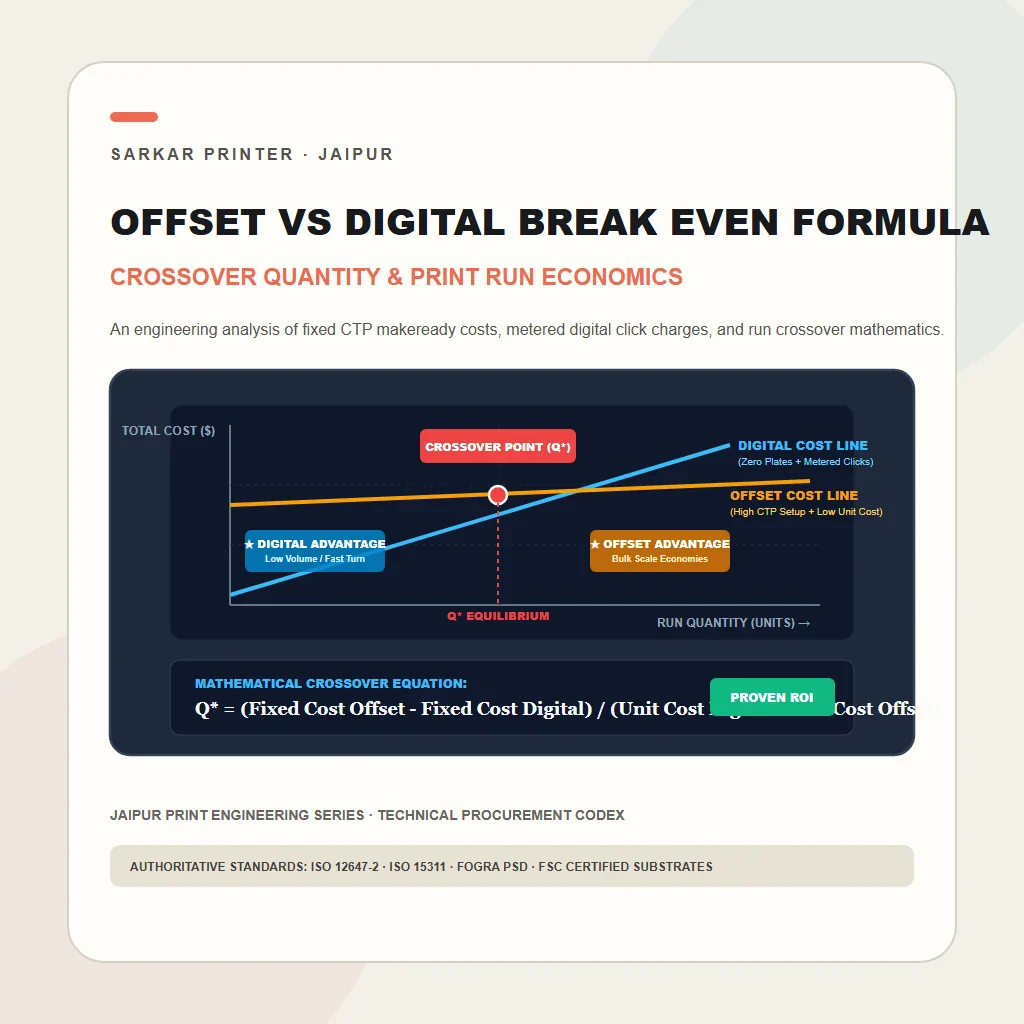
The Mathematical Economics of Commercial Printing: Fixed vs Variable Cost Structures
Every commercial print procurement decision balances two competing cost architectures: the high-fixed, low-variable cost curve of sheetfed offset lithography, and the zero-tooling, linear-variable cost curve of electrophotographic and liquid toner digital production presses. Modern print buyers, production planners, and cost estimators achieve optimal profitability only when they accurately calculate the mathematical equilibrium where these two cost lines intersect.
Sheetfed offset lithography demands substantial up-front capital investment before the press runs a single sellable sheet. Prepress technicians must image aluminum Computer-to-Plate (CTP) thermal plates for every color separation. Press crews clamp plates onto heavy cylinders, calibrate fountain solution dampening chemistry, and adjust motorized ink keys across thirty-two ink zones. During this makeready calibration, the press consumes between one hundred fifty and three hundred sheets of paperboard to achieve registration and solid ink density compliant with ISO 12647-2 standards. Once the operator achieves color approval, however, modern offset presses sprint at speeds reaching sixteen thousand impressions per hour, consuming bulk paste ink that costs a fraction of a cent per sheet.
Conversely, digital production presses eliminate physical tooling. The digital Raster Image Processor (RIP) streams variable bitmap data directly to laser exposure drums or electrophotographic imaging belts. Operators output color-accurate first sheets within sixty seconds, consuming almost zero makeready paper waste. However, digital equipment manufacturers levy a metered click charge for every sheet side passing through the machine, in accordance with ISO 15311 digital print requirements. Furthermore, proprietary micro-fine toner and liquid electroink cost thirty to forty times more per pound than commercial lithographic paste ink. Consequently, digital printing provides outstanding economic efficiency for micro-runs, but maintains a steep, immutable linear cost curve that bleeds corporate profit margins on large-scale production volumes.
Decision Workflow Route: Strategic Production Allocation Pipeline
Production supervisors and procurement directors at Sarkar Printer follow a structured five-stage decision workflow route to determine whether incoming customer orders belong on our multi-color Heidelberg sheetfed offset fleet or our high-speed digital presses. Misallocating an order destroys profit margins and delays manufacturing schedules.
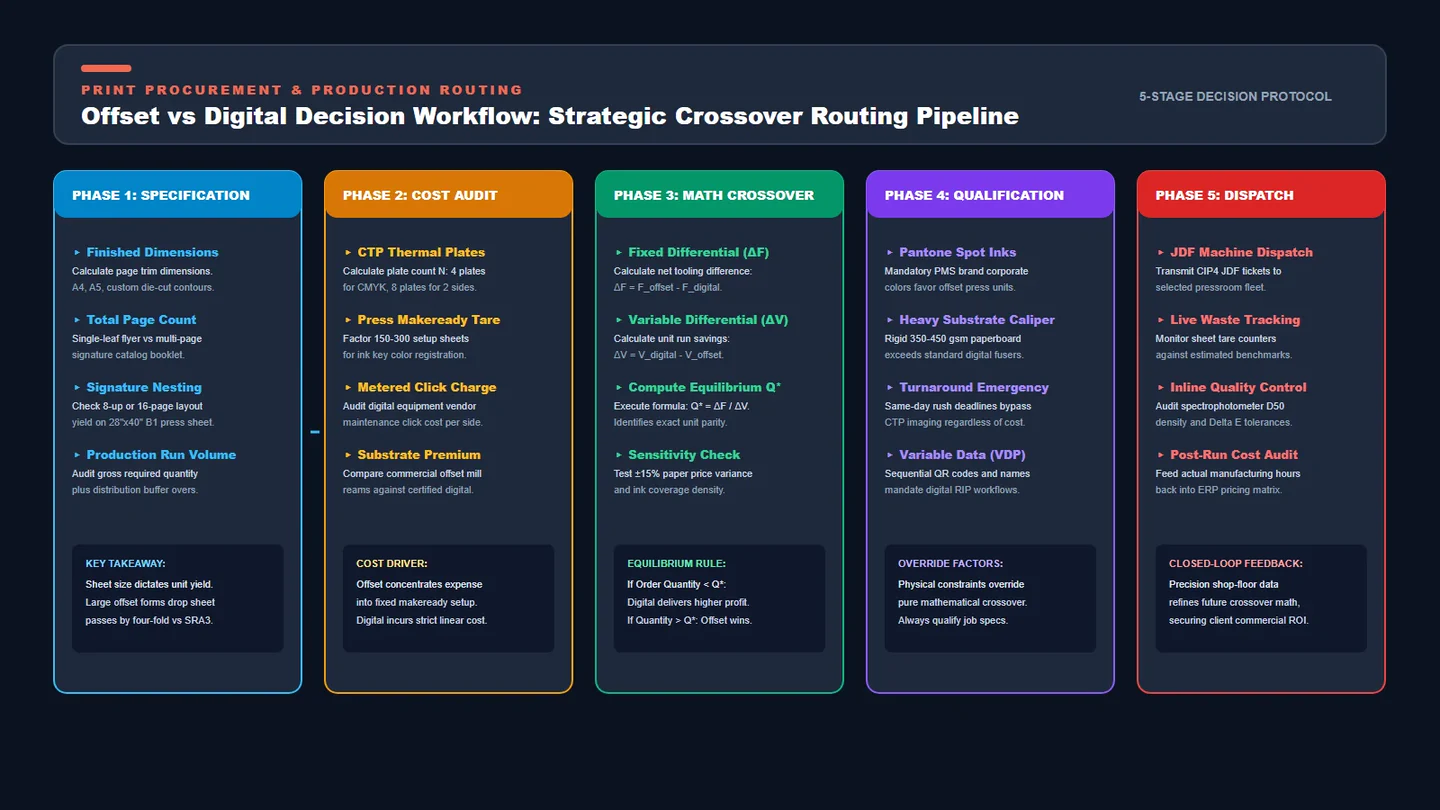
Our production team executes the following five decision phases:
- Job Specification & Imposition Audit: Estimators analyze finished trim dimensions, page count, and binding format. We evaluate whether the job nests efficiently onto full-size B1 (28x40 inch) press sheets or smaller digital formats.
- Cost Parameter Extraction: The estimation system extracts exact real-time cost components: required CTP plate count, press makeready labor rates, substrate cost per hundredweight, and vendor digital click contract fees.
- Mathematical Crossover Calculation: The cost engine executes the break-even formula, identifying the exact unit equilibrium quantity where offset lithography becomes less expensive than digital output.
- Substrate & Turnaround Qualification: Production managers review qualitative physical requirements, including spot Pantone Matching System (PMS) brand colors, heavy packaging board calipers, certified Forest Stewardship Council (FSC) stocks, and strict customer delivery deadlines.
- Shop-Floor Dispatch & Post-Run Audit: The prepress software dispatches CIP4 JDF job tickets directly to the selected press console, monitoring actual sheet tare and makeready duration against estimated benchmarks.
The Break-Even Formula: Deriving the Equilibrium Crossover Quantity (Q*)
To compute the precise crossover run length where total offset production cost equals total digital production cost, print engineers use linear algebraic cost models. We define the total cost of offset production as the sum of fixed setup tooling plus variable impression costs:
C_offset(Q) = F_offset + (V_offset × Q)
In this equation, F_offset represents the total fixed cost incurred during makeready, calculated by summing thermal CTP plate imaging, pressroom setup labor, and makeready substrate spoilage:
F_offset = (N_plates × C_plate) + (T_makeready × R_press_hour) + (S_waste × C_sheet)
The variable cost per net finished unit, V_offset, accounts for bulk ink coverage, live press running time per thousand impressions (IPH), and net paperboard consumption:
V_offset = (R_run_hour / Impressions_Per_Hour) + (C_ink_per_sheet) + (C_net_sheet / Yield_Per_Sheet)
Similarly, we define the total cost of digital production as:
C_digital(Q) = F_digital + (V_digital × Q)
Digital fixed tooling, F_digital, remains exceptionally small, comprising brief prepress RIP preflight verification and a few calibration test sheets:
F_digital = (T_rip × R_prepress_hour) + (S_test × C_digital_sheet)
Digital variable unit cost, V_digital, represents the metered vendor click fee per printed side plus premium digital substrate sheets:
V_digital = (Sides_Per_Unit × Fee_Click) + (C_digital_sheet / Yield_Per_Sheet)
To determine the crossover run quantity, Q*, we set total offset cost equal to total digital cost and solve for Q:
F_offset + (V_offset × Q*) = F_digital + (V_digital × Q*)
Rearranging the terms yields the standard commercial print crossover break-even formula:
Q* = (F_offset - F_digital) / (V_digital - V_offset)
This elegant mathematical equation demonstrates that the crossover equilibrium quantity depends entirely upon the ratio between fixed tooling differentials and variable run savings. As press engineers optimize makeready automation, F_offset shrinks, pulling the crossover point lower and allowing offset lithography to compete profitably on progressively shorter production runs.
Production Economics Matrix: Technology Benchmarks & Cost Drivers
Comparing production parameters across sheetfed offset presses, dry toner xerographic engines, and liquid electroink systems reveals stark technical and commercial tradeoffs. The specification matrix below outlines industry benchmarks and operational rules.
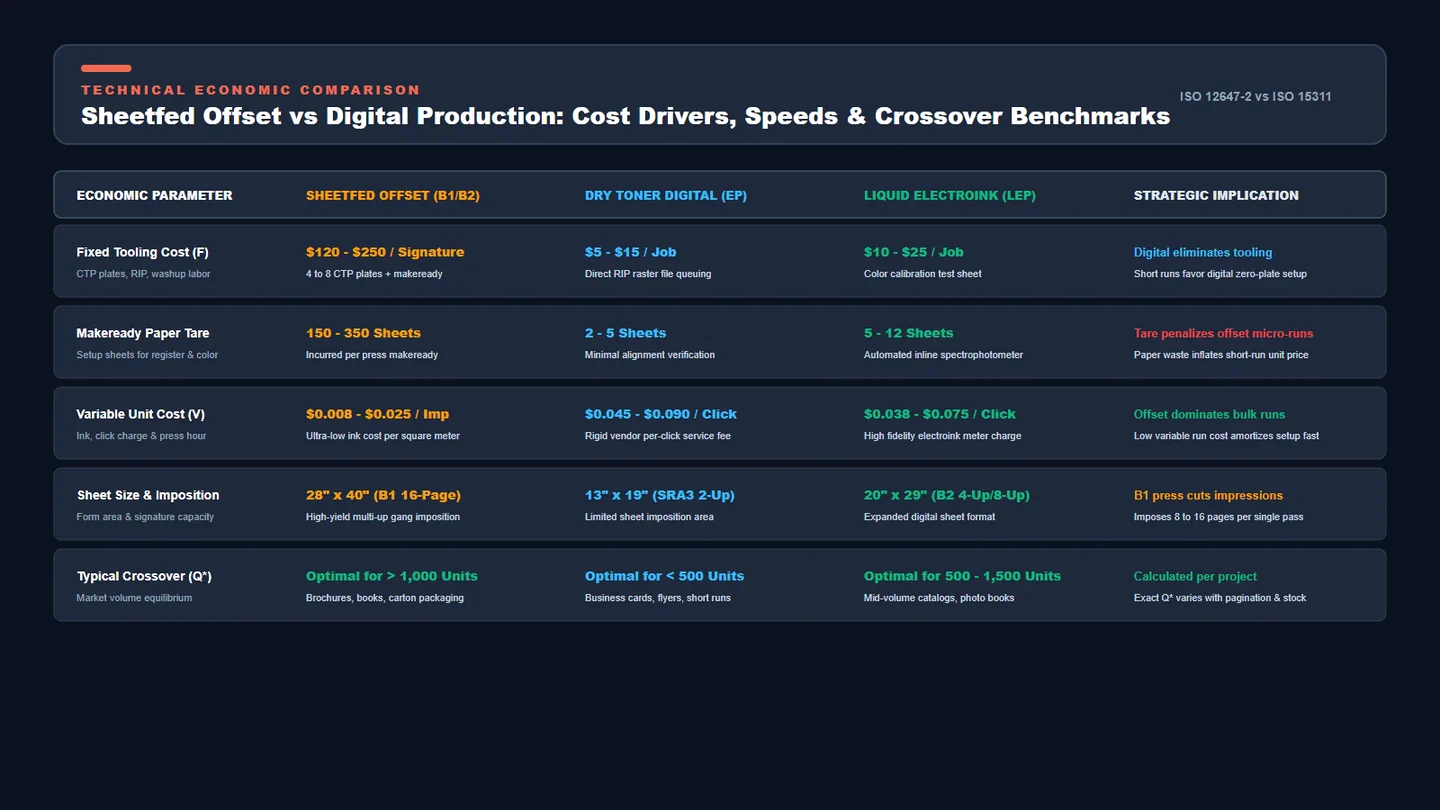
Reviewing this comparative data highlights key economic realities. For example, dry toner digital engines impose zero plate tooling and start running instantly, but their high per-page click charges restrict their economic sweet spot to short-run flyers and on-demand documents under five hundred units. Liquid ElectroInk presses expand sheet sizes to B2 and match offset dot sharpness according to Fogra PSD standards, competing efficiently up to fifteen hundred copies. Above fifteen hundred units, however, sheetfed offset lithography wins decisively, slashing per-unit costs through ultra-fast B1 sheet imposition and low raw ink prices.
Procurement Fault Tree: Diagnosing Profit Margin Bleed
When print buyers or estimators misjudge the break-even crossover volume, profit margins collapse rapidly. Commercial printers face severe margin erosion either from over-burdening short orders with fixed offset tooling or bleeding money on large runs through metered digital click charges.
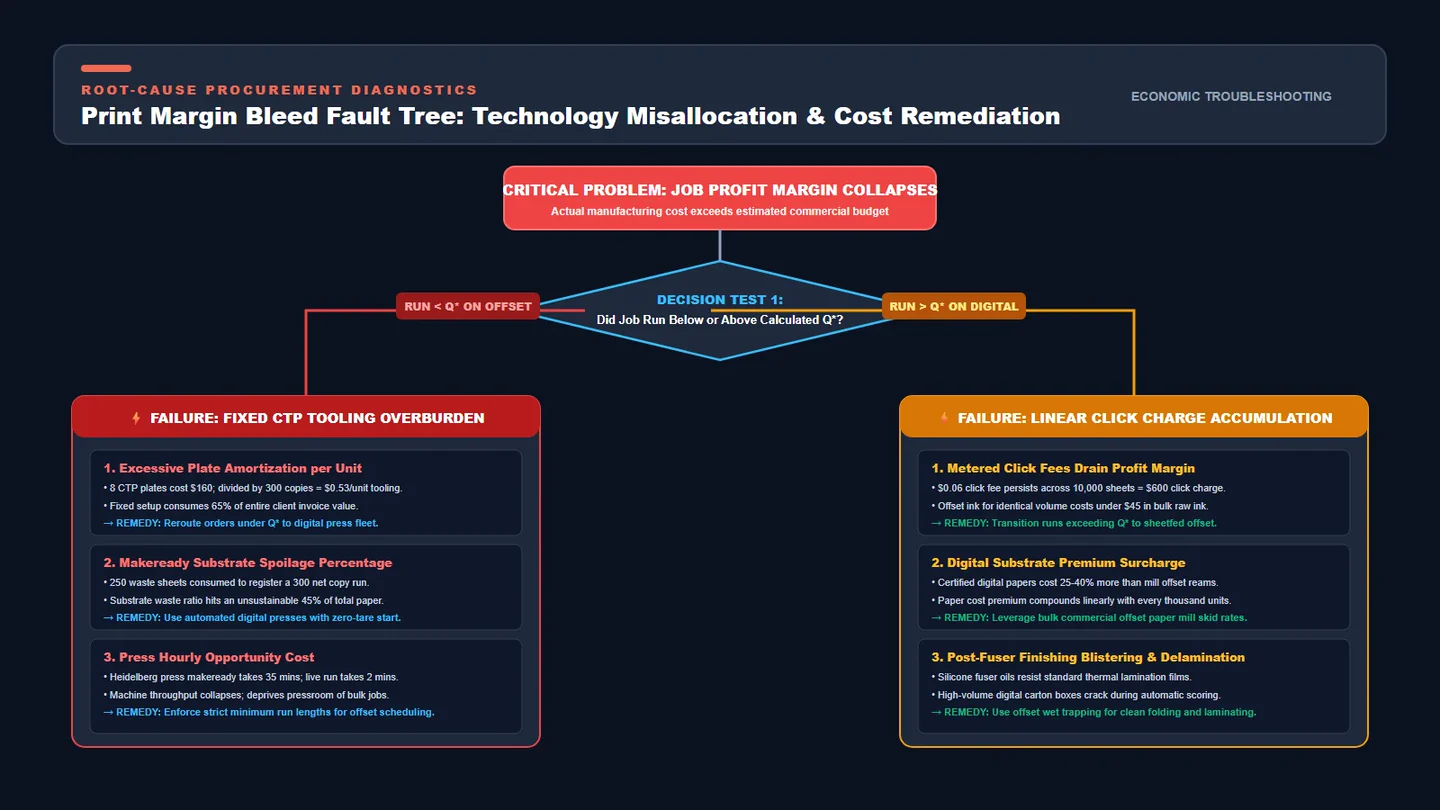
When our estimators review jobs showing thin margins, we examine the following three common miscalculations:
- Offset Fixed Tooling Overburden on Micro-Runs: Running three hundred copies of a multi-page brochure on an offset press forces the client to absorb hundreds of dollars in CTP aluminum plates and press setup time. The fixed setup amortizes over too few copies, generating an uncompetitive unit price. Switching that order to digital production immediately restores healthy profit margins.
- Click Fee Drain on Long-Run Digital Work: Conversely, running five thousand copies of an A4 catalog on digital equipment generates thousands of dollars in cumulative click charges. Equipment manufacturers capture the profit margin through metered maintenance billing. Transferring that job to our Heidelberg offset presses slashes production costs by sixty percent.
- Ignoring Finishing and Fuser Oil Complications: Digital dry toner engines utilize silicone fuser oils and wax additives to release heated paper from toner rollers. When finishing technicians attempt to apply standard thermal lamination film over dense digital toner solids, the film blisters and peels away. Offset lithography uses pure vegetable drying oils that bond tenaciously with thermal films and folding carton glues.
Standard Operating Procedures: 6-Gate Pre-Press Estimation SOP
To eliminate financial guesswork and guarantee commercial profitability, Sarkar Printer enforces a rigorous six-gate standard operating procedure before releasing any commercial print ticket to the shop floor.
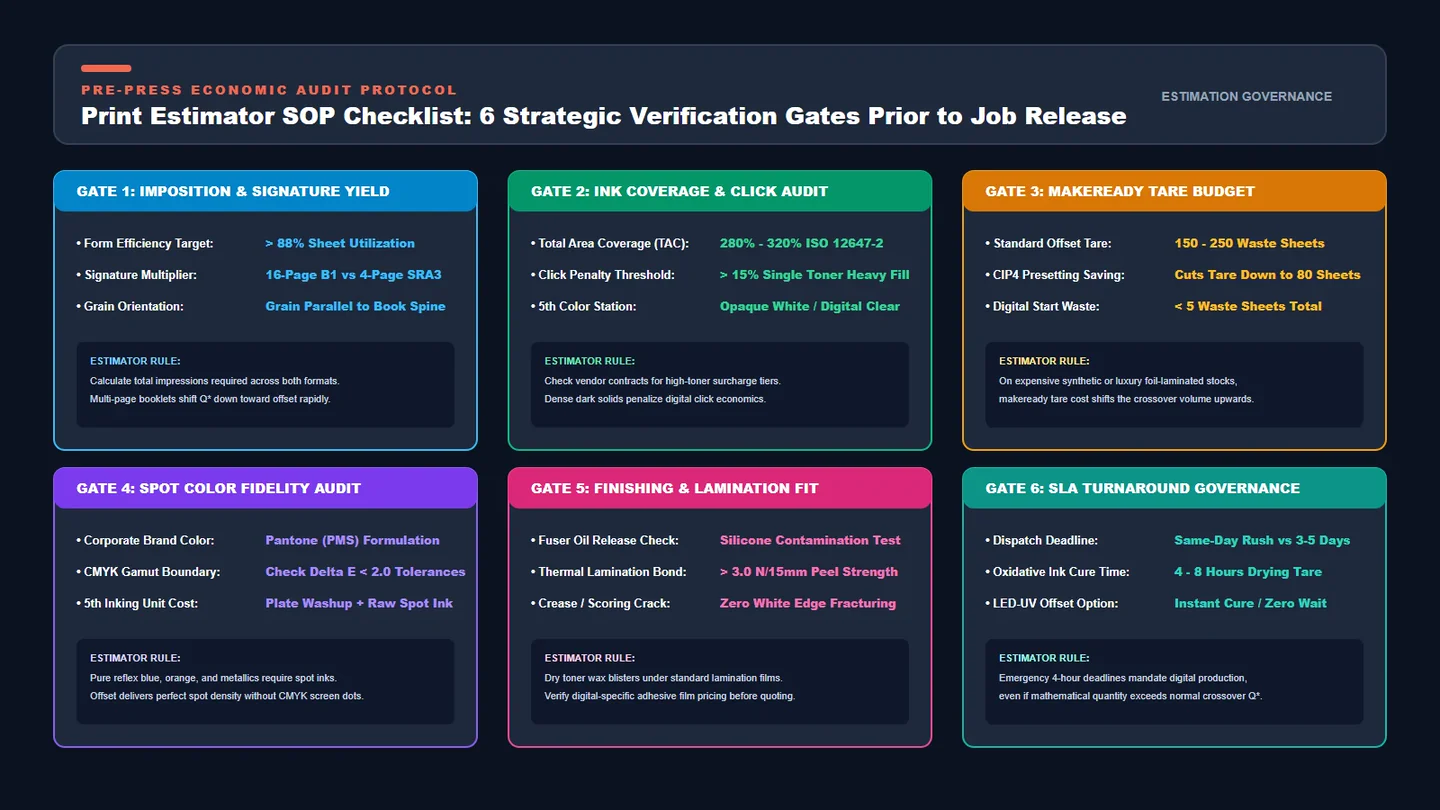
Our technical estimators verify each order against the following six standard operating gates:
- Imposition & Signature Yield Audit: Estimators calculate maximum sheet utilization, verifying whether full-size 28x40 inch B1 forms can nest sixteen pages simultaneously, slashing total press impressions.
- Total Ink Coverage & Click Penalty Check: Technicians inspect CMYK coverage percentages. If solid background fields exceed vendor click contract coverage caps, we factor in heavy toner surcharges.
- Makeready Waste Budget Calculation: On expensive luxury paper stocks, such as metallic foil boards or high-gsm uncoated cotton, makeready sheet tare carries significant financial weight. Estimators incorporate computerized CIP4 ink presetting to suppress waste sheets below one hundred copies.
- Spot Color & Brand Fidelity Verification: If a corporate brand guideline specifies an exact Pantone spot ink, offset presses mix and apply pure spot pigments in dedicated press units. Simulating rich spot colors on digital CMYK engines introduces visible raster screens and color drift.
- Post-Press Lamination & Folding Compatibility: Estimators confirm that printed sheets will accept score creasing, foil stamping, and spot UV without cracking along spine folds.
- Delivery Turnaround SLA Governance: If a client demands same-day dispatch within six hours, production teams route the job to digital presses, bypassing CTP plate queues and oxidative ink curing intervals.
B2B Procurement Impact: Maximizing Return on Corporate Print Spend
For brand managers, corporate procurement officers, and independent publishers, mastering the print break-even crossover formula transforms print buying from a subjective guessing game into an exact engineering science. Allocating print orders based on rigorous mathematical crossover models optimizes commercial budgets, accelerates delivery schedules, and prevents expensive production defects.
At Sarkar Printer, our engineering-driven manufacturing facility houses both state-of-the-art multi-color sheetfed offset presses and cutting-edge digital production systems under one roof. We evaluate every incoming project with algorithmic precision, guaranteeing that your organization benefits from the ideal production technology for your exact run volume, substrate weight, and finishing requirements.
Whether your organization requires large-scale commercial offset printing services, on-demand high-speed digital printing in Jaipur, custom marketing brochures and corporate flyers, multi-page book and booklet publishing, comprehensive catalogues and prospectuses, or precision engineered folding carton packaging solutions, our technical team delivers unmatched quality and cost optimization. Contact our technical estimation desk through our print consultation portal to review your upcoming production schedules and receive an optimized engineering quote.
Frequently Asked Questions
What is the mathematical formula for the offset vs digital print break-even point?
The mathematical crossover formula is Q* = (F_offset - F_digital) / (V_digital - V_offset). F_offset represents fixed offset setup costs including CTP thermal plates, washup labor, and makeready waste tare. F_digital represents fixed digital setup costs like RIP file rasterization. V_digital represents variable digital unit costs including click charges and certified digital paper. V_offset represents variable offset unit costs including bulk raw ink, sheetfed press run time, and mill paper.
Why does sheet imposition size dramatically alter the crossover break-even volume?
Commercial sheetfed offset presses operate on large B1 (28x40 inch) or B2 forms that accommodate 8-page or 16-page signatures in a single press pass. Most digital production presses operate on SRA3 (12x18 inch) or B2 formats that fit only 2 or 4 pages per pass. An offset press running a 64-page catalog requires only 4 signature passes, whereas an SRA3 digital press requires 16 separate sheet passes. This four-fold impression difference slashes offset variable run costs and drives the crossover volume down toward smaller quantities.
How do vendor digital click charges influence long-run print procurement costs?
Digital press equipment manufacturers levy a fixed click charge for every sheet side that passes through the engine, typically ranging from $0.035 to $0.090 per CMYK side. This click fee covers toner, imaging belts, and service parts. Because click fees stay constant regardless of run length, digital printing maintains a rigid linear cost structure with zero bulk economies of scale. Offset lithography uses bulk paste ink costing under $0.01 per sheet, delivering dramatic economies of scale on large print runs.
When does turnaround time override the mathematical break-even quantity?
Urgent turnaround deadlines under 12 hours force production managers to choose digital printing even when print quantities exceed mathematical crossover thresholds. Offset lithography requires thermal CTP plate imaging, physical cylinder mounting, press color registration, and oxidative ink drying periods of 4 to 8 hours before post-press cutting. Digital presses produce fully dry, fuser-bonded prints instantaneously, enabling same-day delivery for corporate conferences and trade shows.