
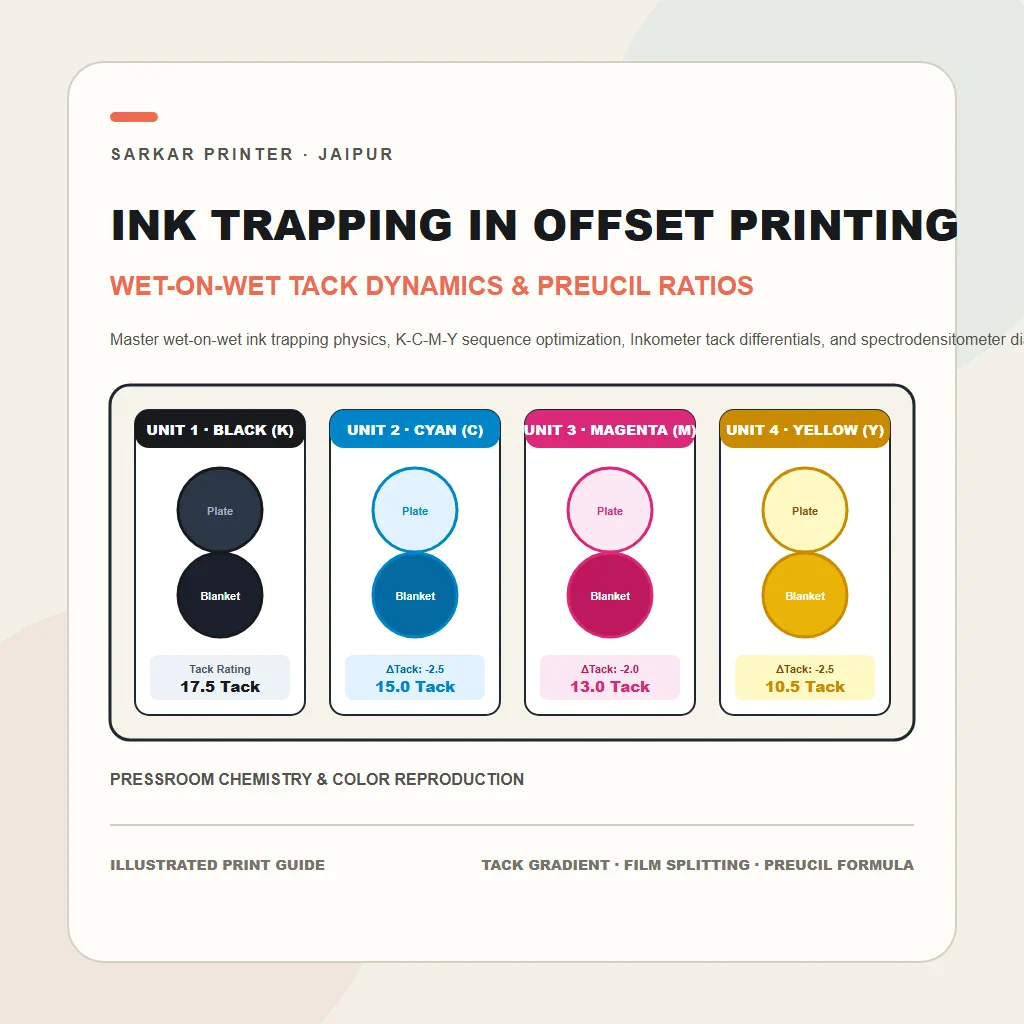
Modern commercial sheetfed lithography operates at speeds exceeding 15,000 sheets per hour. In these multi-unit presses, paper passes from one printing unit to the next in less than 0.10 seconds. This lightning-fast transit requires subsequent ink films to adhere directly onto previously laid, still-wet ink films. Pressroom engineers define this physical phenomenon as wet-on-wet ink trapping. When ink trapping succeeds, the press reproduces brilliant secondary colors like vibrant emerald greens, saturated scarlets, and deep royal violets. When ink trapping fails, downstream printing units pull previously applied wet ink off the paper, muddying ink fountains and destroying chromatic fidelity. Press engineers calibrate ink rheology and sequence parameters according to ISO 12647-2 lithographic process standards and Fogra ProcessStandard Offset specifications.
The Physical Chemistry of Wet-on-Wet Ink Film Splitting
During single-color printing or multi-pass dry printing, an ink film dries completely through oxidation or absorption before the press applies a second color. In modern multi-color inline presses, wet ink meets wet ink under extreme hydrodynamic shear. When the blanket cylinder presses against the paper substrate inside the impression nip, the ink film splits approximately 50/50 between the blanket rubber surface and the receiving substrate.
When Unit 2 applies ink onto Unit 1's wet ink film, the physical dynamics alter dramatically. The second ink film must split within its own internal boundary layer rather than shearing the first ink away from the paper fibers. The internal cohesion of the second ink must remain lower than the adhesion between the first ink and the substrate. If the second ink exhibits greater internal tensile resistance or tack than the first wet layer, the second blanket pulls the first ink film backward off the sheet. Press engineers call this catastrophic failure backtrapping or reverse trapping.
Ink Tack and Inkometer Dynamics: The Golden Pressroom Rule
Ink tack represents the dynamic internal cohesive resistance of an ink film to high-speed splitting. Press technicians measure ink tack using an industry-standard Inkometer or Tack-o-Scope following ASTM D4361 test protocols at 1200 RPM and 32 degrees Celsius (90 degrees Fahrenheit). Tack differs fundamentally from static viscosity: viscosity measures flow resistance under gravity or low shear, whereas tack measures high-speed mechanical film rupture resistance.
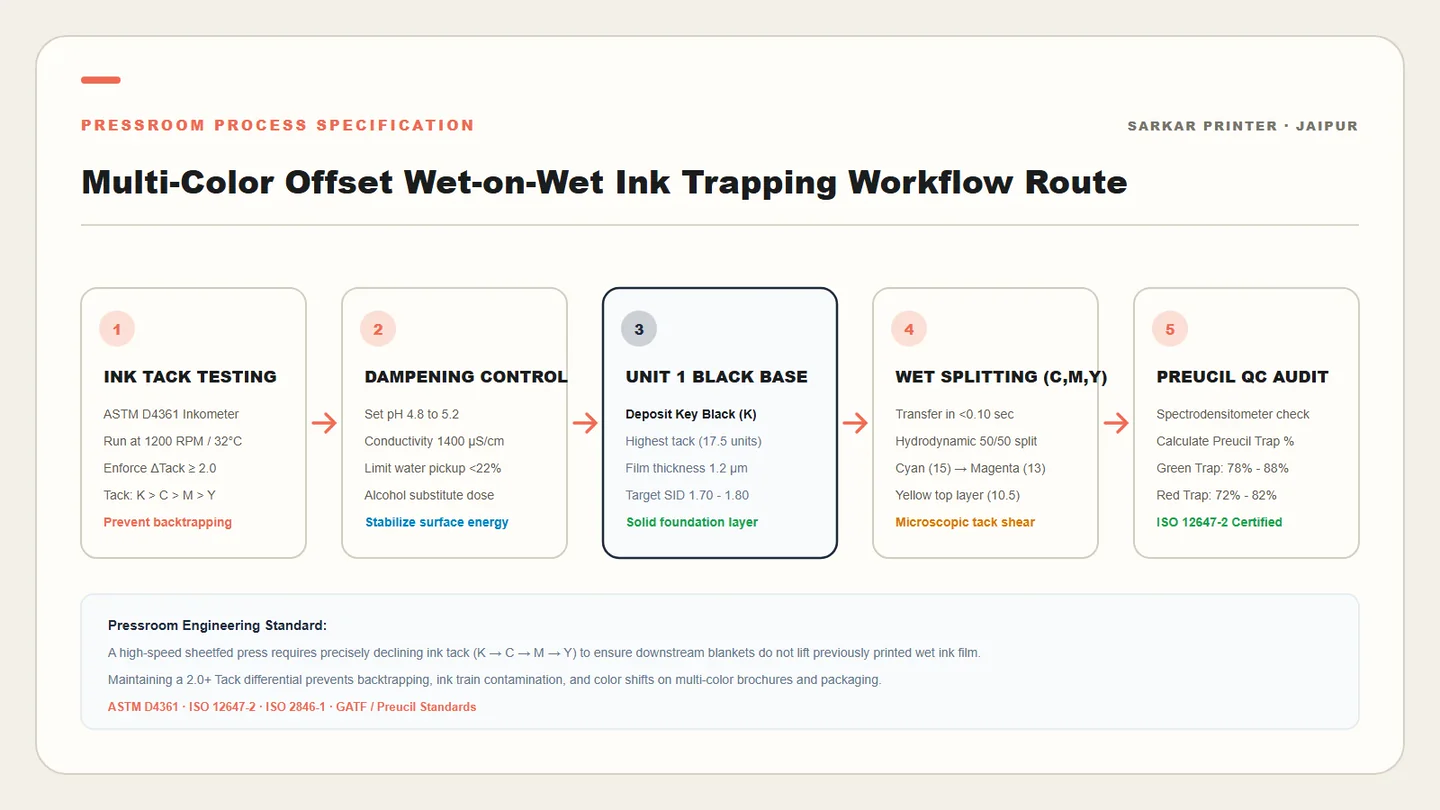
To achieve clean wet-on-wet trapping without backtrapping, press operators enforce a mandatory golden rule: ink tack must decrease sequentially from the first printing unit to the last printing unit. Each downstream unit must lay down an ink with a lower tack rating than the ink applied on the immediately preceding unit. Quality control protocols mandate a minimum tack differential (ΔTack) of 1.5 to 2.5 Inkometer units between consecutive print heads. This differential guarantees that the oncoming ink film splits cleanly across its own core, leaving the underlying wet ink firmly anchored to the paper fibers.
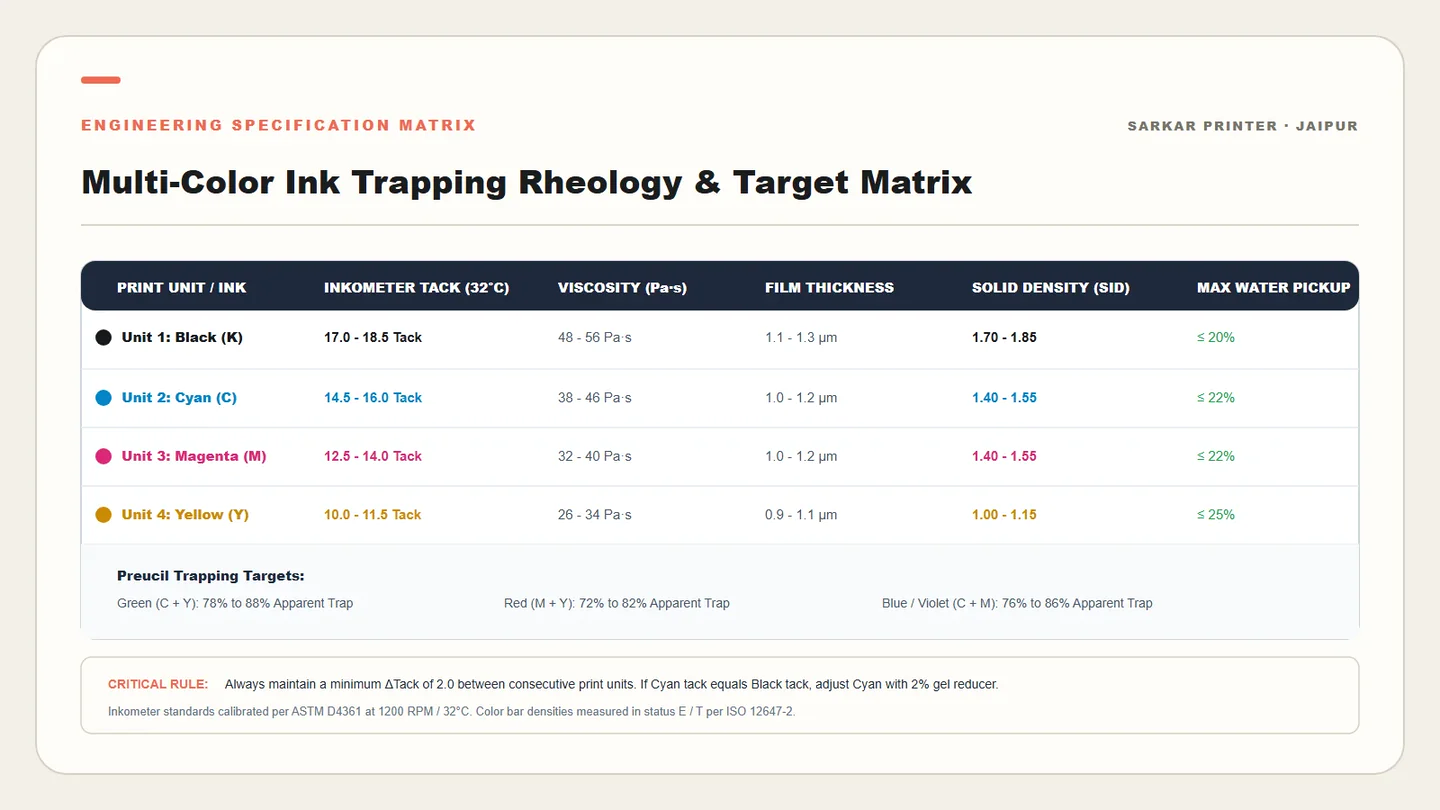
| Printing Unit & Color | Inkometer Tack (1200 RPM, 32°C) | Dynamic Viscosity (Pa·s) | Wet Film Thickness | Solid Density Target (SID) |
|---|---|---|---|---|
| Unit 1 · Black (K) | 17.0 – 18.5 Tack | 48 – 56 Pa·s | 1.1 – 1.3 µm | 1.70 – 1.85 SID |
| Unit 2 · Cyan (C) | 14.5 – 16.0 Tack | 38 – 46 Pa·s | 1.0 – 1.2 µm | 1.40 – 1.55 SID |
| Unit 3 · Magenta (M) | 12.5 – 14.0 Tack | 32 – 40 Pa·s | 1.0 – 1.2 µm | 1.40 – 1.55 SID |
| Unit 4 · Yellow (Y) | 10.0 – 11.5 Tack | 26 – 34 Pa·s | 0.9 – 1.1 µm | 1.00 – 1.15 SID |
The Standard K-C-M-Y Sequence and Special Color Formulations
Why do commercial offset printers run Black first and Yellow last? Optical transparency and pigment loading explain this industrial sequence. Black ink contains carbon black pigments that carry high opacity and high pigment concentration. Placing Black on Unit 1 establishes the structural tonal foundation of the image. Cyan carries the second highest pigment concentration and tack, followed by Magenta. Yellow contains transparent organic azo pigments and possesses the lowest natural tack. Running Yellow on Unit 4 allows light to penetrate through the top yellow layer to reflect off underlying cyan and magenta films, creating vibrant greens and warm scarlets without optical muddiness.
When commercial packaging jobs incorporate heavy spot colors from the Pantone Matching System, press technicians formulate spot inks to match their specific station placement. For example, if a job requires a brand spot color on Unit 5 following Yellow, ink technicians add specialty tack reducers to ensure that the spot ink's tack drops below 9.5 units. Conversely, when printing opaque white on metallic foil or unbleached kraft board certified by the Forest Stewardship Council, operators run opaque white on Unit 1 with maximum tack, providing a stable foundation for four-color process overprints.
Calculating Apparent Trap: Preucil and Brunner Mathematical Formulas
Pressroom quality controllers quantify wet-on-wet ink transfer efficiency using mathematical trapping formulas evaluated with polarized reflection spectrodensitometers. The graphic arts industry relies primarily on the Preucil Trapping Formula, developed by the Graphic Arts Technical Foundation (GATF). The Preucil equation calculates the percentage of the second ink that successfully transfers onto the first wet ink compared to the second ink printed directly onto clean paper substrate:
The Preucil Ink Trapping Formula
Apparent Trap (%) = [ (D_1+2 - D_1) / D_2 ] x 100
Where:
- D_1+2: Optical density of the two-color overprint patch, measured through the complementary filter of the second ink.
- D_1: Optical density of the first ink printed alone, measured through the complementary filter of the second ink.
- D_2: Optical density of the second ink printed alone on bare paper, measured through its own complementary filter.
In dry trap printing, apparent trap percentages reach 90% to 100%. In high-speed wet-on-wet sheetfed lithography, pressrooms target an apparent trap between 75% and 88%. A trap percentage exceeding 75% delivers clean, saturated overprint hues that satisfy ISO 12647-2 gamut tolerances. When the calculated Preucil trap drops below 70%, secondary colors lose chromatic saturation, causing greens to turn olive and reds to appear chalky or brown.
Troubleshooting Ink Trapping Failures and Backtrapping
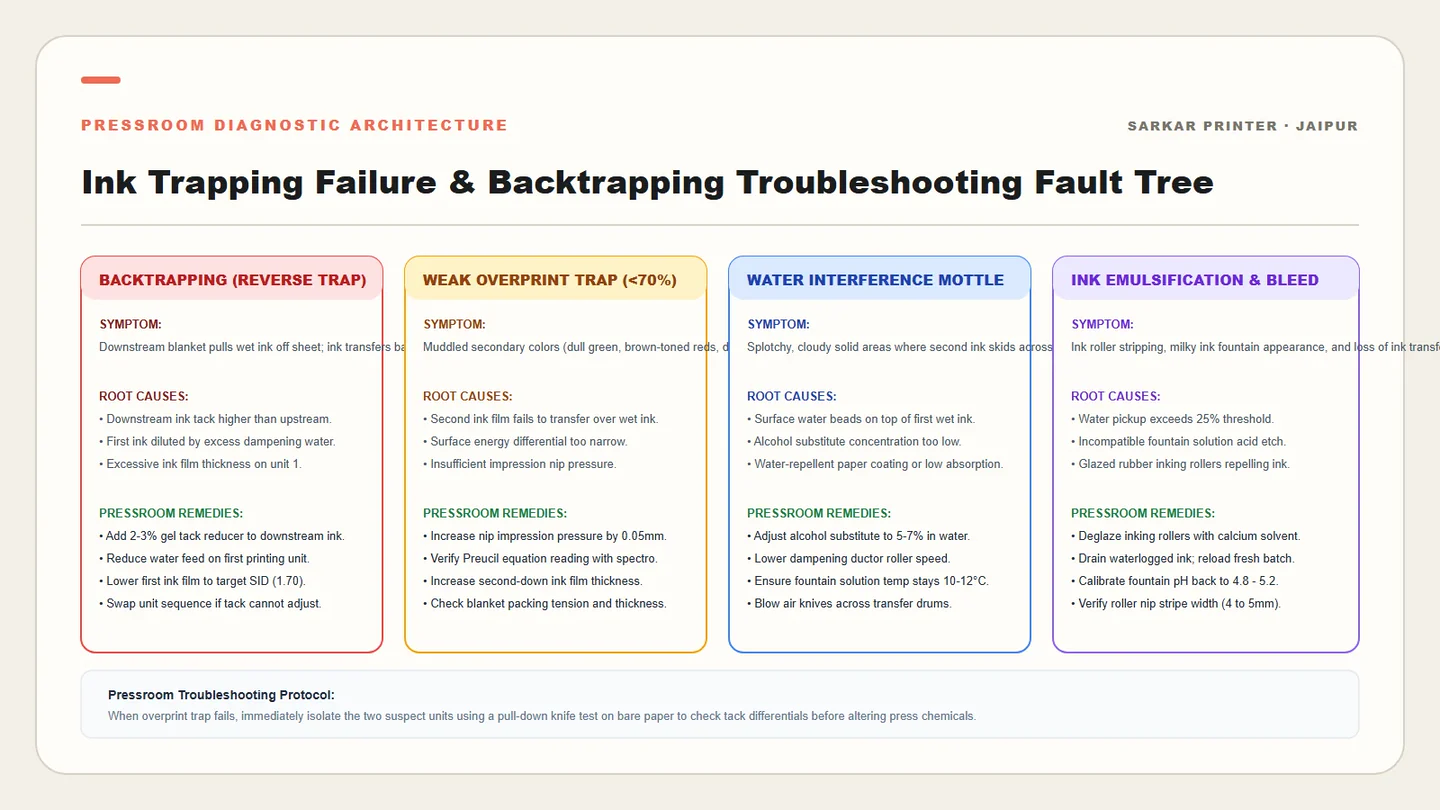
Press crews encounter four common trapping defects during heavy production runs. Diagnosing the exact root cause prevents wasteful paper scrap and protects project delivery timelines across our offset printing services, brochure production lines, and folding carton packaging workflows.
1. Backtrapping (Reverse Trapping)
Backtrapping occurs when a downstream printing unit strips previously transferred ink off the paper sheet. Operators notice backtrapping when yellow or magenta blankets develop dark rings of picked-up cyan or black ink. To eliminate backtrapping, operators add 1% to 3% gel tack reducer into the downstream ink fountain to reduce its mechanical pull. Operators also check dampening water feed on upstream units: excessive dampening water weakens the first ink's adhesion to the paper coating, encouraging premature film lift.
2. Water Interference Mottle
When dampening systems deliver excessive water onto the plate, unevaporated fountain solution forms a microscopic moisture barrier across the first wet ink film. When the sheet enters the next unit nip, this surface water repels the oncoming ink film, causing the second ink to skid and bead. This defect produces an uneven, cloudy texture known as water interference mottle. Operators remedy water mottle by trimming dampening ductor speed, maintaining fountain alcohol substitute levels at 5% to 7% to lower dynamic surface tension, and blowing warm air knives across inter-unit sheet transfer drums.
3. Ink-Water Emulsification
Offset lithography requires a delicate chemical balance between hydrophobic printing ink and hydrophilic fountain solution. Quality control standards dictate that ink must absorb between 15% and 22% fountain solution in the form of a stable water-in-oil emulsion. When water pickup exceeds 25%, the ink loses its internal cohesive strength. Over-emulsified ink cannot transmit shear force across the nip, causing severe trapping failure and inking roller stripping. Operators purge waterlogged ink and restore fountain conductivity between 1200 and 1800 micro-Siemens per centimeter.
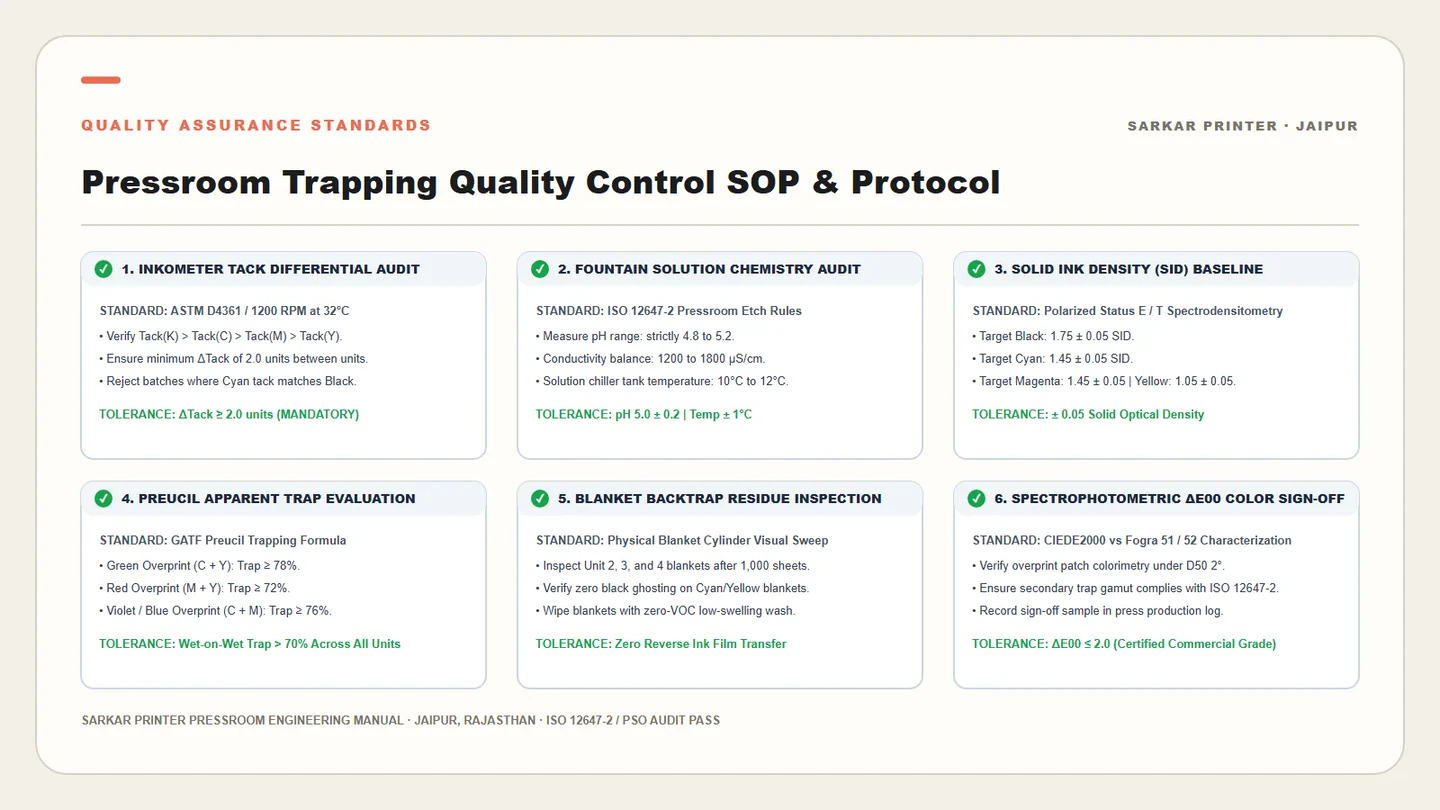
Pressroom Trapping Quality Control Protocol and Verification
At Sarkar Printer in Jaipur, our press crews follow a strict standard operating procedure before signing off on commercial print jobs. Our quality control engineers conduct pull-down knife tests on incoming ink batches, measure solid ink densities with polarized spectrodensitometers, and calculate live Preucil trapping ratios across every production run. By maintaining precise tack differentials and controlling dampening chemistry, we ensure rich color gamut, sharp halftone dot holdout, and flawless color fidelity across premium brochures, annual reports, and luxury folding cartons. For high-volume print production inquiries or technical print consultations, speak directly with our engineering team through our print consultation desk.
Frequently Asked Questions About Ink Trapping
What is the difference between wet-on-wet ink trapping and prepress digital trapping?
Prepress digital trapping expands or contracts adjacent vector color boundaries (choke and spread) in artwork software to conceal physical paper registration misalignments. Pressroom wet-on-wet ink trapping, conversely, describes the physical hydrodynamic transfer and splitting of a downstream wet ink film onto an upstream wet ink film on high-speed printing presses.
Why must ink tack decrease from the first printing unit to the last unit?
Press operators enforce a declining ink tack gradient (Tack 1 > Tack 2 > Tack 3 > Tack 4) because higher downstream tack pulls the previously laid wet ink film off the substrate and transfers it backward onto the downstream blanket. This catastrophic defect, known as backtrapping, contaminates lighter ink fountains and degrades overprint color gamut.
How does an operator calculate apparent trap using the Preucil equation?
An operator uses a calibrated spectrodensitometer to read optical densities through the complementary filter of the second ink. The Preucil formula subtracts the optical density of the first ink from the two-color overprint density, then divides this value by the optical density of the second ink printed alone on bare paper, multiplying by 100 to yield the apparent trap percentage.
What causes water interference mottle during high-speed wet trapping?
Excess dampening water that fails to evaporate or emulsify forms a microscopic surface moisture layer across the first wet ink film. When the sheet enters the second print nip, this surface water prevents direct molecular contact between the two ink films, causing the second ink to skid and produce cloudy, splotchy mottling across solid overprint areas.