
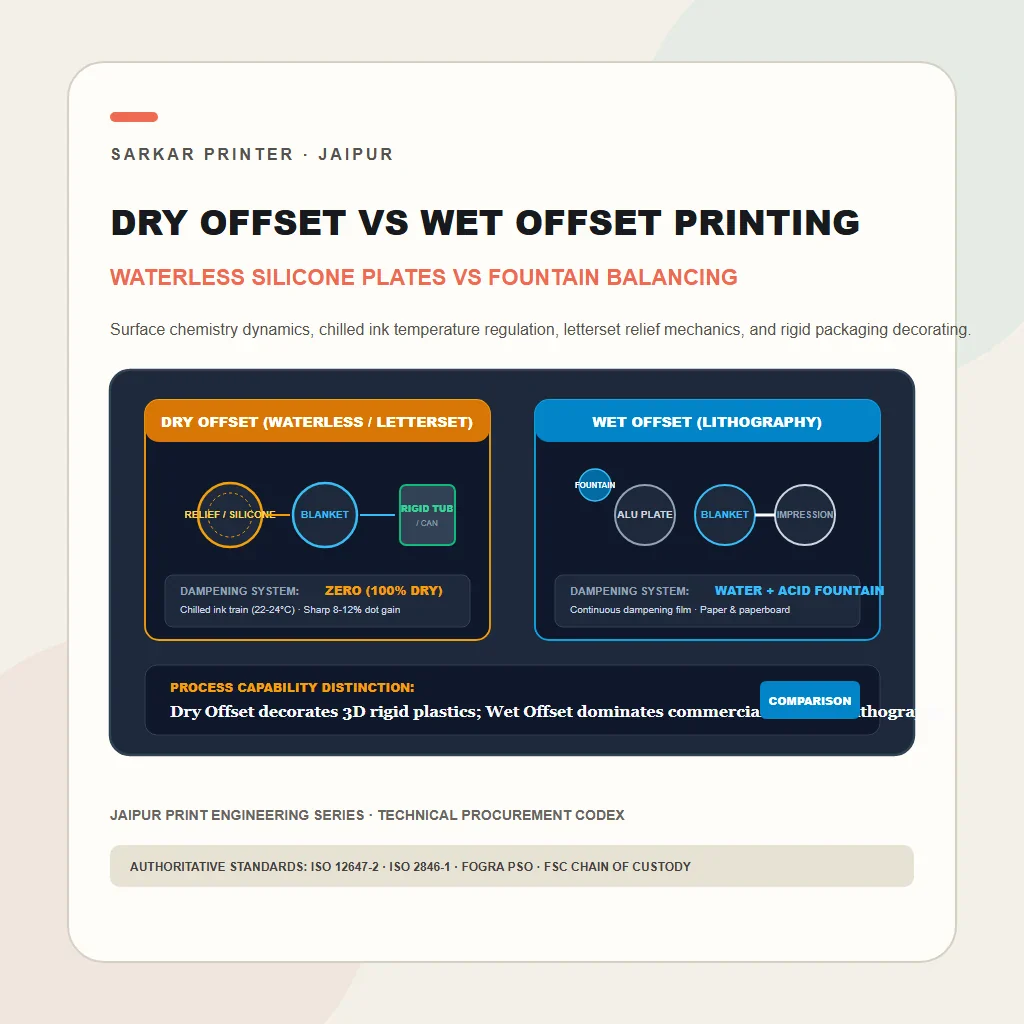
The Surface Chemistry Frontier: Waterless Lithography vs Hydrophilic Balancing
Industrial offset lithography represents the foundation of modern commercial printing. For over a century, press operators relied on a fundamental chemical truth: oil and water naturally repel each other. Conventional wet offset printing exploits this principle by introducing an acidic, aqueous fountain solution across a flat, planographic aluminum plate. The dampening fluid wets microscopic grained pores in non-image areas, preventing oil-based lithographic ink from adhering to unprinted margins.
However, introducing water into the printing nip introduces severe mechanical and physical compromises. Fountain solution dilutes ink tack, generates ink-water emulsions, destabilizes paper fibers, causes dimensional sheet stretch, and demands continuous operator vigilance. To conquer these physical barriers, print engineers created dry offset printing.
Dry offset printing branches into two primary technological paths: waterless offset lithography (utilizing silicone rubber plate barriers) and letterset relief offset (utilizing shallow relief photopolymer plates). Both methodologies completely eliminate dampening units, water tanks, alcohol substitutes, and fountain chemistry. By decoupling print reproduction from the volatile ink-water equilibrium, dry offset achieves surgical dot sharpness, zero paper stretch, and unmatched capability on non-absorbent rigid surfaces like plastic cups, squeeze tubes, and two-piece metal cans.
This technical engineering guide explores the mechanical architectures, ink rheology parameters, surface energy physics, and procurement economics distinguishing dry offset from conventional wet offset lithography.
Mechanical Architectures: Dampening Roller Bypass vs Fountain Solution Trains
Pressroom engineers evaluate the physical layout of the ink metering and transfer system when contrasting dry offset against conventional wet lithography. The absence of the dampening train alters cylinder dynamics, roller pressure curves, and ink transfer physics.
The Conventional Wet Offset Lithographic Train
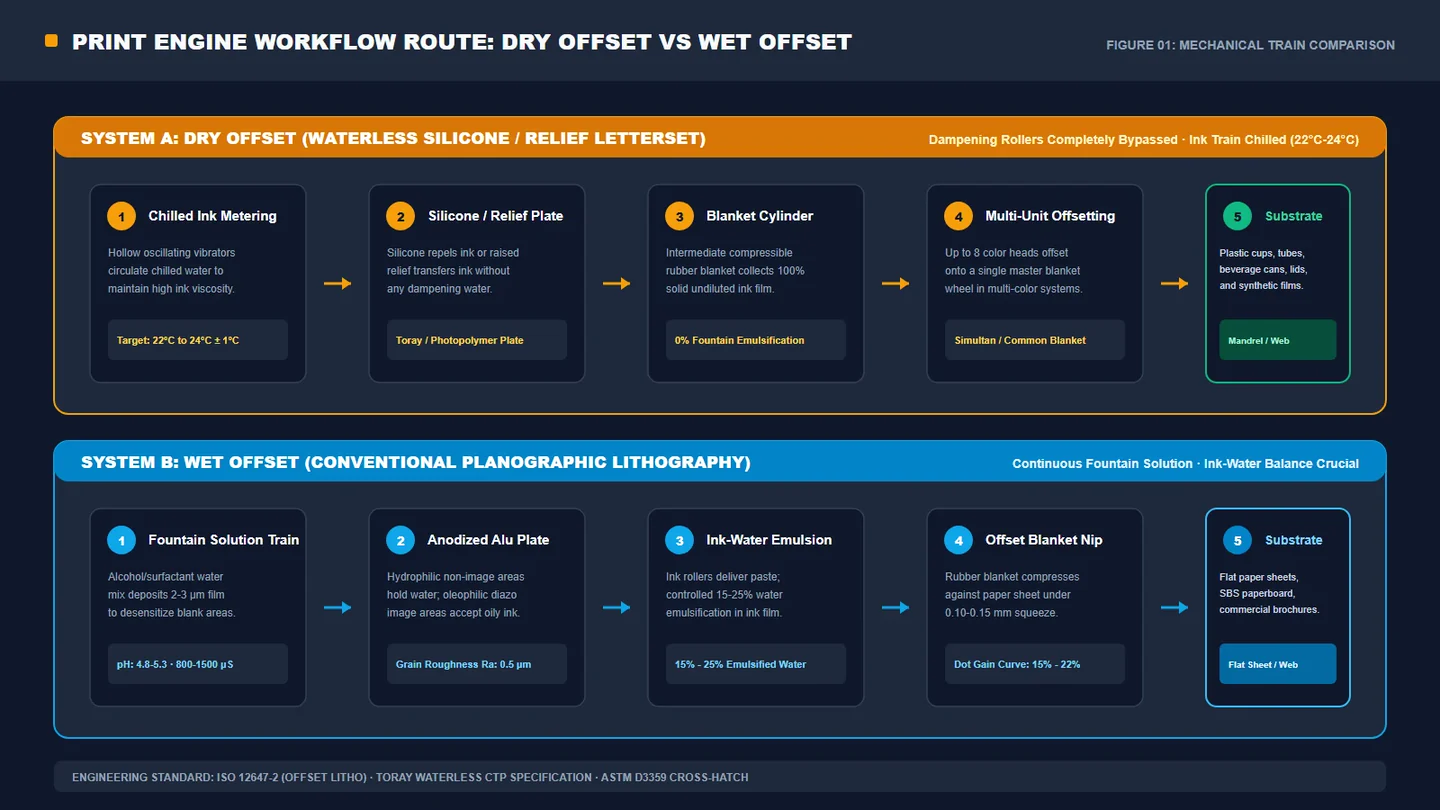
In standard sheetfed offset presses, such as those running in our Jaipur offset printing facility, each printing unit contains two parallel delivery networks: the inking system and the dampening system. Before the inking form rollers touch the aluminum plate, dampening ductor rollers deposit a microscopic water film (roughly 2.0 to 3.0 microns thick) across the plate surface. Non-image areas absorb this fluid due to an anodized aluminum oxide grain treated with hydrophilic gum arabic.
The subsequent inking rollers deliver paste ink across the plate. The ink adheres exclusively to hydrophobic, oleophilic photopolymer resin image areas. The plate then transfers both ink and minute traces of moisture onto a compressible rubber blanket cylinder, which offsets the image onto flat paper or paperboard sheets held by mechanical steel grippers under high impression pressure.
The Dry Offset (Waterless / Letterset) Architecture
Dry offset printing removes the entire dampening apparatus. The press chassis contains zero water pans, zero fountain ductors, and zero dampening vibrators. The inking unit applies ink directly to the dry plate:
- Waterless Planographic Plates: Engineers utilize plates coated with a cross-linked silicone rubber non-image layer, pioneered by Toray Industries. Silicone possesses an exceptionally low critical surface energy (approximately 19 to 20 mN/m). Modern lithographic inks maintain surface tensions between 35 and 40 mN/m. Because the ink cannot wet the lower-energy silicone surface, it releases cleanly without water lubrication.
- Letterset (Relief Offset) Plates: Used extensively for rigid packaging decorating, relief plates position image areas on raised photopolymer plateaus (relieved by 0.25 mm to 0.50 mm above floor depth). Inking form rollers ride precisely over the raised relief surfaces, transferring ink exclusively to raised topographies before contacting the common offset blanket wheel.
Furthermore, multi-color dry offset packaging presses utilize a common impression blanket drum (Simultan architecture). Instead of sending a container through six separate cylinder nips, four to eight individual relief plate heads deposit their spot colors in register onto one central rotating blanket wheel. The blanket wheel subsequently transfers the entire completed multi-color graphic onto the rigid container in a single rotation, eliminating container scuffing and registration drift.
Technical Specification Benchmark: Ink Rheology, Dot Gain, and Temperature Dynamics
Operating without dampening fluid fundamentally alters the thermodynamic and rheological profile of the printing pressroom. Print engineers track tight physical metrics across plate metallurgy, thermal tolerances, and dot reproduction curves.
The Temperature Chilling Imperative in Waterless Systems
In wet offset lithography, water constantly evaporates from the spinning roller train. This endothermic evaporation naturally dissipates frictional mechanical heat generated within high-speed roller nips, stabilizing ink train temperatures at roughly 25°C to 30°C. Dry offset lacks this evaporative cooling mechanism.
As roller friction heats the ink paste, ink viscosity drops exponentially while tack destabilizes. If the ink roller surface temperature exceeds 28°C (82°F), the kinetic energy of the ink overcomes the low surface energy of the plate's silicone layer. The ink begins wetting the non-image silicone, resulting in catastrophic background tinting known in pressroom engineering as toning.
To prevent toning, dry offset and waterless presses mandate high-capacity closed-loop water chillers. Refrigerated coolant flows continuously through the hollow cores of oscillating distributor rollers, regulating ink nip temperatures strictly between 22°C and 24°C (±1.0°C). Maintaining this tight thermal window ensures ink tack remains high enough to reject silicone adhesion.
Halftone Dot Reproduction and Screen Rulings
Halftone reproduction highlights the visual superiority of waterless dry offset. In wet lithography, the water film exerts hydraulic pressure against the ink film during blanket compression. This creates hydraulic squirt and dot fringe spreading, resulting in standard mechanical dot gain curves of 15% to 22% at 50% tint under ISO 12647-2 standards.
Dry offset printing eliminates hydraulic water displacement completely. Ink transfers as a crisp, solid paste film from plate to blanket to substrate. Consequently, mechanical dot gain remains clamped between 8% and 12% across 50% halftones. This extreme dot fidelity allows prepress technicians to image fine screen rulings of 300 to 400 lines per inch (LPI) or deploy ultra-fine stochastic (FM) micro-dot screens without mid-tone filling or shadow clogging.
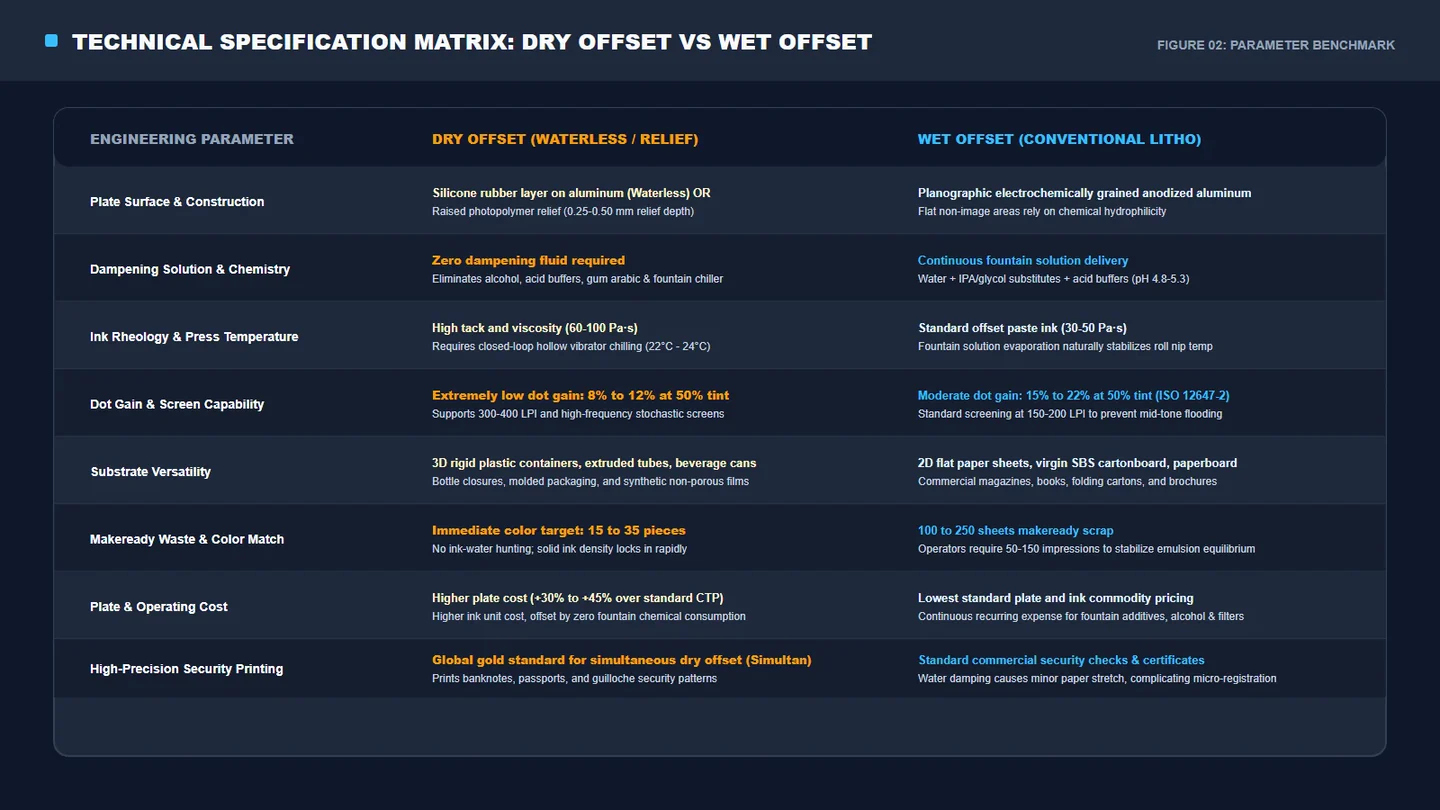
| Engineering Parameter | Dry Offset (Waterless / Relief) | Wet Offset (Lithographic) |
|---|---|---|
| Dampening Fluid Requirement | Zero (100% dry operation) | 2.0 - 3.0 μm water/acid buffer film |
| Non-Image Repulsion Mechanism | Silicone energy barrier (~19 mN/m) or 0.35 mm relief | Hydrophilic aluminum gum desensitization |
| Ink Viscosity Range (Pa·s) | 60 - 100 Pa·s (High tack paste) | 30 - 50 Pa·s (Standard litho paste) |
| Press Chilling Tolerance | Mandatory hollow roller chilling (22°C - 24°C ±1°C) | Standard ambient chilling (fountain pan 10°C) |
| 50% Dot Gain Curve | 8% - 12% (Suppressed gain) | 15% - 22% (ISO 12647-2 Curve A/B) |
| Maximum Screen Ruling | 300 - 400 LPI / 10-micron FM stochastic | 150 - 200 LPI conventional AM screening |
| Substrate Compatibility | 3D plastics, extruded tubes, beverage cans, films | Flat paper, virgin SBS board, folding cartons |
| Average Makeready Waste | 15 - 35 units (Fast solid density lock) | 100 - 250 sheets (Ink-water equilibrium hunting) |
Substrate Specialization: 3D Rigid Packaging Decorating vs Flat Sheet Commercial Runs
Procurement directors and packaging engineers select between dry and wet offset based on geometric substrate constraints and run volume economics.
Dominance in Rigid Plastic Containers and Drawn Aluminum Cans
Dry offset represents the unchallenged manufacturing standard for high-speed decoration of rigid hollow containers:
- Thermoformed and Injection-Molded Polypropylene (PP) Tubs: Yogurt cups, dairy containers, and food tubs require continuous circumferential decoration at speeds up to 600 containers per minute. Dampening water cannot wet or dry on non-porous polyolefins. Dry offset deposits fast-curing UV inks directly around container circumferences mounted on rotating steel mandrels.
- Extruded Cosmetic Tubes: Multi-layer PE/EVOH tubes, widely produced for pharmaceutical and personal care markets, rely on dry letterset offset to achieve precise 360-degree graphics with crisp micro-type and spot varnishes.
- Two-Piece Drawn Aluminum Beverage Cans: Modern high-speed beverage canning lines operate rotary dry offset decorating heads printing up to 2,000 cans per minute before sending cans through thermal pin ovens.
Dominance of Wet Offset in Paper, Board, and Publication Markets
While dry offset excels on rigid plastics, wet offset lithography completely dominates flat paper and paperboard printing. In our production facilities for custom packaging mono-cartons and corporate brochure printing, wet offset remains the most cost-effective and versatile industrial technology:
- Economical Consumables: Standard thermal aluminum CTP plates cost 30% to 45% less than specialized Toray silicone waterless plates. Standard offset inks cost significantly less per kilogram than high-viscosity waterless inks.
- Porosity Compatibility: Absorbent cellulose paper fibers naturally absorb moisture without compromising structural integrity. Water evaporates cleanly during sheet delivery and drying.
- High-Speed Sheetfed Automation: Modern sheetfed presses achieve speeds up to 18,000 impressions per hour with automated plate changers and spectrophotometric ink key presetting, driving down cost-per-piece on medium to large paperboard runs.
High-Security Printing and Banknotes
In high-security document printing—including currency banknotes, passports, and tax stamps—governments deploy specialized Simultan dry offset presses. These machines feed dry offset plates against dual blanket cylinders, printing both sides of the banknote sheet simultaneously with zero registration error. Eliminating fountain water prevents paper fiber swelling, allowing security printers to register intricate guilloche patterns and micro-lettering down to 25 microns without dimensional distortion.
Pressroom Troubleshooting: Root-Cause Fault Tree and Corrective Protocols
Press operators encounter distinct physical failure modes when managing dry versus wet offset pressrooms. Resolving defects requires targeted corrective protocols.
Fault 01: Non-Image Area Background Tinting (Toning vs Scumming)
When ink contaminates unprinted background zones, press mechanics pinpoint the underlying cause:
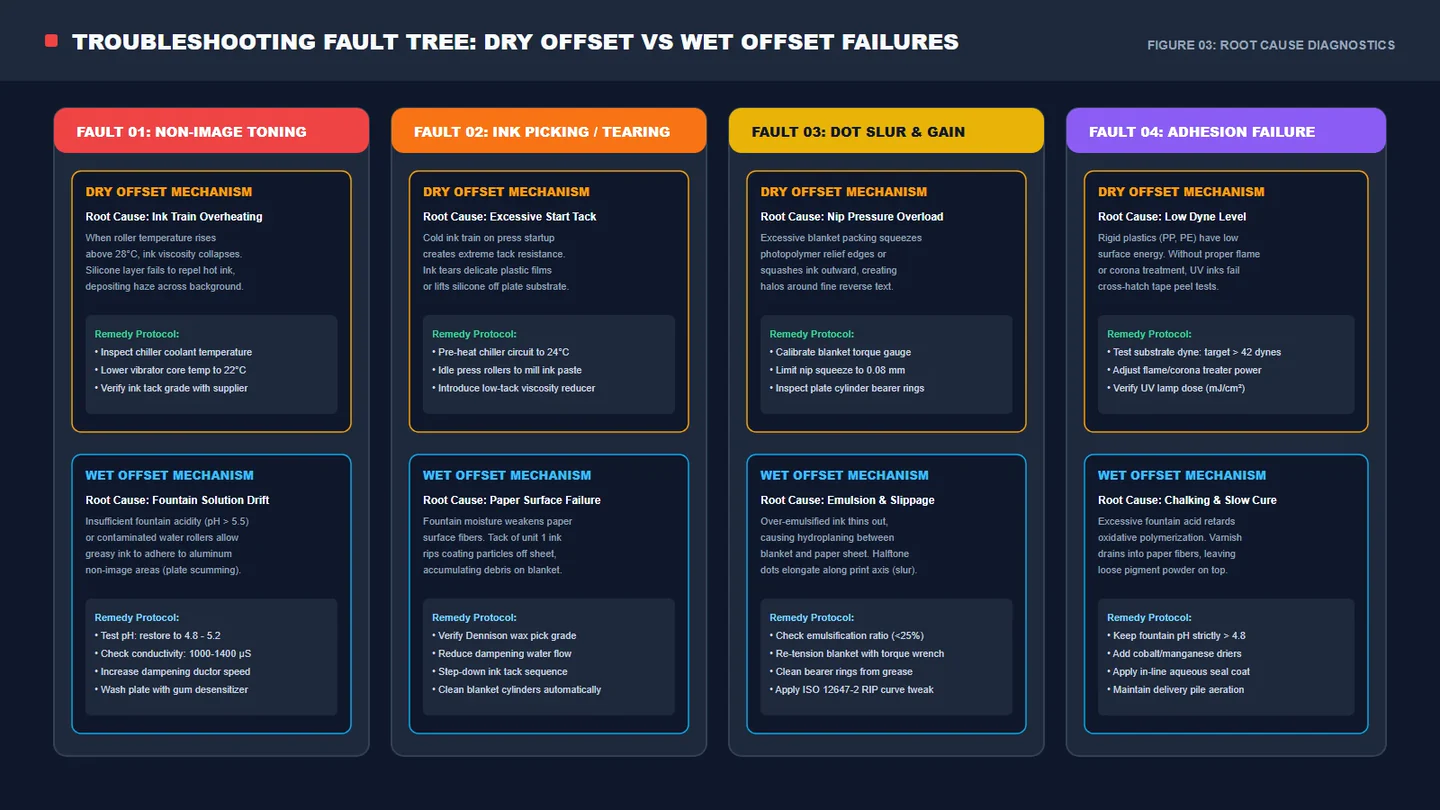
- Dry Offset Toning: Driven almost exclusively by elevated ink train temperature. When the roller temperature exceeds 28°C, the ink tack drops, and ink deposits across the silicone layer. Operators check chiller supply pumps, verify coolant flow through oscillator cores, and reset roller core temperatures to 22°C.
- Wet Offset Scumming: Driven by chemical degradation of the fountain solution or physical plate abrasion. High pH (>5.5) or low conductivity fails to desensitize the plate's anodized grain. Operators titrate fountain concentrate to restore pH to 4.8 to 5.2, verify conductivity between 1,000 and 1,400 μS/cm, and clean the plate with desensitizing gum.
Fault 02: Ink Picking and Surface Delamination
Excessive ink tack creates violent peeling forces in the cylinder nip:
- Dry Offset Tack Resistance: Because waterless inks maintain high initial viscosity, running a cold press at high speed can tear thin plastic films or peel the silicone coating off the aluminum backing plate. Operators engage pre-heating cycles on press chillers prior to makeready, reaching 24°C before accelerating to production speed.
- Wet Offset Surface Weakening: Excess fountain solution softens paper surface starches. High-tack ink on the first printing unit rips coating flakes off the sheet, depositing white hickeys across subsequent blankets. Operators step-down ink tack across color stations (Black > Cyan > Magenta > Yellow) and lower dampening ductor speeds.
Fault 03: Substrate Adhesion Failures on Rigid Containers
On dry offset container printing lines, printing UV ink onto non-polar plastics (PP, PE, HDPE) without adequate surface treatment leads to catastrophic ink flaking under adhesive tape testing. Non-polar polyolefins exhibit low natural surface energies (around 30 to 32 dynes/cm). Operators verify in-line corona discharge or gas flame treaters, elevating plastic surface tension above 42 dynes/cm prior to mandrel transfer. UV curing lamp output must deliver at least 120 mJ/cm² of focused ultraviolet radiation to achieve complete cross-linking.
Quality Control Standards and Production Audit Verification
Maintaining strict quality control across both dry and wet offset lines requires structured stage-gate testing matching global industry benchmarks.
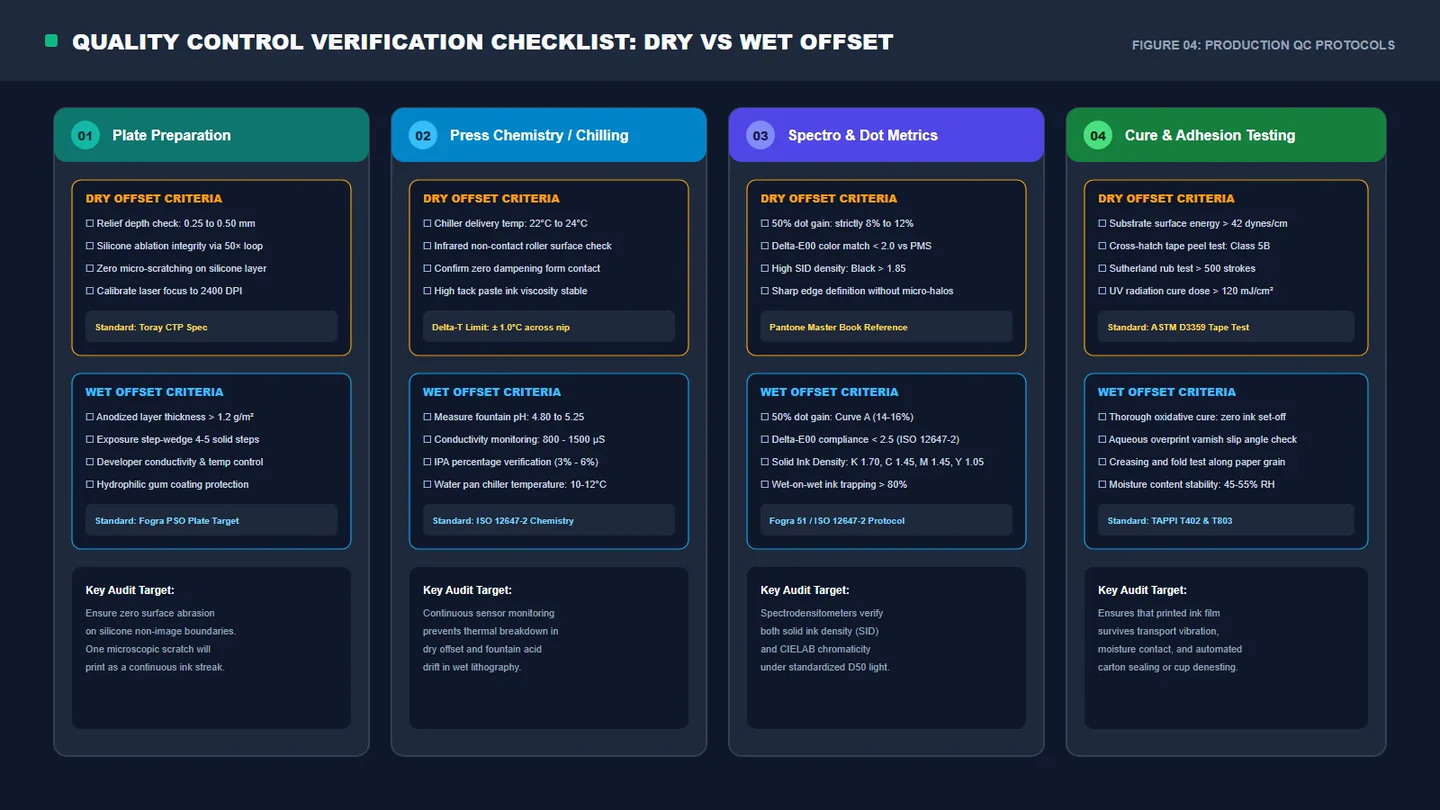
Pressroom quality assurance teams enforce four rigid audit gates during production:
- Pre-Press & Plate Verification: Prepress engineers inspect thermal CTP plate imaging at 2400 DPI. For dry offset, technicians measure relief depths with optical depth gauges (0.25 to 0.50 mm) and inspect silicone boundaries under 50× magnification to ensure zero surface scratches. For wet offset, technicians verify exposure step-wedge scales (solid step 4-5) and check anodized coating weights per Fogra PSO specifications.
- Thermodynamic & Chemical Stabilization: Technicians monitor real-time infrared temperature sensors across dry offset oscillator rollers to guarantee stability within ±1.0°C. Wet offset operators log fountain pH, electrical conductivity, alcohol substitute percentages, and refrigeration loop temps at two-hour intervals.
- Spectrophotometric Colorimetry: Using calibrated 45/0 reflection spectrophotometers under standard D50 lighting, operators verify Solid Ink Density (SID) and Delta-E color tolerances against Pantone Matching System masters. Production runs maintain strict Delta-E00 color deviation thresholds below 2.0.
- Mechanical Adhesion and Durability Testing: Finished goods undergo destructive adhesion testing. Technicians apply ASTM D3359 cross-hatch tape peel tests on rigid containers, demanding Class 5B zero-flaking performance. Folded paperboard cartons undergo Sutherland rub testing (500+ strokes) and grain-direction crease elasticity verification.
The Procurement Verdict: Selecting the Optimum Print Process
Choosing between dry offset and wet offset printing depends directly on product format, substrate geometry, and total run economics:
- Specify Dry Offset (Waterless / Letterset) when: Decorating 3D rigid plastic cups, cosmetic tubs, extruded tubes, beverage cans, aluminum bottle closures, non-porous synthetic films, or high-security documents requiring zero dot distortion and sub-10% dot gain.
- Specify Wet Offset Lithography when: Manufacturing flat commercial paper and paperboard products, including folding mono-cartons, pharmaceutical packaging boxes, multi-page stitched brochures, catalogs, annual reports, and marketing collateral. Wet offset delivers the lowest unit costs on paperboard through fast automated sheet feeding and inexpensive plate consumables.
At Sarkar Printer, our Jaipur pressroom integrates precision prepress imaging, advanced Heidelberg offset presses, and rigorous spectrophotometric color control. Whether your project requires high-speed commercial folding carton packaging or technical print engineering advice, our team delivers consistent, certified quality matching Fogra and ISO standards.
Frequently Asked Questions About Dry vs Wet Offset Printing
What is the primary difference between dry offset and wet offset printing?
Wet offset lithography requires an aqueous fountain solution (water, alcohol substitutes, and acid buffers) to keep non-image plate areas clean through hydrophilic chemical repulsion. Dry offset printing completely eliminates water, utilizing either silicone rubber surface coatings (waterless offset) or physical photopolymer relief plates (letterset) to repel ink across non-image areas.
Why does dry offset printing dominate rigid plastic container decorating?
Dry offset printing accommodates rigid, non-absorbent surfaces such as injection-molded plastic cups, cosmetic squeeze tubes, and two-piece aluminum cans because it deposits dry, undiluted ink films without moisture contamination. Multi-color dry offset presses transfer all colors onto a single common blanket wheel, offsetting the entire composite image onto curved containers in a single rotation.
How does temperature regulation affect dry offset print quality?
Without the evaporative cooling of fountain water, friction between inking rollers generates intense heat. If roller temperature exceeds 28°C, ink viscosity and tack drop below the critical threshold, causing silicone repulsion failure and background toning. Pressrooms maintain closed-loop water chillers circulating through hollow vibrator cores at 22°C to 24°C ± 1°C.
Which process achieves lower dot gain and sharper halftones?
Dry offset achieves significantly lower dot gain (8% to 12% at 50% tint) compared to wet offset (15% to 22%). Eliminating the dampening fluid prevents ink emulsification and hydraulic dot spreading under nip compression, enabling screen rulings up to 300 to 400 LPI and high-definition stochastic screening.
When should commercial print buyers choose wet offset over dry offset?
Print buyers specify wet offset lithography for high-volume commercial flat-sheet paper and paperboard jobs, such as multi-page corporate brochures, catalogs, folding mono-cartons, and publications. Wet offset offers lower plate costs, widely available commodity consumables, and unmatched productivity on absorbent fiber substrates.